

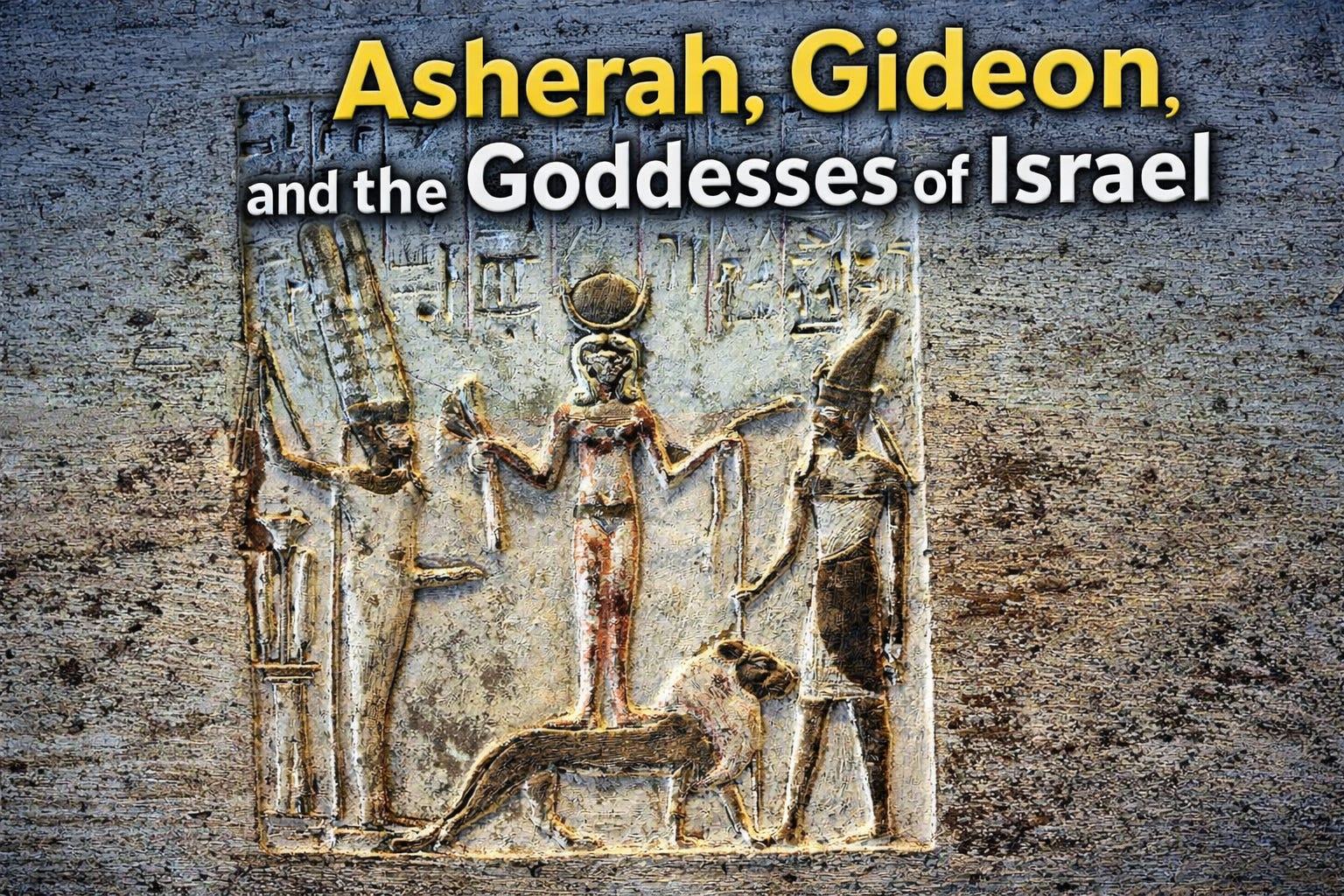
This week on Goddess Bible Study, we are back to our original purpose, discussing the goddesses who appear in the Bible. Let’s dig into some of the archeological evidence for Asherah and the goddesses of pagan Israel.
We continue the story during the period of the Judges in the 10th and 11th centuries BCE, in the depths of the Bronze Age Collapse. It was a lawless and illiterate time in Canaan. The Bible makes it clear that the Israelites worshiped Baal and the Ashtoreths. Baal was the Canaanite king of the gods, like Zeus or Marduk, while Ashtoreths is the goddesses, plural.
Then the Israelites did evil in the eyes of Yahweh and served the Baals. They forsook Yahweh, the God of their ancestors, who had brought them out of Egypt. They followed and worshiped various gods of the peoples around them. They aroused Yahweh’s anger because they forsook him and served Baal and the Ashtoreths.
-Judges 2:11-13
Goddess Archaeology - Israelite Paganism
Thousands of goddess images and figurines have been unearthed by archaeologists all over Syria, Israel, and Palestine, in addition to rich goddess traditions of Egypt. One of the earliest goddess figurines dates back to 4500 BCE and features a naked goddess seated on a stool, balancing a cheese/butter urn atop her head.
Excavations at the early Bronze Age city of Ai, supposedly destroyed by Joshua and the Israelites, uncovered a large post of charred wood, which scholars believe to be an Asherah, one of the sacred wooden poles that represent the goddess.
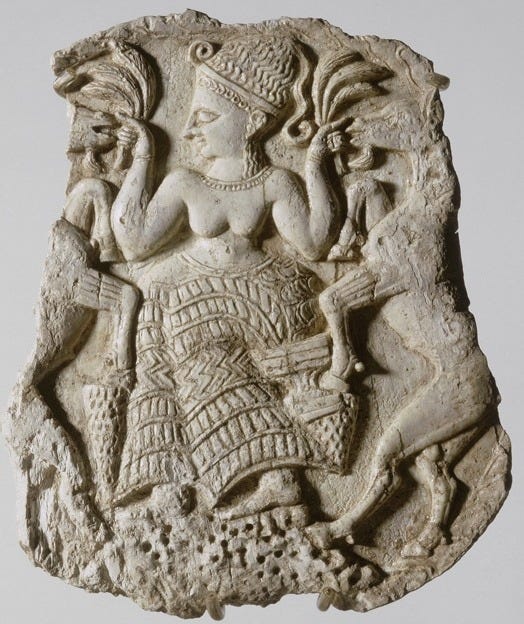
During the 300 years of Egyptian control of Canaan, there was a great deal of religious syncretization between Canaanite and Egyptian gods. This seems to be the milieu in which the triple goddess Asherah, Astarte, and Anat emerged.
Images in the tradition of Asherah are found on plaques dating to 1500-1200 BCE and feature a nude goddess with wide hips, large breasts, and pubic triangle, often astride a lion, wearing an arrow quiver, and holding lotus flowers and snakes.
In some instances, she has many Egyptian symbols, the sun disk representing the Eye of Ra, the cattle horns of Isis, and the bouffant hair of Hathor, goddess of love and beauty.
In Egypt, Asherah, Astarte, and Anat were syncretized into a single lion-riding goddess named Qedesh, “the Holy One.”
This trinity is mapped from the Egyptian triple goddess Hathor, Bastet, Sekhmet, known as the Eye of Ra. All of these goddesses were in turn absorbed into the super-goddess Isis.
In the Koran, this formulation is seen in the daughters of Allah: Allat, Uzza, and Manat.
Contemporary Hindus today call these goddesses Shakti: Parvati, Durga, and Kali.
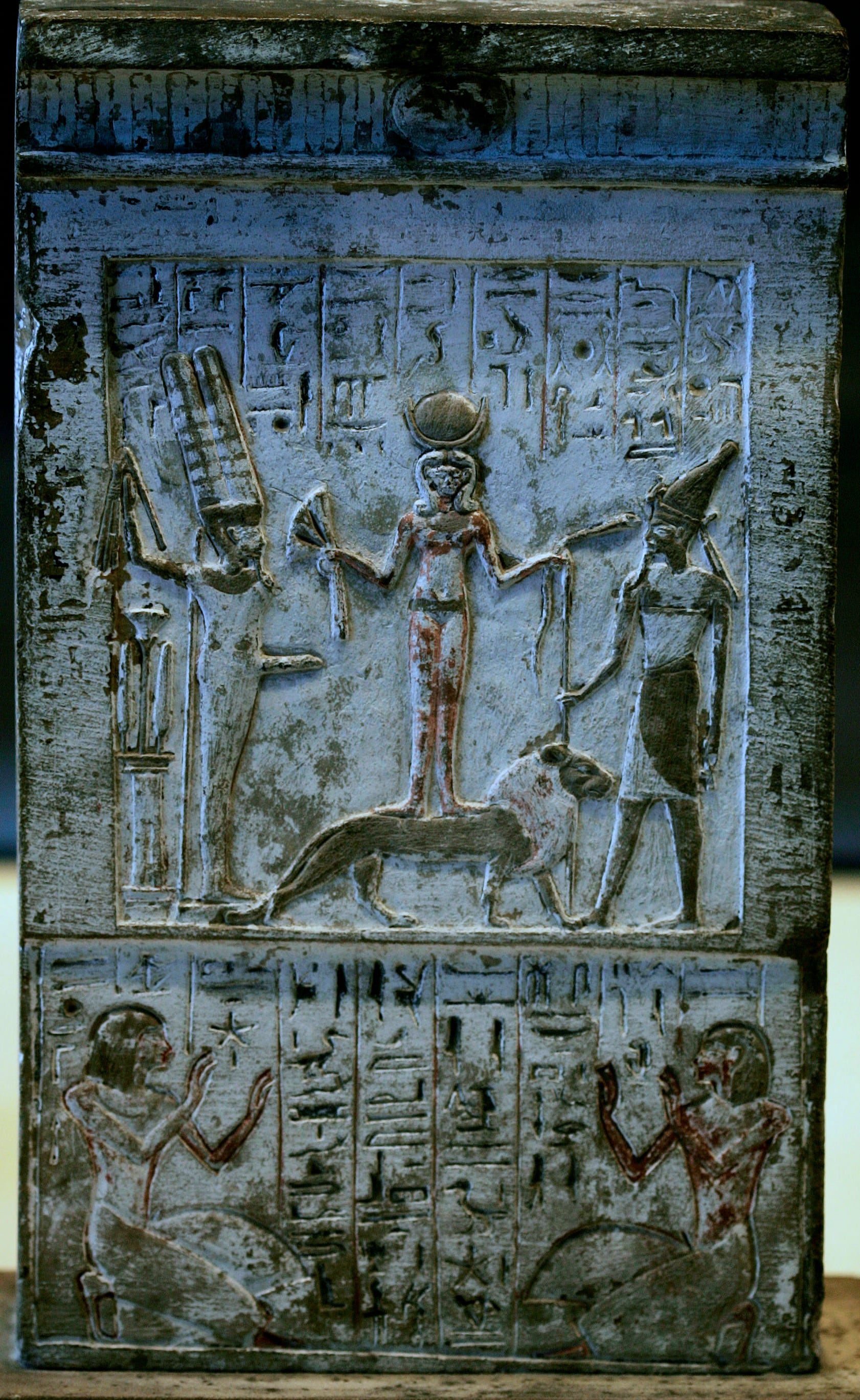
This artifact, known as the Stele of Qetesh (Louvre N 237 or Turin 50066), is a limestone monument from the New Kingdom period (19th Dynasty, circa 1290–1189 BCE) and is a prime example of the syncretization of Egyptian and Canaanite religion.
The stele in the image depicts the Canaanite goddess Qedesh, flanked by the Egyptian god Min on the left and the Canaanite god Resheph on the right. This is a cycle of life trinity as Min, with his fully erect penis, represents life and virility. Resphesh, on the other hand, is a Canaanite warrior god associated with the plague and the underworld. Qedesh is the loving, nurturing, mother of the universe.
Gideon Destroys the Altar to Baal and the Asherah pole
In the Bible story, we see the beginning of the revolt against the goddesses in the character of Gideon, who was an Israelite during the time of the Judges.
In the book of Judges, Yahweh instructs Gideon to tear down the altar to Baal that his father had built and also the Asherah pole beside it.
The fact that Gideon’s father had built the altar and Asherah pole demonstrates clearly that Baal and Asherah were native gods, not foreign gods, and that the early Hebrews were pagan Canaanites.
This story may be fiction, it is difficult to discern the historicity of these particular events, but it follows with the broader intent of the Biblical writers who emphasize their hostility to the old goddess traditions at every opportunity.
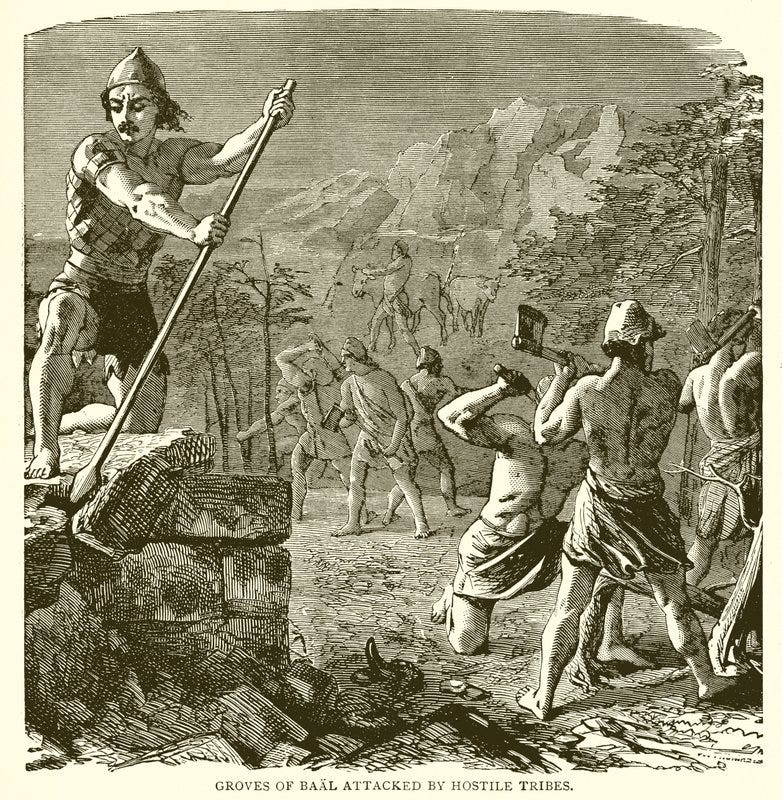
So Gideon took ten of his servants and did as Yahweh told him. But because he was afraid of his family and the townspeople, he did it at night rather than in the daytime. In the morning when the people of the town got up, there was Baal’s altar, demolished, with the Asherah pole beside it cut down and the second bull sacrificed on the newly built altar!
They asked each other, “Who did this?” When they carefully investigated, they were told, “Gideon son of Joash did it.” The people of the town demanded of Joash, “Bring out your son. He must die, because he has broken down Baal’s altar and cut down the Asherah pole beside it.”
But Joash replied to the hostile crowd around him, “Are you going to plead Baal’s cause? Are you trying to save him? Whoever fights for him shall be put to death by morning! If Baal really is a god, he can defend himself when someone breaks down his altar.” So because Gideon broke down Baal’s altar, they gave him the name Jerub-Baal that day, saying, “Let Baal contend with him.”
-Judges 6:27-32
Goddess Figurines in Israel and Judah
Goddesses representing nature were at the heart of popular culture. Molds have been discovered for the mass production of small clay goddess figurines in Israel and Judah. These figurines were popular and found in many homes, and reflect a continuity of goddess worship back to the Ice Age
A later type of figurine emerged after the fall of Samaria in the 7th and 8th centuries BCE. These later Judean figurines are called “pillar-base” because they only depict the upper half of the body and not the legs.
These figurines are nude with prominent breasts, one type has simple finger-pinched faces, while others have molded faces. They are not sexualized images and may represent a nursing mother. Scholars believe they represent household gods and that they are not toys.
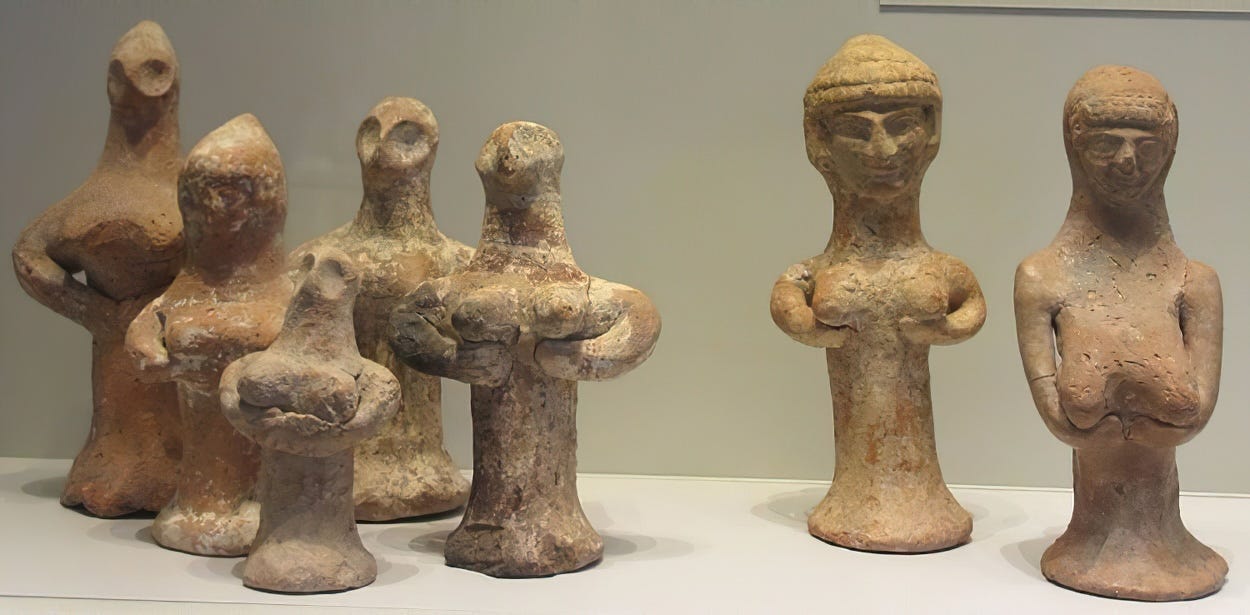
All told, around 3000 goddess figurines have been found in Israel/Palestine. The figurines are generally found in homes or in debris piles, but not in graves. They were likely a part of home/folk traditions and not the official cults.
Yahweh and his Asherah
Among the most controversial archaeological discoveries was an inscription found at Kuntillet Ajrud, which says “Yahweh and his Asherah”, demonstrating a clear connection between the supposedly monotheistic Yahweh and the Goddess.
The inscription dates from ~830-760 BCE during the First Temple period and was found at a remote site in the Sinai desert near the modern border of Israel and Egypt. This period was during the Hebrew culture wars and shows that the Yahwist reformation took centuries to complete.
The inscriptions were found by archaeologists in 1975 on two large storage jars, or pithos, with unusual drawings and letters written in an early Hebrew script. The inscription, “Yahweh and his Asherah,” has caused considerable debate among scholars as to what it means. Do these inscriptions describe God and his wife, or merely God’s possession of a cultic object?
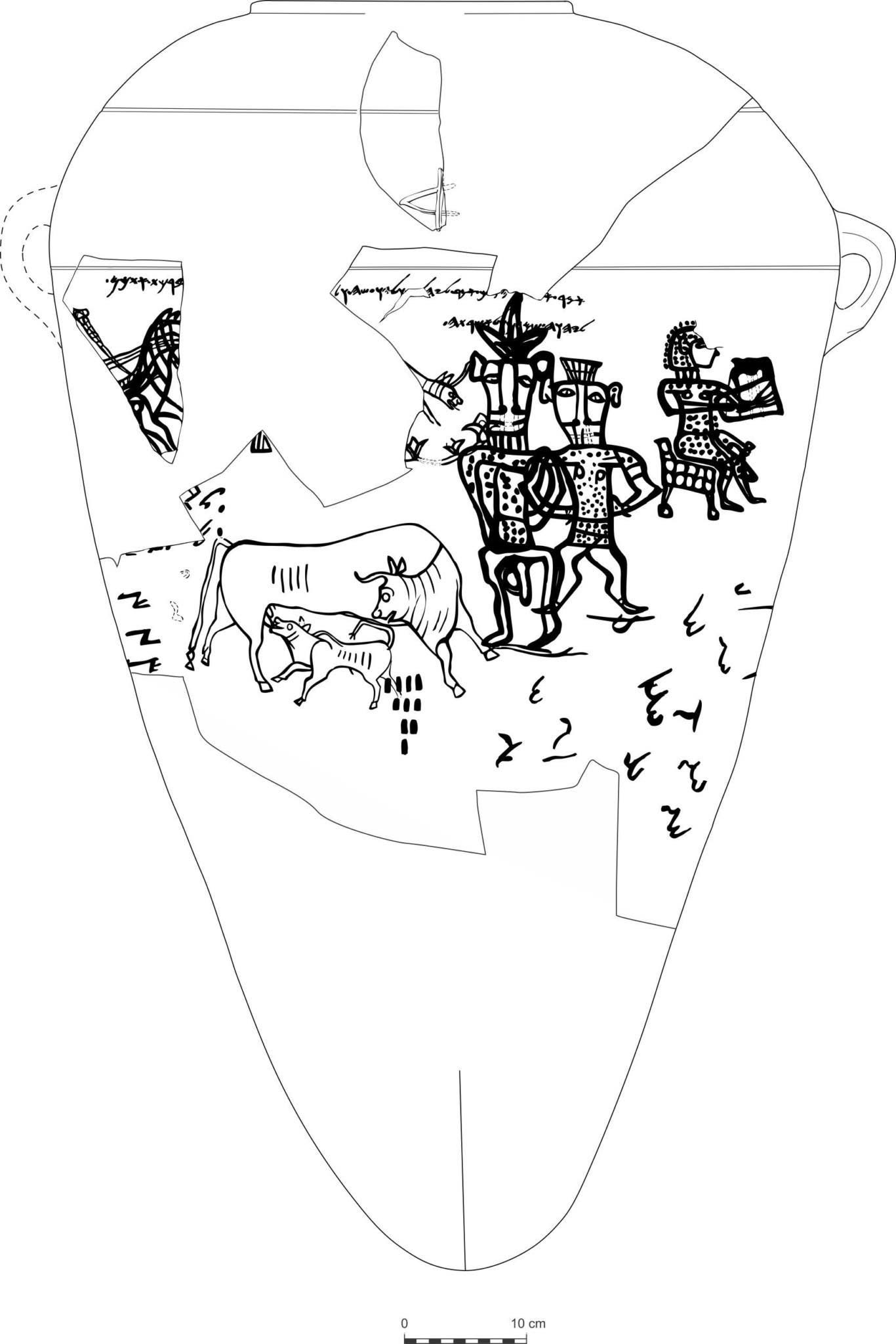
Conservative scholars and theologians loathe the idea that God could have had a wife, but these inscriptions are among the most unequivocal evidence that the early Hebrews were in fact pagan and worshiped the full Canaanite pantheon. The evidence and the scriptures show that the emergence of monotheism played out over centuries of social conflict.
Another 8th century BCE Hebrew inscription from a tomb at Khirbet el-Qôm, near Hebron, contains a blessing invoking "Yahweh and his Asherah," providing additional epigraphic evidence of the goddess traditions in ancient Judah.
Even more intriguing, there was an iconoclastic group of Hebrews at Elephantine Island in Egypt that continued polytheistic Hebrew practices and worshiped Yahweh-Anat (Anat-Yahu) until the 5th century BCE, after the second temple was built. There are many scraps of documents containing signatures dedicated to Yahweh-Anat, and they wrote letters to the Jerusalem temple signed with the Yahweh-Anat honorific.
Jews in the Second Temple were still arguing about polytheism until the Maccabean Revolt in 167 BCE. It was only under the Maccabees and the Hasmonean kingdom that the Jews became truly monotheistic in the manner we are familiar with today.
This sampling of archaeological evidence reviews the most famous and important items, but it is not a complete review of all the evidence. There are thousands of images of goddesses found in Israel and Judah. There is no ambiguity to the argument that the first temple Israelites were completely pagan.
Bonus section: Israelite Matriarchal Marriages
Probably should have included this material in the discussion of the Israelite matriarch Deborah.
A defining characteristic of tribal matriarchal families is that in marriage, the husband lives with the wife’s family, rather than the woman living with her husband’s family.
There are multiple examples of Israelite men living with their wives’ families during the tribal period of the Judges.
Samson goes to live with his wife’s family, who were Philistines. (Judges 15:1) (before Delilah).
Gideon’s Canaanite concubine/wife lived in Shechem, (Judges 8:31). Their son Abimelech led his mother’s tribe in a revolt against Gideon’s family. (Judges 9:1-6).
Live discussion on Tuesday, Jan. 27 at 7pm EST.
Reach out if you would like to join the chat.
goddessbiblestudy@gmail.com
Next session, we will move onto the kings, briefly discussing Saul, but primarly focusing on King David, who took Jerusalem around 1004 BCE. This topic will then lead to King Solomon whom we will stick with for a few weeks, as he is a central figure in the Goddess Bible traditions.
It's always fascinating to learn about early goddess worship within the "monotheistic" religions of today. Great read as usual!