

This week’s Goddess Bible Study digs into one of my personal favorite mythologies, the Baal Cycle.
This rare Canaanite mythology features many of the gods and goddesses we see in the Old Testament: El, Baal, Asherah, Astarte, Anat, Yamm, and Mot. These are the gods of the pagan Israelites. El is the heavenly father, the namesake of Israel.
This is the pantheon that Yahweh entered, staged a coup, and eventually overthrew on the path to monotheism. Yahweh defeats Baal and battles the goddesses in the Bible, and decoding this pagan pantheon reveals much about the development of Biblical monotheism.
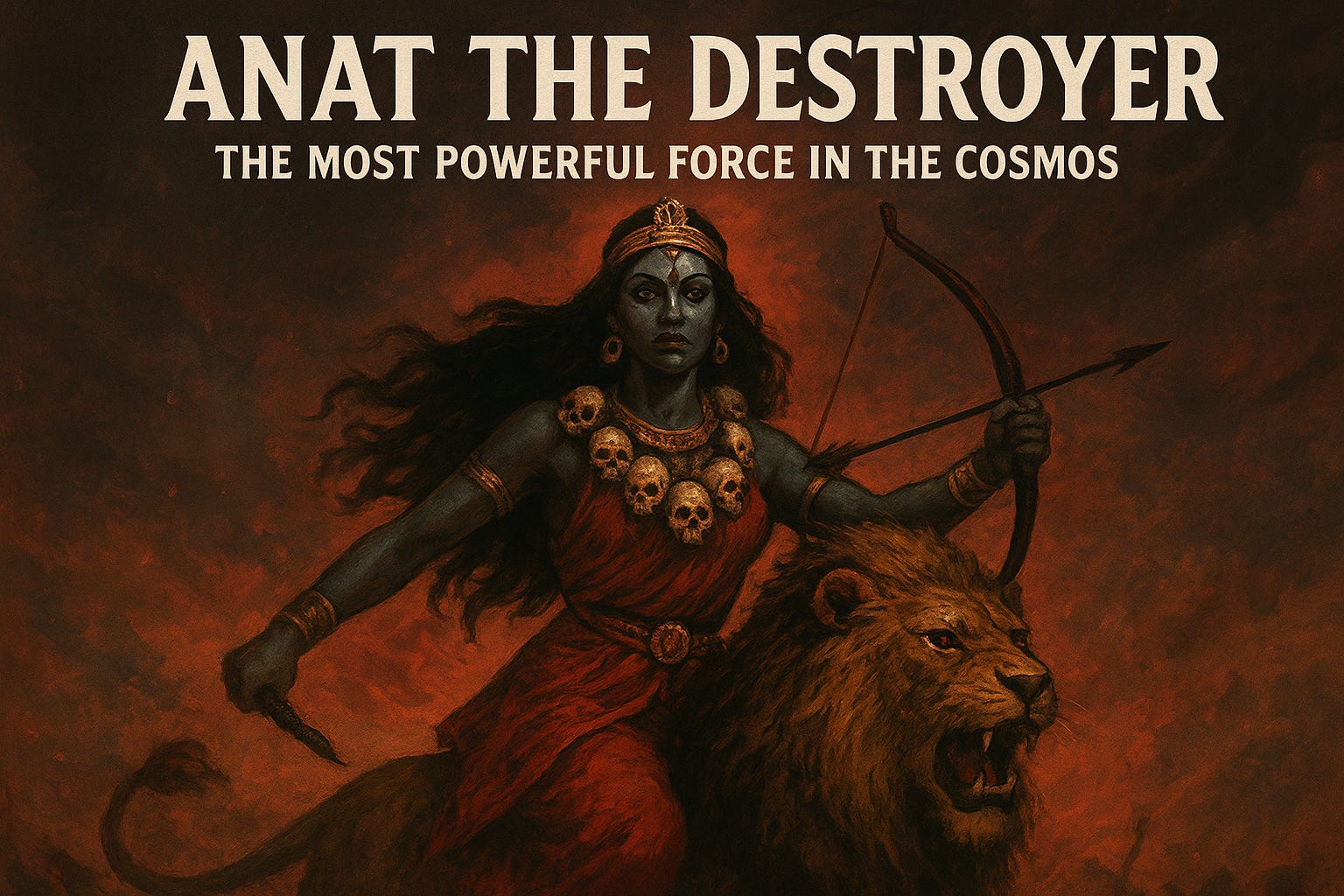
Anat is the destroyer in the triple goddess, along with Asherah the mother, and Astarte the maiden. Anat appears across cultures with different names, always representing the same metaphysical principle, ultimate cosmic destruction.
This goddess first appeared in ancient Egypt, where she was known as Sekhmet, she is Kali in modern India, and she is seen as Manat in the Koran among the pre-Islamic Arabs. She was always highly regarded.
Anat is conspicuously absent from the Biblical text. We know she was there historically because she appears in the names of several people and places, and she was the consort of Baal, who is central to the first temple narrative.
I argue that the Biblical writers do not name Anat out of fear. Anat is more powerful than the Biblical God, and to identify her would undermine the entire proposition of monotheism. The Biblical writers insult Asherah and Astarte, but their only choice with Anat is not to name her.
The Baal Cycle is rare mythology because the public is generally unaware that it exists and that it applies directly to the Bible. It was only recently translated, and until modern archaeology, there had never been any examples of Canaanite mythology.
Secular scholars who study this material are also extremely reticent to draw direct connections to the Bible and therefore fail to recognize the full theological significance of the texts.
The Baal Cycle
The Baal Cycle is a text of Canaanite mythology found in the wreckage of Ugarit, a Phoenician city on the Mediterranean coast (today’s Syria) that was destroyed in the Bronze Age Collapse around 1200 BCE. The texts were first found in 1928 but were not translated and made available to the general public until 1978, with additional work continuing today.
The Baal Cycle, or the Epic of Baal, was central to Canaanite religion. It is the story of how Baal became king of the gods, and also a dying and rising god story featured in agricultural festivals.
The Baal Cycle was found on six clay tablets, written in cuneiform, which are mostly preserved, but with chunks missing throughout the text. It is the longest and most important piece of Canaanite mythology discovered at Ugarit, but not the only one found. El’s Drinking Party is an amusing short story featuring a very drunk El, and a timely plant medicine rescue by Anat and Astarte.
All quotes and translations taken from Stories from Ancient Canaan, 2nd Ed., by Michael D. Coogan and Mark S. Smith, published 2012.
Baal Rises to Kingship by Defeating Yamm
In the story,
Baal rises to be king of the gods after first defeating his brother Yamm (god of the sea) in battle.
Anat grabbed one of Baal’s hands, Astarte grabbed the other, and they proclaimed him king of the gods.
Astarte makes only this brief cameo appearance in the story, but this placement demonstrates both how high-ranking she is (Queen of Heaven) and also that she is friendly with Anat, best friends really.
The brothers Baal, Yamm, and Mot, are equivalent to the Greek Zeus, Poseidon, and Hades.
Asherah Selects the King, and El Stamps the Decision With His Authority
Asherah, the mother of the gods, plays a crucial role in choosing who will be king.
Throughout the story, whenever the throne is vacant, El and Asherah jointly discuss who should be the new king. El repeatedly asks Asherah what she thinks, and then he stamps her decision with his authority.
This important symbolism demonstrates how the women played crucial decision-making roles in matriarchal cultures. Women had a voice in choosing the male leaders of the tribe, it was not simply a matter of the men taking power by force.
Anat Slaughters Soldiers of Yamm, She Revels in the Gore, Heart Filled with Joy
Anat the Destroyer, is Baal’s sister/lover/consort, she assists Baal at every turn and makes him powerful.
Anat slaughters the soldiers of Yamm, she makes their heads roll like balls.
She ties their severed hands to her belt and makes a garland necklace of their skulls.
She bathes in their blood and wallows vulva-deep in the gore.
She laughs out loud, her heart filled with joy, her belly filled with victory.
Anat is the Canaanite Kali.
Baal Needs a Temple Built
Baal and Anat Visit El for Permission
Anat Threatens to Murder El and El Gives Her What She Wants
Now that Baal is king, he needs a temple built. Anat tells Baal that she will speak to El, who will answer her or else…
“I’ll push him to the ground like a lamb, I’ll make his hair run with blood, his gray beard with gore, unless he gives Baal a house like the other gods, and a court like Asherah’s sons.”
Anat went to the encampment of El, her father, the Creator of the Universe, and immediately threatened him.
“Don’t rejoice in your well-built house El, I will seize it with my mighty arm. I’ll smash your head, I’ll make your gray hair run with blood, your gray beard run with gore.”
El, kind and compassionate, took it all in stride, unconcerned by his daughter’s tantrums.
“I know you daughter, how furious you are, that among the goddesses there is no restraining you; what do you want, Maiden Anat?”
Anat threatens to murder El, the high god, but he responds with grace and equanimity, he is not angered at his daughter’s disrespect, nor does he rebuke her. In fact, he gives her what she wants.
This whole scene, and repeated scenes just like it in other stories, give a clear indication that Anat is the most powerful of all the gods. El is the Creator, but Anat is the Destroyer.
“Your decree is wise, El, your wisdom is eternal, a lucky life is your decree”
Anat sounds like a mafia extortionist who has received payment. “It is wise of you to pay me, I would hate to have to break your knees.”
Anat and Baal Visit Asherah, Who is Terrified by Them
El tells Anat to visit Asherah and gain her favor with some gifts.
Asherah was at her home working with her exalted spindle when she saw Anat and Baal approaching. The Mother Goddess was terrified of her mighty children. She broke out in sweat, and her joints trembled.
“Why has Baal the Conqueror arrived? Why has Maiden Anat arrived? Would you kill me or my sons? Or finish off my pride of lions?”
Anat and Baal are terrifying even to the other gods, but this day they came to their mother bearing gifts.
Asherah was relieved when she saw that Anat and Baal were bringing gold, silver, and gifts. She agreed to visit El on their behalf.
Asherah Visits El, who Wants to Have Sex with Her,
but She Declines, and El Still Gives Her What She Wants
Asherah went to El the Bull and prostrated herself before him. El got excited by his wife’s visit, he offered her food and drink, and asked,
“Does the El the King’s passion excite you? Does the love of the Bull arouse you?”
Asherah passed off the seduction but pleaded Baal’s case. El replied spitefully, annoyed that his advances were spurned. But El agreed to the request and ordered a house for Baal to be built. Asherah praised him.
El and Asherah respect each other, but they do not live together.
El is a god of passions and pleasure who likes food, drink, and sex. In other stories, he gets riotously drunk.
Baal Gets His Temple, Anat and Baal Slaughter Many People to Celebrate
Baal’s house was built of silver and gold, Lebanese cedar, and the purest lapis lazuli. Baal then went on a victory tour, dispatching his enemies and sacking many towns.
Baal and Anat both kill humans for fun. This seems unique among the comparable kings of the gods.
Baal Sits on the Throne, Decides to Challenge Mot for Total Supremacy
The Gods Rule that Baal Must Die
Baal was enthroned as the mightiest of the gods, but then decided to challenge his brother Mot, the god of death (like Hades), for ultimate supremacy.
The gods do not accept Baal’s blasphemous impertinence, and Baal is ordered to submit to Mot. Baal had overstepped his boundaries, even the gods must submit to death eventually.
Inanna faced the same judgment when she tried to take over the underworld. Even the gods must obey their limits, and none are more powerful than death (none but one).
Baal was terrified and afraid, but he obeyed. Before Baal went to his doom, he had sex with a young cow who bore him a child.
Mot killed Baal, and the Lord of the Earth perished. Death came upon the land, and fertility vanished.
Baal Dies, Fertility Vanishes From the Land, El Mourns, Anat Mourns
El came down from his house in mourning and lamentations, covering himself with dirt, wearing a sackcloth in the ritual fashion.
El cut his skin with a stone, made incisions with a razor, and cut his cheeks and chin. He raked the length of his arms, he plowed his chest like a garden, he raked his back like a valley.
“Baal is dead, what will happen to the people?”
El is concerned about the fates of the humans. El is generally a kind god (but not always).
Asherah’s sons competed to be the new king, but they were no match for the mighty Baal.
Anat went hunting until she found Baal’s body. She also cut her skin with stones and covered herself in sackcloth. When she was done weeping, she brought Baal’s body back to Mt. Zaphon, and she buried him. Anat made great offerings and sacrifices.
Like the heart of a cow for her calf, so was Anat’s heart for her brother Baal.
Anat Finds Mot and Destroys Him Easily
Baal is Restored to Life and Majesty
Anat is the Most Powerful Deity,
She Can Tear Down Creation and Dispatch Death
Anat sought out Mot.
She grabbed Death by the edge of his clothes, raised her voice, and demanded, “Give me back my brother!”
Anat seized El’s son Death:
With a sword she split him;
With a sieve she winnowed him;
With fire she burned him;
With millstones she ground him;
In the fields she sowed him.
Birds ate his flesh;
Fowl consumed his parts;
Flesh cried out to flesh!
Anat destroyed Death in dramatic fashion, and Baal was restored to life. This is reflective of agricultural rituals.
El was glad. Baal returned to his royal throne and dispatched his rivals.
Anat again demonstrates her power. The other gods must submit to death, but not Anat, who destroyed him easily.
Mot Returns to Fight Baal Again
Then in the seventh year, Mot, apparently not permanently dead, approached Baal, and they proceeded to fight anew.
Mot was strong, Baal was strong.
The Sun eventually interceded, telling Mot not to kill Baal, or surely El would overturn him. Mot was afraid and finally declared,
“Let Baal be enthroned on his royal throne, the seat of his dominion.”
Thus concludes the Baal Cycle.
Baal is enthroned above all, but not without the crucial assistance of his sister Anat, the goddess who defeated Death and had the spirit to challenge El. With Anat at his side, Baal is virtually untouchable among the gods, his rule is supreme.
Anat displays none of the subtlety and magic of Isis, or the sensuality of Ishtar, but there is no denying her raw power. Anat’s mastery of death and ability to drive terror into the hearts of the other powerful gods put Anat into a category of her own.
Anat is the most powerful deity in the pantheon. She is ultimate cosmic destruction. She has checkmate power over God and all the gods.
Goddess Bible Study will discuss this fun topic on Tuesday, November 17, at 7:00 pm EST. Reach out if you would like to join the group discussion or Signal chat.
The next topic will be Helen of Troy and the Trojan War. Then we will return to the Bible with Moses and the Exodus.
goddessbiblestudy@gmail.com