

Cannabis in the Bible
This is the topic that started it all for me. In 2018, I began researching cannabis in the Bible with the plan of writing a book.
I was aware that cannabis is mentioned by name in five verses of the Old Testament in the original Hebrew, but was mistranslated as a different plant, so we don’t see it in modern Bibles. This mistranslation occurred in the Septuagint, the first Greek translation of the Hebrew Bible around 300 BC, so the meaning of the word has long been lost and only recently rediscovered.
We now know that cannabis was once sacred to the Hebrews. It is an ingredient in Moses’ Holy Anointing Oil, a recipe that comes directly from the mouth of God, so it must have been important, but cannabis is clearly not sacred in modern Jewish and Christian traditions today. They must have gotten rid of the plant at some point in history. My plan for the book was to figure out when and why it happened.
I opened a Bible for the first time since High School, and began digging into the modern academic scholarship to try and make sense of the story. It was here that I first discovered Asherah, the one-time wife of God.
God had a Wife?
I thought this was the most outrageous thing I had ever heard, and it made no sense, and now we have Goddess Bible Study, but that is another story.
I quickly came to the hypothesis that cannabis and the goddess must have been thrown out together, and that is exactly what happened. Cannabis was deeply sacred in the goddess traditions of the original pagan Israelites when they still had a mother goddess. But they divorced her when they transitioned from pagans into monotheists, and all her nature-based traditions and sacred plants were deemed profane.
My book was originally titled “Cannabis and the Goddess” before a last-minute change at publication time to “A History of the Goddess: from the Ice Age to the Bible,” which I think is much better.
Anyway, let’s get into the evidence and the stories.
Five Verses
Five verses in the Hebrew Bible (Old Testament) use the Hebrew word kaneh, or kaneh bosm, which is the name of cannabis, but it is mistranslated as either calamus or aromatic cane. In all five instances, cannabis fits the context while calamus and aromatic cane does not. Aromatic cane is rather meaningless.
Exodus 30:23; Song of Solomon 4:14; Isaiah 43:24; Jeremiah 6:20; Ezekiel 27:17
Kaneh is described as a sacred ingredient in Moses’ holy anointing oil, a valued aromatic herb, a burnt offering in the temple (twice), and as an object of trade from Lebanon.
All of these references are during the First Temple period (or earlier). Cannabis was eventually thrown out in the reformations of the Yahweh-alone movement, and it does not appear again in the Second Temple.
Biblical commentary has long noticed that the spice mentioned in these five verses (kaneh, kaneh bosm) is vague and ambiguous, and there is no historical consensus among Jewish and Christian scholars on the proper translation. Bosm means sweet, or pungent; often in the context of aromatics applied to the body.
Among various candidates suggested for kaneh (bosm) include calamus, sweet cane, ginger grass, camel grass, lemon grass, sugar cane, balm oil, fennel, and other plants as well.
Aromatic cane is actually a good description of cannabis, which grows 10 feet tall and is pungent.
This is an important scholarly question, it is not just trivia for potheads. If it can be proven that kaneh is cannabis and was burned in the first Hebrew Temple, then there are profound theological, historical, cultural, and legal implications that reverberate in today’s society, beginning with the entire concept of marijuana prohibition.
Why Not Calamus?
Calamus, Acorus calamus L.- Sweet flag, is an herbaceous perennial, a common marsh plant. The flowers are sweetly fragrant and psychoactive. It is a well-known plant used in Indian traditional medicine for centuries. Its aroma makes calamus an essential oil valued in the perfume industry and used as a flavor for foods, alcoholic beverages, and bitters.
So far, so good for calamus, the problem is that calamus is extremely toxic in high doses, as required in the Holy Anointing Oil, nor is it typically a burnt offering.
Calamus was even banned for use as human food or as a food additive in 1968 by the United States Food and Drug Administration because it contains more than 75% asarone. Asarone is a poison that has been shown to cause cancer, and has ill effects on heart, liver, and kidney functions. This toxin in calamus is used for pest control.
Sula Benet - the Scholar
The etymology of kaneh bosm as cannabis was first identified by Polish scholar Sula Benet (aka Sara Benetowa) in her 1936 PhD thesis from Columbia University, and again in a 1975 paper. Her work has been confirmed by modern scholars, though her conclusions are controversial in conservative circles.
Modern cannabis scholar Chris Bennet discovered Sula Benet’s work in the 1990s and popularized the finding with today’s audiences.
Kaneh bosm has clear similarities to other ancient names for cannabis, such as the Assyrian kunubu. Kunubu is listed as an ingredient in the sacred rites in a letter by the mother of Assyrian King Esarhaddon, 680 BCE, which is contemporary to the First Temple.
Cannabis was widely used for both fibers and drugs across Bronze Age Anatolia, Canaan, Egypt, Mesopotamia, and Persia, and is thoroughly documented as deeply sacred in India since prehistoric times.
Here are the five verses:
Moses’ Holy Anointing Oil
The Holy Anointing Oil is the most important reference since it highlights the sacred value of the plant. This recipe was given directly by God to Moses, and it was used to anoint all the sacred objects in the temple, as well as to anoint high priests and kings.
Producing this recipe with calamus would likely make you sick, but with cannabis, it is highly psychoactive.
The recipe for the holy anointing oil is potent. 250 shekels of cannabis equals 6.28 pounds of flowering cannabis tops infused into roughly 1.5 gallons of olive oil (around 6 liters, hin is not a precise measure), plus myrrh, cinnamon, and cassia. This recipe was boiled and distilled so that all the spices were infused into the oil.
“Take the following fine spices: 500 shekels of liquid myrrh, half as much (that is, 250 shekels) of fragrant cinnamon, 250 shekels of fragrant cannabis [kaneh bosm] [calamus, aromatic cane], 500 shekels of cassia--all according to the sanctuary shekel - and a hin of olive oil. Make these into a sacred anointing oil, a fragrant blend, the work of a perfumer. It will be the sacred anointing oil.”
- Exodus 30:23-33
Song of Songs
Frankincense, myrrh, and cannabis were routinely blended to make intoxicating incense in the ancient world. Here they are listed among aromatic herbs in the romantic Song of Songs.
Your plants are an orchard of pomegranates with choice fruits, with henna and spikenard, spikenard and saffron, cannabis [kaneh] [calamus] and cinnamon, with all the trees of frankincense, myrrh and aloes, and all the finest spices.
- Songs 4:13-14
Isaiah - Burnt Offering to Yahweh
Cannabis was burned in the First Temple, commanded by Yahweh.
“I have not burdened you with offerings, or wearied you with frankincense. You have not bought any cannabis [kaneh] [sweet cane, calamus] with silver for me, or lavished on me the fat of your sacrifices. But you have burdened me with your sins and wearied me with your iniquities”.
- Isaiah 43:23-24
Ezekiel - Trade Goods from Tyre
Cannabis fiber and drug products were widely traded in the ancient world. Here, the prophet Ezekiel listed cannabis among trade goods from the Phoenician (Lebanese) city of Tyre. The Bekaa Valley in Lebanon has been famous for growing cannabis since ancient times.
“Damascus did business with you because of your many products and great wealth of goods. They offered wine from Helbon, wool from Zahar, and casks of wine from Izal in exchange for your wares: wrought iron, cassia, and cannabis [kaneh] [calamus, aromatic cane]”.
- Ezekiel 27:18-19
Jeremiah - Burnt Offering Rejected
Jeremiah was a leading prophet of Yahweh during Josiah’s reign. He witnessed the destruction of Jerusalem and went into exile in Egypt. Yahweh is angry about something here and not satisfied with the offerings being made. Perhaps this is part of the reforms, Jeremiah was one of the reformer prophets.
What do I care about frankincense from Sheba or cannabis [kaneh] [calamus, sweet cane] from a distant land? Your burnt offerings are not acceptable; your sacrifices do not please me.”
- Jeremiah 6:20
Evidence of Cannabis at Tel Arad Temple
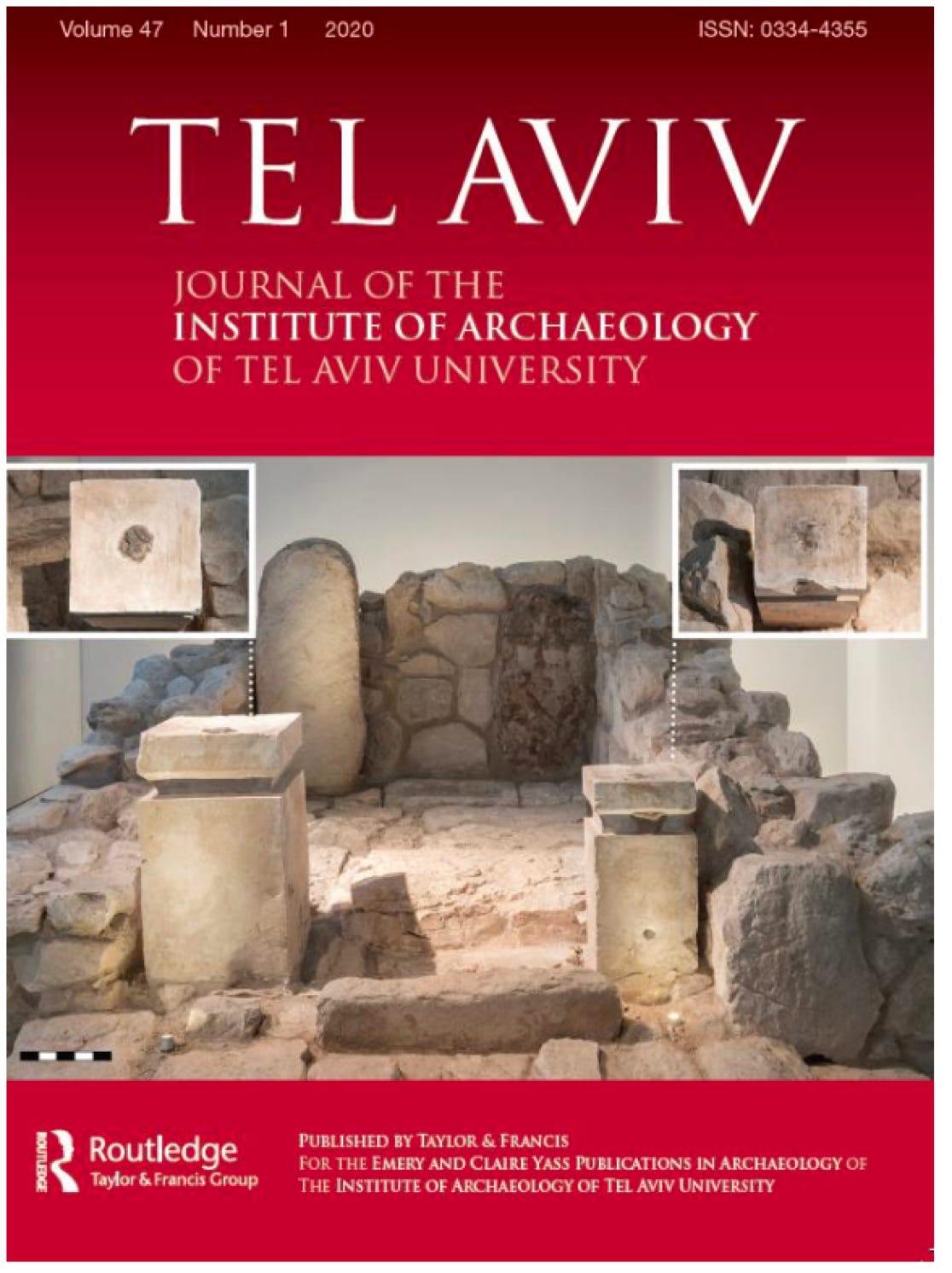
The scholarly argument for cannabis in the Bible had been based on etymology and conjecture until a recent archeological study brought full confirmation. Tel Arad is an extremely important site in Israel, as it contains the only example of a temple outside Jerusalem during the period when the First Temple stood.
The site is controversial because the temple is pagan and clearly contains a pair of standing stones for Yahweh and Asherah in the Holy of Holies. There are also a pair of incense altars accompanying the standing stones.
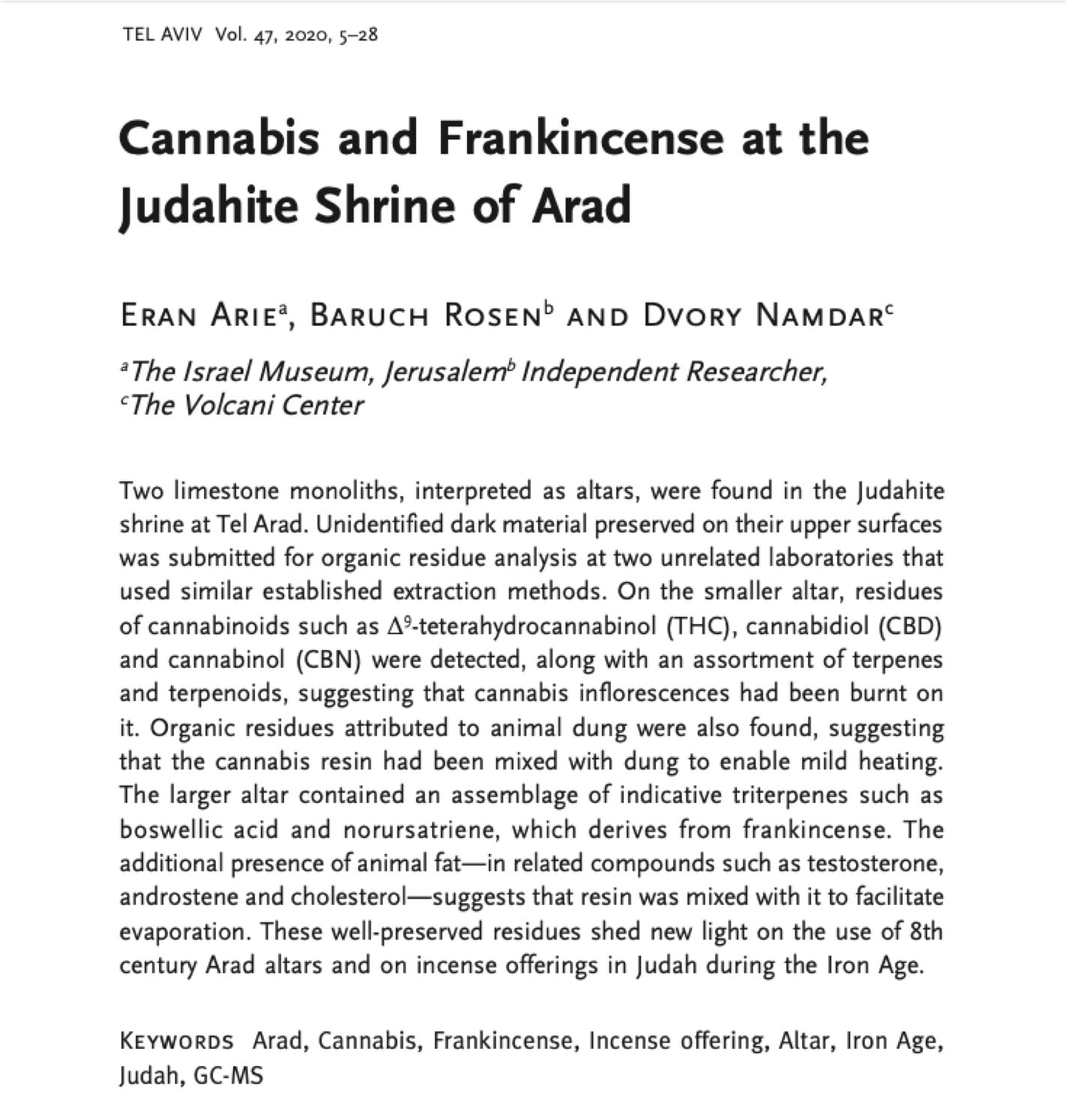
The altars contain residues of plant material. This residue had been observed for decades, but it was only in 2020 that the samples were finally analyzed and the findings published in a peer-reviewed journal.
The pair of incense altars were found to have residues of frankincense and cannabis, and provides firm scientific evidence confirming the etymological argument for cannabis in the Bible.
The smaller altar had cannabis and was paired with the standing stone for Asherah, while the larger frankincense altar went with Yahweh.
Evidence of Reforms at Tel Arad
The Tel Arad temple site had been carefully buried in the 8th century BCE, allowing its full preservation. The twin standing stones and incense altars for Yahweh and Asherah that stood in the Holy of Holies were laid down and buried by hand.
The question is, why was the temple site buried?
The site was either buried because of the monotheistic reforms of King Hezekiah as described in the Bible, or because of the Assyrian invasion in that period that saw Israel destroyed and Jerusalem attacked (but barely surviving). Scholars argue both sides.
The Bible tells us about the reformer kings Hezekiah and Josiah in the 8th and 7th centuries BCE. These kings championed the Yahweh-alone movement and worked to centralize worship in the Jerusalem temple. The reforms centered on shutting down the popular pagan goddess traditions that were not subject to their authority,
Hezekiah was King of Judah from 715-686 BCE. He is a historical figure thoroughly attested by archaeologists. The religious reforms were early in his reign.
He removed the high places, smashed the sacred stones, and cut down the Asherah poles. He broke into pieces the bronze snake Moses had made, for up to that time the Israelites had been burning incense to it. (It was called Nehushtan.)
- 2 Kings 18:4
King Josiah’s Reforms
King Josiah was Hezekiah’s grandson and ruled Judah from 640-609 BCE, with the reforms around 630 BCE.
He did away with the idolatrous priests appointed by the kings of Judah to burn incense on the high places of the towns of Judah and on those around Jerusalem – those who burned incense to Baal, to the sun and moon, to the constellations and to all the starry hosts.
He took the Asherah pole from the temple of Yahweh to the Kidron Valley outside Jerusalem and burned it there. He ground it to powder and scattered the dust over the graves of the common people.
- 2 Kings 23:4-6
He also tore down the quarters of the male qadesh [holy ones] [temple sodomites] that were in the temple of Yahweh, the quarters where women did weaving for Asherah.
- 2 Kings 23:7
Josiah smashed the sacred stones and cut down the Asherah poles and covered the sites with human bones. Even the altar at Bethel ... even that altar and high place he demolished. He burned the high place and ground it to powder, and burned the Asherah pole also.
- 2 Kings 23:14-15
Women Defend the Queen of Heaven
Not long after, in 586 BCE, Jerusalem was sacked and the First Temple destroyed by the invading Babylonians. The Israelites were sent into exile.
As the exiles were leaving their home, with Jerusalem in flames behind them, the prophet Jeremiah attempted to castigate the women for their ongoing goddess worship and scapegoat them for the tragic turn of events.
The women weren’t having it.
“We will not listen to the message you have spoken to us in the name of Yahweh! We will certainly do everything we said we would: We will burn incense to the Queen of Heaven and will pour out drink offerings to her just as we and our ancestors, our kings and our officials did in the towns of Judah and in the streets of Jerusalem. At that time, we had plenty of food and were well off and suffered no harm. But ever since we stopped burning incense to the Queen of Heaven and pouring out drink offerings to her, we have had nothing and have been perishing by sword and famine.”
— Jeremiah 44: 16-18
Divorce of the Sacred Marriage
The Garden of Eden story is a mythological condemnation of the traditional goddess religion of Asherah, Astarte, and Anat. The Garden of Eden story was likely written during the reforms of kings Hezekiah and Josiah, when the Yahwists worked hard to centralize control in the Jerusalem temple and shut down the popular goddess traditions.
Like Hesiod’s Pandora (a contemporary story), the first woman, Eve, was cast as the source of all of men’s troubles, and she must be restrained.
Many celebrated symbols and images of the goddesses, such as the serpent, gardens, sacred plants, and childbirth, were inverted and profaned in the Garden of Eden story in an effort to subvert Eve and all women to patriarchal authority. Cannabis makes an important appearance in my interpretation and is also condemned.
The great goddess traditions were matriarchal women’s religions, and the patriarchal Yahwists shut them down so that the Heavenly Father could rule alone with no wife or competition.
Garden of Eden
And Yahweh God commanded the man, “You are free to eat from any tree in the garden; but you must not eat from the tree of the knowledge of good and evil, for when you eat from it you will certainly die.”
- Genesis 2:15-17
“You will not certainly die,” the serpent said to the woman. “For God knows that when you eat from it your eyes will be opened, and you will be like God, knowing good and evil.”
- Genesis 3:1-5
Adam named his wife Eve, because she would become the mother of all the living.
- Genesis 3:20
The Tree of Knowledge of Good and Evil
Could the forbidden fruit be cannabis? It matches the description.
When the woman saw that the fruit of the tree was good for food and pleasing to the eye, and also desirable for gaining wisdom, she took some and ate it. She also gave some to her husband, who was with her, and he ate it. Then the eyes of both of them were opened, and they realized they were naked; so they sewed fig leaves together and made coverings for themselves.
- Genesis 3:6-7
The fruit of the tree was good for food; cannabis seeds are among the most nutritious seeds found anywhere in nature, valued by humans, animals, and birds.
The woman saw that the plant was pleasing to the eye; cannabis is widely regarded as a beautiful, attractive plant.
The plant is desirable for gaining wisdom; cannabis has long been used in religion and ritual, valued for its capacity to promote shamanistic insight and meditative reflection.
Adam and Eve ate the fruit and their eyes were opened, they realized they were naked; they ate the cannabis, got high, and had ideas; a classic entheogenic experience.
They sewed fig leaves together and made coverings for themselves; they used the hemp fibers to sew clothes.
Revelation - The Tree of Life
Could cannabis be the Tree of Life, yielding its twelve crops of fruit every month?
We will do a dedicated topic on the Book of Revelation when the time comes.
Then the angel showed me the river of the water of life, as clear as crystal, flowing from the throne of God and of the Lamb down the middle of the great street of the city. On each side of the river stood the tree of life, bearing twelve crops of fruit, yielding its fruit every month. And the leaves of the tree are for the healing of the nations.
No longer will there be any curse. The throne of God and of the Lamb will be in the city, and his servants will serve him. They will see his face, and his name will be on their foreheads.
-Revelation 22:1-4
Next episode of GBS, we will dive into the long, cross-cultural traditions of transgender people.
reach out:
goddessbiblestudy@gmail.com
Live discussion on cannabis, Tuesday, April 14, 2026 at 7pm EST.