

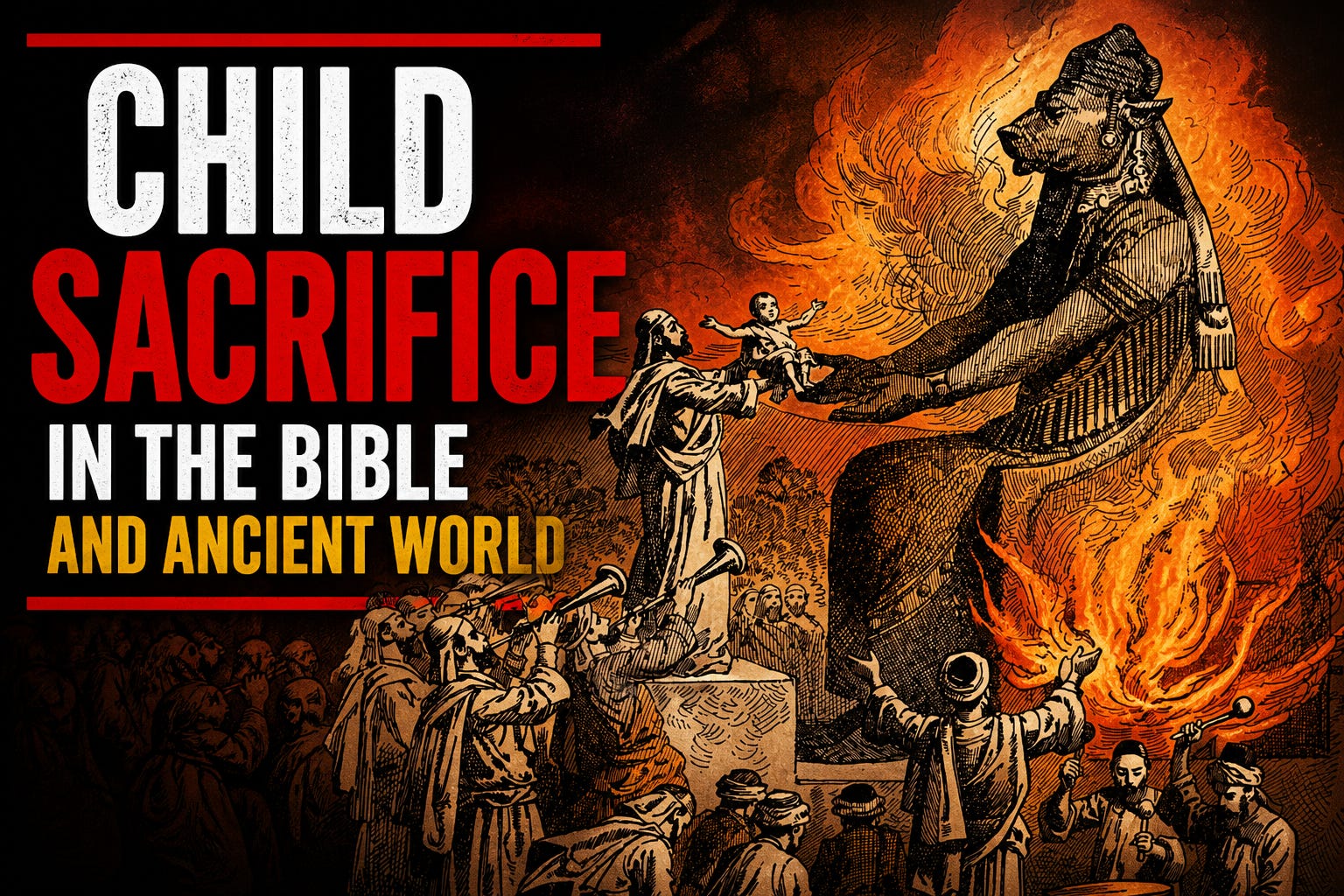
This week’s Goddess Bible Study focuses on one of the most controversial topics in the Bible, the greatest sin committed by the Israelites and Canaanites (aka Phoenicians), child sacrifice.
The grotesque sin of child sacrifice was documented by Greek and Roman writers, in addition to the Hebrew prophets. These imperial rivals to the Phoenicians were universally disgusted by the practice, and it was a crucial distinction between their cultures.
We see evidence of child sacrifice in the cultures that worshipped Baal, particularly Carthage in North Africa, which was a Phoenician colony. The cult of Yahweh emerged in the Iron Age and challenged the primacy of Baal, the incumbent king of the gods. Child sacrifice was one of the most important issues they fought over.
The Greek story of Agamemnon sacrificing Iphigenia at the beginning of the Trojan War, as well as the Hebrew story of Abraham and Isaac, indicate that these practices were culturally familiar, but they were clearly rejected in the religious reformations of the Iron Age.
The Hebrews and Hellenistic Greeks saw themselves as superior peoples, in part, because they rejected the child sacrifice practices of their ancestors.
Sacrifices were made under different circumstances. There were obligatory sacrifices of firstborns, usually animals but sometimes children. Some infants were killed to honor a request being granted by the gods. In other cases, children, including royal children, could be sacrificed in times of danger and deprivation, such as a siege or famine, in hopes of saving the entire community.
This was an era of high child mortality, parents expected to lose many babies, and this is certainly part of the context for these ritual sacrifices.
Child Sacrifice in the Bible
An early passage from the Bible indicates that child sacrifice had once been commanded.
“Do not hold back offerings from your granaries or your vats. “You must give me the firstborn of your sons.”
-Exodus 22:29
One of the most famous stories in the Bible is the near-sacrifice of Isaac by his father Abraham. God (El at this stage of history) ordered Abraham to sacrifice his beloved son, Isaac, and Abraham reluctantly agreed, but upon proving his faith, the demand was rescinded by Yahweh.
It is an interesting detail that the story begins with God demanding the sacrifice, while Yahweh steps in at the end to provide the deliverance. This indicates both the distinction between God (El) and Yahweh, who were two separate gods, and also the opposition to sacrifice by the Yahweh cult.
Many scholars believe the original story featured the death of Isaac and that it was later modified by Yahwists. The sacrifice of Iphigenia is similarly told in contradictory stories; in some cases, the girl dies, and in others she is saved by the goddess Artemis and replaced with a substitute.
When they reached the place God had told him about, Abraham built an altar there and arranged the wood on it. He bound his son Isaac and laid him on the altar, on top of the wood. Then he reached out his hand and took the knife to slay his son. But the angel of Yahweh called out to him from heaven, “Abraham! Abraham!”
“Here I am,” he replied.
“Do not lay a hand on the boy,” he said. “Do not do anything to him. Now I know that you fear God, because you have not withheld from me your son, your only son.”
-Genesis 22:9-12
Several Biblical kings are recorded to have sacrificed their children.
In one instance, Canaanite child sacrifice apparently worked to defend against an assault by the Israelites. Fortunately, we now understand that these sacrifices were a futile and useless superstition that our ancestors were correct to abandon.
The battle featured in the following verse is a real historical incident. The Moabite victory was commemorated on the Mesha Stele from 840 BC, which happens to be the first appearance of Yahweh in the historical record. Mesha, the king of Moab, in an act of desperation, sacrificed his firstborn son, the crown prince, to appeal to the gods to save the city from imminent defeat and destruction. According to the Bible, the sacrifice worked, and victory was snatched from the jaws of defeat.
When the king of Moab saw that the battle had gone against him, he took with him seven hundred swordsmen to break through to the king of Edom, but they failed. Then he took his firstborn son, who was to succeed him as king, and offered him as a sacrifice on the city wall. The fury against Israel was great; they withdrew and returned to their own land.
-2 Kings 3:26-27
According to the Hebrew Bible, several kings, primarily of Judah, engaged in the ritual of child sacrifice. There are suggestions that other kings also permitted or participated in the practice.
Ahaz, King of Judah (c. 735–715 BCE):
Ahaz was twenty years old when he became king, and he reigned in Jerusalem sixteen years. Unlike David his father, he did not do what was right in the eyes of Yahweh, his God. He followed the ways of the kings of Israel and even sacrificed his son in the fire, engaging in the detestable practices of the nations Yahweh had driven out before the Israelites. He offered sacrifices and burned incense at the high places, on the hilltops and under every spreading tree.
-2 Kings 16:2-4
Manasseh, King of Judah (c. 687–643 BCE):
Manasseh was twelve years old when he became king, and he reigned in Jerusalem fifty-five years. His mother’s name was Hephzibah. He did evil in the eyes of Yahweh, following the detestable practices of the nations Yahweh had driven out before the Israelites. He rebuilt the high places his father Hezekiah had destroyed; he also erected altars to Baal and made an Asherah pole, as Ahab king of Israel had done. He bowed down to all the starry hosts and worshiped them. He built altars in the temple of Yahweh, of which Yahweh had said, “In Jerusalem I will put my Name.” In the two courts of the temple of Yahweh, he built altars to all the starry hosts. He sacrificed his own son in the fire, practiced divination, sought omens, and consulted mediums and spiritists. He did much evil in the eyes of Yahweh, arousing his anger. He took the carved Asherah pole he had made and put it in the temple.
-2 Kings 21:1-7
Phoenicians
Despite being a civilized and cosmopolitan people, the Phoenicians were deeply superstitious by Greek and Roman accounts, clinging to talismans and amulets that would help protect them from their malevolent gods.
Archaeology has confirmed that the Baalists did practice human sacrifice. Thousands of infant remains have been unearthed at Carthage in a huge “tophet,” a burial ground for charred human and animal sacrifices.
Smaller tophets were also found at Phoenician sites in Sicily, Sardinia, and Tunisia. Child sacrifice at Carthage took place continuously for over 600 years through good times and bad. No tophets have been found in Israel/Canaan, but they may have once existed.
The tophets contain a mix of animal and child remains carefully placed in urns, indicating that animals were used as well, or as substitutes for children. The fact that the animals and children were all buried together shows that these were not cemeteries, but ritual offerings to the gods.
Human sacrifice in the form of killing war captives and slaves was not unusual in the ancient world. Nor was it unheard of for an entire royal court to practice ritual suicide upon the death of the king or Pharaoh. These and other similar practices, including cannibalism, have been documented in many cultures around the world.
But the Phoenician/Canaanite practice of sacrificing their own children to placate the gods does seem unique in the Iron Age Mediterranean, and does not appear to have been practiced in any of the neighboring cultures like Mesopotamia or Egypt. The Greeks allude to child sacrifice in their mythology as an ancient practice of their uncivilized forebears.
Carthaginian child sacrifices are extremely controversial among academics, some refuse to accept that it was happening. Human sacrifice was part of their culture, and most of the literature describes the sacrifices as the fulfillment of vows and responses to prayers being answered by the gods. Apparently, people would offer a child if the gods delivered their prayer requests.
Dramatic Rituals
The method of sacrifice was dramatic, a bronze statue of a god with arms outstretched was stoked with a hot fire. The babies and animals were placed in the god’s arms and immediately consumed by the flames.
Greek historian Cleitarchus, who wrote a biography of Alexander the Great, also wrote about child sacrifice.
Out of reverence for Cronos, the Phoenicians, and especially the Carthaginians, whenever they seek to obtain some great favor, vow one of their children, burning it as a sacrifice to the deity, if they are especially eager to gain success. There stands in their midst a bronze statue of Cronos, its hands extended over a bronze brazier, the flames of which engulf the child. When the flames fall upon the body, the limbs contract and the open mouth seems almost to be laughing, until the contracted [body] slips quietly into the brazier. Thus it is that the ‘grin’ is known as ‘sardonic laughter,’ since they die laughing.
-Cleitarchus (ca. 310-300 BC)
Children could be purchased from the poor for sacrificial purposes. It was a requirement that the parents of the sacrificed child do not shed any tears, or else the sacrifice was invalidated, the money lost, and the child would still be dead.
Greek historian Plutarch wrote:
With full knowledge and understanding they themselves offered up their own children, and those who had no children would buy little ones from poor people and cut their throats as if they were so many lambs or young birds; meanwhile the mother stood by without a tear or moan; but should she utter a single moan or let fall a single tear, she had to forfeit the money, and her child was sacrificed nevertheless; and the whole area before the statue was filled with a loud noise of flutes and drums so the cries of wailing should not reach the ears of the people.
-On Superstition by Plutarch
Greek writers wrote for Greek audiences, and they routinely used the familiar names of Greek gods when describing foreign gods, which leads to some confusion among later scholars, who must take care to recognize which gods are being described. In the context of human sacrifice, the Greeks consistently describe them as sacrifices to Cronos, the cruel king of the Titans, the older generation of gods who ate his own children and was displaced by his son, Zeus. The Greeks clearly associate Cronos with El, the god of Israel.
El’s Sacrifice of His Son Ieoud
Very little Phoenician writing or mythology has survived, but bits from the legendary writer Sanchuniathon were preserved by Philo of Byblos and recorded later by the Christian Bishop Eusebius in his polemics against the hated pagans.
One Phoenician myth features El sacrificing his infant son Ieoud in a story reminiscent of Abraham and Isaac.
This story again demonstrates that the Greeks correlated El with Cronos.
It was the custom among the ancients, in times of great calamity, in order to prevent the ruin of all, for the rulers of the city or nation to sacrifice to the avenging deities the most beloved of their children as the price of redemption; and those who were thus given up were sacrificed with mystic rites.
Cronos then, whom the Phoenicians call El, who was king of the country and subsequently, after his decease, was deified as the star Saturn, had by a nymph of the country named Anobret an only begotten son, whom they on this account called Ieoud… and when very great dangers from war had beset the country, he arrayed his son in royal apparel, and prepared an altar, and sacrificed him.
-Eusebius, Praeparatio Evangelica, Book I, ch X
Child sacrifices were made by the wealthy and elite, including the royalty. The practice fell into disrepute and corruption when the rich were allowed to purchase the children of the poor as substitutes for their own children. Carthage came under siege in 308 BCE by the king of Syracuse, leading to a political crisis and mass sacrifices.
Therefore the Carthaginians, believing that the misfortune had come to them from the gods, betook themselves to every manner of supplication of the divine powers; ... They also alleged that Cronus had turned against them inasmuch as in former times they had been accustomed to sacrifice to this god the noblest of their sons, but more recently, secretly buying and nurturing children, they had sent these to the sacrifice; and when an investigation was made, some of those who had been sacrificed were discovered to have been supposititious. When they had given thought to these things and saw their enemy encamped before their walls, they were filled with superstitious dread, for they believed that they had neglected the honours of the gods that had been established by their fathers. In their zeal to make amends for their omission, they selected two hundred of the noblest children and sacrificed them publicly; and others who were under suspicion sacrificed themselves voluntarily, in number not less than three hundred. There was in their city a bronze image of Cronus, extending its hands, palms up and sloping toward the ground, so that each of the children when placed thereon rolled down and fell into a sort of gaping pit filled with fire.
-Diodorus Siculus (20.14 via Lacus Curtius)
Biblical Opposition to Sacrifice
The Yahweh cult began pushing its cultural reforms in the 10th century BCE, and child sacrifice was one of the defining issues. The issue was heated throughout the entire First Temple period. The prophet Jeremiah was particularly exercised about it.
“ ‘The people of Judah have done evil in my eyes, declares Yahweh. They have set up their detestable idols in the house that bears my Name and have defiled it. They have built the high places of Topheth in the Valley of Ben Hinnom to burn their sons and daughters in the fire—something I did not command, nor did it enter my mind. So beware, the days are coming, declares Yahweh, when people will no longer call it Topheth or the Valley of Ben Hinnom, but the Valley of Slaughter, for they will bury the dead in Topheth until there is no more room.
-Jeremiah 7:31-32
They have built the high places of Baal to burn their children in the fire as offerings to Baal--something I did not command or mention, nor did it enter my mind.
-Jeremiah 19:5
They built high places for Baal in the Valley of Ben Hinnom to sacrifice their sons and daughters to Moloch, though I never commanded--nor did it enter my mind--that they should do such a detestable thing and so make Judah sin.
-Jeremiah 32:35
“’Do not give any of your children to be sacrificed to Moloch, for you must not profane the name of your God. I am Yahweh.”
-Leviticus 18:21
When you enter the land Yahweh your God is giving you, do not learn to imitate the detestable ways of the nations there. Let no one be found among you who sacrifices their son or daughter in the fire, who practices divination or sorcery, interprets omens, engages in witchcraft, or casts spells, or who is a medium or spiritist or who consults the dead.
-Deuteronomy 18:9-11
Moloch/Mulk
In the Bible, the practice is usually described as sacrifices to the god Moloch, or as “passing the children through fire.”
It is possible that “Moloch” is actually a mistranslation and does not refer to a god but is simply a name for this particular type of sacrifice. Biblical Hebrew is written with no vowels, leading to many possible translations of the same words.
One reason is that there is no evidence in the archaeological record of a god named Moloch anywhere, he only appears in the Bible.
The Hebrew word used is “mlk” traditionally seen as the deity Moloch, but scholars now believe the word is “mulk,” the name used for the sacrifice in Carthage. If the sacrifices were not made to Moloch, that also strengthens the argument that the sacrifices were made to El.
Passing Thru Fire
12th-century Jewish philosopher Maimonides described a pagan custom of passing infants through fire, or a candle, that did not involve sacrifice, but was reminiscent of the Mystery religions, and the various myths where the goddesses Isis and Demeter put an infant in a fire to grant them immortality.
Know that traces of this practice have survived even to the present day, because it was widespread in the world. You can see how midwives take a young child wrapped in its swaddling-clothes, and after having placed incense of a disagreeable smell on the fire, swing the child in the smoke over that fire. This is certainly a kind of passing children through the fire, and we must not do it.
-Maimonides, Guide for the Perplexed, part 3, ch. 37 v.7
I believe all of us today can be thankful that child sacrifice was long ago abandoned.
Livestream Tuesday May 5, 2026 at 7 pm EST.
goddessbiblestudy@gmail.com
Next episode of Goddess Bible Study, we will return to the Book of Kings and the reforms against child sacrifice, and the goddesses.