

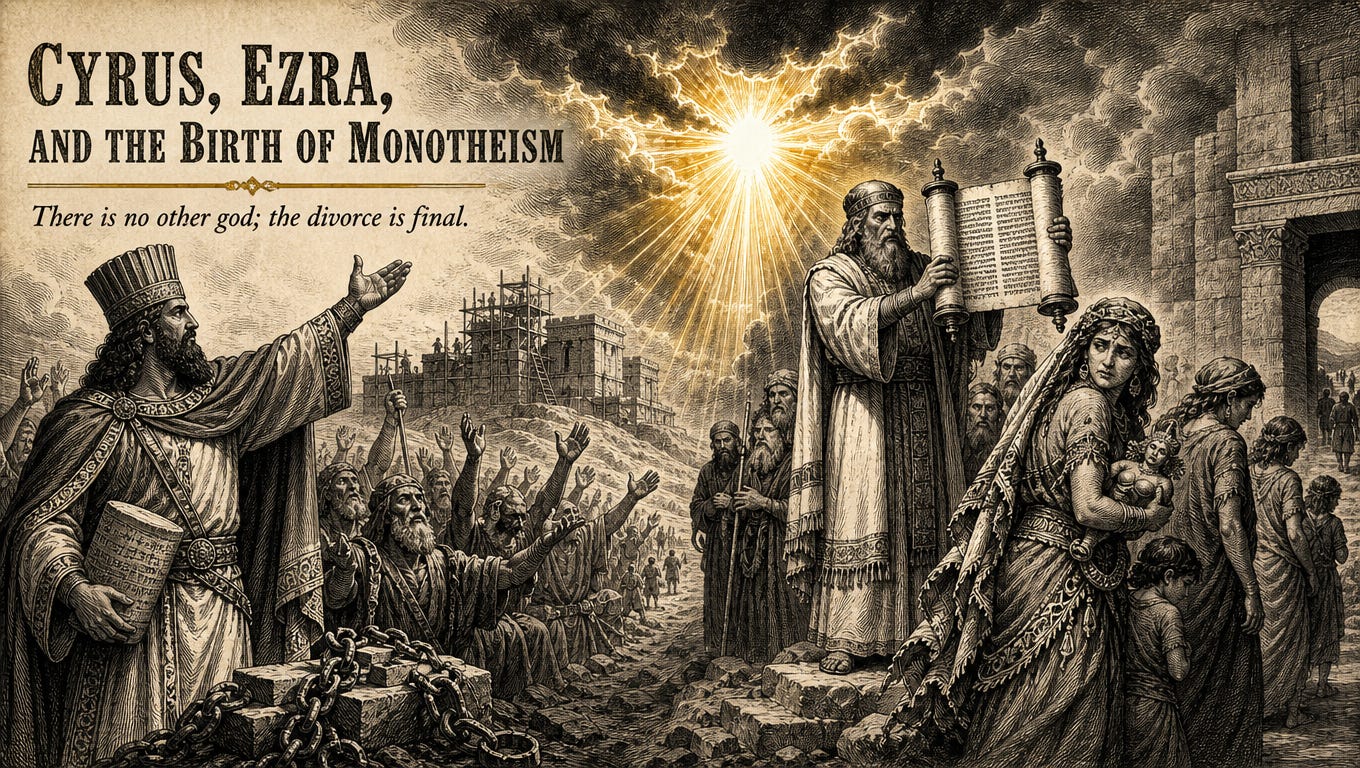
In this episode of Goddess Bible Study, the scene shifts to the Babylonian exile in the 6th century BCE. This is the critical moment when monotheism finally emerged as a coherent intellectual concept. The divorce of the Mother Goddess was final, and Yahweh declared in 2nd Isaiah, “there are no other gods.”
We meet the legendary Persian King Cyrus, who liberated the Hebrews from exile and allowed them to return to Jerusalem to build the Second Temple. Persian Zoroastrianism had a major theological influence on the development of pure monotheism.
We also meet Ezra the Scribe, who brought the Book of the Law back to Jerusalem early in the Second Temple period. Ezra condemned mixed marriages between Israelites and Canaanites, forcing Jewish men to divorce and banish their foreign wives and children, completing the divorce of the Mother Goddess.
We have solid archaeological evidence for this period. The Al-Yahudu Texts ca. 572-477 BCE), roughly 200 tablets discovered in Iraq, provide a window into the life of the Judean exilic community in Babylonia, where they lived as tenant farmers. In exchange for the land, they had to pay taxes and were expected to provide some labor and military service, but were generally free to integrate into the broader society.
The Babylonian empire fell apart quickly after Nebuchadnezzar II died. Cyrus II of Persia, also known as Cyrus the Great, defeated the Babylonians and created the Achaemenid (Persian) Empire, the largest empire the world had known at that time. The Persian Empire stretched from India to Egypt and dominated the Near East for two centuries, until its defeat at the hands of Alexander the Great.
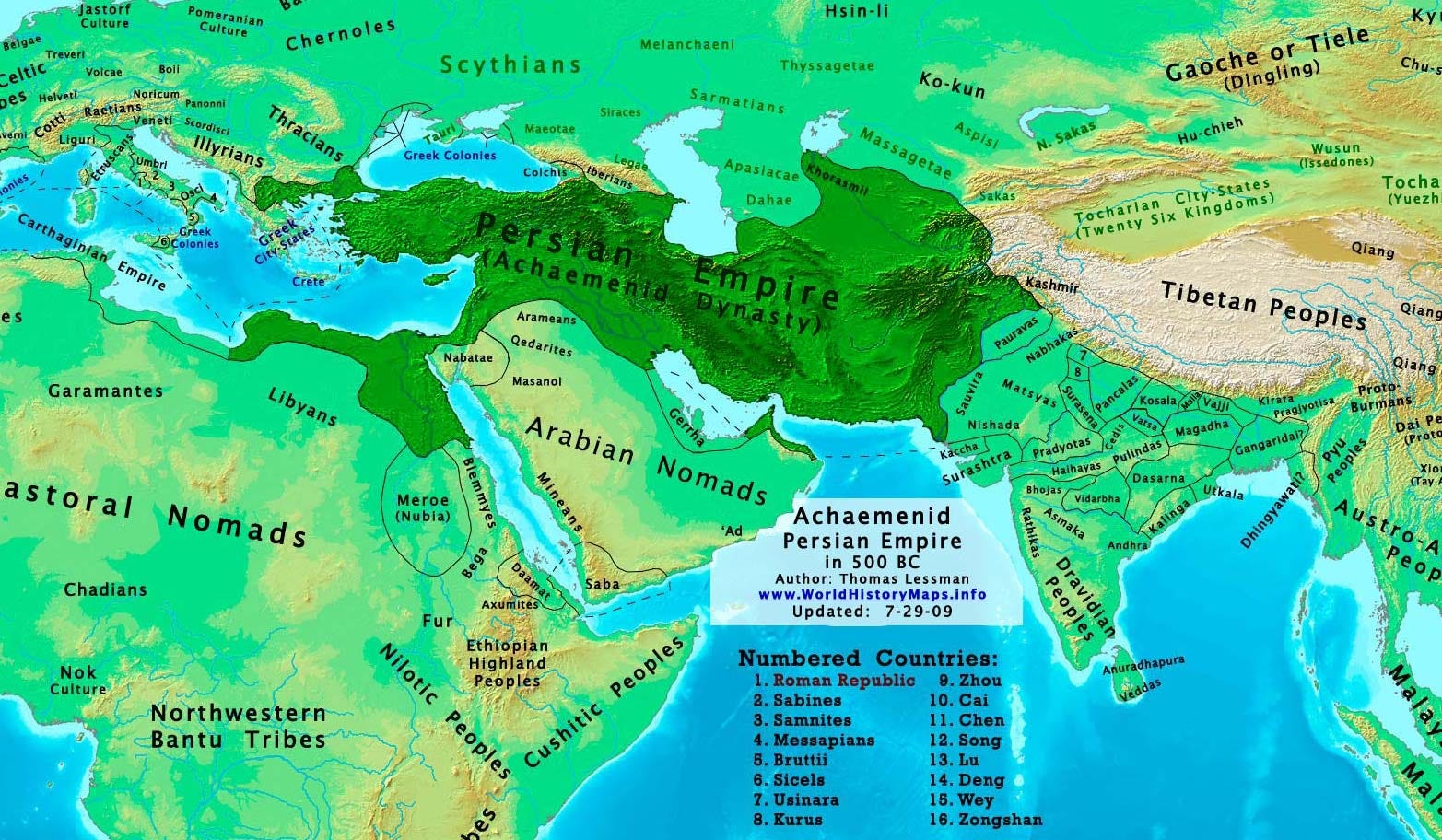
Cyrus marched into Babylon in 539 BCE and was welcomed with open gates and celebrations: the previous king, Nabonidus, was an apostate who had ignored Marduk and the other traditional gods in favor of worshipping the moon god Sin alone.
Cyrus was hailed in his time as a wise and benevolent ruler. He earned the goodwill and loyalty of local populations by rejecting the raw brutality of the Assyrians and Babylonians, promoting religious tolerance, and returning exiles to their homes.
For the Jews, Cyrus was a near-messianic figure who freed them from exile, allowing them to return to Jerusalem and re-establish their community and temple.
After the Persian Empire came to power, the Israelite priests in Babylon were sponsored by a series of Persian kings to return to Jerusalem, restore the temple, and compile their sacred texts. King Cyrus kindly returned the golden treasures that had been seized by Nebuchadnezzar.
In the first year of Cyrus king of Persia, in order to fulfill the word of Yahweh spoken by Jeremiah, Yahweh moved the heart of Cyrus king of Persia to make a proclamation throughout his realm and also to put it in writing:
“This is what Cyrus king of Persia says: ‘Yahweh, the God of heaven, has given me all the kingdoms of the earth and he has appointed me to build a temple for him at Jerusalem in Judah. Any of his people among you may go up to Jerusalem in Judah and build the temple of Yahweh, the God of Israel, the God who is in Jerusalem, and may their God be with them. And in any locality where survivors may now be living, the people are to provide them with silver and gold, with goods and livestock, and with freewill offerings for the temple of God in Jerusalem.’”
- Ezra 1:1-4
Cyrus established Babylon as his administrative center. He made a great declaration of peace and demonstrated his commitment to religious tolerance. Cyrus allowed for all the gods to be restored to their temples, not just Yahweh. The proclamation was written in cuneiform text on a large cylinder and put on public display in Babylon.
Archaeologists found the Cyrus Cylinder. It uses language remarkably similar to the Bible’s, except where the Bible credits Yahweh, Cyrus credits Marduk.
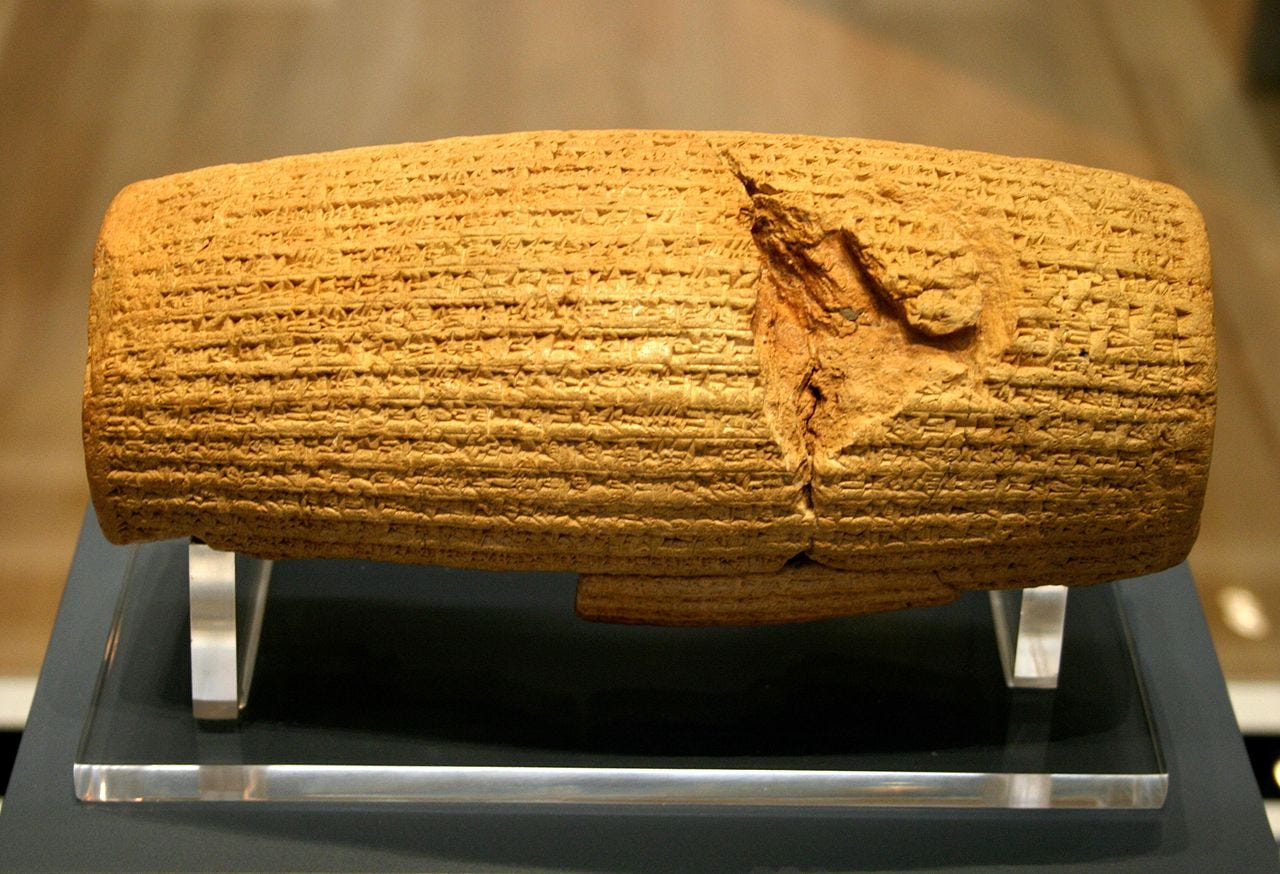
I am Cyrus, king of the world, great king, mighty king, king of Babylon, king of the lands of Sumer and Akkad, king of the four quarters of the universe... from an ancient royal lineage, whose reign is beloved by (the gods) Marduk and Nabu, whose kingship they desired to make them glad.
After entering Babylon in peace, amidst joy and jubilation, I made the royal palace the center of my rule. The great lord Marduk, who loves Babylon, with great magnanimity, established (it) as (my) destiny, and I sought to worship him each day. My vast army marched into Babylon in peace; I did not permit anyone to frighten the people of Sumer and Akkad. I took great care to peacefully (protect) the city of Babylon and its cult places.
(And) as for the citizens of Babylon…whom (Nabonidus) had made subservient in a manner (totally) unsuited to them against the will of the gods, I released them from their weariness and loosened their burden. The great lord Marduk rejoiced in my deeds.
Kindly he blessed me, Cyrus, the king, his worshipper, Cambyses, the offspring of my loins, and all of my troops, so that we could go about in peace and well-being. By his lofty command, all enthroned kings, the whole world, from the Upper Sea to the Lower Sea, inhabitants of distant regions, all the kings of the West, tent dwellers, brought their heavy tribute to me in Babylon and kissed my feet.
From [Babylon] to Ashur and Susa, Agade, Eshnunna, the cities of Zamban, Meturnu, Der as far as the borders of the Gutians – I returned to these sanctuaries on the other side of the Tigris, sanctuaries founded in ancient times, the images that had been in them there and I made their dwellings permanent. I also gathered all their people and returned to them their habitations. And then at the command of Marduk, the great lord, I resettled all the gods of Sumer and Akkad whom Nabonidus had brought into Babylon to the anger of the lord of the gods in their shrines, the places which they enjoy.
May all the gods whom I have resettled in their sacred cities ask Marduk and Nabu each day for a long life for me and speak well of me to him; may they say to Marduk, my lord, that Cyrus, the king who worships you, and Cambyses, his son…their…The people of Babylon blessed my kingship, and I settled all the lands in peaceful abodes.
Cyrus Loses his Head to an Amazon Queen
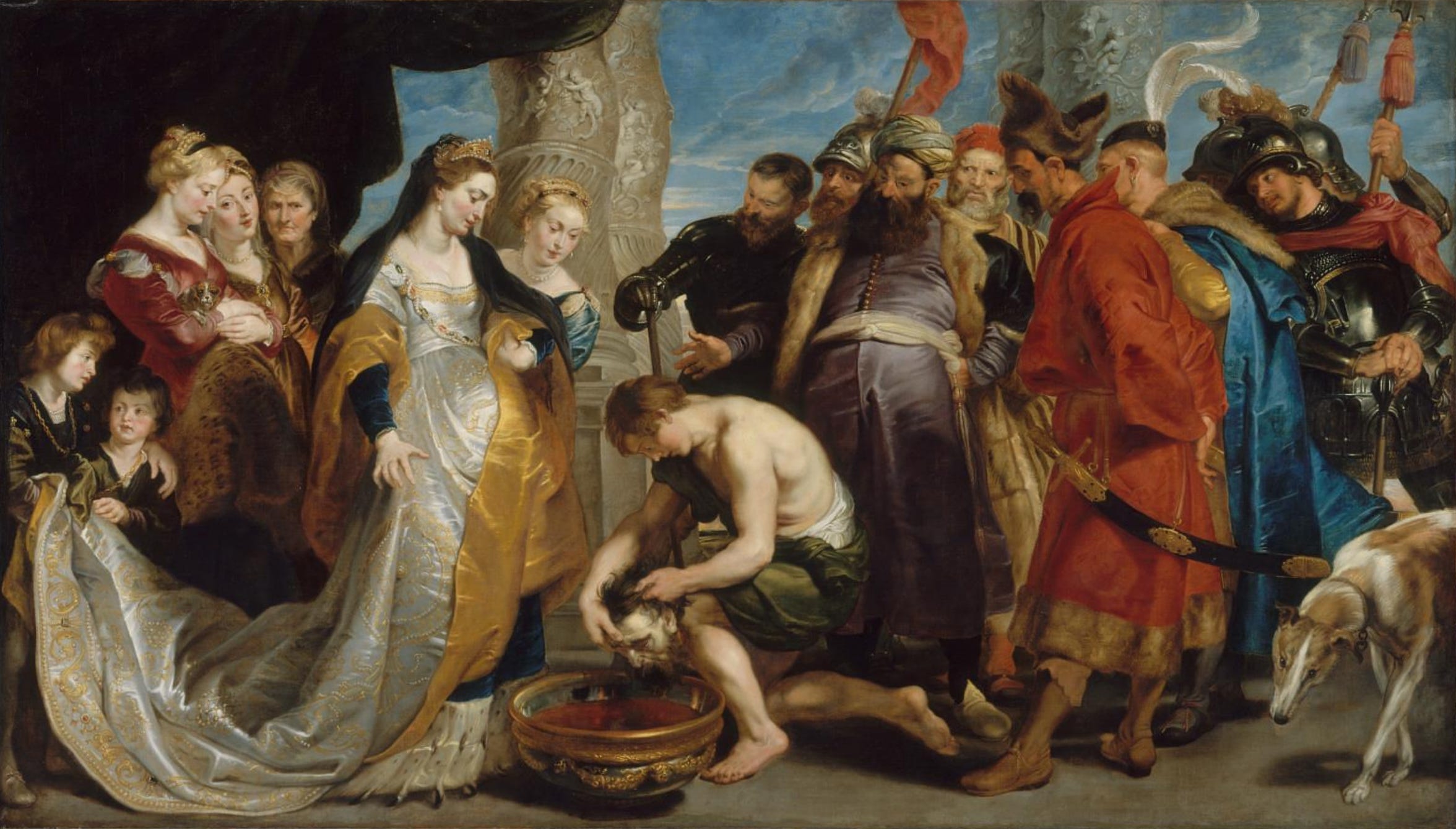
In an ironic twist of fate, King Cyrus was reportedly killed in 530 BCE by the Massagetae Scythian Queen Tomyris; she took his head as a war prize, in revenge for the death of her son. The Scythians are the Amazons of Greek legend, nomadic horse-riding people whose women fought alongside the men.
The account comes only from Herodotus, and it is controversial, since other ancient historians give different accounts of Cyrus’s death. Nonetheless, it’s a fun tale for Goddess Bible Study.
Cyrus, after conquering most of the Near East, turned his ambitions toward the Massagetae — a nomadic, Scythian-related people living beyond the Jaxartes River in Central Asia, ruled at the time by Queen Tomyris, a widow who had taken over from her late husband. Herodotus says Cyrus first tried simply to marry her and absorb her kingdom that way; she saw through it and refused, so he invaded instead.
The campaign turned on a piece of trickery: Cyrus left a lavishly stocked camp of food and wine undefended as bait. The Massagetae weren’t wine-drinkers — Herodotus says they favored getting intoxicated on fermented mare’s milk and cannabis, which they burned in enclosed tents while inhaling the smoke. A detachment under Tomyris’s son Spargapises took the bait, got drunk, and was slaughtered; Spargapises was captured and, once sober and disgraced, killed himself.
Tomyris then sent Cyrus a warning that she’d give him his fill of blood. She met him in open battle and won decisively. She had Cyrus’s corpse decapitated, and his head thrust into a wineskin filled with blood, saying, “Now I make good my threat: you have your fill of blood.”
Monotheism, Finally!
The Persians allowed the Israelites to practice their religion and encouraged their return to Judea (renamed from Judah), where they became “the Jews.” Until then, they had been Israelites and Hebrews — never Jews.
A succession of Persian kings sponsored the Jews to write their sacred texts and provided gold to build the second Jewish Temple in Jerusalem. The Jews were heavily influenced by the Persians and their Zoroastrian traditions, which feature the nearly-monotheistic god Ahura Mazda.
I argue that the Jews could not possibly have developed the full concept of monotheism until the arrival of the Zoroastrians, whose religion was based on a completely different worldview than the nature-based paganism that was the norm across the region. It also helped that the Persians completely defeated the Mesopotamians and Egyptians, giving weight to the idea that those ancient pantheons could be overcome.
I personally find it hard to believe that anyone would have taken seriously the argument that Yahweh was more powerful than Isis, Ashur, or Marduk before the Persians came through.
Zoroastrianism is widely recognized as a predecessor to monotheism because it frames the cosmos as a dualistic battle between the forces of light, represented by the god Ahura Mazda, and the forces of darkness, led by Angra Mainyu, the “spiritual enemy.” This moral framework is carried through in Christianity, where we’re told that one is either with God or with the Devil.
This black-and-white framing of the cosmos replaced the nature-based, cycle-of-life traditions rooted in the Mother Goddess, in effect, pushing her out of the conversation. The Biblical text makes it clear that up until this point, the debate over the Queen of Heaven was at a fever pitch, but the introduction of this new spiritual framework enabled the Yahwists to finally get over the hump and establish their god as the one and only.
2nd Isaiah
The identities of Yahweh and El were formally fused into the single monotheistic God of the Bible in Deutero-Isaiah (Isaiah 40-55). This secondary section of the book of Isaiah is widely understood by scholars to be the work of a later, anonymous author, appended to the original Isaiah. The original prophet was writing in Jerusalem, while this author wrote in Babylon.
This is the first time we see Yahweh clearly claim that there are no other gods in existence. It is no longer monolatry (one god among many); the prophets are proclaiming monotheism. Culturally speaking, though, the Jews remained polytheistic for centuries, until the Hasmonean kingdom in the 2nd century BCE.
Who has performed this and carried it out, calling forth the generations from the beginning? I, Yahweh—the first and the last— I am He.”
- Isaiah 41:4
In the following passage, El and Yahweh are merged in the Hebrew phrase “ha-El Yahweh” (God the LORD). In the Hebrew Bible, the direct compound title ha-El Yahweh, or the explicit juxtaposition of El and Yahweh, is quite rare. There are only three primary passages where they appear back-to-back as a direct compound title: Isaiah 42:5, Psalm 85:8, and Psalm 118:27. The Garden of Eden story also uses Yahweh-Elohim throughout, which is otherwise rare, though it is seen in the Book of Chronicles, which is a later text.
This is what the ha-El Yahweh says—He who created the heavens and stretched them out, who spread out the earth and its offspring, who gives breath to the people on it and life to those who walk in it:
- Isaiah 42:5
I am Yahweh: that is my name: and my glory will I not give to another, neither my praise to graven images.
- Isaiah 42:8
Thus says Yahweh, the King and Redeemer of Israel, Yahweh of Hosts: “I am the first and I am the last, and there is no God but Me.
Who then is like Me? Let him say so! Let him declare his case before Me, since I established an ancient people. Let him foretell the things to come, and what is to take place. Do not tremble or fear. Have I not told you and declared it long ago? You are My witnesses!
Is there any God but Me? There is no other Rock; I know not one.”
- Isaiah 44:6-8
The next couple of passages mention Cyrus, and by Biblical tradition they are read as prophecies written before the Persians’ arrival. I read these as classic ex-post-facto prophecies — meaning they were written after the events occurred and later added to the text as though they were prophetic.
Thus says Yahweh, your Redeemer who formed you from the womb:
“I am Yahweh, who has made all things, who alone stretched out the heavens, who by Myself spread out the earth,
who foils the signs of false prophets and makes fools of diviners, who confounds the wise and turns their knowledge into nonsense, who confirms the message of His servant and fulfills the counsel of His messengers, who says of Jerusalem, ‘She will be inhabited,’ and of the cities of Judah, ‘They will be rebuilt, and I will restore their ruins,’ who says to the depths of the sea, ‘Be dry, and I will dry up your currents,’
who says of Cyrus, ‘My shepherd will fulfill all that I desire,’ who says of Jerusalem, ‘She will be rebuilt,’ and of the temple, ‘Let its foundation be laid.’”
- Isaiah 44:24-28
This is what Yahweh says to Cyrus His anointed, whose right hand I have grasped to subdue nations before him, to disarm kings, to open the doors before him, so that the gates will not be shut: “I will go before you and level the mountains; I will break down the gates of bronze and cut through the bars of iron. I will give you the treasures of darkness and the riches hidden in secret places, so that you may know that I am Yahweh, the God of Israel, who calls you by name.
- Isaiah 45:1-3
I am Yahweh, and there is no other; there is no God but Me.
I am Yahweh, and there is no other; there is no God but Me. I will equip you for battle, though you have not known Me, so that all may know, from where the sun rises to where it sets, that there is none but Me; I am Yahweh, and there is no other.
I form the light and create the darkness; I bring prosperity and create calamity. I, Yahweh, do all these things.
- Isaiah 45:5-7
Yahweh says,
It is I who made the earth and created man upon it. It was My hands that stretched out the heavens, and I ordained all their host.
I will raise up Cyrus in righteousness, and I will make all his ways straight. He will rebuild My city and set My exiles free, but not for payment or reward, says Yahweh of Hosts.”
Isaiah 45:12-13
For thus says Yahweh, who created the heavens—He is God; He formed the earth and fashioned it; He established it; He did not create it to be empty, but formed it to be inhabited:
“I am Yahweh, and there is no other.”
- Isaiah 45:18
Speak up and present your case— yes, let them take counsel together. Who foretold this long ago? Who announced it from ancient times?
Was it not I, Yahweh? There is no other God but Me, a righteous God and Savior; there is none but Me. Turn to Me and be saved, all the ends of the earth; for I am God, and there is no other.
- Isaiah 45:21-22
The following passage mentions the gods Bel and Nebo. Bel is another name for Marduk, the great Babylonian king of the gods. This passage was obviously written after Cyrus had conquered Babylon. After this section, other gods are no longer (or rarely) named in the Bible, while in the earlier First Temple period many other gods are commonly named. Never again in the Biblical text do we see the names Asherah and Astarte.
Bel crouches; Nebo cowers. Their idols weigh down beasts and cattle. The images you carry are burdensome, a load to the weary animal. The gods cower; they crouch together, unable to relieve the burden; but they themselves go into captivity.
Isaiah 46:1-2
Yahweh claims here that he is responsible for sending Cyrus, his “bird of prey from the east,” to conquer Babylon. Once again, we see the Biblical writers playing historical judo, claiming that foreign invading armies are actually following Yahweh’s call rather than their own gods.
Remember what happened long ago, for I am God, and there is no other; I am God, and there is none like Me.
I declare the end from the beginning, and from ancient times what is still to come. I say, ‘My purpose will stand, and all My good pleasure I will accomplish.’
I summon a bird of prey from the east, a man for My purpose from a far-off land. Truly I have spoken, and truly I will bring it to pass. I have planned it, and I will surely do it.
- Isaiah 46:9-11
The Humiliation of Babylon
Here we find another passage with a double meaning, addressing both the city of Babylon and the great goddess, presumably Ishtar. We see many attributes of the goddess — virgin, queen, sorcerer, spells, wisdom, and knowledge — and we hear more of the rough misogyny we heard from Jeremiah and Ezekiel.
“Go down and sit in the dust, O Virgin Daughter of Babylon. Sit on the ground without a throne, O Daughter of the Chaldeans! For you will no longer be called tender or delicate. Take millstones and grind flour; remove your veil; strip off your skirt, bare your thigh, and wade through the streams. Your nakedness will be uncovered and your shame will be exposed. I will take vengeance; I will spare no one.”
Our Redeemer—Yahweh of Hosts is His name—is the Holy One of Israel.
“Sit in silence and go into darkness, O Daughter of the Chaldeans. For you will no longer be called the queen of kingdoms. I was angry with My people; I profaned My heritage, and I placed them under your control. You showed them no mercy; even on the elderly you laid a most heavy yoke.
You said, ‘I will be queen forever.’ You did not take these things to heart or consider their outcome. So now hear this, O lover of luxury who sits securely, who says to herself, ‘I am, and there is none besides me. I will never be a widow or know the loss of children.’
These two things will overtake you in a moment, in a single day: loss of children, and widowhood. They will come upon you in full measure, in spite of your many sorceries and the potency of your spells.
You were secure in your wickedness; you said, ‘No one sees me.’ Your wisdom and knowledge led you astray; you told yourself, ‘I am, and there is none besides me.’
But disaster will come upon you; you will not know how to charm it away. A calamity will befall you that you will be unable to ward off. Devastation will happen to you suddenly and unexpectedly. So take your stand with your spells and with your many sorceries, with which you have wearied yourself from your youth.
Perhaps you will succeed; perhaps you will inspire terror! You are wearied by your many counselors; let them come forward now and save you—your astrologers who observe the stars, who monthly predict your fate.
Surely they are like stubble; the fire will burn them up. They cannot deliver themselves from the power of the flame. There will be no coals to warm them or fire to sit beside. This is what they are to you—those with whom you have labored and traded from youth—each one strays in his own direction; not one of them can save you.
- Isaiah 47:1-15
I gave your mother a certificate of divorce. Send her away. The divorce is final.
This is what Yahweh says: “Where is your mother’s certificate of divorce with which I sent her away? Or to which of My creditors did I sell you? Look, you were sold for your iniquities, and for your transgressions your mother was sent away.
- Isaiah 50:1
Here we see the imagery of the deep waters and the leviathan, who is named Rahab. The word for “sea” is “Yamm,” the same as the Canaanite god of the seas. The “waters of the great deep” is “tehom,” understood to be a cognate of Tiamat, the salt waters of creation, the great Babylonian mother goddess. This word and imagery also appear in Genesis 1. Yahweh is demonstrating his mastery over the chaotic waters of creation, the source mother, and her pet serpent monster, symbols that appear across many cultures.
Awake, awake, put on strength, O arm of Yahweh. Wake up as in days past, as in generations of old. Was it not You who cut Rahab to pieces, who pierced through the dragon?
Was it not You who dried up the sea, the waters of the great deep, who made a road in the depths of the sea for the redeemed to cross over?
- Isaiah 51:9-10
Here is the fifth, and final, cannabis reference. Cannabis and its associated imagery never appear in Second Temple or later Jewish traditions. Cannabis went with the goddesses and was thrown out with them.
Scholarly commentaries, such as this commentary from Bible Hub on Exodus 30:23, have long noted that the word “qaneh” in these five passages is unclear. Qaneh is mentioned as a spice in Exodus 30:23; Song of Solomon 4:14; Isaiah 43:24; Jeremiah 6:20; and Ezekiel 27:17, but the term “aromatic cane” is vague, and it is not at all clear what plant species is meant. Most Biblical scholars have agreed on calamus; I and others argue that it is cannabis.
You have not bought Me qaneh [cannabis, sweet cane, calamus] with your silver, nor satisfied Me with the fat of your sacrifices. But you have burdened Me with your sins; you have wearied Me with your iniquities.
- Isaiah 43:24
Ezra the Scribe and the Return to Jerusalem
The Jews slowly began returning to Jerusalem after an exile of 70 years. In 516 BCE, they began construction of the Second Temple.
There were actually multiple temples to Yahweh outside of Jerusalem in the Second Temple period. We mentioned the temple on Elephantine Island in Egypt last episode. There was also the Samaritan temple to Yahweh on Mount Gerizim, which the Hasmoneans eventually destroyed, and scholars have suggested there were others.
The returning exiles rebuilt the altar on the foundation of Solomon’s Temple, despite their fear of the local people. There was a great deal of resistance and subterfuge from locals who remembered the Yahwists and did not want them to return.
Ezra the Scribe was sent from Babylon by King Artaxerxes with a treasury full of gold and silver and a royal proclamation of his authority to re-establish worship at the Second Temple in Jerusalem.
Ezra is very important to the Jews — even a second Moses — because he brought the Book of the Law to Jerusalem and is the father of many Jewish traditions. Ezra grew up among the Israelites in Babylon who had been there for generations and had good relations with the Persians. There are many legends and myths about Ezra, but we don’t have space to get into them here.
By Jewish tradition, Ezra the Scribe is thought to have edited and compiled the final draft of the Hebrew Bible (the Torah) that we read today, bringing it to Jerusalem from Babylon in 458 BCE (though this dating is subject to scholarly debate).
This is the same year that Aeschylus debuted the Oresteia in Athens; both works of mythology celebrate the introduction of patriarchal law and the end of matriarchal tribal traditions. We will have a dedicated episode on the Oresteia.
I am persuaded by the modern scholarship of Russell Gmirkin and others who argue that the Pentateuch, the Five Books of Moses, was actually written in Alexandria some 200 years later, in the third century BCE — but we will get to that in a later episode.
In the text of the Hebrew Bible, it does not actually say that Ezra brought the completed Torah; it says that he brought the “Book of the Law.” Scholars debate precisely what was included in the Book of the Law. Ezra read it aloud to the community in a single day, implying it was not the full 24 books of the Hebrew Bible, which is far too long to read in one sitting.
Nonetheless, the message was clear to the people. The Jews were to withdraw completely from the broader pagan world and live by their own laws and customs. They were not to mix with the locals, not to share customs or festivals, and nature worship was strictly forbidden.
At that time all the people gathered together in the square before the Water Gate, and they asked Ezra the scribe to bring out the Book of the Law of Moses, which Yahweh had commanded for Israel.
On the first day of the seventh month, Ezra the priest brought the Law before the assembly of men and women and all who could listen and understand. So Ezra read it aloud from daybreak until noon as he faced the square before the Water Gate, in front of the men and women and those who could understand.
And all the people listened attentively to the Book of the Law.
-Nehemiah 8:1-3
Divorce the Pagan Women
But then Ezra discovered that the Jewish men had been marrying local Canaanite women with their detestable customs and having families with them. Ezra was outraged. Ezra prayed in despair. He forced the men to choose between their families and their God.
“Indeed, the Israelites have taken some of their daughters as wives for themselves and their sons, so that the holy seed has been mixed with the people of the land. And the leaders and officials have taken the lead in this unfaithfulness!”
When I heard this report, I tore my tunic and cloak, pulled out some hair from my head and beard, and sat down in horror.
Then everyone who trembled at the words of the God of Israel gathered around me because of the unfaithfulness of the exiles, while I sat there in horror until the evening offering.
- Ezra 9:2-4
Ezra forced the Jewish men who had married pagan women to divorce their wives and children and abandon them. The pagan women continued their goddess worship and nature-based traditions, which was unacceptable to Ezra and the Jewish leaders. It is doubtful that much matriarchy remained at this stage of history; all the imperial cultures were fully patriarchal by the 5th century BCE. Matriarchy only continued among tribal peoples outside the walls of civilization.
Then Ezra the priest stood up and said to them, “You have been unfaithful by marrying foreign women, adding to the guilt of Israel. Now, therefore, make a confession to Yahweh, the God of your fathers, and do His will. Separate yourselves from the people of the land and from your foreign wives.”
-Ezra 10:10-11
The physical divorce of the Jewish men from their pagan wives was the final act in the divorce between the Hebrew God and the Mother Goddess that began centuries earlier, when King Asa first removed the Asherah pole from the Temple of Yahweh in Jerusalem.
This divorce was mythologically confirmed in the Garden of Eden story, which is the divorce papers signed, sealed, and delivered. No longer would the Heavenly Father and Earthly Mother be husband and wife.
For the next few episodes, we will shift our view to the ancient Greeks, who were operating in parallel to the Hebrews and also reordering the cosmos, making the goddesses submissive to Zeus, and wives submissive to their husbands. We will meet back up with the Jews in Alexandria in the third century BCE.