

Goddess Bible Study is back after a couple of weeks off, while I was busy with work.
My intention with this project is to make the case that the triple goddess is a symbolic code that describes the mother of the Biblical God, and the Bible is the story of the divorce of God from his Mother so he could rule the cosmos alone.
And I want to give it away like open-source software. I don’t own any of it to begin with.
I am not marketing a product, and I am under no pressure to produce anything. I am not a religious leader, guru, or authority. I am just a guy who stumbled into a code, and I want to share it. Hopefully, other folks will run with it since there are important cultural, theological, and political implications to God having a mother.
I do have a set of materials to share that tracks the triple goddess across cultures, beginning in Egypt, through Mesopotamia, Israel in the Old Testament, Jesus in the New Testament, Greece, Alexandria, Rome, pre-Islamic Arabia, modern India, and finally today’s neo-Pagans.
The triple goddess is a cross-cultural code told in art and stories, rather than words or numbers, but it is every bit as descriptive of the cosmos as the Pythagorean theorem, Pi, or the golden ratio. The tri-devi is mother, maiden, and death. She describes the cycle of life, the endless cycle of creation and destruction.
Three goddesses in one super-goddess, the one mother of the cosmos. As the mother, she welcomes life, nourishes us, and wishes joy and prosperity upon us. As the maiden, she is the essence of desire, life, beauty, expression, sexuality, and more, she is everything we want and want to be. As death, she is the most powerful force in the cosmos, for everything God creates, she will ultimately destroy.
She is fearsome and terrifying, unstoppable and insatiable, and for the monotheists, she is unacceptable, since they claim their God is omnipotent and unrivaled.
The Old Testament tells the story of the divorce so that the Heavenly Father could rule alone with no partner, and the Koran reiterates the breakup. Monotheism is a religion of subtraction. It is all divine father with no divine mother, and our forefathers worked hard for centuries to get rid of her. But the divine mother never went away, she remains undiminished, even if she was driven underground in the West.
In Goddess Bible Study, we will demonstrate where in the story this divorce occurs, but it requires an understanding of the names, symbols, and traditions of the divine mother.
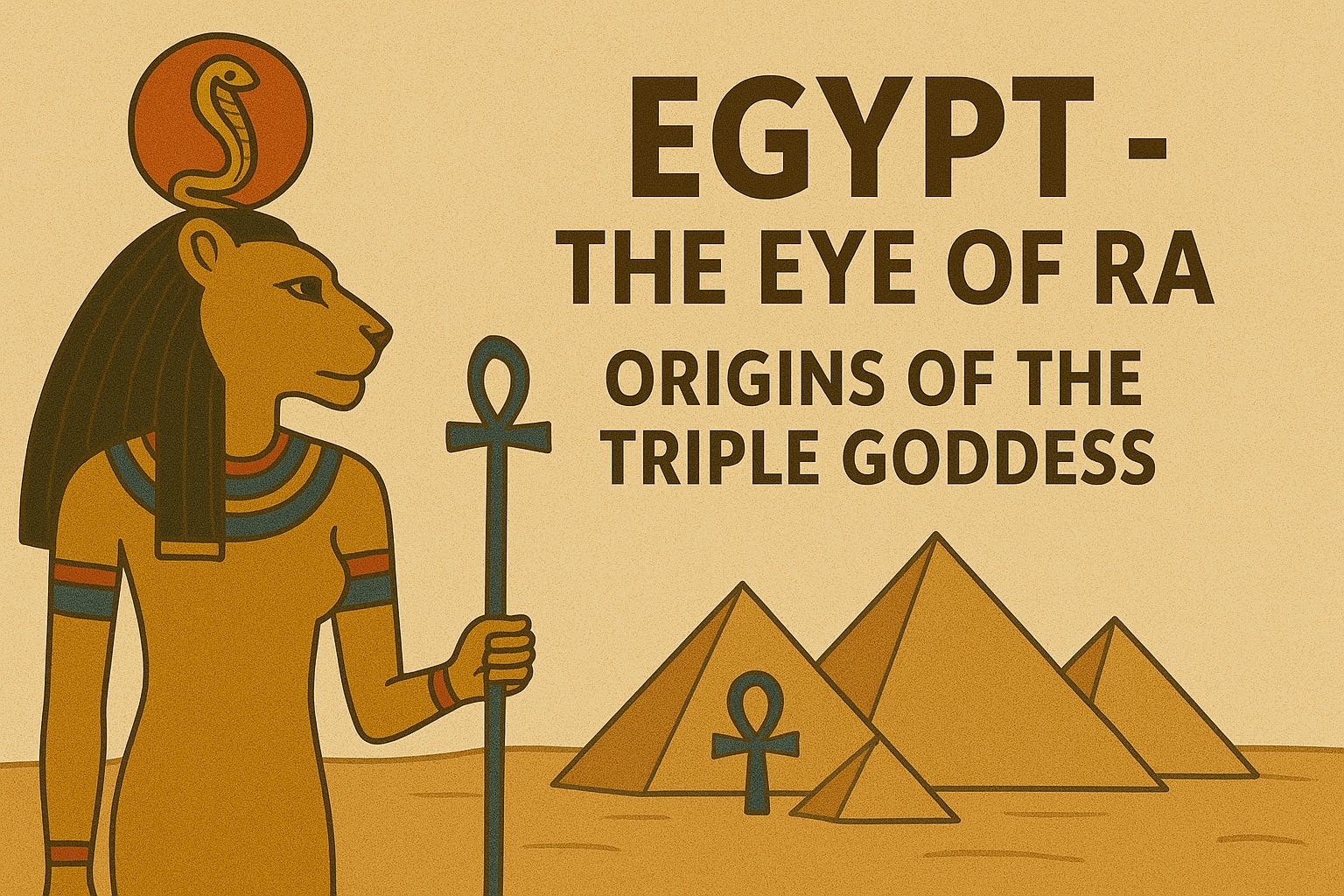
The triple goddess is a specific symbolic motif whose origins appear to be in Egypt, where she is called the Eye of Ra. These are among the oldest stories in Egypt, going back to the invention of writing in the Pyramid texts, around 2400 BC.
Ra is the supreme creator of the Egyptian universe, the first god, who was born from the chaotic waters and set about creating land, wind, rain, and everything else. Ra had only one eye, with which he created a series of primordial goddesses of great importance in Egyptian culture.
The most important of these goddesses were Hathor, Bastet, and Sekhmet. Sekhmet is the first, most primordial, and most powerful of them all. She is the death goddess with the power to consume the entire cosmos. Ra even says that his daughter Sekhmet does not know her own powers.
Hathor is the loving mother goddess, beloved throughout Egypt, goddess of beauty, joy, and prosperity. Bastet, the maiden, offers the more gentle form of love and protection. These goddesses were feline, with the fierce Sekhmet taking the form of a lion, and Bastet as a cat. These goddesses were all one, and Hathor would manifest as Sekhmet or Bastet as needed.
The oldest and central myth of the Eye of Ra is the Book of the Heavenly Cow. In this story, of which there are many versions, humanity rebels against Ra, and he responds by sending out Sekhmet to destroy them all.
The Eye’s fury nearly annihilates humanity, and Ra regrets it. But unfortunately, Sekhmet is unstoppable in her bloodlust, she has finally been unleashed, and she enjoys the carnage too much to stop.
The other gods are powerless and fear the destruction of the entire universe. Since they can’t stop her, the gods devise a plan to trick Sekhmet and hopefully placate her. They brew up a special batch of beer and dye it red so that Sekhmet is fooled into thinking it is blood. The plan worked, the goddess got drunk, relaxed, and resumed the loving form of Hathor, averting disaster. The Hindus tell similar stories of Kali and Parvati.
This myth was central to important beer festivals in ancient Egypt.
The Eye of Ra was a central symbol of divine power throughout Egyptian history. Statues of Sekhmet with her lion head and fearsome visage are common and notable in Egypt. They were typically associated with the Pharaoh, as she was his protector.
There is a particular statue of Sekhmet that modern tourists claim has mystical powers and remains a pilgrimage site. The Vatican has a large collection of Sekhmet statues in its museum.
Hathor was commonly associated with beauty and joy, and particularly with cosmetics. Hathor was known to have the most voluptuous hair, and seeing her hair on other goddesses is a sign of their beauty as well.
These goddesses all have deep and profound meanings in Egyptian culture, we are merely scratching the surface here. The significance for us is that this symbolic motif repeats across cultures, including the Bible, with the most important detail being the death goddess, who is the most powerful deity of all.
Listed below are all the same triple goddess, with different names in different cultures, but the same metaphysics. It’s a code told in art.
Egypt: Hathor, Bastet, Sekhmet
Israel/Canaan: Asherah, Astarte, Anat
Arabia: Allat, Uzza, Manat
India: Parvati, Durga, Kali
There are many other variations as well.
Next week, we will return with the Baal Cycle from the Canaanites, where we will see the unstoppable Anat. Then we will visit Helen of Troy and the Greeks, before we return to the Bible with Moses, Miriam, and the Exodus. All of these are important references to understand what’s happening in the Biblical divorce.
We will have our live discussion Tues, Nov. 11 at 7 pm EST. All are welcome. Reach out if you would like to participate, join the chat group, or have any questions at all.
goddessbiblestudy@gmail.com
Ra was a male creator deity and the Father of the other gods, whose mother was Neith, sometimes referred to as the Terrifying One or thought of as the Void. He has several creation stories.
He - like the god of the Old Testament - created a son and daughter who went on to create the lineage of the gods of the Ancient Egyptian pantheon.
The word "code" feels inappropriate in the context of this discussion as it's often very "New-Agey." Perhaps these word suffice - story, understanding, observation, cycle, mythology, illustration...
Modern Goddess worship and devotees are adopting more nuanced views of the cycles of the Goddess beyond the Triple Goddess that may include Queen/Sovereign, Healer, Priestess, Teacher (Wise One), etc., given the space between Mother and Death - or more commonly Crone - can be vast. Or, that Goddesses and women may not be mothers.