

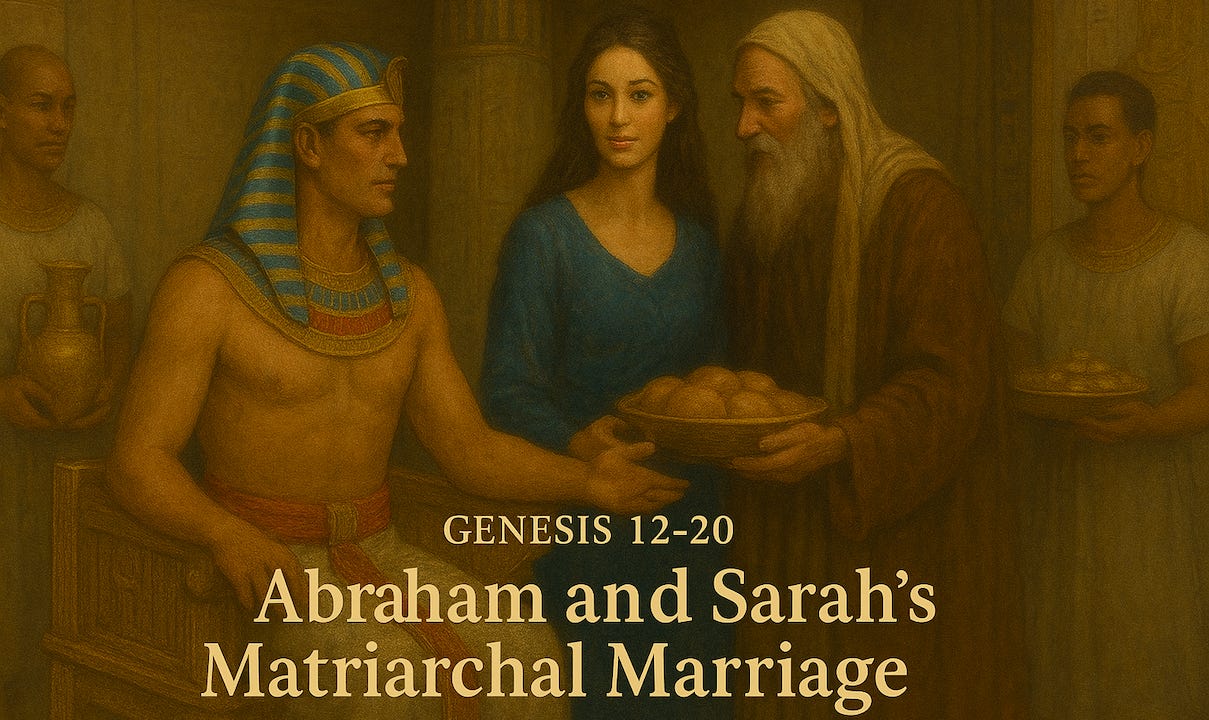
Goddess Bible Study is back this week and we will dig into some of the stranger details about Abraham, the big guy, the father of the three great monotheistic Abrahamic faiths, Judaism, Christianity, and Islam. All of which I argue are divorced from the divine Mother.
The funny thing about Abraham is that much of his story doesn’t seem patriarchal at all. Starting with his marriage to Sarah, the matriarch. First is the fact that they are brother and sister (weird). Second, he doesn’t seem to mind her sleeping with other men (at least one of them was the Pharaoh). Third, she is often telling him what to do, particularly regarding her slave Hagar and the son Ishmael that Abraham had with her. Finally, when Sarah died, Abraham had to travel to the burial, they were not living together.
So what is really going on here?
Besides, she really is my sister, the daughter of my father—though not the daughter of my mother—and she became my wife.
- Genesis 20:12
We also see the interplay of the gods El and Yahweh, and how the Biblical writers (who were Yahwists) skillfully interjected their god Yahweh onto much older stories that were originally about El. You can see here how God of the Bible was carefully stitched together from two separate gods and fused into the monotheistic God we are all familiar with now (along the way, they divorced and removed the Mother Goddess).
It is well understood by modern Biblical scholars that the Old Testament, and particularly the Torah, was pieced together from many sources over a long period of time and stitched together into a coherent narrative with a singular perspective. The Israelites trace their history back to the Middle Bronze Age, but it would be many centuries of oral tradition before anything was written down at all, and another 500 years before the Torah was completed. Over that time, the oldest stories went through many layers of revision, and it is possible to discern funny little details that peek through from the Bronze Age origins.
It is my contention that the stories of Abraham and Sarah have their roots in the Bronze Age when tribal matriarchies were still the common family structure, and marriages functioned differently than in patriarchal families. If Abraham was the first patriarch, it does imply that he lived in a matriarchy in his lifetime, with patriarchies following later. We see all the hallmarks of matriarchy with Abraham and Sarah, she has independence and authority equal to him.
Matriarchal families are by definition matrilineal and matrifocal, and they tend to be egalitarian and cooperative with the women holding equal status to the men. The most important distinction is tracking the bloodlines thru the mother rather than the father because this means society does not need to constrain women’s sex lives. With patriarchal family lines, it is critical to carefully control women’s sex lives, otherwise you don’t know who the baby daddy is.
In matriarchal cultures, they don’t track the fathers; the children belong to the mothers. This means that women have total freedom, while patriarchies are built on hierarchies of control that radiate out through the entire structure of society. We see Sarah’s sexual independence when she goes off with other men, and Abraham does not mind. Matriarchy also explains Abraham and Sarah being the children of the same father but not the same mother, these cultures did not care who the father was.
Secondly, in matriarchal marriages, the man goes and lives with the woman’s family, not the other way around. The women stay together with their sisters and aunties and cousins, and they support each other. If the marriage is unhappy, then they kick the man out and the woman stays in her home with the family wealth. In unhappy patriarchal marriages, the woman is basically screwed, which we see all the time.
Tribal matriarchies were the default family structure of humanity for over a million years. Patriarchy only began to take root in the Bronze Age with the advent of warrior kings taking over society and forcing women and men into slavery and subjugation. Over the 3000 year Bronze Age, matriarchies and patriarchies co-existed, and in the Iron Age, patriarchy took over completely across civilization. Modern matriarchies still exist among Native Americans, various indigenous peoples, and select pockets in India, China, and elsewhere.
I also argue that the original Abraham was a follower of El and never heard of Yahweh. Yahweh came on the scene with Moses at the Exodus, centuries after Abraham. All of the details in these stories that contain Yahweh were written or edited later by the followers of Yahweh, who worked to claim Abraham as their own.
Israel is named for El after all. If the Israelites were named for Yahweh, it would be Isra-Ya instead of Isra-El.
Evidence of El and Yahweh as two separate gods is shown by there being two different English names, God and the LORD, in the Bible. Yahweh is the LORD (always capitalized) while God is a catch-all for Elohim (all the gods), El, and all the various titles such as El Shaddai (God Almighty) or El Elyon (God Most High).
Egypt - Sarah beds the Pharaoh, and Abraham does not mind!
I believe that the Israelites were the Hyksos, or at least friendly to the Hyksos, and I fix my Biblical timeline to their time in Egypt. The Hyksos were chariot-riding Canaanites who ruled Egypt as outsiders for about a century from around 1700-1600 BCE. I place the stories of Abraham and Joseph in Egypt to the 17th century BCE.
The Hyksos were eventually defeated, and some of their people were enslaved for 400 years until around 1200 BCE, which brings the Bronze Age Collapse and the Exodus, which we will get to later.
In this sexy Bible story, Abraham (Abram) and Sarah (Sarai) venture to Egypt to escape famine, and Abraham offers his beautiful wife to Pharaoh in exchange for sparing his life.
Why would Abraham mind? She is only his sister! Abraham was generously rewarded for his gift, so everyone was happy. At least until Yahweh afflicted poor Pharaoh with plagues!
Now there was a famine in the land. So Abram went down to Egypt to live there for a while because the famine was severe. As he was about to enter Egypt, he said to his wife Sarai, “Look, I know that you are a beautiful woman, and when the Egyptians see you, they will say, ‘This is his wife.’ Then they will kill me but will let you live. Please say you are my sister, so that I will be treated well for your sake, and on account of you my life will be spared.”
So when Abram entered Egypt, the Egyptians saw that the woman was very beautiful. When Pharaoh’s officials saw Sarai, they commended her to him, and she was taken into the palace of Pharaoh. He treated Abram well on her account, and Abram acquired sheep and cattle, male and female donkeys, menservants and maidservants, and camels.
The LORD [Yahweh], however, afflicted Pharaoh and his household with severe plagues because of Abram’s wife Sarai. So Pharaoh summoned Abram and asked, “What have you done to me? Why didn’t you tell me she was your wife? Why did you say, ‘She is my sister,’ so that I took her as my wife? Now then, here is your wife. Take her and go!”
Then Pharaoh gave his men orders concerning Abram, and they sent him away with his wife and all his possessions.
- Genesis 12:17-20
Abram meets the Priest of El Shaddai
Here we see examples of the old material discussing El Shaddai, “God Most High”. I believe Abraham was a follower of El and never heard of Yahweh.
Then Melchizedek king of Salem brought out bread and wine—since he was priest of God Most High [El Shaddai] — and he blessed Abram and said:
“Blessed be Abram by God Most High [El Shaddai],
Creator of heaven and earth,
and blessed be God Most High [El Shaddai],
who has delivered your enemies into your hand.”
Then Abram gave Melchizedek a tenth of everything.
The king of Sodom said to Abram, “Give me the people, but take the goods for yourself.”
But Abram replied to the king of Sodom, “I have raised my hand to the LORD [Yahweh] God Most High [El Shaddai] Creator of heaven and earth, that I will not accept even a thread, or a strap of a sandal, or anything that belongs to you, lest you should say, ‘I have made Abram rich.’
- Genesis 14:18-23
From Ur of the Chaldeans (who were not around in the Bronze Age)
Another detail demonstrating layers of edits to the story. The Chaldeans were an Iron Age people group that did not exist in the Bronze Age. This detail points to this editing layer coming from the time of the exile in Babylon, when the Chaldeans were dominant (6th Century BCE).
The LORD also told him, “I am the LORD, who brought you out of Ur of the Chaldeans to give you this land to possess.”
- Genesis 15:7
Sarah instructs Abraham to impregnate her servant Hagar
Here Sarah, who was childless, instructs her husband to impregnate her slave girl Hagar. Sarah wanted this child for herself, not for Abraham, which is a critical detail!
Later on, Sarah would throw Hagar and the child Ishmael out of the house, against Abraham’s wishes. Who is in charge here?
Now Abram’s wife Sarai had borne him no children, but she had an Egyptian maidservant named Hagar. So Sarai said to Abram, “Look now, the LORD has prevented me from bearing children. Please go to my maidservant; perhaps I can build a family by her.”
And Abram listened to the voice of Sarai. So after he had lived in Canaan for ten years, his wife Sarai took her Egyptian maidservant Hagar and gave her to Abram to be his wife. And he slept with Hagar, and she conceived. But when Hagar realized that she was pregnant, she began to despise her mistress.
Then Sarai said to Abram, “May the wrong done to me be upon you! I delivered my servant into your arms, and ever since she saw that she was pregnant, she has treated me with contempt. May the LORD judge between you and me.”
“Here,” said Abram, “your servant is in your hands. Do whatever you want with her.” Then Sarai treated Hagar so harshly that she fled from her.
- Genesis 16:1-6
The Covenant of Circumcision
When Abram was ninety-nine years old, the LORD (Yahweh) appeared to him and said, “I am God Almighty (El Shaddai). Walk before Me and be blameless. I will establish My covenant between Me and you, and I will multiply you exceedingly.”
- Genesis 17:1-2
God also said to Abraham, “You must keep My covenant—you and your descendants in the generations after you. This is My covenant with you and your descendants after you, which you are to keep: Every male among you must be circumcised. You are to circumcise the flesh of your foreskin, and this will be a sign of the covenant between Me and you.
- Genesis 17:9-10
The Destruction of Sodom and Gomorrah
There is a controversial scientific claim that there was a real Sodom that was destroyed by a meteor strike around 1650 BCE. The site is called Tall el‑Hammam, and the claim that it was destroyed by a Tunguska-like airburst is not accepted by mainstream science.
Then the LORD rained down sulfur and fire on Sodom and Gomorrah—from the LORD out of the heavens. Thus He destroyed these cities and the entire plain, including all the inhabitants of the cities and everything that grew on the ground.
But Lot’s wife looked back, and she became a pillar of salt.
- Genesis 19:24-26
Sarah hooks up again, but she is Abraham’s sister, so it is OK
Sarah does it again with another guy, but they don’t quite get to bed, much to Abimelech’s disappointment.
Then Abimelech called Abraham and asked, “What have you done to us? How have I sinned against you, that you have brought such tremendous guilt upon me and my kingdom? You have done things to me that should not be done.” Abimelech also asked Abraham, “What prompted you to do such a thing?”
Abraham replied, “I thought to myself, ‘Surely there is no fear of God in this place. They will kill me on account of my wife.’ Besides, she really is my sister, the daughter of my father—though not the daughter of my mother—and she became my wife. So when God had me journey from my father’s house, I said to Sarah, ‘This is how you can show your loyalty to me: Wherever we go, say of me, “He is my brother.”’”
So Abimelech brought sheep and cattle, menservants and maidservants, and he gave them to Abraham and restored his wife Sarah to him.
- Genesis 20:9-15
The Birth of Isaac - His parents were very old
The famous story of Abraham and Sarah having a child when they were 100 years old. Just might be apocryphal, just maybe.
Now the LORD attended to Sarah as He had said, and the LORD did for Sarah what He had promised. So Sarah conceived and bore a son to Abraham in his old age, at the very time God had promised.
And Abraham gave the name Isaac to the son Sarah bore to him. When his son Isaac was eight days old, Abraham circumcised him, as God had commanded him. Abraham was a hundred years old when his son Isaac was born to him.
- Genesis 21:1-5
Sarah Turns against Hagar
Sarah kicks out Hagar and Ishmael for good. But it works out OK for everyone. Ishmael later became the patriarch of Islam.
But Sarah saw that the son whom Hagar the Egyptian had borne to Abraham was mocking her son, and she said to Abraham, “Expel the slave woman and her son, for the slave woman’s son will never share in the inheritance with my son Isaac!”
Now this matter distressed Abraham greatly because it concerned his son Ishmael. But God said to Abraham, “Do not be distressed about the boy and your maidservant. Listen to everything that Sarah tells you, for through Isaac your offspring will be reckoned. But I will also make a nation of the slave woman’s son, because he is your offspring.”
- Genesis 21:9-13
God Demands the Sacrifice of Isaac
Child sacrifice is a complicated topic that I will dive into in another dedicated post. TLDR; I believe that El worship involved human sacrifice in this era, and that one of the great reforms of the Yahwists was to ban the practice.
But the Biblical writers ran into a problem when they fused together the identities of El and Yahweh, one god demands sacrifice while the other condemns it. This contradiction has troubled Bible believers ever since.
If you read the story closely, you will see that God (Elohim/El) is the one who demands the sacrifice of Isaac, while Yahweh (the LORD) does not appear until the moment of deliverance when Isaac is spared. It is a subtle detail, but I believe this speaks to the reforms the Yahwists brought.
Some time later God tested Abraham and said to him, “Abraham!”
“Here I am,” he answered.
“Take your son,” God said, “your only son Isaac, whom you love, and go to the land of Moriah. Offer him there as a burnt offering on one of the mountains, which I will show you.”
So Abraham got up early the next morning, saddled his donkey, and took along two of his servants and his son Isaac. He split the wood for a burnt offering and set out for the place God had designated.
On the third day Abraham looked up and saw the place in the distance. “Stay here with the donkey,” Abraham told his servants. “The boy and I will go over there to worship, and then we will return to you.”
Abraham took the wood for the burnt offering and placed it on his son Isaac. He himself carried the fire and the sacrificial knife, and the two of them walked on together.
Then Isaac said to his father Abraham, “My father!”
“Here I am, my son,” he replied.
“The fire and the wood are here,” said Isaac, “but where is the lamb for the burnt offering?”
Abraham answered, “God Himself will provide the lamb for the burnt offering, my son.” And the two walked on together.
When they arrived at the place God had designated, Abraham built the altar there and arranged the wood. He bound his son Isaac and placed him on the altar, atop the wood. Then Abraham reached out his hand and took the knife to slaughter his son.
- Genesis 22:1-10
The LORD [Yahweh] Provides the Salvation
Yahweh saves the day.
Just then the angel of the LORD called out to him from heaven, “Abraham, Abraham!”
“Here I am,” he replied.
“Do not lay a hand on the boy or do anything to him,” said the angel, “for now I know that you fear God, since you have not withheld your only son from me.”
Then Abraham looked up and saw behind him a ram in a thicket, caught by its horns. So he went and took the ram and offered it as a burnt offering in place of his son. And Abraham called that place The LORD Will Provide.d So to this day it is said, “On the mountain of the LORD it will be provided.”
And the angel of the LORD called to Abraham from heaven a second time, saying, “By Myself I have sworn, declares the LORD, that because you have done this and have not withheld your only son, I will surely bless you, and I will multiply your descendants like the stars in the sky and the sand on the seashore. Your descendants will possess the gates of their enemies. And through your offspring all nations of the earth will be blessed, because you have obeyed My voice.”
- Genesis 22:11-18
The death and burial of Sarah - Abraham travels to the funeral
In the Bronze Age and later, “visiting marriages” were common among tribal peoples. Husbands and wives would only spend part of the year together. At the time she died, Abraham was nowhere near her.
Now Sarah lived to be 127 years old. She died in Kiriath-arba (that is, Hebron) in the land of Canaan, and Abraham went out to mourn and to weep for her.
Then Abraham got up from beside his dead wife and said to the Hittites,“I am a foreigner and an outsider among you. Give me a burial site among you so that I can bury my dead.”
- Genesis 23:1-4
Next Goddess Bible Study, we will continue the theme of Bronze Age matriarchal marriages as we examine more odd details in the marriage of Jacob to Rachel and her sister Leah, and the dozen kids they had together, along with two more slave women. This was not Jacob’s harem, the women told him who to sleep with.
If you made it this far, then watch the discussion on YouTube live tonight, Sept 16, at 7 pm EST. And reach out if you would like to join the chat.