

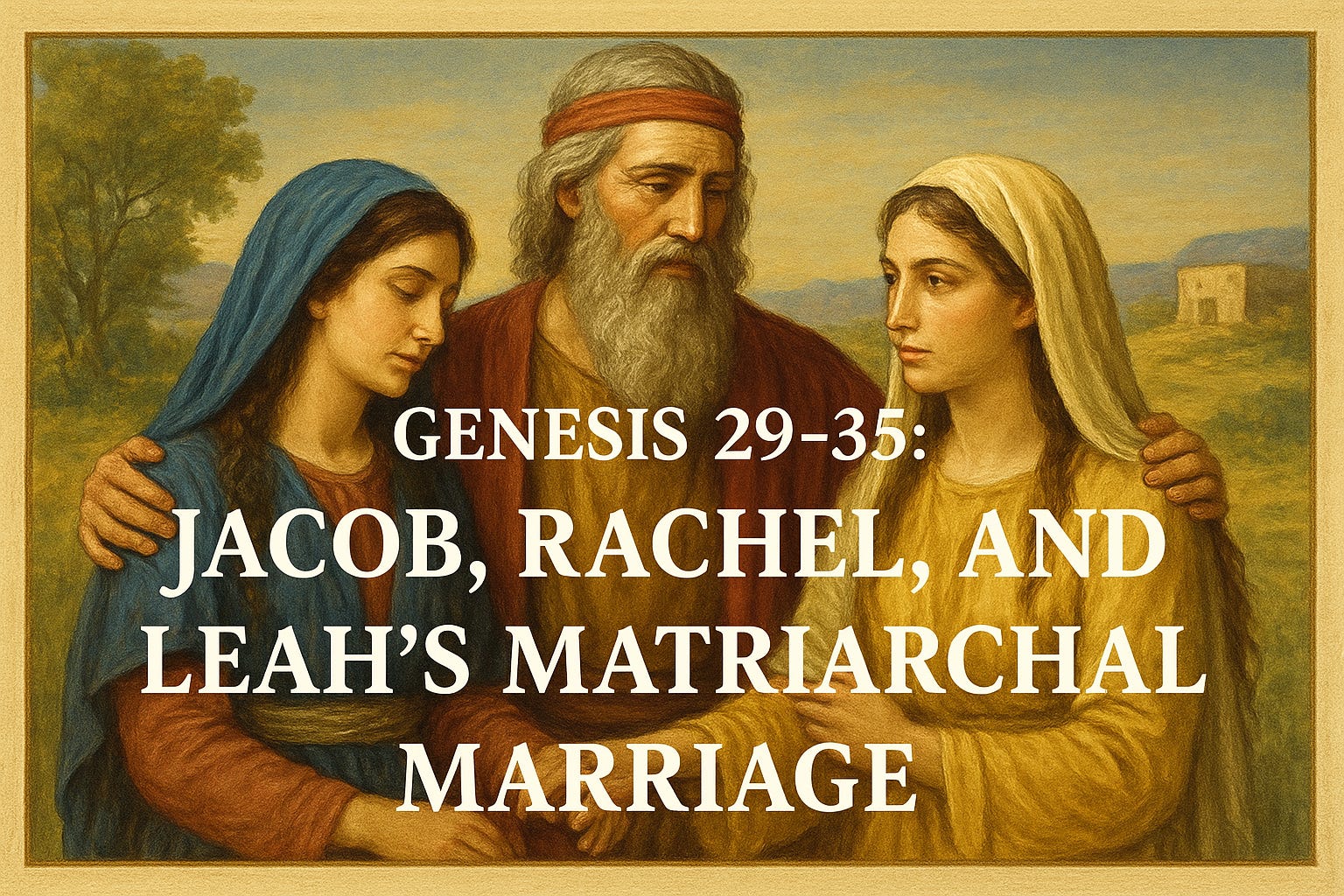
In this week’s discussion in Goddess Bible Study, we continue the theme of Bronze Age matriarchal marriages and look at the relationship of Abraham’s grandson Jacob and his wives Rachel and Leah.
Jacob is of great importance, as the name Israel originates with him, and the 12 sons he had with his two wives and their two slave women would form the 12 tribes of Israel. This is the origin story of Israelite patriarchy, which is still being fought over today more than 3000 years later.
I place all Israelite patriarchs in the 17th century BCE, when the Hyksos ruled Egypt in the Middle Bronze Age, when tribal matrarchies were still the common family structure, but patriarchal families were on the rise.
Students of the Bible have long noticed the quirky cultural elements in these stories that don’t fit in modern times, and here we focus on the marriages. Just as with Abraham and Sarah, we find the wives giving instructions to their husbands, and demanding that he provide them with children, even if that means sleeping with their slave women.
We also see that Jacob went to live with the women’s home when they were married, as is typical in matriarchies. In this case, Jacob was married to two sisters, Rachel and Leah, but Jacob only loved Rachel, leaving us to question who actually impregnated Leah.
Jacob ends up with four wives, but this is no harem. Throughout the story, it is the women who demand that Jacob provide them with children and family, not the man demanding it of his wife.
The Biblical writers never mention Rachel and Leah’s mother, only her father, but that is clearly a reflection of their editorial bias, as they are emphasizing patriarchy at the expense of matriarchy. The Biblical writers did not want people to know that matriarchies ever existed.
Here Jacob meets his brides and father-in-law.
While he was still speaking with them, Rachel arrived with her father’s sheep, for she was a shepherdess. As soon as Jacob saw Rachel, the daughter of his mother’s brother Laban, with Laban’s sheep, he went up and rolled the stone away from the mouth of the well and watered his uncle’s sheep. Then Jacob kissed Rachel and wept aloud. He told Rachel that he was Rebekah’s son, a relative of her father, and she ran and told her father.
Now Laban had two daughters; the older was named Leah, and the younger was named Rachel. Leah had weak eyes, but Rachel was shapely and beautiful. Since Jacob loved Rachel, he answered, “I will serve you seven years for your younger daughter Rachel.”
Laban replied, “Better that I give her to you than to another. Stay here with me.” So Jacob served seven years for Rachel, yet it seemed but a few days because of his love for her.
Finally Jacob said to Laban, “Grant me my wife, for my time is complete, and I want to sleep with her.”
So Laban invited all the men of that place and prepared a feast. But when evening came, Laban took his daughter Leah and gave her to Jacob, and he slept with her. And Laban gave his servant girl Zilpah to his daughter Leah as her maidservant.
When morning came, there was Leah! “What have you done to me?” Jacob said to Laban. “Wasn’t it for Rachel that I served you? Why have you deceived me?”
Laban replied, “It is not our custom here to give the younger daughter in marriage before the older. Finish this week’s celebration, and we will give you the younger one in return for another seven years of work.”
And Jacob did just that. He finished the week’s celebration, and Laban gave him his daughter Rachel as his wife. Laban also gave his servant girl Bilhah to his daughter Rachel as her maidservant.
Jacob slept with Rachel as well, and indeed, he loved Rachel more than Leah. So he worked for Laban another seven years.
Genesis 29:9-30
Here we see that Leah was unloved, so Yahweh made sure that she was impregnated. How are we to interpret this?
The implication throughout is that Jacob was not having sex with Leah because he genuinely loved Rachel, but Leah got pregnant many times.
In the Bronze Age, temple prostitution was still an exalted practice held in high regard. When I see women being impregnated by the gods or having virgin births with no father, I take that to mean they participated in ritual sex. We will discuss the qedesha priestesses, i.e., temple prostitutes, in the upcoming chapters.
In these Bible passages, it says clearly that Yahweh gave the children to Leah, not her husband Jacob, who is avoiding her.
When the LORD [Yahweh] saw that Leah was unloved, He opened her womb; but Rachel was barren. And Leah conceived and gave birth to a son, and she named him Reuben, for she said, “The LORD [Yahweh] has seen my affliction. Surely my husband will love me now.”
Again she conceived and gave birth to a son, and she said, “Because the LORD [Yahweh] has heard that I am unloved, He has given me this son as well.” So she named him Simeon.
Once again Leah conceived and gave birth to a son, and she said, “Now at last my husband will become attached to me, because I have borne him three sons.” So he was named Levi.
And once more she conceived and gave birth to a son and said, “This time I will praise the LORD [Yahweh].” So she named him Judah. Then Leah stopped having children.
Genesis 29:31-35
Here, Rachel is angry and jealous that she has no children of her own. Rachel gives her slave Bilhah to Jacob to make a baby with, or two.
When Rachel saw that she was not bearing any children for Jacob, she envied her sister. “Give me children, or I will die!” she said to Jacob.
Jacob became angry with Rachel and said, “Am I in the place of God, who has withheld children from you?”
Then she said, “Here is my maidservant Bilhah. Sleep with her, that she may bear children for me, so that through her I too can build a family.”
So Rachel gave Jacob her servant Bilhah as a wife, and he slept with her, and Bilhah conceived and bore him a son. Then Rachel said, “God has vindicated me; He has heard my plea and given me a son.” So she named him Dan.
And Rachel’s servant Bilhah conceived again and bore Jacob a second son. Then Rachel said, “In my great struggles, I have wrestled with my sister and won.” So she named him Naphtali.
Genesis 30:1-8
When Leah was done having children, she gave her slave Zilpah to Jacob to impregnate.
Then below, Rachel and Leah exchange a night with Jacob for some fresh fruit. Again, it appears that Jacob does not normally sleep with Leah.
When Leah saw that she had stopped having children, she gave her servant Zilpah to Jacob as a wife. And Leah’s servant Zilpah bore Jacob a son. Then Leah said, “How fortunate!” So she named him Gad.
When Leah’s servant Zilpah bore Jacob a second son, Leah said, “How happy I am! For the women call me happy.” So she named him Asher.
Now during the wheat harvest, Reuben went out and found some mandrakes in the field. When he brought them to his mother, Rachel begged Leah, “Please give me some of your son’s mandrakes.”
But Leah replied, “Is it not enough that you have taken away my husband? Now you want to take my son’s mandrakes as well?”
“Very well,” said Rachel, “he may sleep with you tonight in exchange for your son’s mandrakes.”
When Jacob came in from the field that evening, Leah went out to meet him and said, “You must come with me, for I have hired you with my son’s mandrakes.” So he slept with her that night.
Genesis 30:9-16
Leah has more kids.
And God listened to Leah, and she conceived and bore a fifth son to Jacob. Then Leah said, “God has rewarded me for giving my maidservant to my husband.” So she named him Issachar.
Again Leah conceived and bore a sixth son to Jacob. “God has given me a good gift,” she said. “This time my husband will honor me, because I have borne him six sons.” And she named him Zebulun.
After that, Leah gave birth to a daughter and named her Dinah.
Genesis 30:17-21
Rachel finally gets a baby of her own, Joseph, who would become the favorite of the 12 sons.
Then God remembered Rachel. He listened to her and opened her womb, and she conceived and gave birth to a son. “God has taken away my shame,” she said. She named him Joseph, and said, “May the LORD [Yahweh] add to me another son.”
Genesis 30:22-24
Jacob packs up all his family and leaves the homestead. As they were leaving, Rachel stole all of the household idols that belonged to her father. The story goes on beyond my quote, the father gets angry and they have a big fight, but Rachel lies to her father and they get away.
Household idols are clear evidence of polytheism.
And Rachel and Leah replied, “Do we have any portion or inheritance left in our father’s house? Are we not regarded by him as outsiders? Not only has he sold us, but he has certainly squandered what was paid for us. Surely all the wealth that God has taken away from our father belongs to us and to our children. So do whatever God has told you.”
Then Jacob got up and put his children and his wives on camels, and he drove all his livestock before him, along with all the possessions he had acquired in Paddan-aram, to go to his father Isaac in the land in Canaan.
Now while Laban was out shearing his sheep, Rachel stole her father’s household idols. Moreover, Jacob deceived Laban the Aramean by not telling him that he was running away. So he fled with all his possessions, crossed the Euphrates, and headed for the hill country of Gilead.
Genesis 31:14-21
Here is the story of Jacob wrestling with an Angel of God, for reasons that are not clear. They fight all night, and Jacob holds the stranger off until daybreak.
Jacob is given the name Israel, which means “wrestles with God,” which in this case is El, not Yahweh. In this era, they had never heard of Yahweh, who came along later with Moses. The Biblical writers took old stories and placed Yahweh in them in order to lay claim to old traditions.
Jacob Wrestles with God
During the night Jacob got up and took his two wives, his two maidservants, and his eleven sons, and crossed the ford of the Jabbok. He took them and sent them across the stream, along with all his possessions.
So Jacob was left all alone, and there a man wrestled with him until daybreak. When the man saw that he could not overpower Jacob, he struck the socket of Jacob’s hip and dislocated it as they wrestled. Then the man said, “Let me go, for it is daybreak.”
But Jacob replied, “I will not let you go unless you bless me.”
“What is your name?” the man asked.
“Jacob,” he replied.
Then the man said, “Your name will no longer be Jacob, but Israel, because you have struggled with God and with men, and you have prevailed.”
And Jacob requested, “Please tell me your name.”
But he replied, “Why do you ask my name?” Then he blessed Jacob there.
So Jacob named the place Peniel, saying, “Indeed, I have seen God face to face, and yet my life was spared.”
The sun rose above him as he passed by Penuel, and he was limping because of his hip. Therefore to this day the Israelites do not eat the tendon attached to the socket of the hip, because the socket of Jacob’s hip was struck near that tendon.
Genesis 32:22-32
Jacob makes an altar in Bethel and marks it with the words, “El is the God of Israel.” Not Yahweh.
After Jacob had come from Paddan-aram, he arrived safely at the city of Shechem in the land of Canaan, and he camped just outside the city. And the plot of ground where he pitched his tent, he purchased from the sons of Hamor, Shechem’s father, for a hundred pieces of silver. There he set up an altar and called it El-Elohe-Israel [El is the God of Israel].
Genesis 33:18-20
After Jacob had returned from Paddan-aram, God appeared to him again and blessed him. And God said to him, “Though your name is Jacob, you will no longer be called Jacob. Instead, your name will be Israel.” So God named him Israel.
And God told him, “I am God Almighty. Be fruitful and multiply. A nation—even a company of nations—shall come from you, and kings shall descend from you. The land that I gave to Abraham and Isaac I will give to you, and I will give this land to your descendants after you.”
Then God went up from the place where He had spoken with him.
So Jacob set up a pillar in the place where God had spoken with him—a stone marker—and he poured out a drink offering on it and anointed it with oil. Jacob called the place where God had spoken with him Bethel.
Genesis 35:9-14
Jacob had 12 sons with the four women who are the patriarchs of the 12 tribes of Israel.
Jacob had twelve sons:
The sons of Leah were Reuben the firstborn of Jacob, Simeon, Levi, Judah, Issachar, and Zebulun.
The sons of Rachel were Joseph and Benjamin.
The sons of Rachel’s maidservant Bilhah were Dan and Naphtali.
And the sons of Leah’s maidservant Zilpah were Gad and Asher.
These are the sons of Jacob, who were born to him in Paddan-aram.
Genesis 35:23-26
The next chapter will be about Jacob’s son Judah and his relationship with his step-daughter Tamar, the qedesha, the sacred prostitute. Their children would form the tribe and eventual nation of Judah, which includes Jerusalem, which was the home of the Yahweh cult.
YouTube stream is here: