

Goddess Bible Study is back with another greatest hit of “Embarrassing Bible Stories” that most preachers like to move past quickly with little comment.
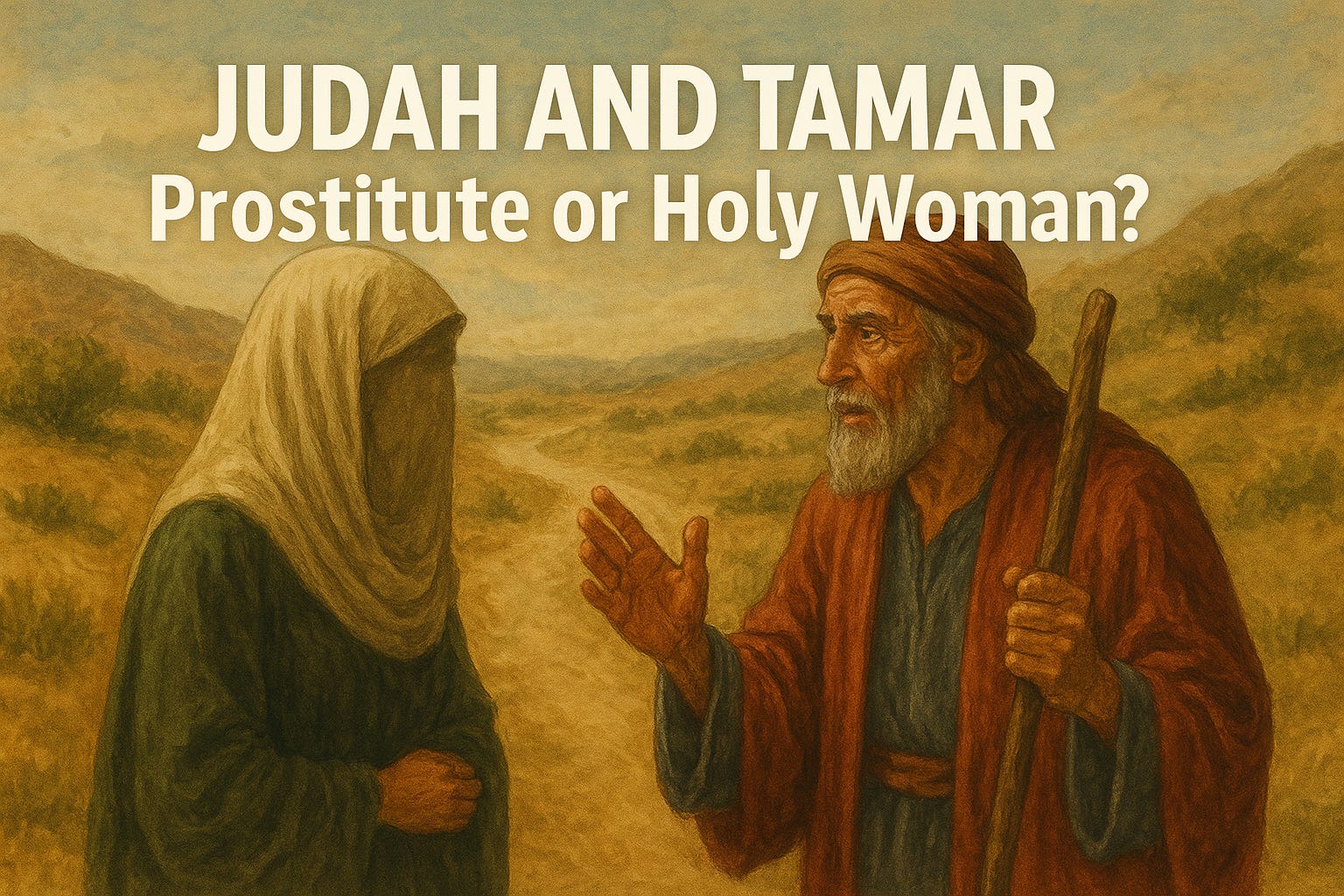
The story of Judah and Tamar reveals the presence of qedesha in the early Israelite community, before they went to Egypt. The qedesha were a class of priestesses in goddess temples common across the ancient Near East, whom we know very little about, except that in the Bible they are described as “temple prostitutes,” while the name actually means “holy ones,” leaving much to the imagination.
The story is also an example of a patriarchal marriage where the woman went to live with the man’s family, which left her vulnerable if her husband abandoned her for any reason, and she had not borne a child that could cement her status in the family.
Judah was a son of Jacob and Leah. He is the patriarch of the tribe of Judah, and eventually the nation of Judah, including Jerusalem, the House of David, and the first temple to Yahweh. Judah’s child with the qedesha Tamar is in this sacred bloodline, and speaks to the need to have the blessing of the goddess, even if it is kept hidden in the patriarchal traditions.
Tamar was married to Judah’s eldest son, who died. The custom in this era of Levirate marriage, as recorded in the Bible, required the dead husband’s brother to step in and father a child with the widow. When this process goes badly for Tamar, she takes the initiative to get pregnant and secure her place in the household by adopting the role of a temple prostitute.
This odd story has long been the source of uncomfortable conversations in Christian Bible study groups.
If brothers are living together and one of them dies without a son, his widow must not marry outside the family. Her husband’s brother shall take her and marry her and fulfill the duty of a brother-in-law to her. The first son she bears shall carry on the name of the dead brother so that his name will not be blotted out from Israel.
- Deuteronomy 25:5-6
Judah got a wife for Er, his firstborn, and her name was Tamar. But Er, Judah’s firstborn, was wicked in the Lord’s sight; so the Lord [Yahweh] put him to death.
Then Judah said to Onan, “Sleep with your brother’s wife and fulfill your duty to her as a brother-in-law to raise up offspring for your brother.” But Onan knew that the child would not be his; so whenever he slept with his brother’s wife, he spilled his semen on the ground to keep from providing offspring for his brother. What he did was wicked in the Lord’s sight; so the Lord put him to death also.
Judah then said to his daughter-in-law Tamar, “Live as a widow in your father’s household until my son Shelah grows up.” For he thought, “He may die too, just like his brothers.” So Tamar went to live in her father’s household.
After a long time Judah’s wife, the daughter of Shua, died. When Judah had recovered from his grief, he went up to Timnah, to the men who were shearing his sheep, and his friend Hirah the Adullamite went with him.
When Tamar was told, “Your father-in-law is on his way to Timnah to shear his sheep,” she took off her widow’s clothes, covered herself with a veil to disguise herself, and then sat down at the entrance to Enaim, which is on the road to Timnah. For she saw that, though Shelah had now grown up, she had not been given to him as his wife.
When Judah saw her, he thought she was a prostitute [zonah], for she had covered her face. Not realizing that she was his daughter-in-law, he went over to her by the roadside and said, “Come now, let me sleep with you.”
“And what will you give me to sleep with you?” she asked.
“I’ll send you a young goat from my flock,” he said.
“Will you give me something as a pledge until you send it?” she asked.
He said, “What pledge should I give you?”
“Your seal and its cord, and the staff in your hand,” she answered. So he gave them to her and slept with her, and she became pregnant by him. After she left, she took off her veil and put on her widow’s clothes again.
Meanwhile, Judah sent the young goat by his friend the Adullamite in order to get his pledge back from the woman, but he did not find her. He asked the men who lived there, “Where is the shrine prostitute [qedesha] who was beside the road at Enaim?”
“There hasn’t been any shrine prostitute [qedesha] here,” they said.
So he went back to Judah and said, “I didn’t find her. Besides, the men who lived there said, ‘There hasn’t been any shrine prostitute [qedesha] here.’ ”
Then Judah said, “Let her keep what she has, or we will become a laughingstock. After all, I did send her this young goat, but you didn’t find her.”
About three months later Judah was told, “Your daughter-in-law Tamar is guilty of prostitution, and as a result she is now pregnant.”
Judah said, “Bring her out and have her burned to death!”
As she was being brought out, she sent a message to her father-in-law. “I am pregnant by the man who owns these,” she said. And she added, “See if you recognize whose seal and cord and staff these are.”
Judah recognized them and said, “She is more righteous than I, since I wouldn’t give her to my son Shelah.” And he did not sleep with her again.
Genesis 38: 6-26
Qedesha - The Holy Ones
The qaditsu (Sumerian), or qedesha (Hebrew), were a class of priestesses, or hierodules. The qadesh were their male (transgender/eunuch) counterparts (who will get their own dedicated article).
The hierodule is the physical embodiment of the goddess herself, and they were prominent in goddess temples throughout the ancient Near East for thousands of years.
The qedesha were known as the holy ones, virgins, or the set apart, which spoke to their respected spiritual purity, and virgins, which referred to their autonomous, unmarried status. The qedesha are mysterious and intriguing, an enigma, our imaginations fueled by vague Biblical mentions. The Biblical writers clearly intend a sexual connotation, and for 2500 years, people have believed in the existence of the sacred harlot.
There is a lot of uncertainty around temple prostitution, as there are no written examples of ritual copulation prescribed for people. Some critical scholars don’t believe that cult prostitution ever even existed.
We do know that early Bronze Age Mesopotamian cultures were openly sexual and celebrated it, while later Iron Age cultures were more restrictive of women, which is exactly the shift we see in the Bible among the Israelites. Brothel districts were common near goddess temples throughout the Greek and Roman pagan eras and were eventually shut down by Christian reformers.
There were entire classes of respectable free women in Mesopotamian society, not only qedesha, though most of them are described as prostitutes in traditional scholarship. It is only in the last generation that critical scholars have challenged this insulting characterization and revealed the depths and variety of independent women’s lives in the Bronze Age.
Qedesha, Naditu, and other consecrated women had special protections under law in Mesopotamian society. They lived together in the temple where they attended school and were trained in the arts, and given special privileges and responsibilities. Qedesha could be married, while harimtu were explicitly not married.
The qedesha were mystical women; healers and midwives, sorceresses, prophetesses, and oracles. The qedesha were known for their charity and powers of divination and prophecy. They were among the most respected and mysterious women.
Qedesha were documented to be midwives and wet nurses. They made lotions, ointments, perfumes, and incense. As midwives, they helped women through pregnancy and childbirth. Abortions by means of herbal medicine were available if needed, and women tracked their fertility cycles. Women were in control of their own cycle of life.
It was a woman’s choice to become a qedesha, and it seems to have been a calling. A father could not refuse his unmarried daughter’s request to serve the goddess, and the qedesha were free to leave the service of the temple at any time. There was no shame or scandal for serving in the temple, and the children born from the service belonged to their mothers. These children were virgin-born and are seen widely in myth and legend.
The qedesha’s rights and good name were protected under law, they could own and inherit property, and were free to return to secular life to marry and have children, though it was said that their independence made them difficult wives.
The number of precise references to qaditsu and qedesha are vanishingly rare, only some 65 references across all of Mesopotamian and Biblical literature, so there is much we don’t know, except that they did certainly exist.
We learn many important details about the qedesha and naditu from the law codes of Hammurabi, written in Babylon, (ca.) 1750 BCE.
The devoted woman could inherit property from her father and do with it as she pleased, and she shared with her brothers an equal portion of their father’s estate upon his passing (Hammurabi’s Laws 178-182).
Children born to qedeshas inherited their name and property from their mother, and the biological father had no claim over the child (law 187).
Qedeshas were banned from opening a tavern, or from even entering one, due to their mastery of mystery potions. The penalty for a qedesha who opened a tavern was to be burned to death (law 110).
The Hebrew prophets and Biblical writers condemned the qedesha and banned the practice from the community as part of the Yahwist reformation around 600 BCE, under King Josiah, that eventually led to Biblical monotheism.
Qedesha and all independent women were incompatible with Biblical patriarchal values, but the mere presence of the ban is a strong indication that qedesha were once a vibrant part of the Israelite community.
Next episode, we will step away from the Bible and take a deeper dive into the variety of free women and sacred sex in Mesopotamian society.
No Israelite man or woman is to become a qedesha.
Deuteronomy 23:17
Join the discussion live on Youtube Tuesday Oct. 6 at 7pm EST or listen later.
Email: goddessbiblestudy@gmail.com if you would like to participate.