

Goddess Bible Study - Genesis 4
Cain and Abel, the famous story of fraternal murder, when the treacherous farmer Cain killed his innocent shepherd brother Abel in cold blood, is a well-known tale of jealousy and violence.
The short story fills only one page in the Bible and offers remarkably few details, yet for centuries it has inspired philosophers and theologians to expound on the meaning of sin, sibling rivalry, sacrifice, murder, God’s love, and redemption.
But what is the source of the rivalry? Are these brothers simply agriculturalists competing over land as often claimed by academics? Or is there more to the symbolism of farmers and shepherds that provides greater insight into this inscrutable story?
Where there was once a sacred marriage of the Shepherd King to the Queen of Heaven, in the Bible, we find fratricide and divorce.
And Adam had relations with his wife Eve, and she conceived and gave birth to Cain.
“With the help of the LORD I have brought forth a man,” she said. Later she gave birth to Cain’s brother Abel.
Now Abel was a keeper of sheep, while Cain was a tiller of the soil. So in the course of time, Cain brought fruit of the soil as an offering to the LORD, while Abel brought the firstborn of his flock.
And the LORD looked with favor on Abel and his offering, but He had no regard for Cain and his offering. So Cain became very angry, and his countenance fell.
“Why are you angry,” said the LORD to Cain, “and why has your countenance fallen? If you do what is right, will you not be accepted? But if you refuse to do what is right, sin is crouching at your door; it desires you, but you must master it.”
Then Cain said to his brother Abel, “Let us go out to the field.” And while they were in the field, Cain rose up against his brother Abel and killed him.
And the LORD said to Cain, “Where is your brother Abel?”
“I do not know!” he answered. “Am I my brother’s keeper?”
“What have you done?” replied the LORD. “The voice of your brother’s blood cries out to Me from the ground. Now you are cursed and banished from the ground, which has opened its mouth to receive your brother’s blood from your hand. When you till the ground, it will no longer yield its produce to you. You will be a fugitive and a wanderer on the earth.”
But Cain said to the LORD, “My punishment is greater than I can bear. Behold, this day You have driven me from the face of the earth, and from Your face I will be hidden; I will be a fugitive and a wanderer on the earth, and whoever finds me will kill me.”
“Not so!” replied the LORD. “If anyone slays Cain, then Cain will be avenged sevenfold.” And the LORD placed a mark on Cain, so that no one who found him would kill him.
So Cain went out from the presence of the LORD and settled in the land of Nod, east of Eden.
- Genesis 4:1-16
Much has been said about this short story, yet no philosopher has ever offered a satisfactory explanation for what was wrong with Cain’s offering from the fields.
Why did God reject the farmer’s sacrifice of vegetables, while he approved of the shepherd’s sacrifice of an animal?
Is there something wrong with farmers?
My suggestion is that from the Biblical writer’s perspective, there is a lot wrong with farmers.
But it must be understood that farmers aren’t simply farmers, they are a symbol for an entire group of people, and so are shepherds. And there was a big rivalry between the “farmers” and the “shepherds” in those days.
The Biblical writers identify with the shepherds, and shepherd symbolism is consistently used in Biblical traditions as a sign of honor, care, protection, and stewardship.
Shepherd Kings was a commonly used title in ancient Mesopotamia when kingship was first established. Many of the most famous kings called themselves shepherds in king lists and mythology, Dumuzi (later Tammuz) whom we see romancing Inanna below, Gilgamesh and his father Lugalbanda, Babylonian king Hammurabi who is remembered for his law codes, and many others. Closer to the Israelites, we see the Hyksos, Canaanite invaders of Egypt who may well have been the ancestors of the Israelites, called themselves the Shepherd Kings.
My thesis is that in the Bronze Age, matriarchal and patriarchal family structures co-existed in Mesopotamian culture. Tribal matriarchies were the indigenous peasant farmers, while the shepherd kings emerged as a new patriarchal ruling class with the advent of Bronze Age weaponry, armies, slavery, and kingship around 3500 BC.
In the early days of kingship, the alliance of farmers and shepherds was celebrated, and the hieros gamos, the sacred marriage between the shepherd king and the great goddess, was enacted as an annual festival tradition through the Bronze Age.
In the Bible, this sacred marriage was broken up, and there was a sacred divorce.
These tribal matriarchies celebrated the mother goddess and linked human sexuality with agricultural abundance. In these matriarchal cultures, sex was not meant to be constrained; it was put on full public display in hopes that it would make the flowers grow.
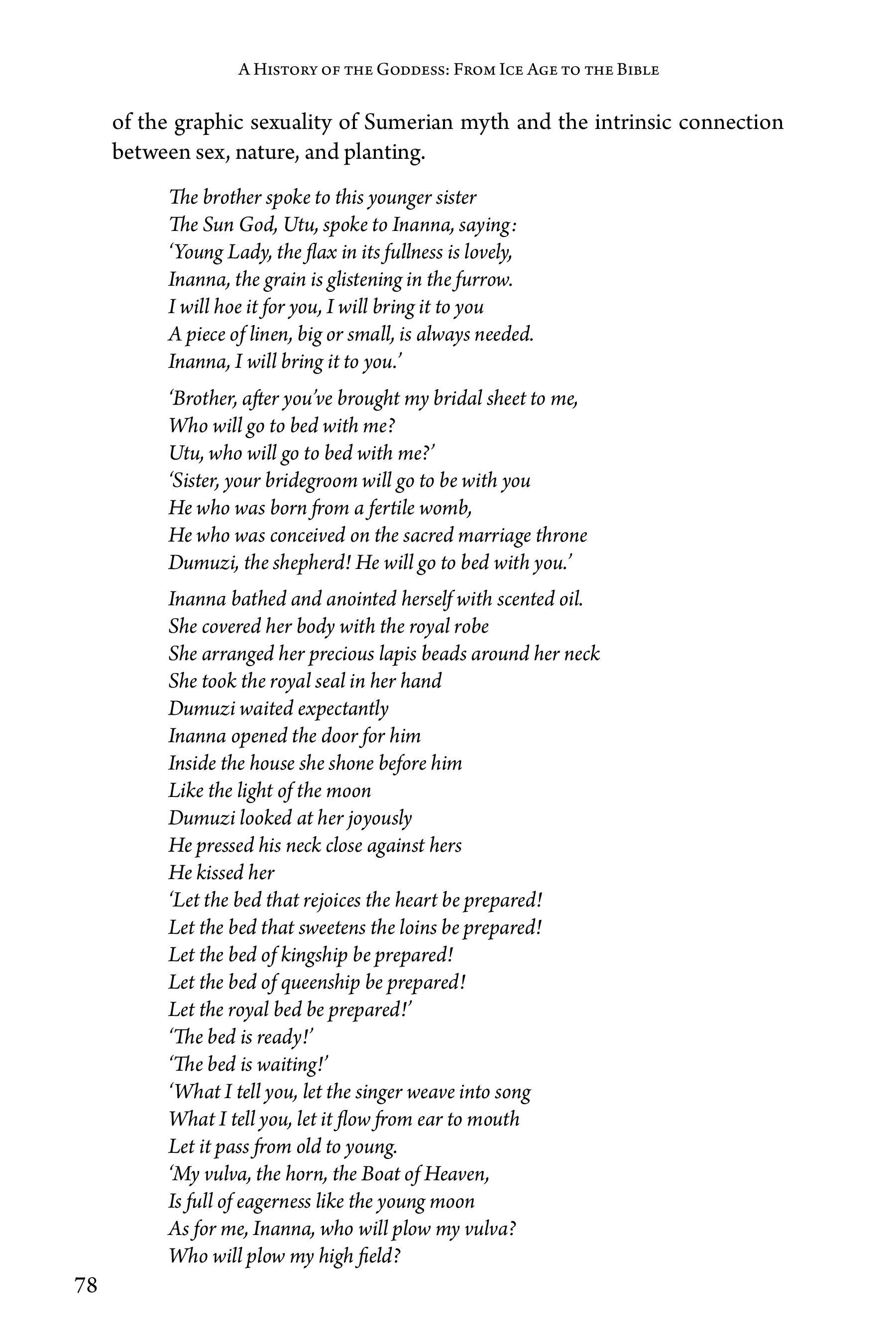
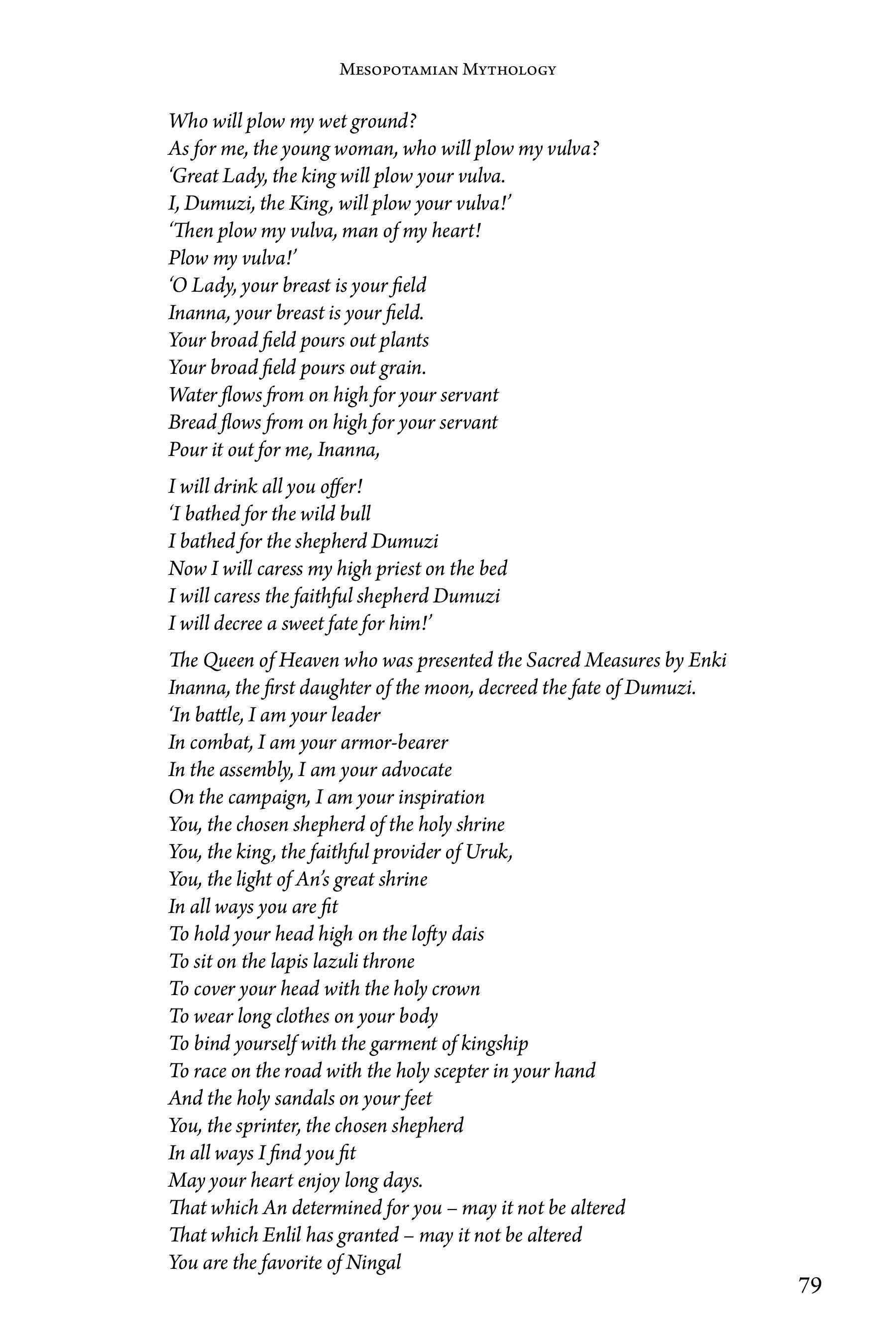
Farming metaphors were commonly used as sexual symbolism in Mesopotamian literature, as you can see in the story below.
“Who will plow my vulva? Who will plow my wet field"? Asks Inanna, and this is but one example of dozens from Mesopotamian literature that equate human sexuality to the fertility of nature.
Inanna was the most popular goddess in Bronze Age Mesopotamia. She is the Queen of Heaven, Venus, the goddess of love and war, the maiden who was never submissive, her fierce independence could not be contained by any man. She was the radiant goddess of love, sexuality, and fertility, and simultaneously the formidable and terrifying deity of war and political power. Her multifaceted nature made her one of the most significant and enduring figures in Mesopotamian religion and culture for millennia.
Inanna was later renamed Ishtar and is seen as Astarte in the Bible, being worshipped by King Solomon. She has many other names in many other cultures.
A central characteristic of Inanna was her unbridled sexuality. Her liturgies are graphically sexual and stand in stark contrast to any acceptable portrayals of femininity in patriarchal Western Civilization.
By Christian standards, Inanna’s stories are straight-up pornography, and much of this sexuality is presented using farming metaphors.
From the Biblical perspective in the later Iron Age, farmers and their goddesses were seen as immoral and sexually decadent and needed to be restrained.
I believe that the Biblical writers were deliberate in their attempts to craft a divorce of the sacred marriage. The Cain and Abel story is part of this effort as it portrays the farmers as treacherous and murderous, while the virtuous shepherds stand in God’s good graces.
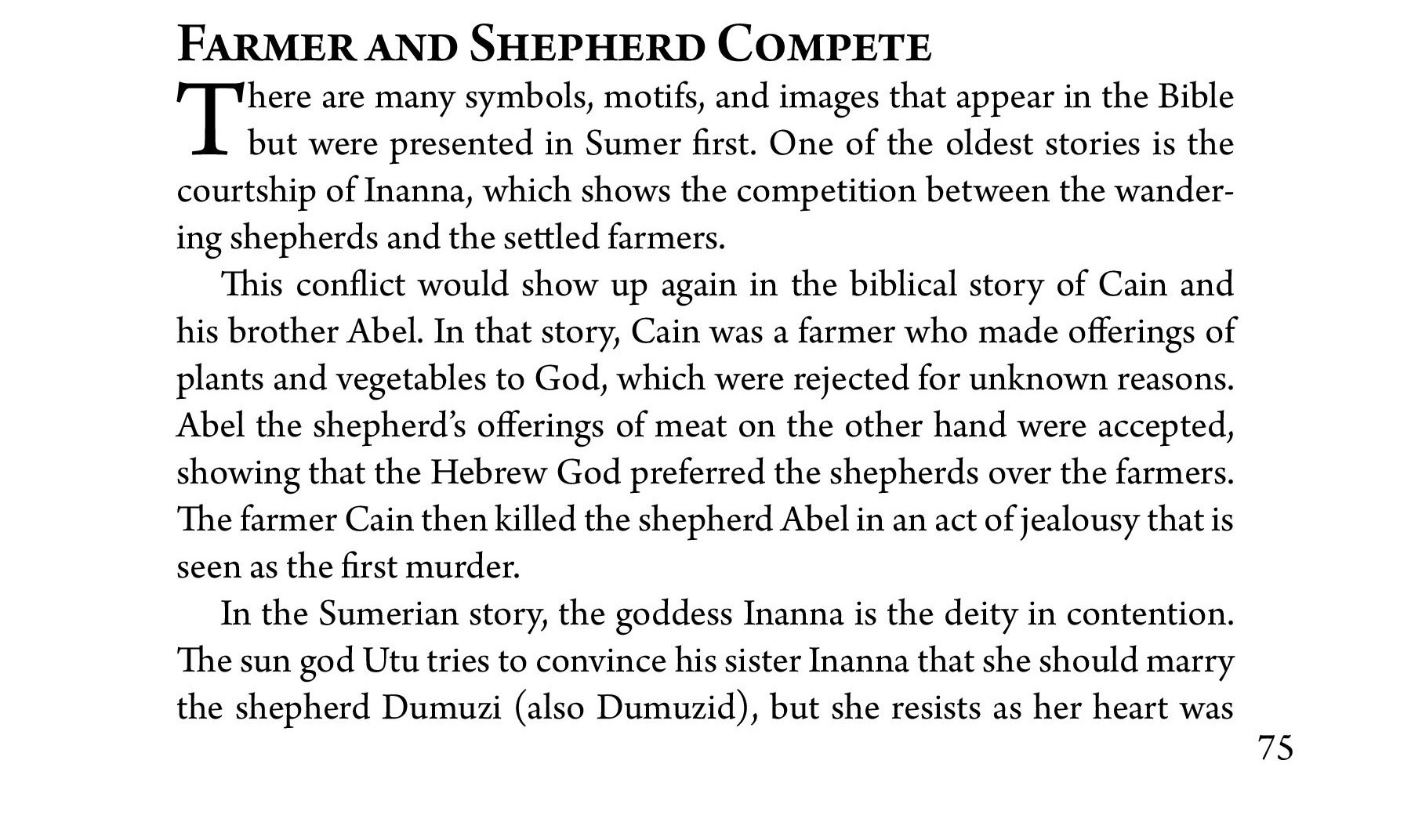
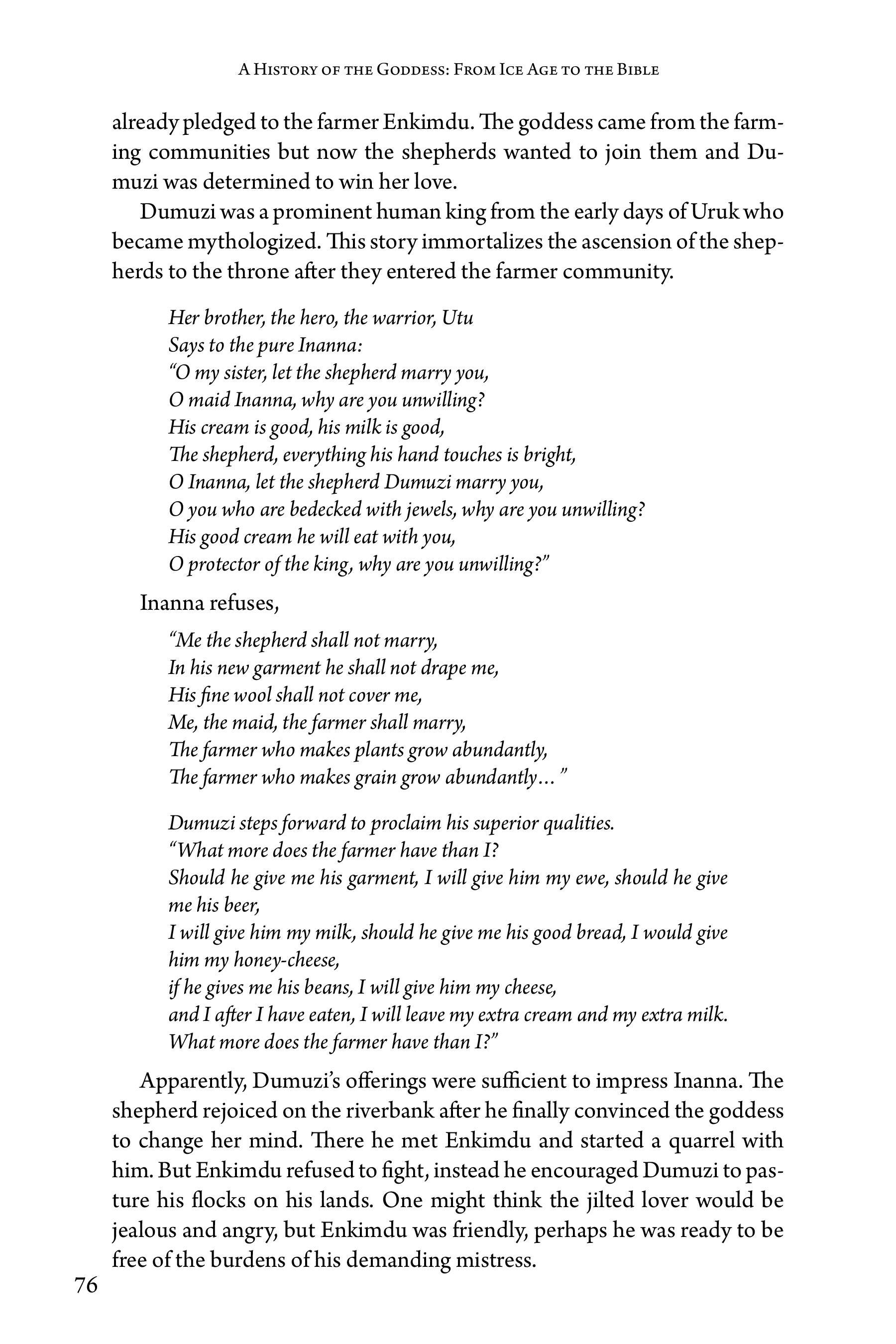
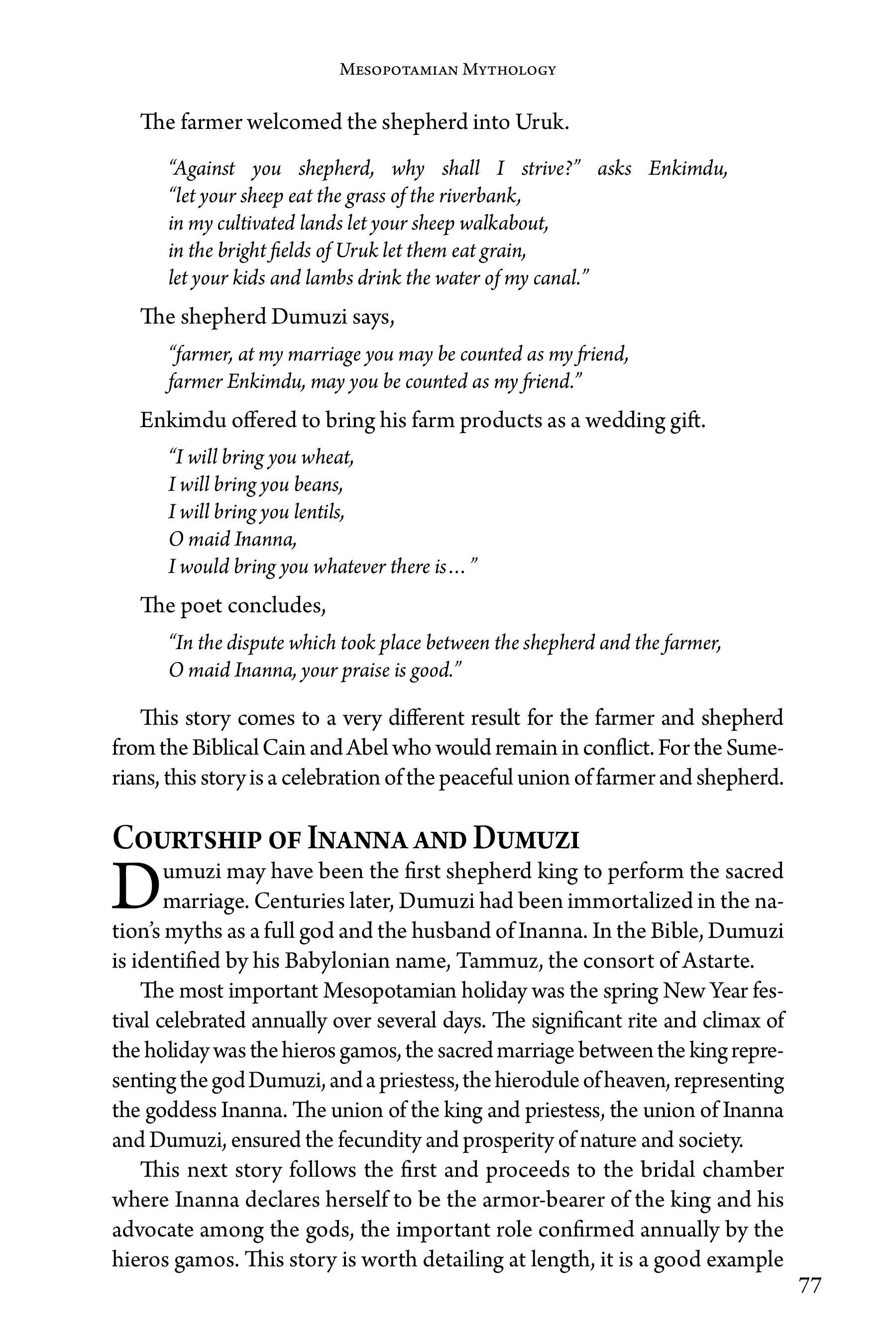
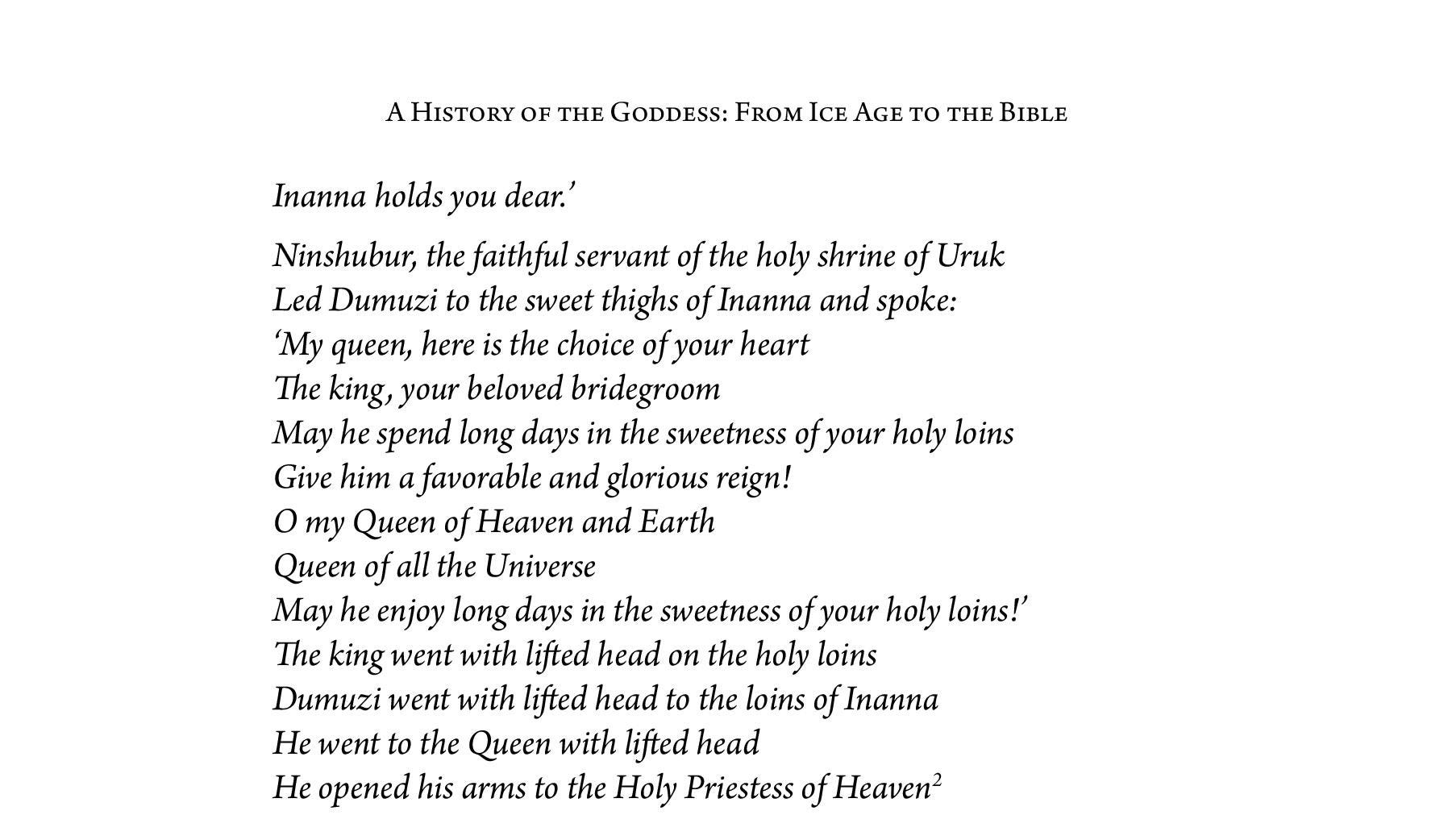
The following screenshots are taken from my book, “A History of the Goddess: from the Ice to the Bible” and explore the early Mesopotamian myth, the “Courtship of Inanna and Dumuzi.” This Sumerian tale dates back to the invention of writing and is one of the oldest myths ever written down (3rd millennium BC).
Next up: Genesis 6-9 - Noah’s Ark - the Great Flood Across Cultures
Was there an epic disaster, a mass extinction event, at some deep point in human history?