

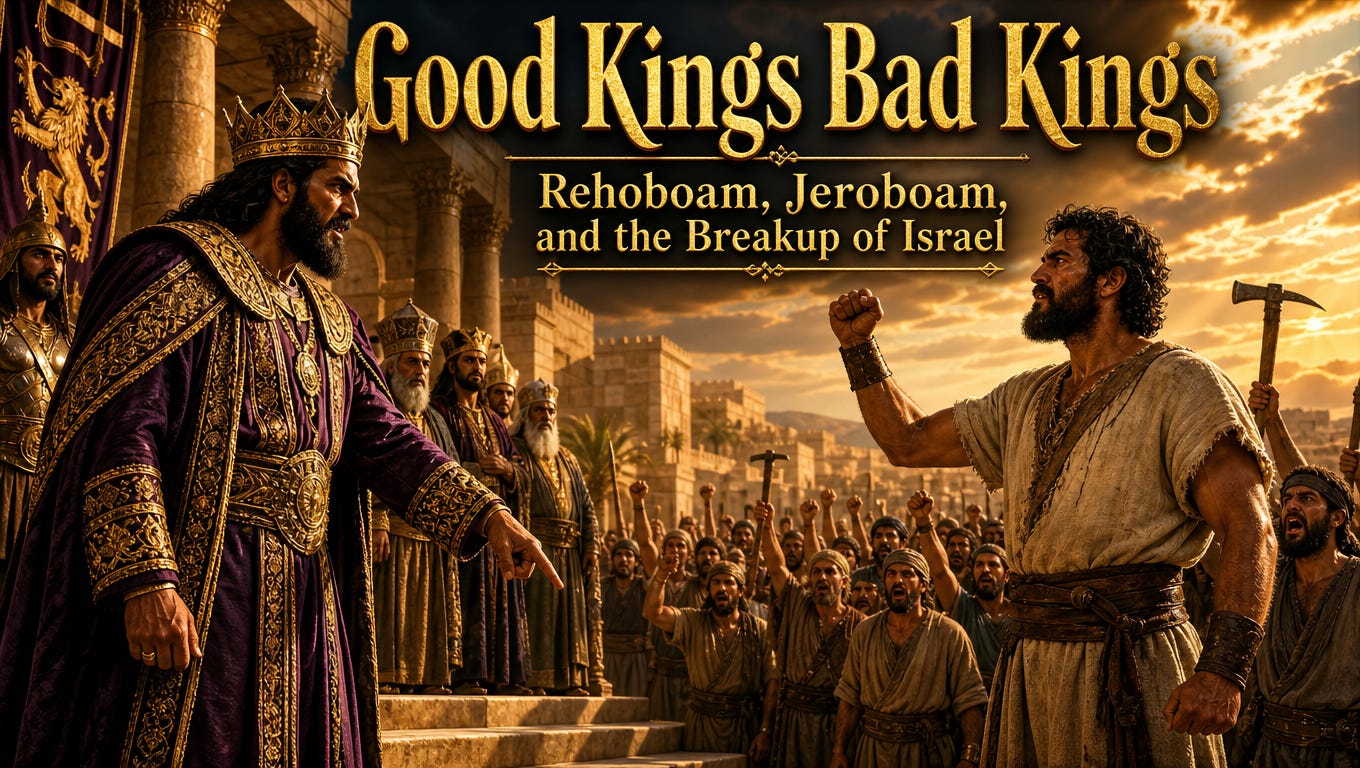
Goddess Bible Study returns this week, and we dive into the histories of pagan Israel and pagan Judah during the First Temple period. For the next few sessions, we will be on the historical era of the First Temple as recorded in the Books of I & II Kings, along with some prophets, including Hosea, Jeremiah, and Ezekiel.
Today, we discuss some good kings and bad kings to kick off the journey.
931 BCE - The Death of King Solomon
In 931 BCE, King Solomon died after a glorious 40-year reign. He passed fat, rich, and happy in his bed, surrounded by his many wives who loved him dearly. If his goddess worship angered any deities, they did not show it in his lifetime.
If anything, the goddesses wept for the loss of their favorite king.
Jerusalem was the spiritual home of Yahweh, but in the late 10th century BCE, the Israelites were entirely pagan, with a full pantheon of gods. Monotheism was centuries away.
Yahweh was worshiped as part of the Divine Council, alongside the mother goddess Asherah, Astarte (Ashtoreth) and Anat, and qedesha priestesses worked in the temple. The “Yahweh and his Asherah” inscriptions date from this period.
The Biblical writers claim that Yahweh chastised Solomon for his worship of the goddess and threatened to divide the kingdom of Israel. Yet the story itself does not illustrate such a tale, as we will see, the stated reasons for the breakup had nothing to do with religion.
So Yahweh said to Solomon, “Since this is your attitude and you have not kept my covenant and my decrees, which I commanded you, I will most certainly tear the kingdom away from you and give it to one of your subordinates. Nevertheless, for the sake of David your father, I will not do it during your lifetime. I will tear it out of the hand of your son.
- 1Kings 11:11-12
I will do this because they have forsaken me and worshiped Ashtoreth the goddess of the Sidonians, Chemosh the god of the Moabites, and Milcolm the god of the Ammonites, and have not walked in obedience to me, nor done what is right in my eyes, nor kept my decrees and laws as David, Solomon’s father, did.
- 1Kings 11:33
Solomon’s death and burial were recorded simply:
As for the other events of Solomon’s reign--all he did and the wisdom he displayed--are they not written in the book of the annals of Solomon?
Solomon reigned in Jerusalem over all Israel forty years. Then he rested with his ancestors and was buried in the city of David his father. And Rehoboam his son succeeded him as king.
- 1 Kings 12:41-43
The Kingdom Splits: Rehoboam and Jeroboam
Solomon was succeeded by his son Rehoboam, a famously bad king who inspired ten of the twelve tribes to revolt and form the northern kingdom of Israel, leaving the smaller state of Judah with Jerusalem as its capital and the temple of Yahweh.
The founding of Israel and Judah remains a mystery to scholars. There is firm evidence that both nations existed as independent countries, a wide variety of coins and royal inscriptions have confirmed this. But there is no firm evidence of a united kingdom that broke apart, or of the kings Rehoboam or Jeroboam.
All the written evidence is from the 9th century forward. King Solomon lived in the 10th century BCE, an illiterate period before the new Hebrew written language was invented. We do know that Jeroboam II was a highly successful king of Israel in the 8th century BCE.
Egypt still recorded hieroglyphics on monuments, but the relevant records are damaged, as we will see below.
Jeroboam was a work supervisor under King Solomon and had objected to the heavy labor demanded of the workers. Solomon forced him into exile. Jeroboam returned when Rehoboam was crowned and attempted to mend fences with the new king.
Solomon tried to kill Jeroboam, but Jeroboam fled to Egypt, to Shishak the king, and stayed there until Solomon’s death.
- 1 Kings 11:40
The breakup of the kingdom was, at its core, a labor dispute, a workers’ revolt against a bad king. Biblical writers blame Solomon's paganism for the split, but the Bible describes a conflict over harsh labor practices.
Rehoboam went to Shechem, for all Israel had gone there to make him king. When Jeroboam son of Nebat heard this (he was still in Egypt, where he had fled from King Solomon), he returned from Egypt.
So they sent for Jeroboam, and he and the whole assembly of Israel went to Rehoboam and said to him: “Your father put a heavy yoke on us, but now lighten the harsh labor and the heavy yoke he put on us, and we will serve you.”
Rehoboam answered, “Go away for three days and then come back to me.” So the people went away.
Then King Rehoboam consulted the elders who had served his father Solomon during his lifetime. “How would you advise me to answer these people?” he asked.
They replied, “If today you will be a servant to these people and serve them and give them a favorable answer, they will always be your servants.”
But Rehoboam rejected the advice the elders gave him and consulted the young men who had grown up with him and were serving him. He asked them, “What is your advice? How should we answer these people who say to me, ‘Lighten the yoke your father put on us’?”
The young men who had grown up with him replied, “These people have said to you, ‘Your father put a heavy yoke on us, but make our yoke lighter.’ Now tell them, ‘My little finger is thicker than my father’s waist. My father laid on you a heavy yoke; I will make it even heavier. My father scourged you with whips; I will scourge you with scorpions.’ ”
Three days later Jeroboam and all the people returned to Rehoboam, as the king had said, “Come back to me in three days.” The king answered the people harshly. Rejecting the advice given him by the elders, he followed the advice of the young men and said, “My father made your yoke heavy; I will make it even heavier. My father scourged you with whips; I will scourge you with scorpions.” So the king did not listen to the people, for this turn of events was from Yahweh, to fulfill the word Yahweh had spoken to Jeroboam son of Nebat through Ahijah the Shilonite.
When all Israel saw that the king refused to listen to them, they answered the king: “What share do we have in David, what part in Jesse’s son? To your tents, Israel! Look after your own house, David!” So the Israelites went home. But as for the Israelites who were living in the towns of Judah, Rehoboam still ruled over them.
King Rehoboam sent out Adoniram, who was in charge of forced labor, but all Israel stoned him to death. King Rehoboam, however, managed to get into his chariot and escape to Jerusalem. So Israel has been in rebellion against the house of David to this day.
When all the Israelites heard that Jeroboam had returned, they sent and called him to the assembly and made him king over all Israel. Only the tribe of Judah remained loyal to the house of David.
-1 Kings 12:1-20
Golden Calves at Bethel and Dan
The first thing Jeroboam did after breaking away from the temple leadership in Jerusalem was to establish pagan shrines in Israel, particularly erecting Golden Calves in the towns of Bethel and Dan.
Bethel was a rival worship center to Jerusalem’s temple and they did not like each other. Bethel represented the old traditions of El and Baal. It is home to the altar built by Jacob that reads “El Elohe Israel” - El is the god of Israel.
The northern kingdom of Israel was pagan throughout its entire 210-year history. Israel originally worshiped Baal as king of the gods, but the competitive Yahweh cult made inroads, competing for kingship. Israel was always polytheistic.
King Jeroboam built high places, new altars, and instituted new festivals to create political allegiance to his new kingdom, pulling the people away from Jerusalem.
Then Jeroboam fortified Shechem in the hill country of Ephraim and lived there. From there he went out and built up Peniel.
Jeroboam thought to himself, “The kingdom will now likely revert to the house of David. If these people go up to offer sacrifices at the temple of Yahweh in Jerusalem, they will again give their allegiance to their lord, Rehoboam, king of Judah. They will kill me and return to king Rehoboam.”
After seeking advice, the king made two golden calves. He said to the people, “It is too much for you to go up to Jerusalem. Here are your gods, Israel, who brought you up out of Egypt.” One he set up in Bethel, and the other in Dan. And this thing became a sin; the people came to worship the one at Bethel and went as far as Dan to worship the other.
Jeroboam built shrines on high places and appointed priests from all sorts of people, even though they were not Levites. He instituted a festival on the fifteenth day of the eighth month, like the festival held in Judah, and offered sacrifices on the altar. This he did in Bethel, sacrificing to the calves he had made. And at Bethel he also installed priests at the high places he had made. On the fifteenth day of the eighth month, a month of his own choosing, he offered sacrifices on the altar he had built at Bethel. So he instituted the festival for the Israelites and went up to the altar to make offerings.
-1 Kings 12:25-33
Jeroboam erected Asherah poles across the land and appointed priests from among the common people. This did not please the Biblical writers.
Even after this, Jeroboam did not change his evil ways, but once more appointed priests for the high places from all sorts of people. Anyone who wanted to become a priest he consecrated for the high places. This was the sin of the house of Jeroboam that led to its downfall and to its destruction from the face of the earth.
-1 Kings 13:33-34
He will uproot Israel from this good land that he gave to their ancestors and scatter them beyond the Euphrates River, because they aroused Yahweh’s anger by making Asherah poles. And he will give Israel up because of the sins Jeroboam has committed and has caused Israel to commit.”
-1 Kings 14:15-16
Rehoboam, King of Judah
Meanwhile, the kingdom of Judah under Rehoboam was no more virtuous than Israel under Jeroboam. Judah too maintained its pagan practices - Asherah poles, high places, sacred stones, and even the male qadesh shrine priests all persisted under the House of David.
Rehoboam son of Solomon was king in Judah. He was forty-one years old when he became king, and he reigned seventeen years in Jerusalem, the city Yahweh had chosen out of all the tribes of Israel in which to put his Name. His mother’s name was Naamah; she was an Ammonite.
Judah did evil in the eyes of Yahweh. By the sins they committed they stirred up his jealous anger more than those who were before them had done. They also set up for themselves high places, sacred stones and Asherah poles on every high hill and under every spreading tree. There were even male qadesh shrine prostitutes in the land; the people engaged in all the detestable practices of the nations Yahweh had driven out before the Israelites.
In the fifth year of King Rehoboam, Shishak king of Egypt attacked Jerusalem. He carried off the treasures of the temple of Yahweh and the treasures of the royal palace. He took everything, including all the gold shields Solomon had made. So King Rehoboam made bronze shields to replace them and assigned these to the commanders of the guard on duty at the entrance to the royal palace. Whenever the king went to Yahweh’s temple, the guards bore the shields, and afterward they returned them to the guardroom.
As for the other events of Rehoboam’s reign, and all he did, are they not written in the book of the annals of the kings of Judah? There was continual warfare between Rehoboam and Jeroboam. And Rehoboam rested with his ancestors and was buried with them in the City of David.
-1 Kings 14:21-31
925 BCE - Pharaoh Shishak attacks Canaan
Pharaoh Shishak (Sheshonq I) is a historical figure. The Bible says Shishak attacked Jerusalem and plundered the wealth from the temple, perhaps conveniently covering for the fact that there never was any such wealth there.
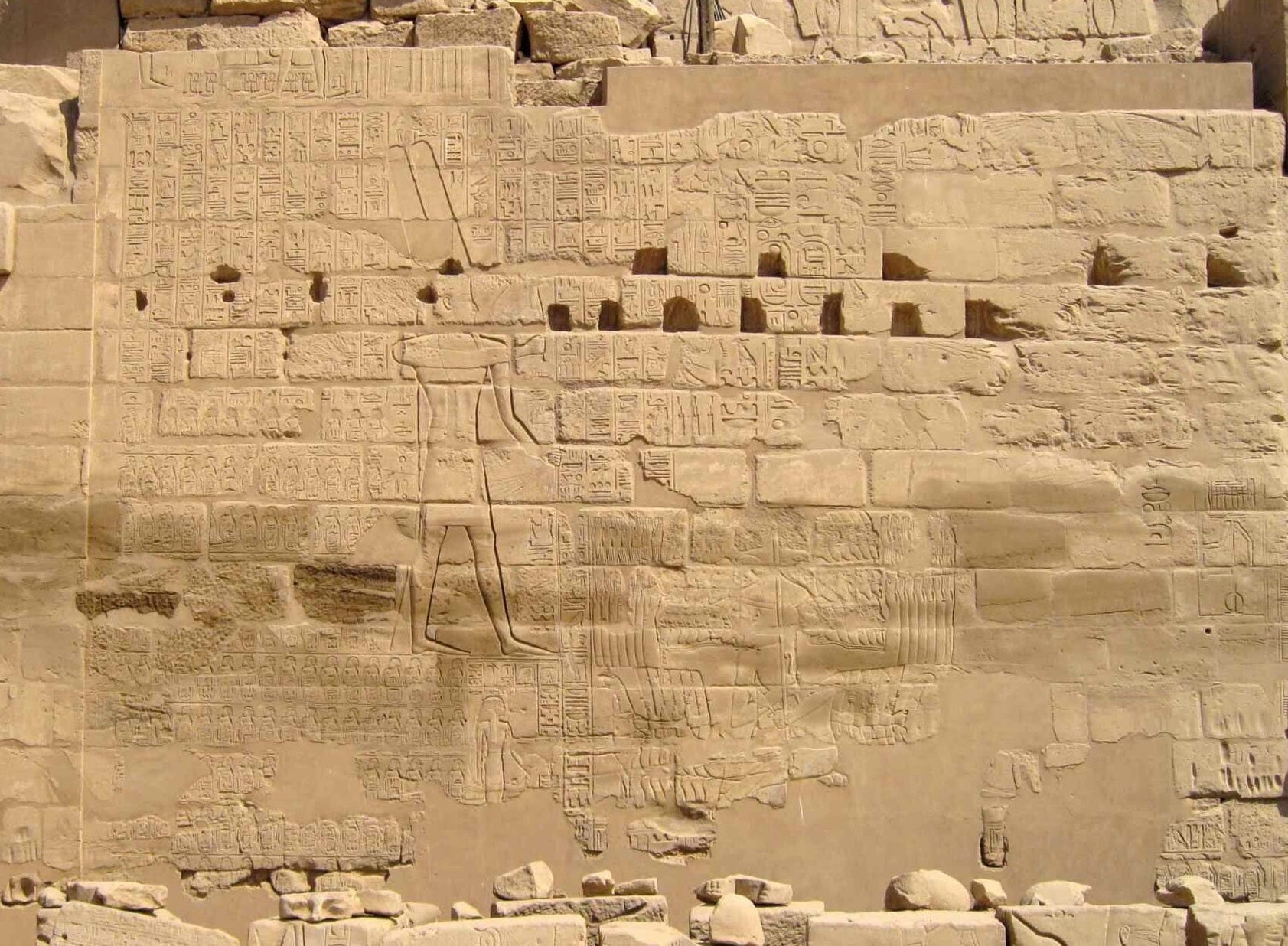
Shishak really did attack Canaan in 925 BCE. His victory stele, recorded on the Bubastite Portal at the temple of Karnak, details his military conquests across Canaan. The portal mentions many towns that were sacked, but does not mention Jerusalem.
Many scholars believe this is evidence that Shishak did not sack Jerusalem because there was nothing of value there. But the stele is fractured, and the location where Jerusalem would appear has been rubbed away. It remains an enigma. If Jerusalem were clearly mentioned, it would help resolve the mystery of Solomon and the united kingdom of Israel.
Egyptian hieroglyphics were rare in this period, used only on royal monuments — not for day-to-day texts and letters. What survives is precious, and what is missing is maddening.
Next time on Goddess Bible Study, we will continue in the Book of Kings. We will detail the fall of the Three Queen Mothers, Maacah, Jezebel, and her daughter Athalia. Along with the famous Battle of the Prophets on Mt. Carmel, and the palace coup by Jehu, who then committed a series of mass murders and desecrated the temple of Baal. This topic may spread across two sessions.
Queen Jezebel of Israel is the Bible's most famous villain — and its most reviled woman. Her name alone became a byword for wickedness, manipulation, and dangerous sexuality, an image that has endured for three thousand years. But from her perspective, she was behaving honorably and defending her traditions against dangerous revolutionaries.
Let’s learn more about Jezebel!
The podcast discussions are continuing, but will appear in a separate email. We are upgrading the production, details soon.
Contact:
goddessbiblestudy@gmail.com