

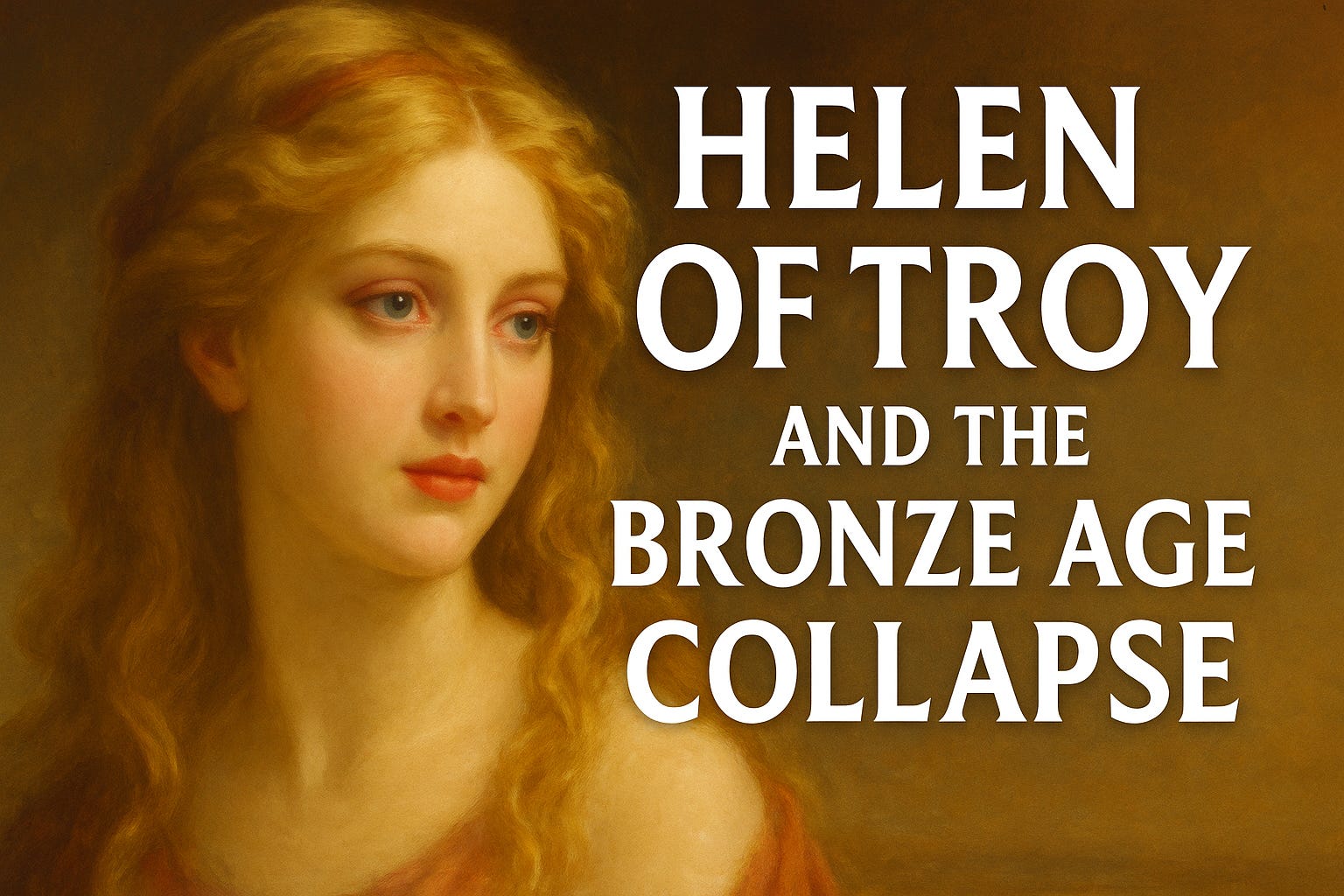
This week on Goddess Bible Study, we take a look at the timeless beauty, Helen of Troy, and the fall of Mycenaeans during the Bronze Age Collapse around 1200 BCE. Next week, we will return to the Bible with Moses and the Exodus, which I argue was a contemporary event to the fall of Troy.
Helen of Troy has always loomed large in the imagination of Western culture, long before Homer codified the epic tales of the Iliad and the Odyssey in the 7th century BCE. In Homer’s Iliad, he assumes the audience is already familiar with Helen’s tragic story. I am also going to assume that my readers are familiar with the Trojan War and don’t require a recap. I want to focus on a couple of specific points.
It’s important to recognize that the Mycenaean Greeks from the Iliad were a distinct culture from the familiar Hellenistic Greeks of classical antiquity, from whom we learn the stories. Homer was a Hellene, recounting stories from the previous culture that had fallen tragically.
The Mycenaeans were one of the leading imperial cultures of the late Bronze Age, alongside the Hittite Empire in Turkey and the New Kingdom Empire in Egypt that dominated Canaan. All of these empires were wiped out in the Bronze Age Collapse.
Helen is of course, the most beautiful woman who ever lived, a beguiling figure who drove men to murderous passions. She is the face who launched a thousand ships, but Helen was no empty vessel or passive victim, she played an active role in her own fate.
Helen was a demigod, a child of Zeus. Her beauty was dreadful and otherworldly, a force of nature beyond the control of mere mortals. Even after their city was destroyed, following ten years of war and suffering, the Trojans could still not deny Helen her place of honor.
The character of Helen personifies the primeval power of beauty and sexuality, and how it is a match for the strength of arms. If power, in human terms, is the ability to get people to do stuff they would not otherwise want to do (like parting with their money), then sex and beauty is truly a power that can match violence as a source of influence and coercion.
Helen was not merely beautiful, she was also a royal princess and heir to the throne of Sparta. Late Bronze Age societies still had potent matriarchal cultures with powerful goddesses leading their pantheons and inheritances passing thru daughters.
Matriarchal inheritance was quite normal in the Bronze Age, and stands in contrast to the hardline patriarchy that emerged in the Iron Age, where male inheritance was the norm. We see this tradition in all the great Queens of the Iliad, Helen, her sister Clytemnestra, and their cousin Penelope, all of whom married great heroes of the epic.
As heir to the throne of Sparta, Helen’s husband would become king. This was also true for Penelope, who was heir to the throne in Ithaca. Penelope married the clever Odysseus, who became king of Ithaca and whose story is told in the Odyssey.
Agamemnon was king of Mycenae, the greatest house, and he married Helen’s younger sister Clytemnestra, who came to live with him. We will return to the blood-soaked tragedy of Clytemnestra and Agamemnon in a later dedicated episode. Clytemnestra was no trivial figure either.
Helen’s beauty had made her famous throughout Greece, and a great contest was held by all the heroes to compete for her hand and the throne of Sparta. Agamemnon arranged for his younger brother Menelaus to win the hand of Helen. Unfortunately for Menelaus, Helen did not care much for him, and she ran off with Prince Paris from Troy, along with her treasure. This undermined Menelaus’s claim to the throne, in addition to the humiliation.
The Greek heroes had already made a pact to support Menelaus, and they rallied one of the greatest armadas of all time to sail across the Aegean and attack Troy. This war took ten years and spawned an entire library of legends that continue to captivate audiences to this day.
The Mycenaeans eventually managed to sack and destroy Troy, after deploying the subterfuge of the Trojan Horse that allowed them to sneak some warriors inside the city walls and open the gates. But this was a pyrrhic victory for the Mycenaeans, whose entire civilization disintegrated in the wake of the war. The Hellenistic Greeks certainly saw it as a cautionary tale.
For many centuries, the Trojan War was viewed as completely mythological, but in the late 1800s, an obsessive archaeologist named Heinrich Schliemann discovered the site of Troy on the Turkish coast. Modern scholars now accept that the city of Troy was sacked and destroyed sometime around 1200 BCE, and inspired the Homeric tales.
The collapse of Mycenaea led to a roughly 300-year dark age in Greece, when there was no governance, organized trade, literacy, or social order. The Hellenes came in from the north and eventually took over Greece, establishing a new cultural and religious order featuring the Olympian gods headed by Zeus. The Mycenaeans had a related but different pantheon where Zeus was a minor god and not the leader (who may have been the sea god Poseidon).
The Greek Dark Age was known in antiquity, but now we know that this dark age was not limited to Greece, but extended throughout the eastern Mediterranean, bringing down the Hittite civilization, and severely damaging both the Egyptians and Assyrians. For 300 years, from around 1200-900 BCE, there was a total civilizational breakdown known as the Bronze Age Collapse.
It seems there were many contributing factors to the Bronze Age Collapse, a century of drought caused famines and social unrest, and a series of earthquakes contributed to the misery. This caused migrations, civil unrest, and political revolutions. There was also a technology shift from bronze to iron, which disrupted trade and undermined the wealth earned from the trade in copper and tin that had been the financial foundation for the Bronze Age aristocracies.
Ultimately, the Sea Peoples, a motley crew of sea-faring raiders from the Aegean, which likely included Mycenaean refugees, sacked and destroyed nearly every coastal city along the eastern Mediterranean, ultimately attacking Egypt in titanic battles in 1209 BCE and 1177 BCE (my timing for the Exodus).
The city of Ugarit on the Syrian coast was destroyed in 1180 BCE, leaving behind dramatic records of the invasion, as well as rare Canaanite mythology, including the Baal Cycle, which we discussed in our last session.
The Iron Age followed the Bronze Age, with new trade routes and new empires. Armies were outfitted with iron and steel weapons superior to the old bronze. The old cuneiform writing that had been anchored in the palaces with royal scribes completely disappeared and never returned. There were 300 years of illiteracy with no record keeping, before the new phonetic alphabet (invented by the Phoenicians) came into use in the 9th century BCE. The Hebrews and Greeks were among the first to use the new writing systems.
Iron Age cultures were deeply patriarchal, and we see the status of women fall harshly in the first millennium BCE. All of the leading imperial cultures in that era, the Neo-Assyrians, the Babylonians (Chaldeans), the Hebrews, the Greeks, and others, all severely restricted their women. Matriarchal inheritance, especially around kingship, mostly went away.
Since this represents most of classical antiquity, we take it for granted in Western culture that women were always treated poorly compared to men. It is only recent archaeological and scholarly work that is beginning to reveal the rich Bronze Age cultures where women had much greater property rights and personal latitude in their behavior.
We also see a complete revamping of the goddesses in the Iron Age, no longer would they be independent. The Hebrews completely went to war with their goddesses Asherah, Astarte, and Anat and eventually eliminated them from worship, as we see in the Bible. The Greeks meanwhile, reordered the Olympian pantheon to ensure all the goddesses would be submissive to Zeus.
The clearest distinction between the Bronze Age and Iron Age goddesses is that the Bronze Age goddesses were sexually independent and not submissive to their husbands and fathers, while the Iron Age goddesses are submissive.
Helen of Troy represents this transition, her beauty was feared and respected, but her independence was seen as problematic. Helen always had a mixed reputation in Greek culture, they could never really decide if she was a victim or an agent of destruction. The Greeks and those who followed came to see beauty and feminine power as a source of trouble that needed to be restrained.
For more scholarly information on Helen, I recommend both of these podcasts by eminent historians.
Bettany Hughes focuses on the history of the Mycenaean culture that spawned the legend of Helen.
Tom Holland’s treatment of Helen focuses on the literary and mythical qualities of the stories.
We will discuss this topic live on Tuesday, December 2 at 7:00pm EST.
Reach out if you would like to join our Signal chat group or join the discussion.
goddessbiblestudy@gmail.com