

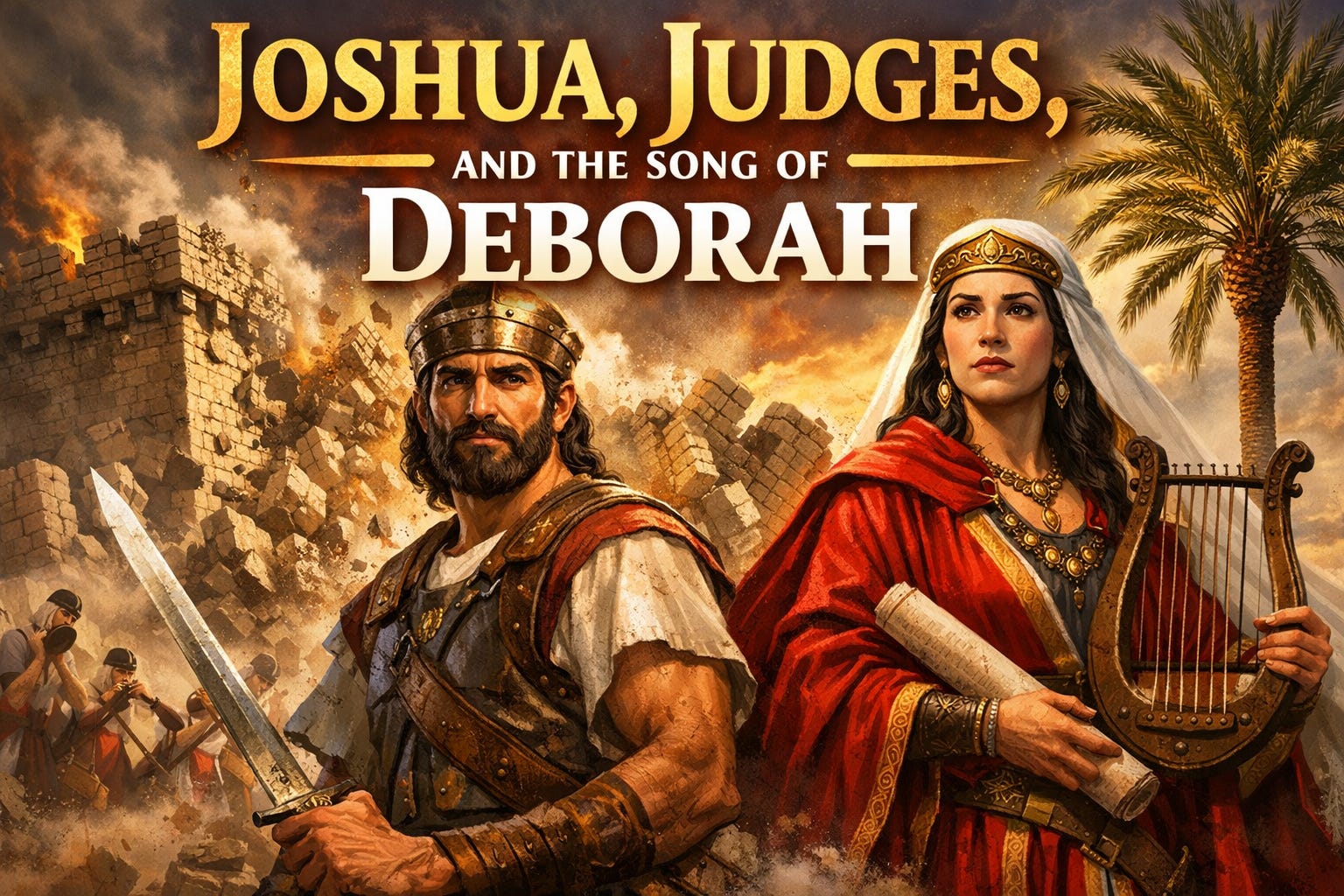
This week on Goddess Bible Study: Joshua, Jericho, the conquest of Canaan, and the Song of Deborah.
12th century BCE
We are now in the 12th century BCE. Egypt fought the Sea Peoples for the second time in 1177 BCE, and lost control of its empire in Canaan, setting the stage for the Israelites to enter the promised land of Canaan in the books of Joshua and Judges.
The Hittite empire was to the north, and the Bronze Age Collapse caused both empires to suffer. The Hittites disappeared completely, while Egypt was forced to withdraw to its homeland, leaving Canaan without governance. The Egyptians had controlled Canaan for 300 years as a buffer state, and they ordered most of the cities to have no walls or fortifications. The loss of Egyptian control plunged Canaan into lawlessness and violence.
This anarchic time period is known in the Bible as the conquest of Canaan and the time of the Judges. Kingship would come a century and a half later, for now the Israelites were still tribal, pagan, and at least partly matriarchal, as we will see.
In those days there was no king in Israel. Everyone did what was right in his own eyes.
-Judges 21:25
The pagan Israelites worshiped Baal and the Ashtoreths, the common religion of the day. Baal was king of the gods. Astarte was the Queen of Heaven. Ashtoreths means, “shameful Astarte” in plural. Telling us that goddess temples and shrines were common across the land.
Then the Israelites did evil in the eyes of Yahweh and served the Baals. They forsook Yahweh, the God of their ancestors, who had brought them out of Egypt. They followed and worshiped various gods of the peoples around them. They aroused Yahweh’s anger because they forsook him and served Baal and the Ashtoreths.
-Judges 2:11-13
As I have argued previously, I believe that this Biblical time period is akin to the Trojan War, in that dramatic historical events were occurring, but there was no literacy, so all stories were recorded in oral tradition. Dramatic episodes quickly became legends, and after a while, full-on myths complete with supernatural elements and esoteric importance.
Moses died when the Israelites were on the edge of the promised land, and Joshua became the new leader of the Israelites. They fought their neighbors, the Moabites, Edomites, Philistines, and others, for a homeland of their own. These were all new kingdoms that emerged after the big fight in 1177 BCE. The Philistines were likely among the Sea Peoples and settled in today’s Gaza Strip.
Joshua and the Conquest of Canaan
The conquest of Canaan, led by Joshua, is one of the more colorful sections of the Bible, filled with genocidal violence and famous stories of entire cities being sacked and destroyed. This has been a ripe area of investigation for archaeologists, leading to many interesting results.
Similar to the Exodus, there is no evidence that the stories of the Conquest ever happened exactly as described in the Bible. But there is evidence that some stuff happened, and we do know for certain that it was an anarchic time period full of violence.
The most famous Conquest story by far is the destruction of Jericho by the Israelites in Joshua chapter 6. This story perfectly exemplifies the debates between secular scholars and the faithful.
Jericho is the oldest continually inhabited city in the world. Jericho is even older than Catal Huyuk, its Neolithic settlements are 10,000 years old. Residents of Jericho today describe it as humanity’s oldest city.
By the time Joshua and the Israelites showed up, Jericho had already been inhabited for 7000 years. Precise settlement locations did move around a bit over the centuries, but there is a water source, which was always valuable.
In the story, the Israelites marched around the city for seven days, carrying the mystical Ark of the Covenant, bringing down the tall, impenetrable walls. Children sing songs about it in Sunday School.
The site has been heavily analyzed by archaeologists and apologists, and they did find thick city walls that had been knocked down in apparently dramatic fashion, but the dating is highly controversial.
The ruined walls and burned city appear just as they are described in the Bible. The faithful take this as a sign of the Bible’s inerrancy. But is that really the correct interpretation?
Archaeologist Kathleen Kenyon did extensive work in Jericho and dated the destruction of the walls to 1550 BCE. Fundamentalist scholars have argued for a later date of 1400 BCE, which is when the religious faithful believe the Israelites entered Canaan.
Academics attribute the destruction of Jericho’s thick walls to an earthquake centuries before the Israelites arrived. They believe that Jericho was basically uninhabited when the Israelites emerged in the area around 1200 BCE.
The important question is, when did the walls fall? Were the Hebrews responsible for bringing the walls down as described in the Bible? Or did they find the walls already broken down and then invent stories, taking credit for the ruins in their midst?
Rahab the Prostitute
The story of Rahab is interesting from a goddess perspective. Rahab was a prostitute who lived in Jericho and helped Israelite spies enter the city in exchange for sparing the lives of her and her family.
Rahab is a significant figure in the Bible, she demonstrated faith in Yahweh, and her family was spared destruction. Ultimately, she became an ancestor of Jesus Christ.
And the city and all that is within it shall be devoted to Yahweh for destruction. Only Rahab the prostitute [zonah] and all who are with her in her house shall live, because she hid the messengers whom we sent.
-Joshua 6:17
Rahab’s family owned a tavern, and she is described as a “zonah”, a conventional prostitute and not a “qedesha.” It was typical for workers in taverns to supplement their income with prostitution, and it was quite normal in ancient times.
Some scholars have suggested Rahab was a qedesha. The name Rahab is one of the names for the Leviathan, the primordial serpent monster swimming in the chaotic seas of creation, and closely associated with Goddess traditions.
Deborah the Prophetess and Matriarch
We discussed the Song of Deborah previously, it is among the oldest passages in the Bible, dating back to 12th century oral tradition. The song appears to commemorate the anarchy and historical fighting after Egypt left Canaan. Judges 4 tells the full story, while chapter 5 is the original song in archaic Hebrew.
The Song mentions Shamgar, son of Anath, and is one of the few mentions of Anat in scripture, demonstrating that the terrifying goddess of destruction was known at the time, even though the Biblical writers were afraid to discuss her directly.
Song of Deborah
In the days of Shamgar son of Anath,
in the days of Jael,
the highways were deserted
and the travelers took the byways.
Life in the villages ceased;
it ended in Israel,
until I, Deborah, arose,
a mother in Israel.
When they chose new gods,
then war came to their gates.
Not a shield or spear was found
among forty thousand in Israel.
My heart is with the princes of Israel,
with the volunteers among the people.
Bless Yahweh!
-Judges 5:6-9
Deborah was an Israelite matriarch and prophetess. She calls the tribes to battle and leads the men. The story reflects that older tribal matriarchal traditions were still going strong when Yahweh first emerged on the scene.
Deborah orders Barak to lead the men into battle, but he says he will only go if she does. Deborah replies that the honor of Yahweh will then belong to a woman.
Jael is also a woman who kills the enemy commander Sisera when he is asleep.
Victory in the battle belongs to the warrior women!
Now Deborah, a prophet, the wife of Lappidoth, was leading Israel at that time. She held court under the Palm of Deborah between Ramah and Bethel in the hill country of Ephraim, and the Israelites went up to her to have their disputes decided.
She sent for Barak son of Abinoam from Kedesh in Naphtali and said to him, “Yahweh, the God of Israel, commands you: ‘Go, take with you ten thousand men of Naphtali and Zebulun and lead them up to Mount Tabor.
I will lead Sisera, the commander of Jabin’s army, with his chariots and his troops to the Kishon River and give him into your hands.’”
Barak said to her, “If you go with me, I will go; but if you don’t go with me, I won’t go.”
“Certainly I will go with you,” said Deborah. “But because of the course you are taking, the honor will not be yours, for Yahweh will deliver Sisera into the hands of a woman.” So Deborah went with Barak to Kedesh.
-Judges 4:4-9
Barak and Deborah defeated Sisera’s troops and the enemy commander fled on foot, only to meet his fate at the hands of Jael, who plunged a tent spike into his skull.
Sisera, meanwhile, fled on foot to the tent of Jael, the wife of Heber the Kenite, because there was an alliance between Jabin king of Hazor and the family of Heber the Kenite.
Jael went out to meet Sisera and said to him, “Come, my lord, come right in. Don’t be afraid.” So he entered her tent, and she covered him with a blanket.
“I’m thirsty,” he said. “Please give me some water.” She opened a skin of milk, gave him a drink, and covered him up.
“Stand in the doorway of the tent,” he told her. “If someone comes by and asks you, ‘Is anyone in there?’ say ‘No.’”
But Jael, Heber’s wife, picked up a tent peg and a hammer and went quietly to him while he lay fast asleep, exhausted. She drove the peg through his temple into the ground, and he died.
-Judges 4:17-21
Next episode, we will continue in the time of the Judges, and will take a deeper dive into the goddess worship of the era. We will look at Gideon and the moves he makes against Baal and Asherah. We will also look at some of the archaeological evidence for Israelite worship of the mother goddess Asherah.
Live discussion Tuesday, Jan 20 at 7:00 pm EST.
Reach out if you would like to participate or join the discussion group.
goddessbiblestudy@gmail.com