

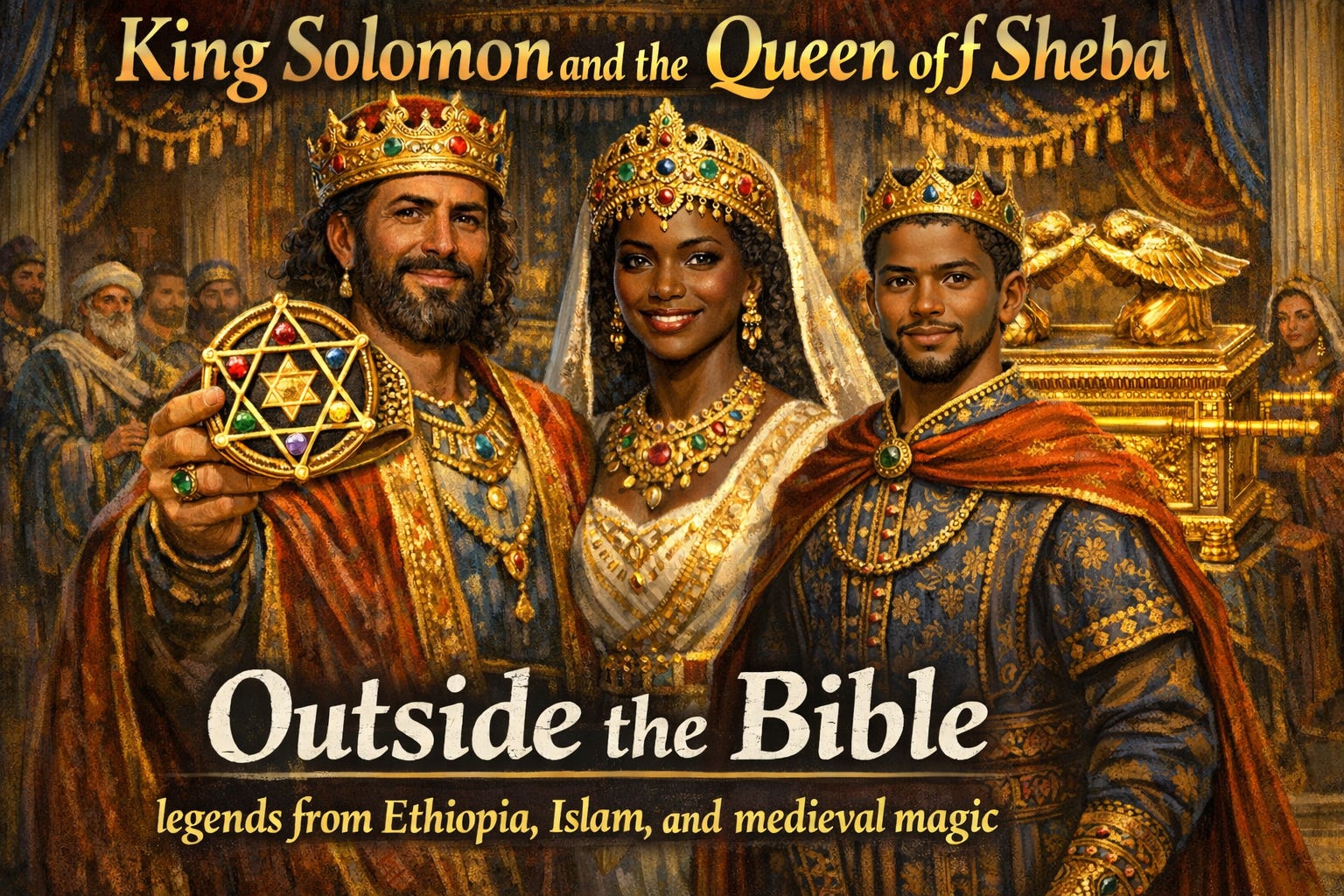
This week on Goddess Bible Study, we conclude our deep dive into King Solomon, the father of the wisdom traditions, with some of his legends outside the Bible.
Our favorite goddess worshipper is arguably the most celebrated biblical figure over the centuries, across many cultures. King Solomon looms large in the religious traditions of Ethiopia, the spiritual legends of the Islamic world, and the magical traditions of Renaissance Europe.
Queen of Sheba
We will start with one short passage from the Bible, the famous story of the Queen of Sheba, which inspired profound traditions in Ethiopia that live on to this day.
The Queen of Sheba visited King Solomon. The beautiful Queen had heard of Solomon’s great wisdom and wealth and wanted to see for herself. She came bearing fabulous gifts and departed with many of her own.
In Ethiopian legend, the King and Queen had a child of noble birth and historic importance. By tradition, the Queen is believed to have come from Ethiopia, though many scholars say the location was more likely Yemen (especially Yemeni scholars).
When the queen of Sheba heard about the fame of Solomon and his relationship to Yahweh, she came to test Solomon with hard questions. Arriving at Jerusalem with a very great caravan - with camels carrying spices, large quantities of gold, and precious stones - she came to Solomon and talked with him about all that she had on her mind. Solomon answered all her questions; nothing was too hard for the king to explain to her.
When the queen of Sheba saw all the wisdom of Solomon and the palace he had built, the food on his table, the seating of his officials, the attending servants in their robes, his cupbearers, and the burnt offerings he made at the Temple of Yahweh, she was overwhelmed. She said to the king, “The report I heard in my own country about your achievements and your wisdom is true. But I did not believe these things until I came and saw with my own eyes. Indeed, not even half was told me; in wisdom and wealth, you have far exceeded the report I heard. How happy your people must be! How happy your officials, who continually stand before you and hear your wisdom!”...
King Solomon gave the queen of Sheba all she desired and asked for, besides what he had given her out of his royal bounty. Then she left and returned with her retinue to her own country.
-1 Kings 10:1-8; 13
Kebra Nagast
In Ethiopian tradition, the Queen of Sheba is named Makeda. She had a child with King Solomon named Menelik, who became king and patriarch of the Solomonic dynasty of Ethiopia. The Kebra Nagast, the “Glory of Kings,” is an Ethiopian sacred text written 1314-1322, but whose origins were centuries earlier. It expounds on many Biblical tales and presents the history of the Solomonic dynasty.
The Kebra Nagast tells the full story of the Queen of Sheba and King Solomon. It also tells how their son Menelik took the Ark of the Covenant with him back to Ethiopia, where it still resides today.
By tradition, the Ark of the Covenant is said to reside in a small chapel in the Ethiopian town of Axum under the careful watch of a single priest who will remain on duty until he dies. Tourists can visit the chapel, but no one is allowed in.
Menelik
The Kebra Nagast tells the story of how Menelik traveled from Ethiopia to Jerusalem to meet his father for the first time when he was 22 years old. As Menelik approached Jerusalem, the people who saw him were amazed at his resemblance to King Solomon. The people became excited, and Solomon soon learned of the regal visitor making his way to the palace.
When the king first saw Menelik, he knew immediately that the visitor was his son and embraced him warmly. No proof was required as their features and manner were so similar. Menelik displayed great bearing and wisdom even as a young man.
King Solomon brought Menelik into his chambers and arrayed him in gorgeous apparel, including a belt of gold and a crown. Solomon presented Menelik to all the nobles, who accepted him and gave him presents.
Solomon wanted Menelik to remain in Jerusalem and succeed him as king, but Menelik was anxious to return to Ethiopia and be king there.
Menelik knew that his half-brother Rehoboam had a claim to the throne in Jerusalem and would be a rival. Rehoboam was six years older and born to Solomon’s wife, while Makeda and Solomon were never married.
King Solomon was aware that Rehoboam lacked wisdom and would be a poor king. Solomon begged Menelik to stay, he offered him the kingdom and many wives and concubines, but Menelik would not be swayed.
Menelik had sworn on his mother’s breast that he would return home soon and not marry a woman in Israel. To swear by a woman’s breast was a serious matter.
Solomonic Dynasty
Solomon saw that it was impossible to keep Menelik in Jerusalem. So the king declared his intention to send the eldest sons of the nobles to Ethiopia, to found a new colony of Hebrews. Zadok the priest anointed Menelik King of Ethiopia inside the Holy of Holies, drenching him with the sacred cannabis oil. Menelik took the Hebrew name, David II, after his grandfather.
Not everyone was happy to leave Jerusalem, for the Ark of the Covenant contained the laws of God and brought good fortune to Israel. Some of Menelik’s men suggested that they secretly take the Ark with them. Some versions of the story say that Menelik knew of the plan, others say he did not.
Menelik’s men fashioned a wooden box that was a replica of the Ark, which was always kept covered under a sacred cloth. The men were not being completely selfish, for they knew that the Kingdom was not stable. Solomon was getting old, and many enemies were rising against him.
Ark of the Covenant
Menelik’s men were able to sneak the Ark of the Covenant out of the Temple because Yahweh wanted the Ark moved. The Ark was loaded onto a wagon and covered with baggage. Menelik received Solomon’s blessings and said farewell. As the caravan left Jerusalem, the men and women wailed, and the animals howled. King Solomon and his people knew instinctively that the glory of Israel had departed with the caravan.
As Menelik traveled, the caravan was led by the Archangel Michael, who cut a path and sheltered them from the heat. Neither man nor beast touched the ground with their feet, they were carried aloft with the speed of an eagle. The caravan traveled in one day a distance that normally took thirteen.
It was revealed to the entire company that they were in possession of the Ark of the Covenant. They all let out a great cheer, and Menelik vowed to establish the second Kingdom of God in Ethiopia.
King Menelik ruled honorably and fathered the Solomonic dynasty. The Ark of the Covenant has remained in Ethiopia until this day, 3000 years later.
When Zadok the priest discovered the Ark missing, he fainted on the spot. Solomon led his men in pursuit of the caravan, but it was too late. The king returned to Jerusalem and wept bitterly. King Solomon knew that the Ark of the Covenant could not have been carried off without Yahweh’s support, for the Ark is powerful and able to take care of itself. Previous usurpers had all been destroyed.
Satisfied that the will of God is irresistible, Solomon and the priests vowed to keep the disappearance of the Ark a secret. They allowed the duplicate box to remain in place, covered with cloth, lest enemies take advantage of their misfortune.
After King Solomon died, he was followed by his cruel and unwise son, Rehoboam. The ten northern tribes rebelled against the young king and formed the northern kingdom of Israel. The nation was split in two, never to be rejoined until modern times.
Pharaoh Shishak’s Invasion
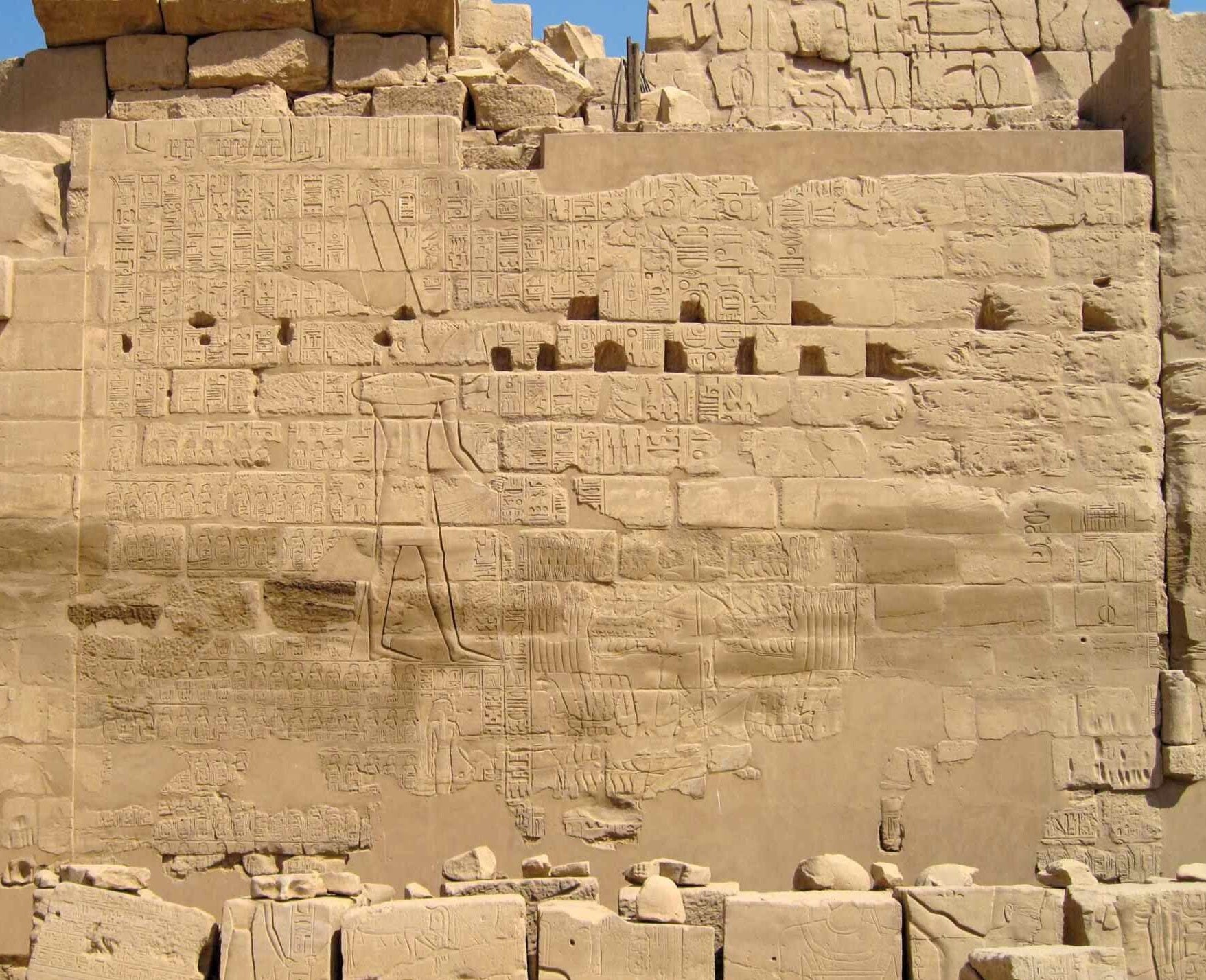
In Rehoboam’s fifth year, 925 BCE, Pharaoh Shishak of Egypt led a military campaign across Canaan. He attacked Judah and plundered the temple, taking away everything, so it was good that the Ark of the Covenant had already been moved to Africa. It is never mentioned again in the Biblical text.
In the fifth year of King Rehoboam, Shishak king of Egypt attacked Jerusalem. He carried off the treasures of the temple of Yahweh and the treasures of the royal palace. He took everything, including all the gold shields Solomon had made.
-1 Kings 14:25-26
Pharaoh Shishak’s invasion of Canaan was a real historical event recorded in both Egyptian records and the Bible, with the dates from both sources aligning perfectly.
Shishak recorded his campaign on the Bubasite Stele in Karnak, but unfortunately for us, the stele is heavily damaged. The sections about Jerusalem and Judah are not legible, and therefore, we don’t know what was taken from the Jerusalem temple, if anything. The Bible says that all the gold in the temple was taken by Shishak, but the proof text is lost to us.
Ethiopia
Ethiopia is the birthplace of humanity, the oldest human skeletons were found there, and it is where the migrations out of Africa originated. There are many important spiritual traditions in Ethiopia. To this day, Ethiopia has maintained the oldest continuous traditions of Judaism and Christianity. The country played an important role in the foundation of Islam, and was an inspiration to modern Rastafarians.
Beta Israel is an ancient tribe of Black Jews who live in Ethiopia and neighboring Eritrea. Beta Israel traces their heritage directly back to King Menelik and are pre-Rabbinic. They have unique traditions, and no one is sure of their most ancient origins, except that they migrated down the Nile River over time. The Black Jews are the keepers of the Ark of the Covenant, and the Kebra Nagast is one of their sacred texts.
The Ark of the Covenant is kept in a small chapel in the town of Axum (Aksum) where only a single priest, appointed for life, is allowed to see it. Apparently, Indiana Jones and the rest of the Protestants have not been well-informed, because they seem to think the Ark has been lost all this time.
Ethiopian Coptic Christians trace their roots back to the first century CE and the evangelizing of the Apostle Matthew, who was one of the original 12 disciples of Jesus. Coptic traditions are as old as the Catholic Church, and they traditionally depict Jesus as black.
The Prophet Mohammed also visited Ethiopia in the early days of Islam to escape persecution and was given sanctuary. In thankfulness and respect for his hosts, Mohammed dictated in the Koran that jihad, holy war, should never be conducted in Ethiopia. When all the neighboring African countries became thoroughly Islamic, Ethiopia was spared. The native Ethiopian Jewish and Christian traditions were permitted to co-exist alongside Islam, an arrangement that has persisted to this day.
Emperor Haile Selassie
Modern Ethiopians trace their royal lineage back 3000 years, to King Solomon, Makeda, and Menelik. In practice, their royal line began in the 1200’s and continued unbroken to their last emperor in the 20th century, Haile Selassie.
Emperor Haile Selassie had a long career and was a major figure in international politics. Selassie successfully resisted European colonialism and fought an important war against fascist Italy in the 1930s. Ethiopia is the only African country not colonized by either Europeans or Islamists.
Haile Selassie was the last, and only true African royalty of the 20th century, during an era of rising African Black pride and independence. Haile Selassie was given equivalent honors to all the royalty in Europe and was hailed by Africans the world over, who were struggling to reclaim their identity after centuries of slavery and oppression. The Emperor helped to found the League of Nations and the United Nations, where he represented the voices of the colonized Africans.
Sadly, Haile Selassie was deposed and murdered by Marxist insurgents in 1975 under circumstances that remain disputed.
Haile Selassie was seen by some people to be a messiah, and he inspired a new religion in the 1930’s called Rastafari, though Selassie himself never claimed divine powers of any kind. This new religion was founded in Jamaica and empowered many pan-African liberationists, such as Marcus Garvey, who sought to overthrow the European colonial powers dominating Africa. The most famous Rastafarian is the late Reggae musician Bob Marley, and the religion continues to have a strong community to this day.
King Solomon in Islam
King Solomon (Sulayman in Arabic) is a towering figure in Islamic culture. He appears in the Koran and is widely celebrated in Arab folklore, literature, and occult traditions, often depicted as the ultimate master of the supernatural. The Koran portrays him as a prophet-king, while broader Arab culture expanded his persona into a legendary mage and a central character in epic storytelling.
In popular Arab legends, Solomon’s power is physically tied to the Seal of Solomon (Khatam Sulayman), a miraculous signet ring that contains his seal of intertwined triangles and precious stones. The ring gives Solomon power over jinn, animals, and the elements, and was his protective amulet.
Solomon appears frequently in the Arabian Nights (Alf Layla wa-Layla) as the “Lord of the Age” who imprisons disobedient Jinn.
In stories like “The Fisherman and the Jinni,” Solomon is the one who sealed rebellious spirits in copper carafes with leaden seals, throwing them into the sea to remain until found by unsuspecting humans centuries later. He is often associated with the construction of legendary, unreachable cities made of metal or glass, where his magical legacies are guarded by mechanical automata or trapped spirits.
Occult and Esoteric Traditions
Solomon is a foundational figure in Arabic grimoires and “books of wonders.” He is viewed as the “Grandmaster” of all secret knowledge, including alchemy and the summoning of spirits. Works like those of Ahmed al-Buni (a famous 13th-century occultist) attribute complex magical squares and talismans to Solomon’s wisdom.
Arab folklore attributes the construction of various ancient megalithic sites—such as Palmyra (Tadmur) in Syria and Persepolis in Iran—to Solomon’s Jinn, claiming only supernatural labor could move such massive stones.
Solomon’s wisdom is so ingrained that he is a frequent subject in Arabic poetry and idioms. To say someone has “the wisdom of Solomon” or to reference his ability to “hear the whisper of the ant” is a common way to denote extreme perception or justice in Arabic literary culture.
The Hoopoe, or Messenger Bird, Solomon’s scout, remains a symbol of loyalty and the “bearer of news” in traditional Arab imagery.
Solomonic Magic
King Solomon continued to inspire people’s imaginations for thousands of years. Solomonic magic is a system of European ceremonial magic rooted in Medieval and Renaissance grimoires attributed to the Biblical King Solomon. A grimoire is a book of spells and incantations.
The three great European grimoires are the Key of Solomon and the Lesser Key of Solomon, which focus on rituals and preparations of the magicians, and also the Testament of Solomon, which is written in the first person and describes how Solomon created the magical ring of Andaleeb and used it to control demons and build the First Temple in Jerusalem. The Key and Lesser Key of Solomon are likely medieval texts, while the Testament of Solomon may be much older, going back to the 1st century AD. Scholars have no consensus on when the texts were written.
Aleister Crowley and co-writers translated all three texts from the original Greek language into English and compiled them into a single book, “The Three Magical Books of Solomon.”
Another famous grimoire is the Hygromanteia, the Magical Treatise of Solomon. This is a 16th-century Byzantine work that serves as a bridge between late antique Greek magic and later European traditions. The book was written in medieval Greek and contains various magical techniques and tools, as well as guides for how to summon and control spirits and demons.
King Solomon’s wisdom, wealth, magic, poetry, and sensuality are all gifts of the divine Mother. These attributes are all seen in the traditions of Isis and the Hindu goddesses, and that is a lesson we can take with us.
I don’t think it is an accident that the goddess-worshipping King Solomon is the most popular and enduring Bible character outside the Bible, with more stories and traditions than anyone else. He is the one character that people seem to feel free to write new stories about, outside the sacred scriptures, without being accused of blasphemy and heresy.
I think it is because the goddess brings undeniable authority of her own.
In the next few weeks, we will focus on some specific topics before jumping back into Bible history in the book of Kings.
First, a topic near and dear to my heart. We will do a complete breakdown on the evidence of cannabis in the Bible, the subject that got me started on the path of the goddess.
Second, another timely political topic, transgenders! Most people don’t know that there are transexual eunuchs in the Bible called the holy ones. They are the male counterparts of the qedesha priestesses. The male qadesh are only mentioned when they are being chased away, but they are mentioned.
Trans folks were high priests of the goddesses across many pagan cultures, and there is a rich set of traditions for them in the ancient world.
Third, we will dig into the evidence for child sacrifice rituals among the Canaanites, which I believe was real. Eliminating child sacrifice was one of the central reforms the Hebrew prophets were trying to achieve, and I think most modern folks can thank them for their efforts.
Reach out:
goddessbiblestudy@gmail.com
Live discussion Tuesday, April 7 at 7 pm EST.