

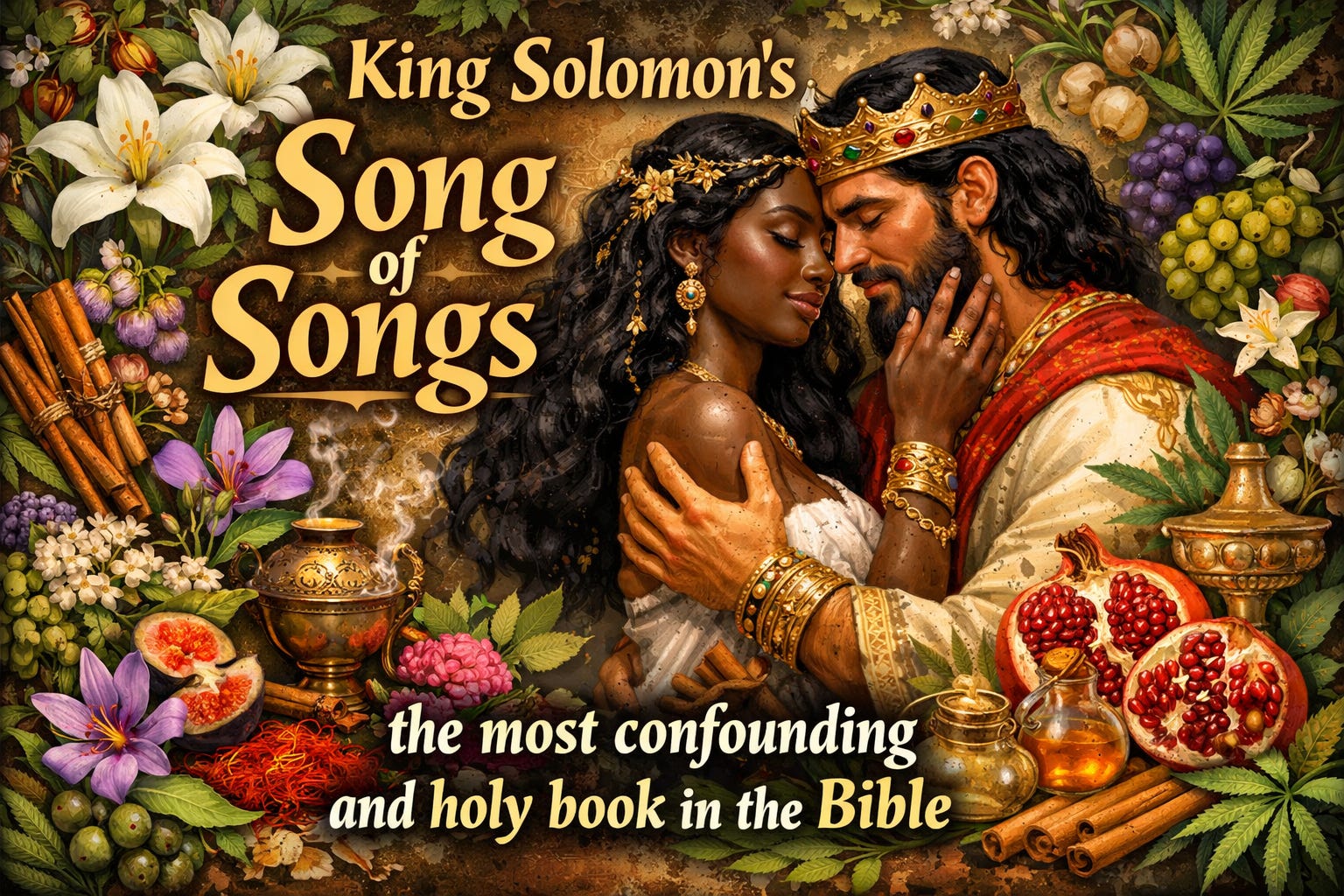
This week on Goddess Bible Study, we continue with King Solomon, our favorite Biblical goddess worshipper.
In this episode, we focus on the Song of Songs, also called the Song of Solomon, or the Canticles. It is the most confounding book in the Bible, possibly the most popular, and arguably the most holy. It is also the most goddess-infused.
Song of Songs is the only openly romantic and erotic book in the Bible, and it gives more voice to a woman than any other. It makes no mention of God or anything particularly spiritual, yet rabbis treat it as very holy. It is traditionally read in synagogues on the Shabbat of Passover, and also at weddings.
Song of Songs is a collection of steamy, sultry love poetry, completely lacking in religious content, full of detailed descriptions of the lovers’ relations and naked bodies. There is no mention of God, piety, moral instruction, deliberations over justice, or the fate of humankind. It never mentions Israel, its history, or its covenant.
It is a love song of passion and devotion between the groom and his beautiful new bride. It is among the most difficult books to interpret in the Bible and provides some of the greatest hermeneutical challenges. How is a sexy love poem revealed by God Almighty?
This question was hotly disputed when the final canon of the Hebrew Bible was determined at the Council of Jamnia in 90 AD. Jamnia was the main spiritual center in Israel after Jerusalem, and the 2nd temple were destroyed. The Song of Solomon and Ecclesiastes, another late text also attributed to Solomon, were the last selected for canonization, after a fierce debate.
The highly respected Rabbi Aqiva carried the day with his famous declaration:
All eternity is not as worthwhile as the day the Song of Songs was given to Israel, for all biblical books are holy, but the Song of Songs is holy of holies.
Whoever warbles the Song of Songs in the banquet-hall and makes it into a kind of love-song has no portion in the world-to-come.
-Rabbi Aqiva - 90 AD, Council of Jamnia, Israel
The song is credited to King Solomon, who lived in the 10th century BC, but no one believes he actually wrote it. By tradition, King Solomon was known for his wisdom, poetry, and his love of learning. He also had 700 wives and 300 concubines.
Most scholars believe Song of Songs is a late text, written in the Hellenistic era, perhaps the 3rd century BC, but there is no consensus on who wrote it, when, or who the characters are.
The song clearly comes from the tradition of Babylonian hieros gamos love poetry that goes back to Bronze Age sacred marriage rituals, joining the king with the great goddess. King Solomon worshipped the love goddess Astarte and may have taken part in the rituals personally. The old goddess-worshiping traditions had an entire genre of sacred love poetry that was read aloud during hieros gamos celebrations.
The Bride is unnamed, and the groom’s identity is ambiguous, he may or may not be Solomon. By tradition, she is thought to be the Pharaoh’s daughter, but of course, Solomon had many wives. In the verses, she is said to be from Lebanon. The bride is dark-skinned, and Solomon has black hair.
There is heavy garden imagery throughout. Songs 4:14 mentions cannabis (qaneh) in a list of aromatic and psychoactive herbs, but it is usually translated as calamus, so readers miss the cannabis reference.
Theologians generally view the Song of Songs as an allegory of God’s love for Israel if one is Jewish, or Christ’s love for the church for Christians, and of the redemptive history of Israel.
One may see the Song of Songs as God’s love for the Goddess, his bride, Mother Nature, and all of creation.
Muslims believe the Song is about the Prophet Muhammad. They believe the word “altogether lovely” (mhmdym) in the following verse translates as the name of Muhammad because it sounds similar.
His mouth is sweetness itself; he is altogether lovely. This is my beloved, this is my friend, daughters of Jerusalem.
-Song of Songs 5:16
Here, the legendary Billy Graham gives his take. The Song of Songs is God’s love affair with humanity.
The Song advances through a few sections, first the bride and groom describe their love for one another, and she lists his virtues to her friends, perhaps the bridesmaids. Then there is the wedding day and celebration, as well as absence, longing, and searching for one another. The song is circuitous and meandering, and one can see why it is tricky to understand.
Here is the entire Song of Songs from the NIV, New International Version.
I.
Solomon’s Song of Songs.
She
Let him kiss me with the kisses of his mouth—
for your love is more delightful than wine.
Pleasing is the fragrance of your perfumes;
your name is like perfume poured out.
No wonder the young women love you!
Take me away with you—let us hurry!
Let the king bring me into his chambers.
Friends
We rejoice and delight in you;
we will praise your love more than wine.
She
How right they are to adore you!
Dark am I, yet lovely,
daughters of Jerusalem,
dark like the tents of Kedar,
like the tent curtains of Solomon.
Do not stare at me because I am dark,
because I am darkened by the sun.
My mother’s sons were angry with me
and made me take care of the vineyards;
my own vineyard I had to neglect.
Tell me, you whom I love,
where you graze your flock
and where you rest your sheep at midday.
Why should I be like a veiled woman
beside the flocks of your friends?
Friends
If you do not know, most beautiful of women,
follow the tracks of the sheep
and graze your young goats
by the tents of the shepherds.
He
I liken you, my darling, to a mare
among Pharaoh’s chariot horses.
Your cheeks are beautiful with earrings,
your neck with strings of jewels.
We will make you earrings of gold,
studded with silver.
She
While the king was at his table,
my perfume spread its fragrance.
My beloved is to me a sachet of myrrh
resting between my breasts.
My beloved is to me a cluster of henna blossoms
from the vineyards of En Gedi.
He
How beautiful you are, my darling!
Oh, how beautiful!
Your eyes are doves.
She
How handsome you are, my beloved!
Oh, how charming!
And our bed is verdant.
He
The beams of our house are cedars;
our rafters are firs.
II
She
I am a rose of Sharon,
a lily of the valleys.
He
Like a lily among thorns
is my darling among the young women.
She
Like an apple tree among the trees of the forest
is my beloved among the young men.
I delight to sit in his shade,
and his fruit is sweet to my taste.
Let him lead me to the banquet hall,
and let his banner over me be love.
Strengthen me with raisins,
refresh me with apples,
for I am faint with love.
His left arm is under my head,
and his right arm embraces me.
Daughters of Jerusalem, I charge you
by the gazelles and by the does of the field:
Do not arouse or awaken love
until it so desires.
Listen! My beloved!
Look! Here he comes,
leaping across the mountains,
bounding over the hills.
My beloved is like a gazelle or a young stag.
Look! There he stands behind our wall,
gazing through the windows,
peering through the lattice.
My beloved spoke and said to me,
“Arise, my darling,
my beautiful one, come with me.
See! The winter is past;
the rains are over and gone.
Flowers appear on the earth;
the season of singing has come,
the cooing of doves
is heard in our land.
The fig tree forms its early fruit;
the blossoming vines spread their fragrance.
Arise, come, my darling;
my beautiful one, come with me.”
He
My dove in the clefts of the rock,
in the hiding places on the mountainside,
show me your face,
let me hear your voice;
for your voice is sweet,
and your face is lovely.
Catch for us the foxes,
the little foxes
that ruin the vineyards,
our vineyards that are in bloom.
She
My beloved is mine and I am his;
he browses among the lilies.
Until the day breaks
and the shadows flee,
turn, my beloved,
and be like a gazelle
or like a young stag
on the rugged hills.
III
All night long on my bed
I looked for the one my heart loves;
I looked for him but did not find him.
I will get up now and go about the city,
through its streets and squares;
I will search for the one my heart loves.
So I looked for him but did not find him.
The watchmen found me
as they made their rounds in the city.
“Have you seen the one my heart loves?”
Scarcely had I passed them
when I found the one my heart loves.
I held him and would not let him go
till I had brought him to my mother’s house,
to the room of the one who conceived me.
Daughters of Jerusalem, I charge you
by the gazelles and by the does of the field:
Do not arouse or awaken love
until it so desires.
Who is this coming up from the wilderness
like a column of smoke,
perfumed with myrrh and incense
made from all the spices of the merchant?
Look! It is Solomon’s carriage,
escorted by sixty warriors,
the noblest of Israel,
all of them wearing the sword,
all experienced in battle,
each with his sword at his side,
prepared for the terrors of the night.
King Solomon made for himself the carriage;
he made it of wood from Lebanon.
Its posts he made of silver,
its base of gold.
Its seat was upholstered with purple,
its interior inlaid with love.
Daughters of Jerusalem, come out,
and look, you daughters of Zion.
Look on King Solomon wearing a crown,
the crown with which his mother crowned him
on the day of his wedding,
the day his heart rejoiced.
IV
He
How beautiful you are, my darling!
Oh, how beautiful!
Your eyes behind your veil are doves.
Your hair is like a flock of goats
descending from the hills of Gilead.
Your teeth are like a flock of sheep just shorn,
coming up from the washing.
Each has its twin;
not one of them is alone.
Your lips are like a scarlet ribbon;
your mouth is lovely.
Your temples behind your veil
are like the halves of a pomegranate.
Your neck is like the tower of David,
built with courses of stone;
on it hang a thousand shields,
all of them shields of warriors.
Your breasts are like two fawns,
like twin fawns of a gazelle
that browse among the lilies.
Until the day breaks
and the shadows flee,
I will go to the mountain of myrrh
and to the hill of incense.
You are altogether beautiful, my darling;
there is no flaw in you.
Come with me from Lebanon, my bride,
come with me from Lebanon.
Descend from the crest of Amana,
from the top of Senir, the summit of Hermon,
from the lions’ dens
and the mountain haunts of leopards.
You have stolen my heart, my sister, my bride;
you have stolen my heart
with one glance of your eyes,
with one jewel of your necklace.
How delightful is your love, my sister, my bride!
How much more pleasing is your love than wine,
and the fragrance of your perfume
more than any spice!
Your lips drop sweetness as the honeycomb, my bride;
milk and honey are under your tongue.
The fragrance of your garments
is like the fragrance of Lebanon.
You are a garden locked up, my sister, my bride;
you are a spring enclosed, a sealed fountain.
Your plants are an orchard of pomegranates
with choice fruits,
with henna and nard,
nard and saffron,
cannabis and cinnamon,
with every kind of incense tree,
with myrrh and aloes
and all the finest spices.
You are a garden fountain,
a well of flowing water
streaming down from Lebanon.
She
Awake, north wind,
and come, south wind!
Blow on my garden,
that its fragrance may spread everywhere.
Let my beloved come into his garden
and taste its choice fruits.
V
He
I have come into my garden, my sister, my bride;
I have gathered my myrrh with my spice.
I have eaten my honeycomb and my honey;
I have drunk my wine and my milk.
Friends
Eat, friends, and drink;
drink your fill of love.
She
I slept but my heart was awake.
Listen! My beloved is knocking:
“Open to me, my sister, my darling,
my dove, my flawless one.
My head is drenched with dew,
my hair with the dampness of the night.”
I have taken off my robe—
must I put it on again?
I have washed my feet—
must I soil them again?
My beloved thrust his hand through the latch-opening;
my heart began to pound for him.
I arose to open for my beloved,
and my hands dripped with myrrh,
my fingers with flowing myrrh,
on the handles of the bolt.
I opened for my beloved,
but my beloved had left; he was gone.
My heart sank at his departure.
I looked for him but did not find him.
I called him but he did not answer.
The watchmen found me
as they made their rounds in the city.
They beat me, they bruised me;
they took away my cloak,
those watchmen of the walls!
Daughters of Jerusalem, I charge you—
if you find my beloved,
what will you tell him?
Tell him I am faint with love.
Friends
How is your beloved better than others,
most beautiful of women?
How is your beloved better than others,
that you so charge us?
She
My beloved is radiant and ruddy,
outstanding among ten thousand.
His head is purest gold;
his hair is wavy
and black as a raven.
His eyes are like doves
by the water streams,
washed in milk,
mounted like jewels.
His cheeks are like beds of spice
yielding perfume.
His lips are like lilies
dripping with myrrh.
His arms are rods of gold
set with topaz.
His body is like polished ivory
decorated with lapis lazuli.
His legs are pillars of marble
set on bases of pure gold.
His appearance is like Lebanon,
choice as its cedars.
His mouth is sweetness itself;
he is altogether lovely.
This is my beloved, this is my friend,
daughters of Jerusalem.
VI
Friends
Where has your beloved gone,
most beautiful of women?
Which way did your beloved turn,
that we may look for him with you?
She
My beloved has gone down to his garden,
to the beds of spices,
to browse in the gardens
and to gather lilies.
I am my beloved’s and my beloved is mine;
he browses among the lilies.
He
You are as beautiful as Tirzah, my darling,
as lovely as Jerusalem,
as majestic as troops with banners.
Turn your eyes from me;
they overwhelm me.
Your hair is like a flock of goats
descending from Gilead.
Your teeth are like a flock of sheep
coming up from the washing.
Each has its twin,
not one of them is missing.
Your temples behind your veil
are like the halves of a pomegranate.
Sixty queens there may be,
and eighty concubines,
and virgins beyond number;
but my dove, my perfect one, is unique,
the only daughter of her mother,
the favorite of the one who bore her.
The young women saw her and called her blessed;
the queens and concubines praised her.
Friends
Who is this that appears like the dawn,
fair as the moon, bright as the sun,
majestic as the stars in procession?
He
I went down to the grove of nut trees
to look at the new growth in the valley,
to see if the vines had budded
or the pomegranates were in bloom.
Before I realized it,
my desire set me among the royal chariots of my people.
Friends
Come back, come back, O Shulammite;
come back, come back, that we may gaze on you!
He
Why would you gaze on the Shulammite
as on the dance of Mahanaim?
VII
How beautiful your sandaled feet,
O prince’s daughter!
Your graceful legs are like jewels,
the work of an artist’s hands.
Your navel is a rounded goblet
that never lacks blended wine.
Your waist is a mound of wheat
encircled by lilies.
Your breasts are like two fawns,
like twin fawns of a gazelle.
Your neck is like an ivory tower.
Your eyes are the pools of Heshbon
by the gate of Bath Rabbim.
Your nose is like the tower of Lebanon
looking toward Damascus.
Your head crowns you like Mount Carmel.
Your hair is like royal tapestry;
the king is held captive by its tresses.
How beautiful you are and how pleasing,
my love, with your delights!
Your stature is like that of the palm,
and your breasts like clusters of fruit.
I said, “I will climb the palm tree;
I will take hold of its fruit.”
May your breasts be like clusters of grapes on the vine,
the fragrance of your breath like apples,
and your mouth like the best wine.
She
May the wine go straight to my beloved,
flowing gently over lips and teeth.
I belong to my beloved,
and his desire is for me.
Come, my beloved, let us go to the countryside,
let us spend the night in the villages.
Let us go early to the vineyards
to see if the vines have budded,
if their blossoms have opened,
and if the pomegranates are in bloom—
there I will give you my love.
The mandrakes send out their fragrance,
and at our door is every delicacy,
both new and old,
that I have stored up for you, my beloved.
VIII
If only you were to me like a brother,
who was nursed at my mother’s breasts!
Then, if I found you outside,
I would kiss you,
and no one would despise me.
I would lead you
and bring you to my mother’s house—
she who has taught me.
I would give you spiced wine to drink,
the nectar of my pomegranates.
His left arm is under my head
and his right arm embraces me.
Daughters of Jerusalem, I charge you:
Do not arouse or awaken love
until it so desires.
Friends
Who is this coming up from the wilderness
leaning on her beloved?
She
Under the apple tree I roused you;
there your mother conceived you,
there she who was in labor gave you birth.
Place me like a seal over your heart,
like a seal on your arm;
for love is as strong as death,
its jealousy unyielding as the grave.
It burns like blazing fire,
like a mighty flame.
Many waters cannot quench love;
rivers cannot sweep it away.
If one were to give
all the wealth of one’s house for love,
it would be utterly scorned.
Friends
We have a little sister,
and her breasts are not yet grown.
What shall we do for our sister
on the day she is spoken for?
If she is a wall,
we will build towers of silver on her.
If she is a door,
we will enclose her with panels of cedar.
She
I am a wall,
and my breasts are like towers.
Thus I have become in his eyes
like one bringing contentment.
Solomon had a vineyard in Baal Hamon;
he let out his vineyard to tenants.
Each was to bring for its fruit
a thousand shekels of silver.
But my own vineyard is mine to give;
the thousand shekels are for you, Solomon,
and two hundred are for those who tend its fruit.
He
You who dwell in the gardens
with friends in attendance,
let me hear your voice!
She
Come away, my beloved,
and be like a gazelle
or like a young stag
on the spice-laden mountains.
Next week is possibly our last devoted to King Solomon, if we can get through all the remaining material. We will dive into the extra-biblical legends of King Solomon, particularly the Ethiopian traditions of the Kebra Nagast, featuring the Queen of Sheba, Menelik, and the Ark of the Covenant. As well as Islamic traditions, and Solomonic magic from medieval Europe.
We will discuss on the podcast, livestreaming on Tuesday, March 24, at 7 pm EST.
goddessbiblestudy@gmail.com