

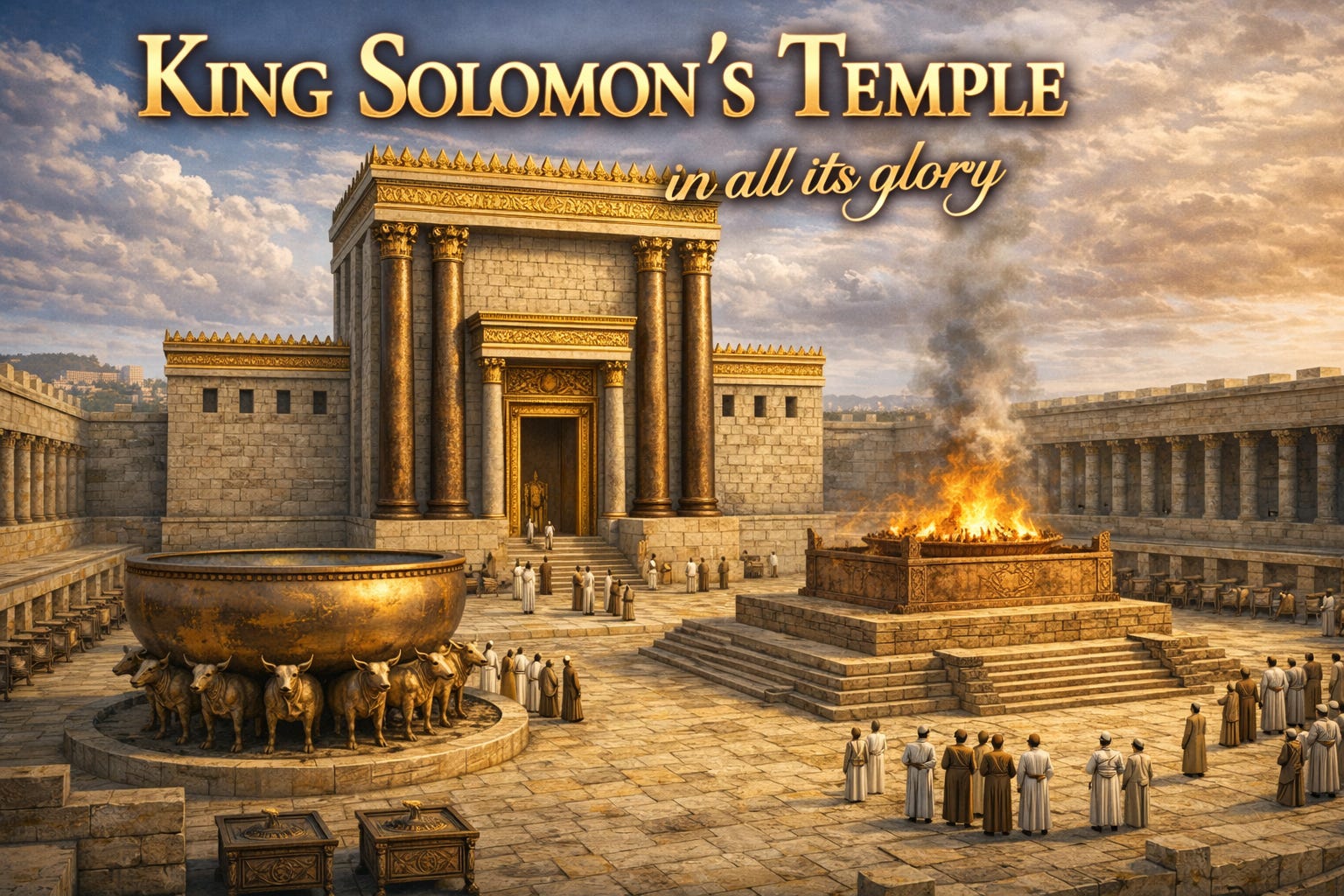
We continue with King Solomon on Goddess Bible Study, our favorite goddess-worshipping wiseman. I must confess that this post is a bit of a cheat, I am repeating the Biblical material about King Solomon’s temple that we did not get to last week.
We spent the entire previous podcast discussing the potential for a Third Temple in today’s Israel and the implications for WW3. I am personally quite pessimistic and alarmist about current events, but no need to get into that now.
This week, we continue with our regularly scheduled programming and dive into the most glorious temple in the ancient world, according to the Bible.
The image above from ChatGPT is not perfect, here is a more accurate infographic of the temple. Courtesy of the Armstrong Institute of Biblical Archaeology.
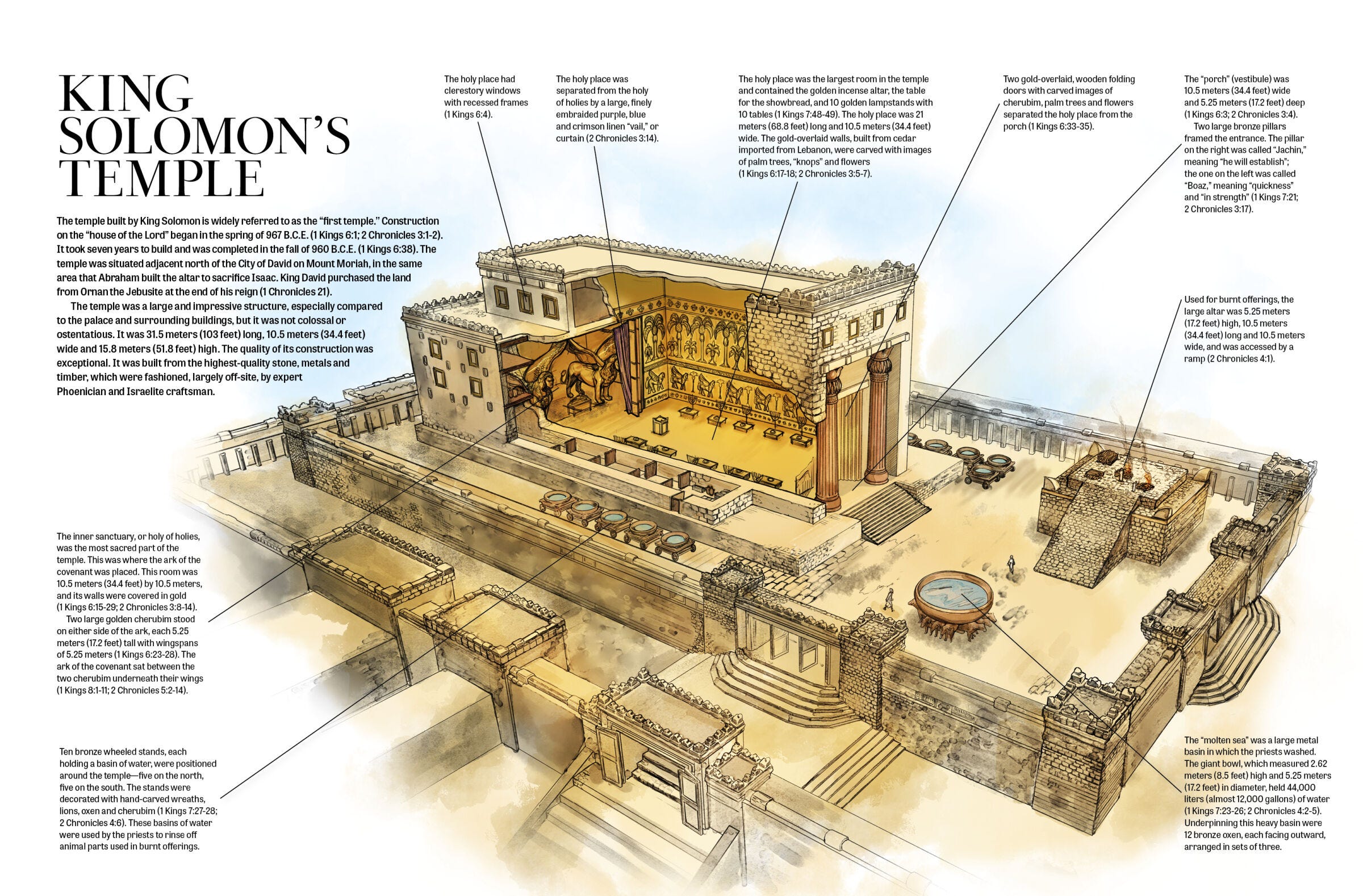
King Solomon’s Temple
King Solomon’s Temple was the first Hebrew temple in Jerusalem. It was built around 957 BCE on top of Mount Moriah, where a sacred stone is said to be the location where Abraham attempted to sacrifice his son, Isaac.
Extensive retaining walls and a platform were built on the steep hillsides to provide a location for the temple, which is known as the Temple Mount. The Holy of Holies at the heart of the temple is over the sacred foundation stone.
King Solomon was a pagan goddess worshipper, and an Asherah pole representing the mother goddess stood beside the altar to Yahweh in the temple for two-thirds of its history, roughly 240 out of 360 years, according to the eminent Jewish historian Raphael Patai, author of “The Hebrew Goddess.”
King Solomon’s temple was destroyed by the Babylonians in 586 BCE, sending the Israelites into exile. The Israelites were allowed to return after 70 years when the Persian King Cyrus defeated the Babylonians. It is more than a bit ironic (or moronic) that the contemporary Israelis now find themselves at war to the death with the Persians.
A modest second temple was restored immediately, but it was dramatically rebuilt under King Herod around 18 BCE during Roman rule. The expanded Temple Mount was the largest religious building in the Roman Empire and among the most grand. Jesus visited this temple in the Gospels, and he was crucified nearby. The Second Temple was destroyed by the Romans in the year 70 CE after the Jews revolted.
Jerusalem was burned down by the Romans, but was rebuilt by Emperor Hadrian and renamed Aelia Capitolina in 130 CE after yet another Jewish revolt. A temple to Jupiter was built on the Temple Mount, and Jews were banned from the city.
In the 4th century, Emperor Constantine converted to Christianity and made it the Imperial religion. Jerusalem was consecrated as a holy Christian city. The temple to the goddess Venus near the Temple Mount was sanctified as the church of the Holy Sepulcher, the burial place of Jesus Christ.
The Roman city later fell into decline, and it was taken by the Muslims in 638 without a fight.
Wealth
The original United Kingdom of Israel reached its greatest territorial expanse under King Solomon in the 10th century BCE. He dominated the local tribes to the east, the Ammonites, Moabites, and Edomites, and sent his armies into Syria as well. He exacted tribute and forced the tribes to labor on his building projects. Palestine lies along important trade routes linking Africa to Asia and Europe.
Solomon had close and profitable relations with King Hiram of Tyre and the Phoenicians. With control of Edom, Israel had ports on both the Mediterranean and the Gulf of Aqaba on the Red Sea, enabling lucrative trade from the Atlantic Ocean to the Indian Ocean.
Solomon raised the kingdom to the heights of its commercial potential. He became fabulously wealthy, and the people were very happy. With trade came peace, and King Solomon ruled over a prosperous kingdom. At least, that is the story.
The people of Judah and Israel were as numerous as the sand on the seashore; they ate, they drank, and they were happy. And Solomon ruled over all the kingdoms from the Euphrates River to the land of the Philistines, as far as the border of Egypt. These countries brought tribute and were Solomon’s subjects all his life.
– 1 Kings 4:20-21
King Hiram of Tyre
King Solomon’s alliance with the Phoenician King Hiram of Tyre had previously been established by King David. The Tyrians were among the world’s great sailors, traders, and craftsmen, and they possessed the valuable cedar forests of Lebanon. King Hiram provided Solomon with all the cedar and juniper timber he wanted, and Solomon paid him in wheat and olive oil. Together, they engaged in wide-ranging and profitable trade.
King Solomon also built ships at Ezion Geber, which is near Elath in Edom, on the shore of the Red Sea. And Hiram sent his men--sailors who knew the sea--to serve in the fleet with Solomon’s men. They sailed to Ophir and brought back 420 talents of gold, which they delivered to King Solomon.
– 1 Kings 9:26-28
Gold from Ophir
King Solomon is reported to have been the richest king ever, his gold from Ophir is legendary. For centuries, people have searched for Solomon’s famous gold mines, but nothing definitive has been found.
King Solomon was said to be so wealthy that he used gold plates, goblets, and utensils, and that the people of Israel did not even bother using silver because it was as common as stones. Solomon amassed massive stores of gold, thousands of horses, cavalry, men, and chariots. We can assume the elaborate claims of wealth to be literary embellishments.
All King Solomon’s goblets were gold, and all the household articles in the Palace of the Forest of Lebanon were pure gold. Nothing was made of silver, because silver was considered of little value in Solomon’s days.
The king had a fleet of trading ships at sea along with the ships of Hiram. Once every three years it returned, carrying gold, silver and ivory, and apes and baboons. King Solomon was greater in riches and wisdom than all the other kings of the earth.
The whole world sought audience with Solomon to hear the wisdom God had put in his heart. Year after year, everyone who came brought a gift – articles of silver and gold, robes, weapons and spices, and horses and mules.
Solomon accumulated chariots and horses; he had fourteen hundred chariots and twelve thousand horses, which he kept in the chariot cities and also with him in Jerusalem. The king made silver as common in Jerusalem as stones, and cedar as plentiful as sycamore-fig trees in the foothills.
– 1 Kings 10:21-27
Building Projects
Solomon went on an extensive building campaign throughout the country. According to the Bible, he built garrison towns for his cavalry, and the fortified cities of Hazor, Megiddo, and Gezer, along with impressive water conduits that allowed cities to withstand sieges.
Solomon was especially lavish with his capital, Jerusalem; he built a great wall and terraces to support buildings and paid particular attention to the new temple and royal palace. Solomon also built temples and tolerated the worship of foreign gods by travelers and visitors on trade missions. Solomon put thousands of men into forced labor to build his palace, temple, and other civil works.
Solomon conscripted the descendants of all these peoples remaining in the land, whom the Israelites could not exterminate, to serve as slave labor, as it is to this day. But Solomon did not make slaves of any of the Israelites; they were his fighting men, his government officials, his officers, his captains, and the commanders of his chariots and charioteers.
– 1 Kings 9:21-22
In time, Solomon’s ill-treatment of his slaves and laborers led to the revolt that split the kingdom of Israel. Although the Yahwist prophets and Biblical writers would scapegoat his goddess worship instead.
Hiram Abiff
Modern Freemason mythology centers on King Solomon’s architect and his tragic murder.
King Hiram sent architects and skilled craftsmen to help King Solomon build his temples and other projects. Chief among them was Hiram Abiff, the widow’s son from Tyre. Hiram Abiff was skilled in every kind of bronze work, and Solomon appointed him to be chief architect and Master of Works.
And King Solomon sent and fetched Hiram out of Tyre. He was a widow’s son of the tribe of Naphtali, and his father was a man of Tyre, a worker in brass: and he was filled with wisdom, and understanding, and cunning to work all works in brass. And he came to King Solomon and wrought all his work.
– 1 Kings 7:13-14 (KJV)
Hiram Abiff constructed Solomon’s grand throne made of ivory and overlaid with gold, with six steps, two lions stood beside the armrests, and twelve more lions stood beside the six steps. A throne of lions fit for a king, or for a goddess.
Then the king made a great throne covered with ivory and overlaid with fine gold. The throne had six steps, and its back had a rounded top. On both sides of the seat were armrests, with a lion standing beside each of them. Twelve lions stood on the six steps, one at either end of each step. Nothing like it had ever been made for any other kingdom.
– 1 Kings 10:18-20
The lion throne is another clear indication of Solomon’s goddess worship. This tradition goes back to Catal Huyuk, but the Biblical writers seem to think it was unique. The goddess Cybele sat in a similar lion throne a thousand years later in Rome.
Solomon’s Temple
King Solomon constructed the legendary first Hebrew Temple in Jerusalem. It took seven years to build. The Temple’s magnificence is detailed in the Bible and has long been extolled in legend. King Hiram of Tyre provided the materials and skilled workmen, and the Temple was built in the style of pagan temples of the era.
The Biblical description of Solomon’s Temple suggests that the inside ceiling was 60 cubits long (90 feet), 20 cubits wide (30 feet), and 30 cubits high (45 feet). Solomon’s Temple had a three-room plan with an inner sanctum at the rear. The temple was built from stone and cedar, and the construction consisted of finely hewn masonry combined with carved wooden cherubs and bronze basins. The inner walls were overlaid with carved cedar and completely gilded with gold.
The temple was decorated in a Garden of Eden motif of cherubs and verdant vegetation; palm trees, open flowers, pomegranates, gourds, lions, and oxen. The cherubim appear like angels with wings. There was a pair of large cherubim statues that guarded the Ark of the Covenant in the Holy of Holies, an interior room no one was allowed into except the high priest.
The plans of the building were Phoenician in origin, and the materials, skilled workmen, and architects were delivered by King Hiram of Tyre. Archaeologists have uncovered pagan temples virtually identical to Solomon’s from the same era. The Ain Dara temple to Astarte in Syria has the same layout and was operating from 1300 BCE to 740 BCE, the same period as Solomon’s.
The inside of the temple was cedar, carved with gourds and open flowers. Everything was cedar; no stone was to be seen.
Solomon covered the inside of the temple with pure gold, and he extended gold chains across the front of the inner sanctuary, which was overlaid with gold. So he overlaid the whole interior with gold. He also overlaid with gold the altar that belonged to the inner sanctuary.
– 1 Kings 6:18; 21-22
He placed the cherubim inside the innermost room of the temple, with their wings spread out. The wing of one cherub touched one wall, while the wing of the other touched the other wall, and their wings touched each other in the middle of the room. He overlaid the cherubim with gold. On the walls all around the temple, in both the inner and outer rooms, he carved cherubim, palm trees and open flowers. He also cov- ered the floors of both the inner and outer rooms of the temple with gold.
– 1 Kings 6:27-30
Holy Smoke
When the priests dedicated the temple and brought the Ark of the Covenant into the Holy of Holies, a thick cloud of smoke, the Shekinah, filled the temple and prevented the completion of the rituals.
The priests then brought the ark of Yahweh’s covenant to its place in the inner sanctuary of the temple, the Most Holy Place, and put it beneath the wings of the cherubim. When the priests withdrew from the Holy Place, the cloud filled the temple of Yahweh. And the priests could not perform their service because of the cloud, for the glory of Yahweh filled his temple.
– 1 Kings 8:6; 10-11
The Shekinah, the presence of God, manifests as a cloud of smoke that filled the Temple.
Then the temple of Yahweh was filled with the cloud, and the priests could not perform their service because of the cloud, for the glory of Yahweh filled the temple of God.
– 2 Chronicles 5:13-14
Phoenician Megalithic Stones
Final bonus, deep inside one of the retaining walls on the western side of the Temple Mount, where the Jews have been allowed to excavate, they discovered one of the largest megalithic stones ever used anywhere in the world.
This stone is estimated to weigh 570 tons and is similar in style to the stones used in Baalbek, Lebanon. Even though this wall is said to be Herodian, the Romans never worked stones so large. This stonework is thought to be the work of the Phoenicians, if not some earlier culture. King Hiram of Tyre was a Phoenician, so that would track with the Biblical text.
Live discussion on Tuesday, March 17 at 7pm EST.
Reach out at:
goddessbiblestudy@gmail.com