

We are back to the Bible this week on Goddess Bible Study with Moses and the Exodus.
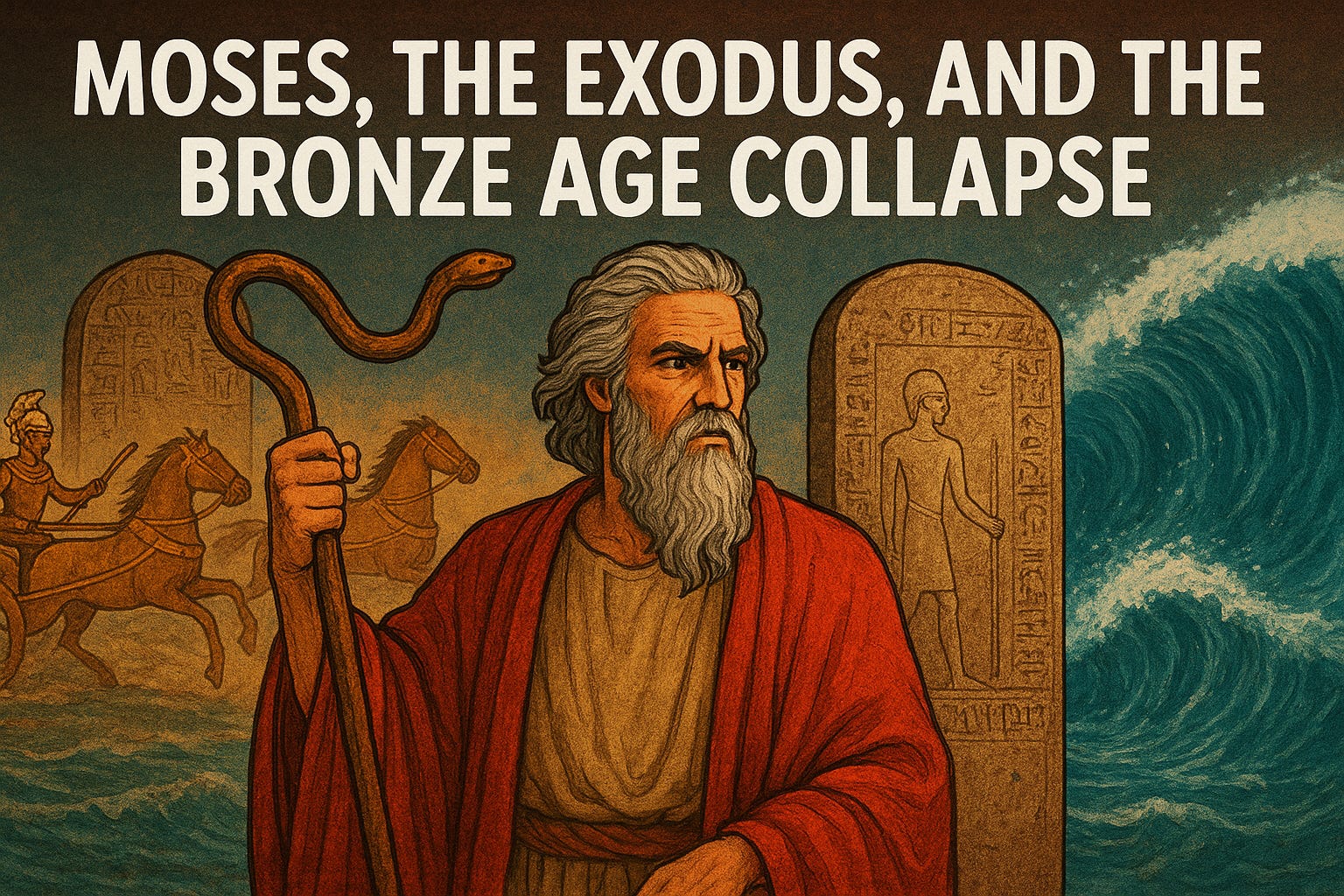
I am going out on a scholarly limb with this topic and am arguing that the Exodus is rooted in an actual slave escape from Egypt, and that we can put it on the historical timeline around 1209 BCE during the Bronze Age Collapse. This would make the Exodus contemporary to the Trojan War, which we discussed last week.
We will get into the character of Moses more in subsequent sessions. Here, we focus on the historical timeline and the evidence we have to work with.
I believe that the first mention of Israel in archaeology, Pharaoh Merneptah’s victory stele, and one of the oldest passages in the Bible, the Song of the Sea (Exodus 15), are speaking to the same event, a slave escape during the chaotic years when Egypt was repeatedly invaded.
The Song of the Sea and the Song of Deborah are considered to be the oldest passages in the Bible because the language is archaic Hebrew. Most scholars believe they come from the oral tradition, perhaps mid-12th century BCE, centuries before written Hebrew emerged around 850 BCE.
The Exodus is a controversial subject due to its central importance to religious tradition. The dating is highly disputed. Religious tradition places the Exodus around 1450 BCE, while critical scholarship places any possible Exodus in the 1200s BCE or later. Plenty of scholars view the Bible stories as entirely fictional, or as a tapestry of different people’s memories stitched together, perhaps going as far back as the Hyksos.
The 15th century BCE is unlikely because Canaan was firmly under Egyptian control at that time, and their military dominance did not end until the Bronze Age Collapse around the 12th century BCE.
Scholars are in wide agreement that the Exodus did not happen as literally described. The Bible claims a population left Egypt of 600,000 fighting men, plus women and children, which is upwards of 2 million people. A group of that size would have been larger than the biggest cities of the ancient world, like Uruk, Babylon, and Nineveh, or the entire population of Canaan, and would have left some evidence for archeologists to find.
Scholars do recognize that there were plenty of Semitic peoples living in Egypt at the time, who were subjugated in the same places, such as Avaris, that scripture claims the Hebrews lived in.
Smaller groups of slaves escaping is perfectly reasonable, perhaps even an entire town’s worth of 15- 30,000 people. There exist many Egyptian records over the centuries describing the use of the army to capture escaped slaves, it is not unusual or remarkable.
So here is ED’s Exodus Timeline
1200s BCE - Egypt has ruled Canaan for centuries as a protective buffer state.
1209 BCE - Egypt is attacked by Libyans from the west and Sea Peoples from the Mediterranean. Iit was a costly fight, though the Egyptians prevailed.
Pharaoh Merneptah’s Victory Stele - details his glorious military campaign and describes Egypt’s continuing dominance in Canaan.
The stele features the first mention of Israel in the archaeological record.
The text describes Israel as a people, not a place, and says they have been wiped out.
“Canaan is captive with all woe. Ashkelon is conquered, Gezer seized, Yanoam made nonexistent; Israel is wasted, bare of seed”
Merneptah Stele, c. 1209 BCE
Most scholars view this as evidence that Israel was already in the land and the Exodus must have been earlier, around 1250 BCE.
I think it could be Egyptian propaganda downplaying the loss of a large group of Israelite slaves.
“Yahweh is a warrior. Pharaoh’s chariots and his army he has hurled into the sea.”
Song of the Sea (Exodus 15) - 12th C. BCE
All Egyptian royal writing was propaganda, celebrating victories and minimizing defeats.
Could the Israelites have taken advantage of the ongoing invasions to escape their bondage, fleeing the town of Avaris?
Archaeological record of Avaris matches the Biblical tale of Hebrew enslavement.
Avaris was once the capital of the Hyksos, and was then sacked and enslaved after the Hyksos were overthrown in 1550 BCE. Avaris declined in the 1200s and was finally abandoned in 1060 BCE.
1175 BCE - Battle of the Delta - Sea Peoples attack Egypt again
The Sea Peoples were repelled again, but at great cost to Egypt, whose power wobbled.
Wall Relief at Medinet Habu - inscriptions of the battle depict women and children loaded in ox carts, indicating that the attackers may have been refugees looking to settle.
This second war provides the timing and context for 40 years of wandering in the desert.
When the Israelites first escaped in 1209 BCE, Egypt still ruled Canaan, but their grip slipped 34 years later, allowing the Israelites to finally enter the promised land.
Canaanite cities had no defensive walls per Egyptian dictates, so the situation became dangerous in the power vacuum. Native peoples were forced to move around due to a breakdown in law and order.
People left the cities and made new hilltop settlements, not because they were comfortable or good for farming, but because they were defensible.
The Sea Peoples settled in the Gaza Strip and became the Philistines of the Bible. They were not present in the area earlier.
The Philistines, Moabites, Edomites, and Israelites all began to settle in Canaan, eventually forming the kingdoms seen in the Bible, which were new at the time.

1140 BCE - Pharaoh Ramses VI withdraws forces and ends Egyptian rule in Canaan.
This is the Biblical time period of Joshua, the Conquest of Canaan, and the Judges. All very chaotic and violent times.
Song of Deborah - When the people chose new gods, like Yahweh (and the Greek Olympians).
Israel chose new gods, then war was in the gates.
Song of Deborah (Judges 5) - 11th-12th C. BCE
1004 BCE - King David takes Jerusalem
850 BCE - Iron Age Kingdoms of Israel and Judah
Hebrew writing appears
During this illiterate time period, all knowledge was passed thru oral tradition. The Song of the Sea and the Song of Deborah are considered to be the oldest passages in the entire Bible due to linguistic clues indicating their archaic character.
Yahweh is a warrior; Yahweh is his name. Pharaoh’s chariots and his army he has hurled into the sea. The best of Pharaoh’s officers are drowned in the Reed Sea. The deep waters have covered them; they sank to the depths like a stone.
Exodus 15:3-5
Then Miriam the prophetess, the sister of Aaron, took a tambourine in her hand, and all the women went out after her with tambourines and dancing.
Exodus 15:20
The Song of the Sea is also known as Miriam’s Song since it was probably associated with her originally, as women were responsible for music and dance.
The Song of the Sea is the passage closest to the events of the Exodus, and it provides the core, minimal details of the encounter with the Egyptian army.
We see the Israelites fleeing and being pursued by the army, and then through some stroke of good fortune (call it a miracle), Egyptian chariots fell into the water and were lost, allowing the Israelites to escape with their lives into the desert.
When compared to the Merneptah Stele, I believe we see two sides of the same event.
Pharaoh says in his propaganda, “We wiped out those escaping slaves, you will never hear from them again.”
While the Israelites proclaim, “We escaped by the skin of our teeth, it was a miracle! Praise Yahweh!”
Is this a crazy theory? Or does it make sense?
The rest of the timeline comes together as well. We can see why the Israelites were forced to wander in the desert for nearly 40 years, until Egyptian rule finally crumbled. We then see a century and a half of chaotic lawlessness that tracks with the storylines of the Conquest of Canaan and the period of the Judges. The Israelites taking Jerusalem around 1004 BCE is the next historical event we can confirm.
The Song of Deborah provides some clues to the quality of life during the lawless era of the Bronze Age Collapse. The Song gives a glimpse of tribal matriarchal leadership in the era before kings emerged and patriarchy followed. There is also a rare reference to Anat!
In the days of Shamgar son of Anath,
in the days of Jael,
the highways were deserted
and travelers kept to the side roads.
Villages were deserted,
they were deserted in Israel,
until I, Deborah arose,
a mother in Israel.
Israel chose new gods,
then war was in the gates.
Not a shield or spear was seen
among 40,000 in Israel.
-Judges 5:6-8
Discussion is scheduled for Dec. 9 at 7pm EST.
Reach out if you would like to join the call.
goddessbiblestudy@gmail.com
Next week, we will take a deeper dive into Moses, Miriam, and Aaron, who I believe were totally polytheistic and did not engage in any religious reforms at all.
The stories of Moses on Mt. Sinai, bringing down the Ten Commandments and demanding the worship of Yahweh alone, were written many centuries later, in my humble opinion (and based on modern scholarship).
That said, I think we can discern clues about the early pagan Moses.