

This week on Goddess Bible Study, we continue our exploration of the Mesopotamian goddess mythology that the Hebrew prophets would later rebel against. For the Israelites in the Bible, this goddess and her husband were Astarte and Tammuz.
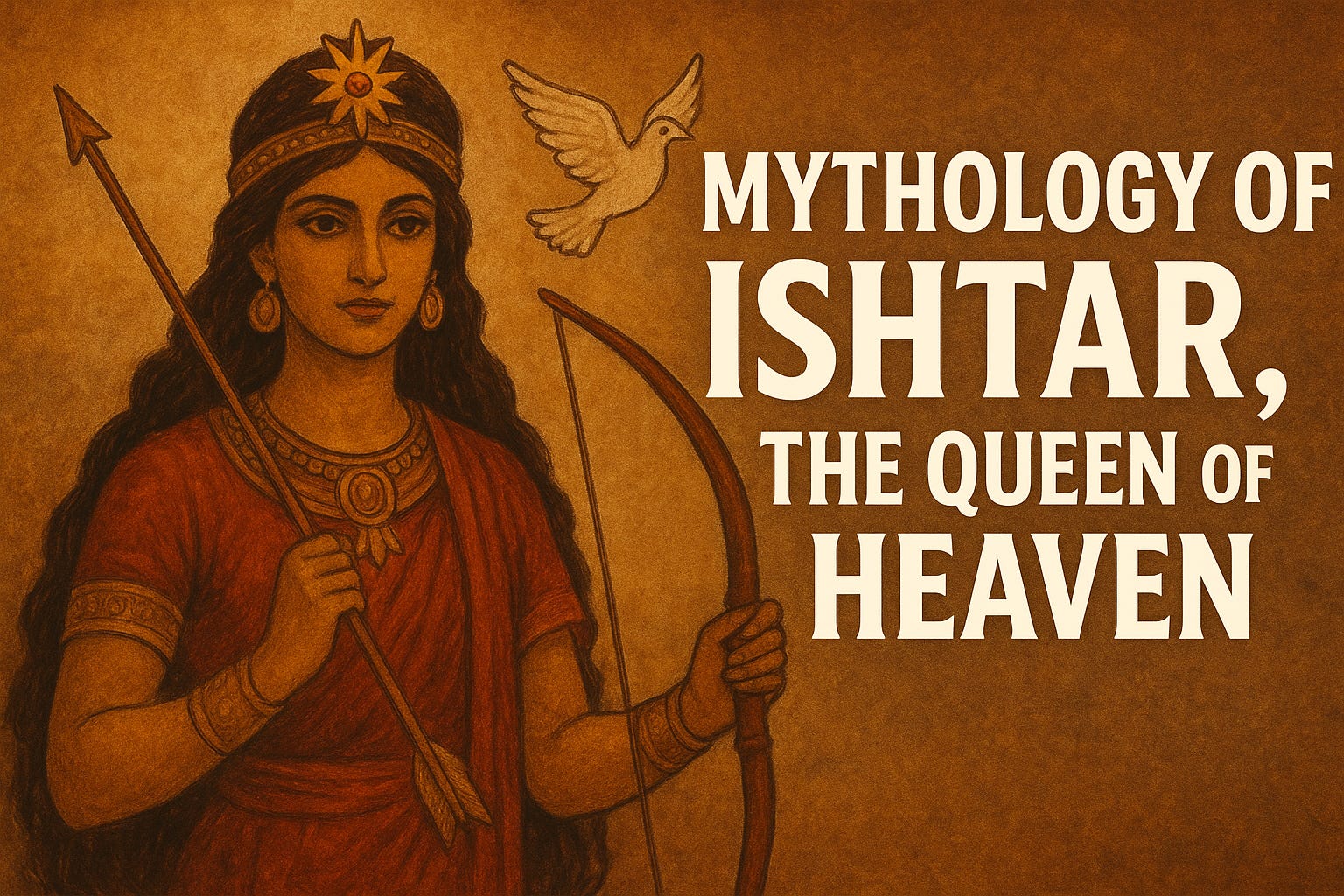
The most popular and important Mesopotamian goddess of the Bronze Age, the Queen of Heaven, was known by many names across many cultures. The goddess of love and war, the maiden, the virgin, she was called Inanna to the Sumerians, Ishtar in Babylon, Astarte by the Israelites and Canaanites in the Bible (King Solomon worshipped her), Aphrodite Urania to the early Greeks, Venus for the Romans, Uzza to the pre-Islamic Arabs (she is named in the Koran), she remains vibrant today in India as Durga, among her many other names.
More stories were written about Ishtar than any other deity. Her festivals were at the heart of the popular culture, and her mythology was foundational to society.
These myths show Ishtar in her full character; vibrant and wild, she is endlessly ambitious, always seeking more power and authority. She is never submissive to any male god, neither her husband nor her father, and she often treats her many lovers poorly.
Ishtar is the essence of beauty and desire. She embodies everything that we want and want to be with, in ourselves, our friends, and our lovers. To simply have her look upon you and smile would fulfill all the wishes of anyone alive.
Ishtar is a screaming banshee in battle. She is Venus, the morning star and the evening star, representing the qualities of love and war. Daytime is for fighting, and nighttime is for loving.
The contrast in character of the familiar Greek and Roman goddesses with the Bronze Age goddesses leaps out at the reader. In Greek and Roman mythology, and even most modern Hindu myths (with the exception of Durga), the goddesses are submissive to their husbands and reflect the patriarchal cultural standards we take for granted in the modern day.
Ishtar is not a patriarchal goddess. She is completely outside of patriarchal control, and that is why the patriarchal reformers had to get rid of her, or at least clip her wings. They could not have these wildly sexual and independent goddesses running around, encouraging women in society not to submit to their husbands.
We will review three of the most important myths that were cornerstones of society in the Ancient Near East.
These first stories come from Sumer, and are among the oldest myths ever written down. Many symbols, motifs, and images that appear in the Bible were presented in Sumer first.
One of the oldest stories is the courtship of Inanna, which shows the competition between the wandering shepherds and the settled farmers. The shepherd kings were the patriarchal warriors who imposed themselves as a new ruling class over the matriarchal farming settlements in the early Bronze Age.
The farmer and shepherd motif was common in the era and appears in the Biblical rivalry between Cain and Abel. In that story, Cain was a farmer who made offerings of plants and vegetables to God, which were rejected for unknown reasons. Abel, the shepherd’s offerings of meat, on the other hand, were accepted, showing that the Hebrew God preferred the shepherds over the farmers. The farmer Cain then killed the shepherd Abel in an act of jealousy that is seen as the first murder.
The Sumerian story is a celebration of the farmers and shepherds coming together, and predates Cain and Abel by over a thousand years.
The sun god Utu tries to convince his sister Inanna that she should marry the shepherd Dumuzi, but she resists, as her heart is already pledged to the farmer Enkimdu. The goddess came from the farming communities, but now the shepherds wanted to join them, and Dumuzi was determined to win her love.
Dumuzi was apparently a prominent human king from the early days of Uruk who became mythologized, alongside Gilgamesh. This story immortalizes the ascension of the shepherds to the throne after they entered the farmer community.
Dumuzi was a long-lived god as well, a dying and rising god in fact. The Israelites knew him as Tammuz, and he has a cameo in the Bible (being criticized, of course). The Greeks and Romans called him Adonis, and he was the lover of Aphrodite and Persephone.
The Courtship of Inanna and Dumuzi
Her brother, the hero, the warrior, Utu, says to the pure Inanna:
“O my sister, let the shepherd marry you,
O maid Inanna, why are you unwilling?
His cream is good, his milk is good,
The shepherd, everything his hand touches is bright,
O Inanna, let the shepherd Dumuzi marry you,
O you who are bedecked with jewels, why are you unwilling?
His good cream he will eat with you,
O protector of the king , why are you unwilling?”
Inanna refuses,
“Me the shepherd shall not marry,
In his new garment he shall not drape me,
His fine wool shall not cover me,
Me, the maid, the farmer shall marry,
The farmer who makes plants grow abundantly,
The farmer who makes grain grow abundantly...”
Dumuzi steps forward to proclaim his superior qualities.
“What more does the farmer have than I?
Should he give me his garment,
I will give him my ewe,
should he give me his beer,
I will give him my milk,
should he give me his good bread,
I would give him my honey-cheese,
if he gives me his beans,
I will give him my cheese,
and I after I have eaten,
I will leave my extra cream and my extra milk.
What more does the farmer have than I?”
Apparently, Dumuzi’s offerings were sufficient to impress Inanna and win her love.
The shepherd rejoiced on the riverbank after he finally convinced the goddess to change her mind.
There, he met Enkimdu and started a quarrel with him. But Enkimdu refused to fight, instead, he encouraged Dumuzi to pasture his flocks on his lands.
One might think the jilted lover would be jealous and angry, but Enkimdu was friendly, perhaps he was ready to be free of the burdens of his demanding mistress.
The farmer welcomed the shepherd into Uruk.
“Against you shepherd, why shall I strive?” asks Enkimdu,
“let your sheep eat the grass of the riverbank,
in my cultivated lands let your sheep walkabout,
in the bright fields of Uruk let them eat grain,
let your kids and lambs drink the water of my canal.”
The shepherd Dumuzi says,
“farmer, at my marriage you may be counted as my friend,
farmer Enkimdu, may you be counted as my friend.”
Enkimdu offered to bring his farm products as a wedding gift.
“I will bring you wheat,
I will bring you beans,
I will bring you lentils,
O maid Inanna,
I would bring you whatever there is...”
The poet concludes,
“In the dispute which took place between the shepherd and the farmer,
O maid Inanna, your praise is good.”
This story comes to a very different result for the farmer and shepherd from the Biblical Cain and Abel, who would remain in eternal conflict. For the Sumerians, this story is a celebration of the peaceful union of farmer and shepherd.
Kramer, Samuel Noah. History Begins at Sumer: Thirty-Nine Firsts in Recorded History. University of Pennsylvania Press, 1956.
The Hieros Gamos, the Sacred Marriage
Dumuzi may have been the first shepherd king to perform the sacred marriage. Centuries later, Dumuzi had been immortalized in the nation’s myths as a full god and the husband of Inanna.
The most important Mesopotamian holiday was the spring New Year Akitu festival, celebrated annually over 12 days in the spring. Among the significant rites, and the climax of the holiday was the hieros gamos, the sacred marriage between the king representing the god Dumuzi, and a priestess, the hierodule of heaven, representing the goddess Inanna.
The union of the king and priestess, the union of Inanna and Dumuzi, ensured the fecundity and prosperity of nature and society. It has long been rumored, but there is no proof, that the king would have sex with the priestess in the rites.
This next story follows the first and proceeds to the bridal chamber, where Inanna declares herself to be the armor-bearer of the king and his advocate among the gods, the important role confirmed annually by the hieros gamos.
This story is worth detailing at length, it is a good example of the graphic sexuality of Sumerian myth and the intrinsic connection between sex, nature, and planting.
This is the sacred marriage, and the Bible tells the story of the divorce.
The brother spoke to his younger sister
The Sun God, Utu, spoke to Inanna, saying: ‘Young Lady, the flax in its fullness is lovely, Inanna, the grain is glistening in the furrow.
I will hoe it for you, I will bring it to you
A piece of linen, big or small, is always needed. Inanna, I will bring it to you.’
‘Brother, after you’ve brought my bridal sheet to me, who will go to bed with me?
Utu, who will go to bed with me?’
‘Sister, your bridegroom will go to be with you
He who was born from a fertile womb,
He who was conceived on the sacred marriage throne, Dumuzi, the shepherd! He will go to bed with you.’
Inanna bathed and anointed herself with scented oil. She covered her body with the royal robe
She arranged her precious lapis beads around her neck. She took the royal seal in her hand
Dumuzi waited expectantly
Inanna opened the door for him
Inside the house, she shone before him
Like the light of the moon
Dumuzi looked at her joyously
He pressed his neck close against hers
He kissed her
‘Let the bed that rejoices the heart be prepared! Let the bed that sweetens the loins be prepared! Let the bed of kingship be prepared!
Let the bed of queenship be prepared!
Let the royal bed be prepared!’
‘The bed is ready!’
‘The bed is waiting!’
‘What I tell you, let the singer weave into song What I tell you, let it flow from ear to mouth Let it pass from old to young.
‘My vulva, the horn, the Boat of Heaven,
Is full of eagerness like the young moon
As for me, Inanna, who will plow my vulva?
Who will plow my high field?
Who will plow my wet ground?
As for me, the young woman, who will plow my vulva?
‘Great Lady, the king will plow your vulva.
I, Dumuzi, the King, will plow your vulva!’
‘Then plow my vulva, man of my heart!
Plow my vulva!’
‘O Lady, your breast is your field
Inanna, your breast is your field.
Your broad field pours out plants
Your broad field pours out grain.
Water flows from on high for your servant
Bread flows from on high for your servant
Pour it out for me, Inanna,
I will drink all you offer!
‘I bathed for the wild bull
I bathed for the shepherd Dumuzi
Now I will caress my high priest on the bed. I will caress the faithful shepherd Dumuzi, I will decree a sweet fate for him!’
The Queen of Heaven, who was presented the Sacred Measures by Enki Inanna, the first daughter of the moon, decreed the fate of Dumuzi.
‘In battle, I am your leader
In combat, I am your armor-bearer
In the assembly, I am your advocate
On the campaign, I am your inspiration
You, the chosen shepherd of the holy shrine
You, the king, the faithful provider of Uruk,
You, the light of An’s great shrine
In all ways, you are fit
To hold your head high on the lofty dais
To sit on the lapis lazuli throne
To cover your head with the holy crown
To wear long clothes on your body
To bind yourself with the garment of kingship
To race on the road with the holy scepter in your hand and the holy sandals on your feet
You, the sprinter, the chosen shepherd
In all ways, I find you fit
May your heart enjoy long days.
That which An determined for you – may it not be altered.
That which Enlil has granted – may it not be altered
You are the favorite of Ningal
Inanna holds you dear.’
Ninshubur, the faithful servant of the holy shrine of Uruk led Dumuzi to the sweet thighs of Inanna and spoke: ‘My queen, here is the choice of your heart
The king, your beloved bridegroom
May he spend long days in the sweetness of your holy loins.
Give him a favorable and glorious reign!
O my Queen of Heaven and Earth
Queen of all the Universe
May he enjoy long days in the sweetness of your holy loins!’
The king went with lifted head on the holy loins
Dumuzi went with lifted head to the loins of Inanna
He went to the Queen with lifted head
He opened his arms to the Holy Priestess of Heaven
Wolkstein, Diane, and Samuel Noah Kramer. Inanna: Queen of Heaven and Earth; Her Stories and Hymns from Sumer. Harper & Row, 1983.
Inanna’s Descent To the Underworld
Inanna’s Descent to the Underworld is one of the most significant Sumerian myths and the prototype for the cycle of life resurrection traditions that lasted thousands of years. These same stories were told about Ishtar and Tammuz.
Here, Inanna is the first of the dying and rising gods. This story also tells the tragic second act of Inanna’s marriage to Dumuzi, which does not go so well for him.
Though she was already the Queen of Heaven, Inanna was ambitious and sought even greater power and glory. She decided that she would challenge her older sister, Ereshkigal, over her rule of the underworld. Inanna adorned herself in her Queenly robes and jewels, and gathered up the divine laws in preparation for entering the land of no return.
Inanna gave instructions to her vizier and faithful lady-servant Ninshubur. If Inanna failed to return after three days, then Ninshubur must set up a lament for her in the assembly of the gods. Ninshubur was to then go visit Enlil and plead with him to save her. If Enlil refused, then Ninshubur was to go visit the moon god Nanna and repeat her plea. If Nanna also refuses, then Ninshubur was to go visit Enki, the god of wisdom who “knows the food of life” and “the water of life,” and who would surely come to Inanna’s rescue.
Inanna descended to the nether world and approached the gate of the lapis lazuli castle, demanding to be let in. Inanna spoke with the gatekeeper, who had been given instructions by his mistress.
Ereshkigal was no fool, she knew her sister’s intentions. The gatekeeper insisted that Inanna was bound by the same rules as everyone else and must remove one piece of her clothing at each of the seven gates.
The seven gates are highly symbolic of the journey to mystical enlightenment and are reflected in many other traditions.
At the first gate, her crown was removed. Inanna protested but was told that she must respect the laws of the underworld. At the second gate, the measuring rod and line were removed, and again she protested. At the third gate, her lapis lazuli necklace was removed. At the fourth gate, more jewelry was removed. At the fifth gate, the gold ring from her hand was removed. At the sixth gate, her breastplate was removed. At the seventh gate, her garment was removed, leaving her naked.
Bowed low and humbled, yet furious, Inanna was brought naked before her sister Ereshkigal, who was seated on her lapis lazuli throne. The Annunaki, the seven judges of the underworld, pronounced judgment upon Inanna. Death!
Inanna was struck down, and her corpse hung on a hook.
After waiting three days and nights, the faithful Ninshubur set up the lamentation and beat a drum in mourning. She traveled to visit Enlil, who would not help. Ninshubur then traveled to visit Nanna, who would also not help her. But Enki was greatly disturbed by the news and immediately jumped to aid the beloved Inanna.
What now has happened to my daughter! I am troubled,
What now has happened to Inanna! I am troubled,
What now has happened to the queen of all the lands! I am troubled, What now has happened to the hierodule of heaven! I am troubled.
He brought forth dirt from his fingernail and fashioned the kurgarru, He brought forth dirt from the red painted fingernail and fashioned the kalaturru,
To the kurgarru he gave the “food of life”
To the kalaturru he gave the “water of life”
The kurgarru and the kalaturru were sexless eunuchs who traveled to the underworld with the food of life and the water of life, and are symbolic of eunuch priests. They met with Ereshkigal and requested the corpse of Inanna.
In some versions of the story, when Inanna died, all sexual activity on Earth came to an abrupt halt, greatly concerning the gods and interfering with the cycle of life.
When the eunuchs met Ereshkigal, they found her in agony, as though she was in labor even though she was not with child.
The eunuchs requested the corpse of Inanna, and it was removed from the hook; they sprinkled on her the food of life and the water of life, and she rose from the dead.
Before Inanna could ascend from the underworld, the servants of Ereshkigal reminded her of her obligations. No one can leave the underworld without sending down a replacement. Vicious demons followed Inanna to ensure that she returned a suitable substitute.
The first deities that Inanna met upon ascending prostrated themselves before her, showing their humility and servitude. This pleased Inanna, and they were spared, and she continued the journey to her home.
When she arrived at Uruk, she found her husband Dumuzi sitting proudly on her throne, dressed in his finest regalia, and celebrating his ascension with dancing girls.
Inanna was enraged at his lack of respect and mourning for her, she cast upon him the “eye of death!”
Inanna gave her one and only husband to the demons and the underworld.
Dumuzi wept and pleaded to Utu, his brother-in-law, for deliverance from this cruel fate. Utu felt mercy and changed Dumuzi into a gazelle so he could escape, but the demons caught and beat him.
All his attempts to escape failed, and ultimately, the demons killed poor, terrified Dumuzi, the tragic victim of Inanna’s ambition and rage and his own unrighteousness.
Inanna then deeply regretted her actions, she wept and mourned for Dumuzi, along with his mother, and his sister, Geshtinanna, the goddess of vegetation. The three goddesses worked to bring Dumuzi back from the netherworld, but since there must always be a replacement, it was agreed that Geshtinanna would take his place half the year.
The annual transfer from Dumuzi to Geshtinanna back to the underworld represented the turning of the seasons and was at the heart of the annual springtime New Year festival.
Inanna’s Descent to the Underworld is an archetypal story that was taken up by many other cultures and lived on for thousands of years. These stories of a dying and rising god brought back from the underworld for half the year were retold in the Mystery religions as the myths of Demeter and Persephone, Aphrodite and Adonis, Isis and Osiris, Cybele and Attis, Orpheus and Eurydice, Ishtar and Tammuz, Dionysus, and others. These stories symbolize the lean winter months followed by the bountiful spring and summer.
Jesus Christ would, of course, become the ultimate dying and rising god.
The Sumerian version of the story is unique, not only because it is the oldest we know, but because it is Inanna’s ambitions for power that cause her husband to be killed. In other versions of the story, the hero dies in more innocent circumstances.
For goddess religions, these cycle of life myths and their springtime resurrection festivals are central to their beliefs, and are every bit as important as Easter is for Christians.
Easter is a Christian springtime resurrection holiday with Jesus as the dying and rising god, which was explicitly syncretized from these older traditions. The difference is that the Christian ritual is separated from nature and the cycle of life, and instead converted into a celebration of transcendent eternal life.
In other words, patriarchal instead of matriarchal.
Next week on Goddess Bible Study, we will dive into the dramatic mythology of the Canaanites that was only made public in recent years and is not well-known by the public. These stories are full of surprises and feature all the Canaanite gods of the Bible: El, Baal, Asherah, Astarte, and Anat. The Baal Cycle was discovered by archaeologists in the ancient Syrian city of Ugarit, which was sacked and destroyed in the Bronze Age collapse.
Join the discussion on YouTube, live Tuesday, Oct 21 at 7:00pm EST