

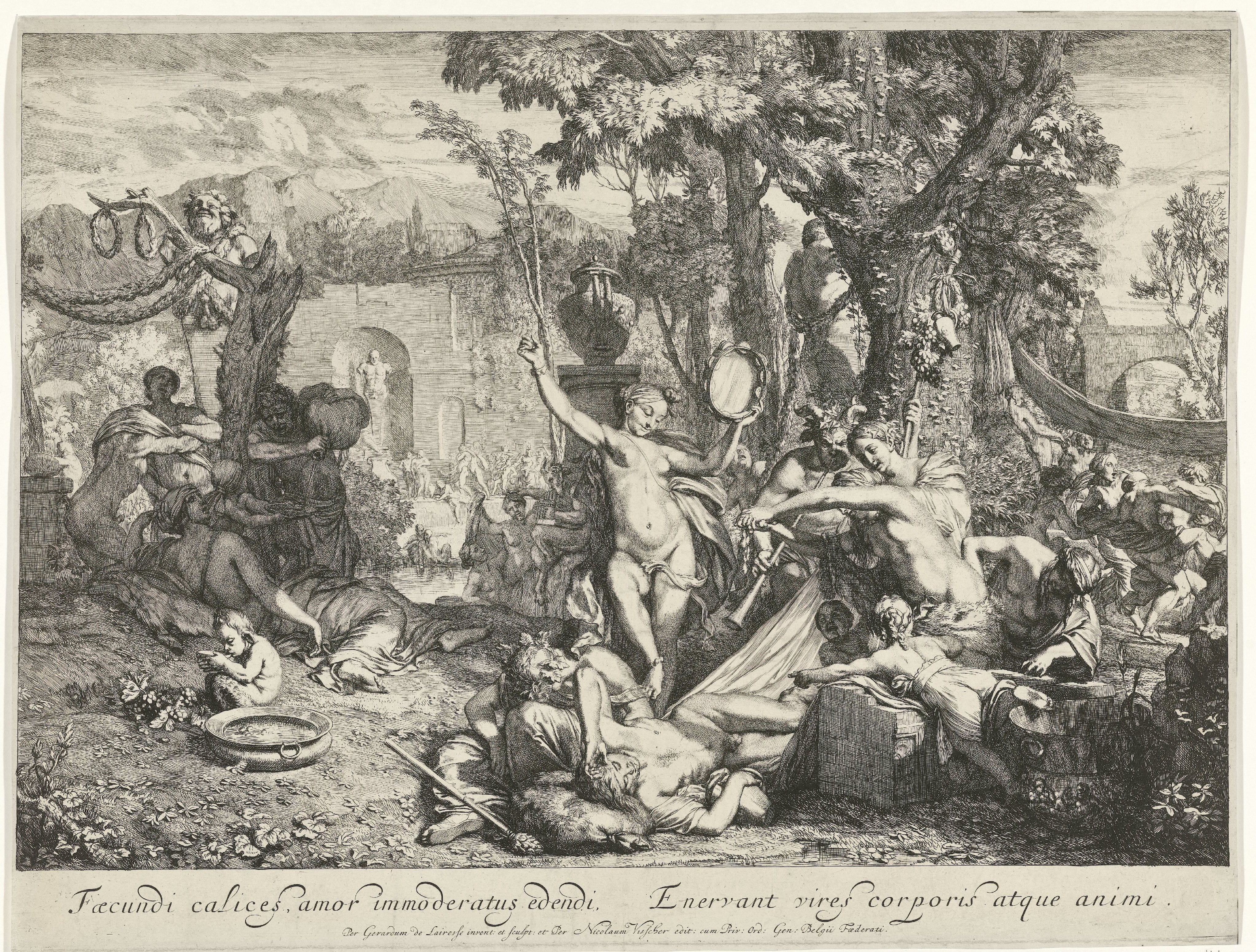
I have a beef with contemporary academia when it comes to scholarship on goddess traditions and matriarchies. I actually have a beef with academia on many subjects, but we'll stick to goddesses for now. Specifically, I have a beef with the atheist postmodernists who dominate Western academia in the 21st century and who delight in deconstructing religious and mythological narratives without offering anything coherent in return.
Scientific materialism has been the lingua franca of academia since the Enlightenment. This worldview holds that the cosmos is purely material, science is the only source of truth, there is no God, soul, or afterlife, and any mention of non-material reality is illusion. According to this view, religion is archaic, a relic to be left in the dustbin of history, and mythology teaches us nothing. Critical theory is then used to dismantle these notions and show that they are untrue. In the 21st century, atheist postmodernism has additionally come into vogue, asserting that there is no firm foundation to reality at all; it's all just a social construct determined by those who hold power.
Atheist postmodernist academics don't believe in God, and they're not interested in Goddess either. I believe in both, recognizing that this poetic symbolism helps describe the nature of reality.
Today's academics are completely failing to see what the evidence is telling us regarding goddesses, matriarchies, ritual sex, plant drugs, and transgenders. I view all this collected data as evidence of one big cross-cultural religious tradition of the Mother Goddess. The academics are familiar with this argument, but they reject this conclusion with hostility and derision.
The atheist postmodernist academics are wrong on this point.
There most certainly are cross-cultural traditions of the Mother Goddess. These traditions are alive and well in India, where they are known as Shakti, and paganism never disappeared in the West either. In fact, pagans arrived in America in the 1620s and fought with the Puritans in Massachusetts. These Mother Goddess traditions blend seamlessly, then and now, with indigenous traditions in North and South America.
I came across the blog of Dr. Andrea Sinclair, an archaeologist and Egyptologist. I had never heard of her before this week, and this critique isn't personal, though I disagree with her worldview and conclusions. Dr. Sinclair's technical work is excellent and covers much of the material I'm interested in, which is why I'm highlighting it. More than that, she's a perfect representative of the current academic consensus on these subjects.
Dr. Sinclair has a series of articles on her blog dismissing claims of goddess traditions, sacred prostitution, and drugs in the ancient world. These articles do a terrific job of presenting the core evidence on these subjects, and I recommend them to anyone interested, even though I dispute her conclusions. (All the following quotes are from these posts.)
Outdated Archeology #6: The Mother Goddess and prehistoric matriarchy
This is an introduction to the origins of the Great Mother Goddess myth, a topic that is no longer de rigueur in archeology, except as an intellectual exercise (history of research), yet refuses to die gracefully elsewhere. As a result it is one topic that can get me in trouble, due to its not matching the public’s accepted view of prehistory.
If you are new to this myth (which I doubt), it is the idea that prehistoric cultures were matriarchal, and that they worshiped one Great Goddess whose divine aspects were Maiden, Mother and Crone. This myth argues that later European and Near Eastern goddesses are derived from the prehistoric goddess.
This myth is thoroughly embedded in modern culture, popping up all over in art, literature, film and music, from the early 20th century until today.
We begin with a fundamental, methodological disagreement: do myths have anything to teach us? In modern parlance, myths are seen as fiction, but that's a misunderstanding. Quality mythology uses poetry and symbolism to portray the structure of the cosmos and humans' place in it, within a given culture's understanding. Good myths contain many deep layers of meaning, but you'll get in trouble in academia if you attempt to use any of them as data points.
Anyway, the Great Mother Goddess is not even a myth — it's a living spiritual and metaphysical tradition; it’s a worldview.
Matriarchies are not a myth either; they’re a common family structure seen among tribal peoples around the world to this day. Matriarchies are defined by maternal family lines and matrilocal marriages, where the man goes to live with the woman’s family. These family dynamics result in societies that are more egalitarian and cooperative than patriarchal ones. By contrast, building family lines through the men means women’s sex lives must be carefully and systematically controlled, resulting in societies structured as domination hierarchies.
Matriarchies are not societies where women dominate and emasculate men, since there’s no evidence that such societies have ever existed. Women don’t want weak men; matriarchies cultivate warriors who can defend them, as we see across Native American cultures.
Matriarchal cultures celebrated women's sexuality as the source of life and creation, and were not shy about it. Women are not required to submit to men, and their goddesses do not submit to the male gods either. We see powerful, non-submissive goddesses throughout Bronze Age cultures, especially in figures like Ishtar, who is extremely sexual and domineering. These goddesses were all brought to heel in the Iron Age; the Israelites left us their diary of the events in the Bible.
A discerning reading of mythological texts tells us a great deal about how those cultures saw the world.
Dismissal of mythology is why academics hate Graham Hancock so much, since he takes mythology seriously and uses the stories as a springboard for his research. For example, the Biblical flood stories of Noah are repeated across cultures with varying names and details. Graham Hancock sees this as evidence of a cataclysmic, mass extinction event in history, but mainstream academics do not. They argue that there is no evidence of a giant flood in the time period these stories were written (which is true for the third millennium BC), and categorically dismiss the idea that the flood stories could be memories of events much further back in history.
Hancock argues (and I am persuaded to agree) that the flood stories are a memory of a mass extinction event caused by meteor strikes at the end of the Ice Age in the Younger Dryas period (12,800 ya), causing widespread flooding from suddenly released ice water. This emerging theory is gaining more widespread acceptance every year.
One's presuppositions about the value of mythology likely predetermine whether you're willing to entertain the Younger Dryas comet-impact hypothesis. This theme repeats with the casual dismissal of ancient writers like Herodotus as liars and frauds (which some are) whenever their work runs counter to today's accepted shibboleths.
The first reference to the Goddess, or rather the Mother of the Gods - the 'Meter Theon' ('Mother of Gods') / 'Magna Mater' ('Great Mother') - likely occurred in 1849 in an academic lecture presented at the Royal Academy of Science in Berlin by Classical archaeologist Eduard Gerhard.
While Gerhard did not invent the idea of Mother Earth, as this was embedded in European literary lore, he did lay the foundation for the myth of the Great Goddess by arguing that the attraction of the cult of the Phrygian mother of gods (Cybele/Magna Mater) for Athenians was that the many Greek goddesses had originally stemmed from one earlier goddess of creation and fertility.
The first mention of the Great Mother was categorically not in 1849 by some random academic in Victorian England. The Mother Goddess has always been around. She never went away, and the basic precepts have always remained the same.
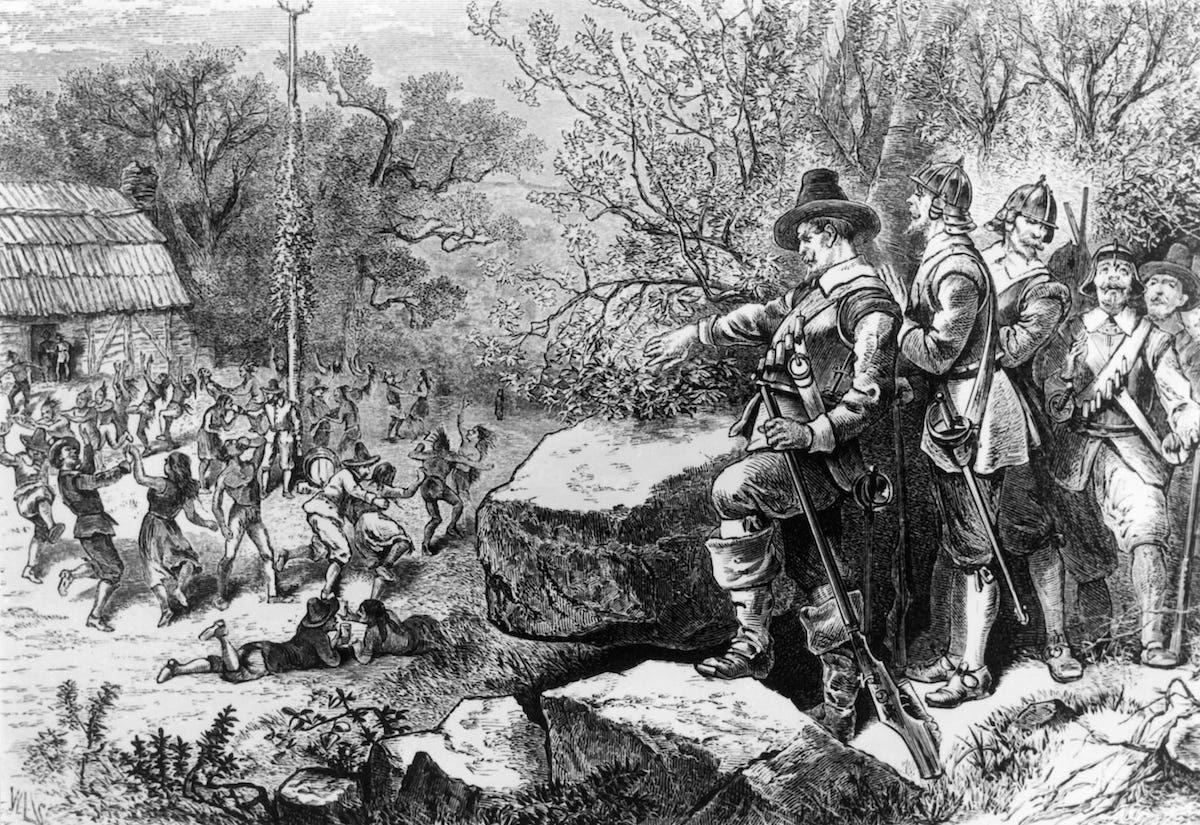
The European version of the Mother Goddess arrived in America with the first colonists in 1622, two years after the Puritan Pilgrims settled nearby in Plymouth, MA. Thomas Morton, the Pagan Pilgrim, helped establish Mount Wollaston in today's Quincy, MA, but then overthrew its leader when it was discovered the man was selling indentured servants (white folks) into slavery in Virginia.
Morton organized a coup in 1626, freed the remaining indentured servants, and renamed the colony Merrymount, for Mary, the Mother of God, combined with merriment, joy, and revelry. The name was a pun intended to annoy the virulently anti-Catholic Puritans. Morton was proudly pagan and wrote poetry to the goddesses.
Thomas Morton was close friends with the local Algonquian tribes and a sworn enemy of the Puritans. He wrote in his book, "I found two sorts of people, the one Christians, the other Infidels; these I found most full of humanity, and more friendly than the other."
The Puritans saw America as the new Israel from the start; Morton’s vision was for a new Canaan.
Thomas Morton loved America — its landscapes, forests, and wildlife — writing about them floridly in his book New English Canaan. He was very fond of the Natives, spending a great deal of time with them, showing them the greatest respect, extolling their values, and encouraging his people to intermarry. Morton also sold the Natives guns, enraging the Puritans, and built a thriving fur trade business. While the Plymouth colony struggled to survive, Merrymount prospered.
In 1627, Morton erected a huge 80-foot maypole, visible from the sea, to guide visitors to Merrymount. Then he and the colonists brewed beer and threw a raucous May Day party with the Natives, filled with song, dance, revelry, and Morton's ribald poetry to the goddesses.
Needless to say, the Puritans were not pleased. After Morton repeated the festival in 1628, the Puritans burst in, arrested him, and sent him back to England. They then burned the entire colony to the ground in 1630. Legal dramas played out over the following years, and both sides wrote books detailing their versions of events, so this chapter of American history is well documented — though rarely taught in schools.
Dr. Sinclair carefully lists all the important writers from the mid-19th century onward who influenced the discussion of the Mother Goddess, and systematically dismisses every one of them as uninformed racists, misogynists with prurient sexual imaginations, or naively misguided charlatans.
She details her objections to James Frazer's The Golden Bough, Jane Harrison, and Arthur Evans, who excavated the great palaces at Minoan Crete, with their feminine, bare-breasted murals. Dr. Sinclair lists many sources I wasn't familiar with (thanks!). She devotes special attention to Robert Graves, whose books, including The White Goddess, captivated her in her teens but which she now sees as painfully tenuous and bogus.
She does not hide her disdain, writing “...insert exasperated *facepalm* here ...”
To be fair, I don't think any of these writers are above criticism — they were all products of their times and worked with much more limited data than we have today.
Dr. Sinclair criticizes sources I learned a lot from, and whose work I believe still stands up, including Mircea Eliade (The Sacred and the Profane, 1957), Carl Jung, and James Mellaart, who excavated the famous Neolithic site Çatal Höyük and identified figurines of the Triple Goddess. Merlin Stone's When God Was a Woman, which was formative for me, gets a shoutout. She is especially critical of Marija Gimbutas, who was the last prominent academic to champion the case for cross-cultural mother goddess traditions until her death in 1994.
Marija Gimbutas was the 'pin up girl' for the Great Mother Goddess, for late 20th century feminism, goddess worshipers and for many manifestations of neo-paganism, although some feminists justifiably rejected her theories as essentialistic and perpetuating antiquated models of gender and social evolution.
Dr. Sinclair completely dismisses any significance of the Triple Goddess, without even attempting to offer an alternative reading of the evidence, simply writing off the entire concept as a product of the male sexual imagination.
It is really too bad, since Dr. Sinclair is an Egyptologist, because the Triple Goddess has its roots in Egypt with Hathor, Bastet, and Sekhmet, who combine as the Eye of Ra. This symbolism is so potent that it was transmitted across cultures and is still used today. Modern Hindus see her in the form of Parvati, Durga, and Kali.
Between ancient Egypt and modern India, we see the Triple Goddess in many important cultures. The Greeks had her as Demeter, Persephone, and Hecate, who were central to the Eleusinian Mysteries — the most important and profound religion in all of classical Greece, attended by the majority of its great leaders and philosophers.
Even more importantly, the Triple Goddess appears in both the Bible and the Koran, where the prophets divorced the goddesses in favor of monotheism, the religion of the father alone. The Israelite/Canaanite Triple Goddess was Asherah, Astarte, and Anat, while the Arabian was Allat, Uzza, and Manat. Check out Goddess Bible Study, where we go into the details.
This divine triad - Maiden, Mother, Crone - or - Virgin, Lover, Hag - the so-called essential stages of a woman’s life, is at its core a polite way of defining the sexual availability of a woman: undeflowered adolescent, child-bearing adult or postmenopausal elderly.
In fact, the aspects of the Great Goddess are a model entirely based on a woman’s relative shagability.
Dr. Sinclair questions why goddesses must be associated with fertility, seeming to forget that it is women who give birth.
She finds it mind-boggling that Mother Nature has been with us forever and that human beings have, for tens of thousands of years, consistently built spiritual and religious traditions around the cycle of life. It doesn’t seem weird to me — I rather like it.
She asks, “Why is it necessary to invert patriarchal monotheism and make ancient goddesses into an all-mighty mother?”
Because God has a Mother, and she is the most powerful force in the cosmos.
There are a few basic precepts of Goddess theology. First, it is rooted in Mother Nature and the cycle of life. Mother is the material world, and she is circular — the endless cycle of creation and destruction, the cycle of life. Since she can destroy all that God creates, she is the most powerful force in the cosmos.
Secondly, all the goddesses are, in fact, one super-goddess, sourced from the waters of creation. This theology is explicit, both in the Shakti traditions of modern Hinduism and in the Hellenistic Isis traditions of the Roman Empire. As an Egyptologist, Dr. Sinclair should know this.
The identities of goddesses are intrinsically fluid; they can be endlessly conflated, syncretized, and intertwined with one another. We see this pattern repeat constantly with ancient goddesses, whose names, symbols, attributes, and stories are commonly recycled and fused together.
Third, the most important and primeval goddesses are the Triple Goddess: Mother, Maiden, Destruction/Death. This trio repeats across cultures and is always popular. It is a metaphysical model of the cosmos representing the cycle of life.
Stories of dying-and-rising gods are all goddess mythologies; they are a genre, demonstrating her mastery of the cycle of life.
The goddess holds paradoxes in her hand. She is love and war, the virgin and the harlot, mother and destruction. She is all these things and more.
The title Virgin is applied widely to goddesses and does not mean they never had sex. In human terms, it means an independent young woman, childless and unmarried, or a priestess. For goddesses, it is a term of respect — as in the Virgin Mother of God.
When a woman becomes pregnant through ritual sex and the father is not tracked, it is called a virgin birth. There are countless examples in the ancient world, including Helen of Troy and Alexander the Great, both born of queens who claimed not to have been impregnated by their royal husbands.
‘Mesopotamian sacred prostitution’ … is largely a myth created by a few not unbiased ancient writers and then reinforced by James George Frazer in 1911.
Dr. Sinclair, and all of today's academics, write off temple prostitution. They completely misunderstand the nature of sacred sexuality and reduce temple offerings to mere commerce. They ignore the evidence of Tamar the qedesha in the Bible and Shamhat the harimtu in the Epic of Gilgamesh, both of whom engage in ritual sex at critical turning points in the narratives.
Let's not forget that ritual prostitution and sacred sex never went away — it still exists in India today in the form of the Devadasis, though they now survive in a degraded state on the fringes of society. Tantric sex, from Hindu Shakti traditions, is an advanced set of techniques for achieving ecstasy and communion with the divine through ritual sexual practices. Somehow, none of this data makes it into her analysis.
Dr. Sinclair throws around terms like "misinformation," "pseudoscience," "unsound," and "embarrassing," making it clear that we should all simply defer to the academic "experts."
I have studied these "experts" in some detail, and I find these 21st-century postmodernists to be woefully lacking.
Since the late 20th century, the theory of prehistoric matriarchy and a Great Mother Goddess has been binned within anthropology and archaeology, because the original model is out-of-date, fatally flawed and 150 years of archaeological research has done nothing to confirm any of it.
The topic has been adequately investigated and critiqued by many competent individuals among archaeologists, anthropologists, classicists, historians, feminists, neo-pagans and a variety of other academic disciplines and inclinations, some of whose names have been given here and are also provided below.
But these ideas have not lost ground elsewhere, as the sheer breadth of alternative literature and freedom of misinformation pays tribute to the power of the past to inspire the present. Which would be cool if it were constructive, but what we actually have is a compelling modern fairy tale, like a lot of feel-good nonsense online and in print.
This myth emerged from questionable beginnings in ethnocentric and conservative 19th century classics and ethnology, was used as a model of primitive depravity and to reinforce the social model of traditional marriage at a time when western women were beginning to push back against this.
From this unsound basis the ideas were extended out to include many ancient cultures over a mind bogglingly long period that spans tens of thousands of years from the Palaeolithic to the Iron Age.
Johann Bachofen’s model of the Goddess was created at a time when archaeological research was in its infancy and embarrassingly ethnocentric, that is, it was too reliant on the religious and cultural models of its time.
If Mother’s Law were written now it would be pseudoscience and probably have a Netflix contract.
Dr. Sinclair carefully engages with all the source material, yet routinely dismisses the authors as liars with a wave of her hand, just because they don’t fit her ideological position — without offering any better accounting of the data.
Contemporary academics routinely engage with this material in bad faith and take the least charitable readings at all times, minimizing and cherry-picking the data. They don’t even try to make sense of the data — they just label everyone they dislike as unsophisticated racists and misogynists, whether in the present day or the ancient past.
Endless critical theory dismantles narratives and leaves behind nothing but rubble; it does not result in truth.
Thanks so much for this article! I loved your book, which contributed much to my goddess understanding. It was pivotal research for my historical fiction novel that comes out next year. Long live the goddesses :)