

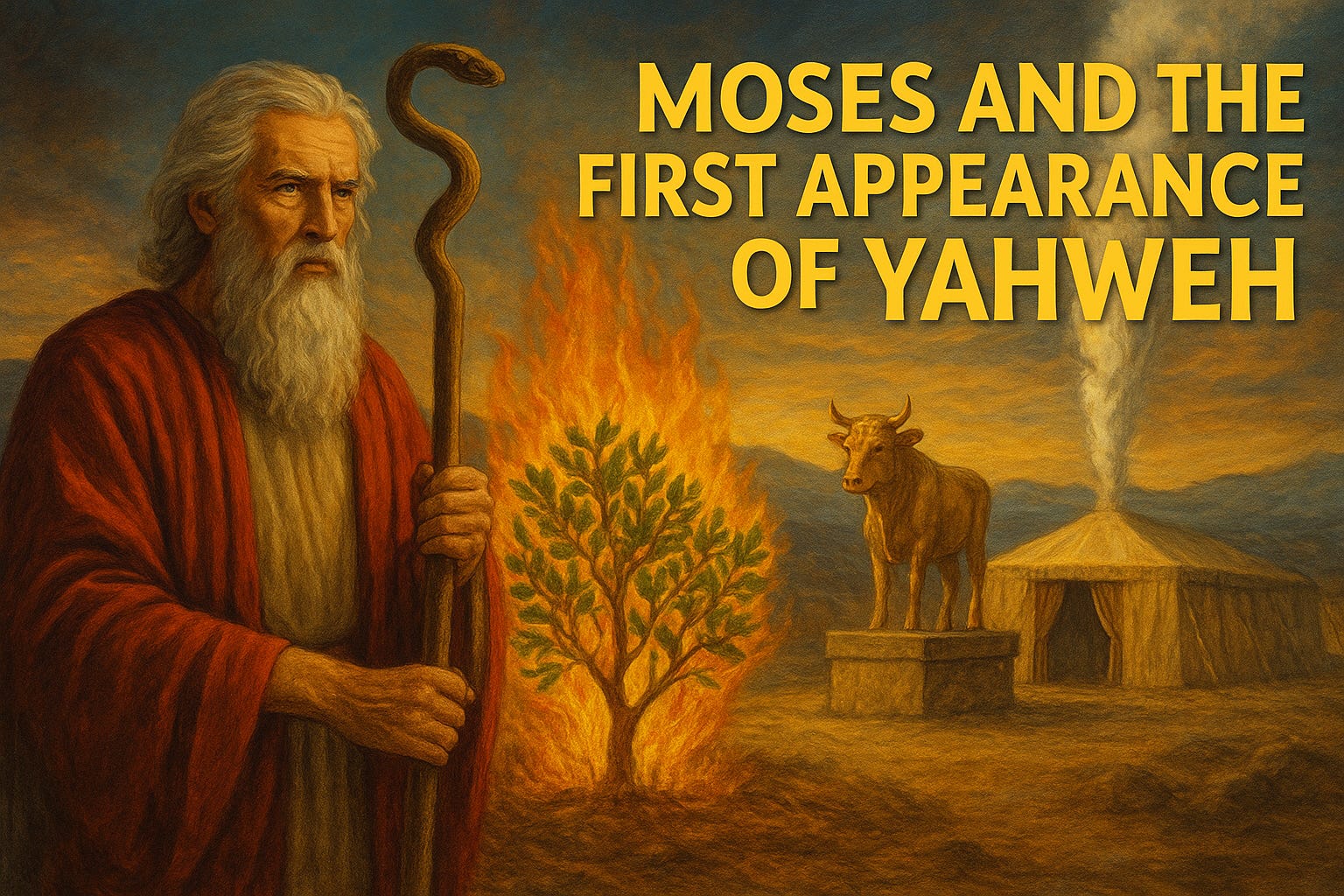
This week on Goddess Bible Study, we will continue our discussion of Moses, which began with the Exodus last week. I am going to make the case for a minimalist, historical, pagan Moses.
I believe there was an early tradition of Moses, a prophet of Yahweh, who led the Israelites out of slavery in Egypt around 1209 BCE in the Bronze Age Collapse. But I also think that they were completely polytheistic in this period, and there were no religious reforms for Yahweh, who was just another pagan god at this time.
I am persuaded by modern scholarship that suggests the Torah was completed in Alexandria, Egypt, in the 3rd century BCE, and that many of the most important stories were written at that time, layered on top of older source material.
Monotheism was an invention of a completely different era from any historical Moses, and the stories of him bringing the Ten Commandments down from Mt. Sinai, or smashing the Golden Calf to end pagan traditions, were almost certainly later additions to old legends.
By tradition, Moses led the Israelites out of Egyptian captivity and into 40 years of wandering. There is no confirmation of a historical Moses, and many critical scholars believe he never existed.
Moses is called the “Law-giver.” Tradition says that he wrote the Torah (first five books of the Bible) and laid down an elaborate list of laws and religious reforms before the Israelites ever entered Canaan, but there is no evidence that this is true.
The Torah and law codes do not appear in the Bible story in the First Temple period, nor were the Israelites apparently literate at that time. They were singing songs in the oral tradition, some of which are in the Psalms. The Torah also includes Moses’s death and funeral, making it hard for him to have written.
Considering that the Hebrew written language appears in the 9th century BCE, not the 12th, it is unlikely that a historical Moses, if he existed, wrote anything at all.
Moses’ legendary backstory is well known. He was born a Hebrew slave in Egypt, and his mother put the infant in a basket in the river to escape an order by Pharaoh to kill all Hebrew babies. Moses was found by one of Pharaoh’s daughters and raised as royalty in the palace.
As a young man, Moses killed an Egyptian officer who was abusing a Hebrew and fled into exile. Moses escaped to Midian, where he met Jethro, a pagan priest, and married his beautiful daughter Zipporah, with whom he had a family.
It was in Midian that Moses first encountered Yahweh at the Burning Bush while out shepherding a flock. This is the first appearance of Yahweh in Israel’s mythical history. The first appearance of Yahweh in archaeology is 850 BCE in the Mesha Stele.
Yahweh encouraged Moses to return to Egypt to save his people from captivity, where he confronted Pharaoh along with his brother Aaron. The Exodus was followed by 40 years of wandering in the desert, before the Israelites could enter the promised land of Canaan (we discussed the timing of these events in the last session).
According to the scripture, Abraham and the patriarchs never knew Yahweh. Yahweh was a new god for the polytheistic Israelites, just another tribal god in those early days, one of the many sons of El. Later Yahwist writers added him to older stories of Abraham with El in the effort to conflate Yahweh with El as the single monotheistic God.
I appeared to Abraham, to Isaac, and to Jacob as El-Shaddai—‘God Almighty’—but I did not reveal my name, Yahweh, to them.
- Exodus 6:3
Elohim also said to Moses, “Say to the Israelites, ‘Yahweh, the Elohim of your fathers – the god of Abraham, the god of Isaac and the god of Jacob – has sent me to you.’ “This is my name forever, the name you shall call me from generation to generation.”
-Exodus 3:15
The Biblical writers portray Moses as establishing the covenant with Yahweh and initiating religious reforms right away, with new laws presented by Yahweh.
Yahwists would become a patriarchal moral reform cult over the centuries, especially after kingship was established. But it is hard to know at what point they began in earnest to challenge the existing traditional religions by smashing idols and cutting down Asherah poles.
Be careful not to make a treaty with those who live in the land where you are going, or they will be a snare among you. Break down their altars, smash their sacred stones and cut down their Asherah poles.
Do not worship any other god, for Yahweh, whose name is Jealous, is a jealous God. “Be careful not to make a treaty with those who live in the land; for when they prostitute themselves to their gods and sacrifice to them, they will invite you and you will eat their sacrifices. And when you choose some of their daughters as wives for your sons and those daughters prostitute themselves to their gods, they will lead your sons to do the same.
-Exodus 34:12-16
One of the most famous Bible stories takes place while Moses was talking to Yahweh on Mt. Sinai, receiving the laws. Moses was gone for many days, and the people got impatient waiting for him to return.
The pagan Israelites implored Aaron to build a traditional idol, so he collected all the gold jewelry and built a golden calf, the symbol of the Bull of Heaven. They sacrificed to the idol and had a festival.
[Aaron] took what they handed him and made it into an idol cast in the shape of a calf, fashioning it with a tool. Then they said, “These are your gods, Israel, who brought you up out of Egypt.”
-Exodus 32:4
Yahweh and Moses were outraged. Moses rallies the Levites to follow him and kill all the idol worshippers. The golden calf was destroyed, but Aaron escaped punishment.
The Levite priests were descendants of Aaron, and centuries later, they wrote the Torah.
Then he said to them, “This is what Yahweh, Elohe of Israel, says: ‘Each man strap a sword to his side. Go back and forth through the camp from one end to the other, each killing his brother and friend and neighbor.’ The Levites did as Moses commanded, and that day about three thousand of the people died.
-Exodus 32:27-28
The golden calf continued to be a feature of Israelite society. Two more were made centuries later in the towns of Bethel and Dan in the northern kingdom of Israel.
Moses used many pagan symbols that would later be banned.
Moses and Aaron carried a staff that turned into a serpent - a symbol of his wisdom and power. Serpents were a common pagan spiritual symbol and closely associated with goddess traditions.
In the Garden of Eden, the serpent was demonized.
So Moses and Aaron went to Pharaoh and did just as Yahweh commanded. Aaron threw his staff down in front of Pharaoh and his officials, and it became a snake. Pharaoh then summoned wise men and sorcerers, and the Egyptian magicians also did the same things by their secret arts: Each one threw down his staff and it became a snake. But Aaron’s staff swallowed up their staffs.
-Exodus 7:10-12
The serpent staff continued to appear during the wandering in the desert.
And Yahweh said to Moses, “Make a fiery serpent and set it on a pole, and everyone who is bitten, when he sees it, shall live.”
-Numbers 21:8
The bronze serpent on a pole was called the Nehushtan, and it was held onto as an idol. Some 500 years later, around 710 BCE, it was destroyed by the reformer King Hezekiah.
He removed the high places, smashed the sacred stones, and cut down the Asherah poles. He broke into pieces the bronze snake Moses had made, for up to that time the Israelites had been burning incense to it. (It was called Nehushtan.)
Hezekiah trusted in Yahweh, the God of Israel. There was no one like him among all the kings of Judah, either before him or after him.
-2 Kings 18:4-5
Another curious detail that suggests a pagan Moses is the shatnez, which is a law that wool and linen threads should not be mixed. This law is still followed by observant Jews today, kosher clothes cannot be linsey-woolsey, but modern rabbis don’t really know why.
Do not wear clothes of wool and linen woven together.
-Deuteronomy 22:11
It is a curious law because Moses specifically ordered that the holy vestments for the priests and the curtains in the tabernacle be made of linen and wool blended together. Linen and wool are a blend of animal and vegetable, farmer and shepherd, god and goddess.
These anti-pagan reforms were almost certainly many centuries after Moses lived.
All those who were skilled among the workers made the tabernacle with ten curtains of finely twisted linen and blue, purple and scarlet yarn, with cherubim woven into them by expert hands.
– Exodus 36:8
Maimonides, the famous Jewish philosopher from the Middle Ages, described the reasons for shatnez in his 1190 CE book, the Guide for the Perplexed. Maimonides wrote that the shatnez was part of the ban on pagan magical practices and connections to idolatry, and also that the practitioners were typically women.
For the same reason, the wearing of garments made of linen and wool is prohibited: the heathen priests adorned themselves with garments containing vegetable and animal material, whilst they held in their hand a seal made of a mineral. This you find written in their books.
– Maimonides, Guide for the Perplexed, part 3, ch. 37, v. 5
Next week, we will continue with Moses, the prophetess Miriam, cannabis in the holy anointing oil, the menorah, and some other pagan goodies.
Discussion rescheduled for January 6, at 7pm EST.
Reach out if you would like to join.
goddessbiblestudy@gmail.com