

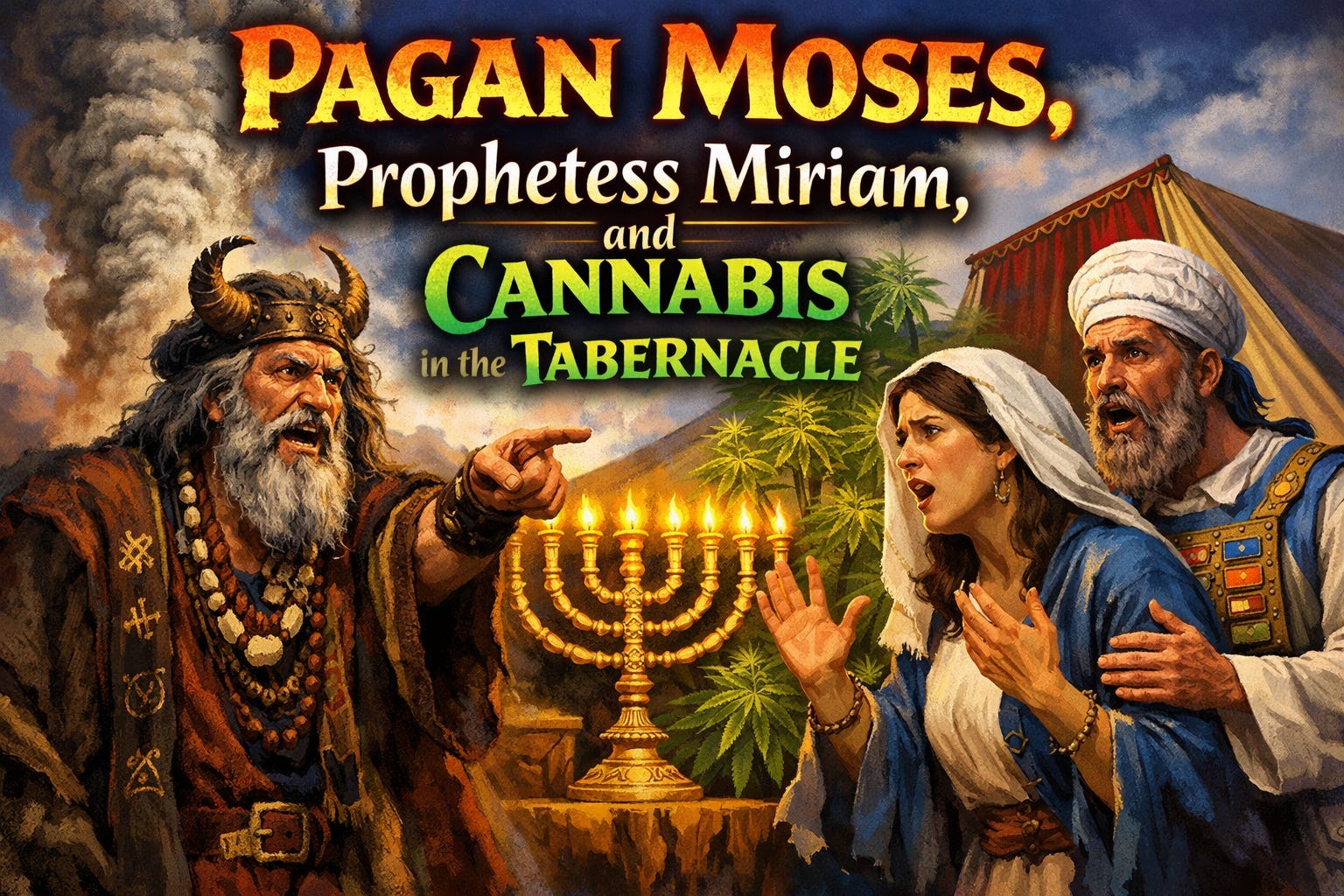
This week on Goddess Bible Study, we have our third and final session with the pagan Moses. Many details in the Bible story suggest that the original Moses was a far cry from the Moses who lives in popular imagination today. The stories of Moses, Miriam, and Aaron have layers, added by numerous authors over many centuries as social, political, and religious circumstances changed.
Monotheistic reformers in both the First Temple and Second Temples worked to make Moses their own by adding layers to the story that reflected their reform agendas, but original layers remained, creating symbolic enigmas.
I contend that there are specific contradictions in the actions of Moses when compared to the Laws of Deuteronomy, which Moses supposedly wrote. These contradictions, along with other odd behaviors, indicate that the oldest layers of Moses reflect pagan Israelite traditions that were later reformed away on the path to monotheism.
Last week, we discussed some of these contradictions, including Moses using powerful snake magic against Pharaoh and among the Israelites, but then condemning the serpent in the Garden of Eden. Moses commands that linen and wool be woven together when constructing the tabernacle and its curtains, but this blend is then explicitly forbidden in Deuteronomy, and is known as shatnez.
This week, we explore how cannabis is in the holy anointing oil, God appearing in a pillar of smoke, and the menorah, the seven-branched candle stand.
Even more importantly, we look at the prophetess Miriam, sister of Moses and Aaron, and leader of the women. Miriam is punished by God in a curious story and unceremoniously exits the narrative, only to be buried in the holy city of Kadesh.
Who is Miriam? Was she a qedesha? Why does she disappear from the story?
Cannabis in the Holy Anointing Oil
Let’s start with cannabis as an ingredient in the holy anointing oil. Modern scholarship reveals that cannabis is named five times in the Hebrew Bible as the word “qaneh,” but was mistranslated in the Septuagint in the 3rd century BC.
These five verses have long troubled Biblical translators, and the holy anointing oil has major theological significance. The English language versions typically say “aromatic cane,” or “calamus,” neither of which makes sense in context, while cannabis does make sense. (We will have a dedicated session on cannabis in the Bible exploring all the references.)
The holy anointing oil was very important. The recipe was prescribed by Yawheh directly to Moses. It distinguished the sacred from the secular, and was used to anoint the priests and kings by pouring it over their heads until the oil dripped from their beards. The holy anointing oil was wiped on every item in the tabernacle, and all over the cloth and carpets of the tabernacle itself, to mark them as sacred.
“Take the following fine spices: 500 shekels of liquid myrrh, half as much (that is, 250 shekels) of fragrant cinnamon, 250 shekels of fragrant cannabis [qaneh bosm], 500 shekels of cassia--all according to the sanctuary shekel - and a hin of olive oil.
“Make these into a sacred anointing oil, a fragrant blend, the work of a perfumer. It will be the sacred anointing oil. Then use it to anoint the tent of meeting, the ark of the covenant law, the table and all its articles, the lampstand and its accessories, the altar of incense, the altar of burnt offering and all its utensils, and the basin with its stand. You shall consecrate them so they will be most holy, and whatever touches them will be holy.
“Anoint Aaron and his sons and consecrate them so they may serve me as priests. Say to the Israelites, ‘This is to be my sacred anointing oil for the generations to come. Do not pour it on anyone else’s body and do not make any other oil using the same formula. It is sacred, and you are to consider it sacred. Whoever makes perfume like it and puts it on anyone other than a priest must be cut off from their people.’”
-Exodus 30:23-33
The recipe for the holy anointing oil is psychoactive and potent. 250 shekels of cannabis equals 6.28 pounds of flowering cannabis tops infused into roughly 1.5 gallons of olive oil (around 6 liters, hin is not a precise measure), plus myrrh, cinnamon, and cassia. This recipe was boiled and distilled so that all the spices were infused into the oil.
Cannabis can be absorbed through the skin, and in the context of a spiritual ritual where the set and setting encourage a mystical experience, the holy anointing oil can create an intense connection to the divine. People continue to prepare this recipe today and attest to its medicinal and psychoactive value.
Calamus can be medicinal but is poisonous in large doses, as would be required in the holy anointing oil.
The prohibition against sharing the recipe or using it for anything other than sacred purposes shows how important the holy anointing oil was. In many cultural traditions, sacred and medicinal recipes were kept secret and never to be revealed, especially if they had potent mystical properties, as magic revealed is magic lost.
There are similar instructions for making sacred incense in the following verses, though they do not explicitly mention qaneh bosm.
God in a Cloud of Smoke
Moses led the tribes back to Mount Sinai, where he first met Yahweh in the burning bush. Yahweh always visits him in a cloud of smoke. This makes Moses look like a desert shaman, showing the pagan roots of the early Hebrews.
Could the burning bush be cannabis? Many people have thought so over the centuries, and there is no definitive answer to the question.
Could the pillar of smoke be intoxicating smoke? The context makes sense. Many neighboring cultures in this era burned cannabis in a ritual manner.
Yahweh said to Moses, “I am going to come to you in a dense cloud, so that the people will hear me speaking with you and will always put their trust in you.”
-Exodus 19:9
Mount Sinai was covered with smoke, because Yahweh descended on it in fire. The smoke billowed up from it like smoke from a furnace, and the whole mountain trembled violently.
-Exodus 19:18
Moses pitched his own tent outside the camp, called the “Tent of the Meeting,” or the Tabernacle, where he met with Yahweh. The people watched Moses whenever he went to the tent, and waited for the pillar of smoke to arise, which signaled that he was speaking to God.
As Moses went into the tent, the pillar of cloud would come down and stay at the entrance, while Yahweh spoke with Moses. Whenever the people saw the pillar of cloud standing at the entrance to the tent, they all stood and worshiped, each at the entrance to their tent. Yahweh would speak to Moses face to face, as one speaks to a friend.
-Exodus 33:9-11
Then the cloud covered the tent of meeting, and the glory of Yahweh filled the tabernacle.
Moses could not enter the tent of meeting because the cloud had settled on it, and the glory of Yahweh filled the tabernacle.
In all the travels of the Israelites, whenever the cloud lifted from above the tabernacle, they would set out; but if the cloud did not lift, they did not set out - until the day it lifted. So the cloud of Yahweh was over the tabernacle by day, and fire was in the cloud by night, in the sight of all the Israelites during all their travels.
-Exodus 40:34-38
Shekinah is the Hebrew word describing the physical manifestation of God, particularly as the cloud of smoke in the Tabernacle and later in the Jerusalem Temple. The word does not appear in the Bible but is used by scholars.
Shekinah is a feminine word, invented by medieval Kabbalists in a partial rebirth of the feminine divine. The Kabbalists were Jewish mystics who presented the Shekinah as the feminine representation of God’s earthly presence, the wife of God manifested in stories as a cloud of smoke. The Kabbalists graphically portrayed God and his bride in a sexual embrace.
This motif of God appearing in a cloud of smoke is only seen in the First Temple, when the Israelites were still pagan and burning cannabis. When the Israelites later returned from exile and built the Second Temple, they had moved to monotheism, and God no longer appeared in a cloud of smoke.
Cannabis is obviously not part of Jewish tradition, going back to the time of Jesus. I argue that cannabis was sacred to the pagan Israelites and was eliminated along with the Goddess traditions in the monotheistic reforms.
The Menorah as the Burning Bush
Another data point to consider is the Menorah, and the Hebrew words used to describe it, since qaneh appears again. Qaneh can also mean “branch” or “reed.” Yahweh provides precise instructions to Moses for how to design the seven-branched candle stand, and the word qaneh repeats over and over. (Strong’s Hebrew Concordance; 7070: qaneh.)
Make a lampstand of pure gold. Hammer out its base and shaft, and make its flowerlike cups, buds and blossoms of one piece with them. Six branches [qaneh] are to extend from the sides of the lampstand - three on one side and three on the other. Three cups shaped like almond flowers with buds and blossoms are to be on one branch [qaneh], three on the next branch [qaneh], and the same for all six branches [qaneh] extending from the lampstand. And on the lampstand there are to be four cups shaped like almond flowers with buds and blossoms. One bud shall be under the first pair of branches [qaneh] extending from the lampstand, a second bud under the second pair, and a third bud under the third pair - six branches [qaneh] in all. The buds and branches [qaneh] shall all be of one piece with the lampstand, hammered out of pure gold.
-Exodus 25:31–36
Jewish tradition holds that the Menorah is supposed to represent the Burning Bush, where Yahweh first met Moses, and the Tree of Life. It is one of their oldest symbols, and large ones stood in both the First and Second Temples.
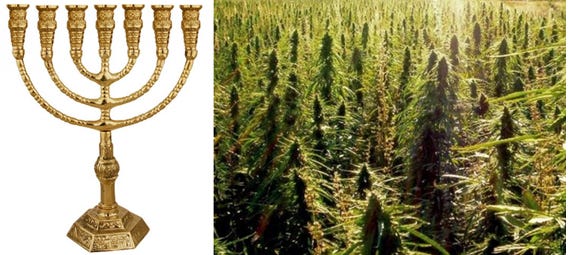
The Menorah can be seen as representing cannabis and an earlier phase of pagan Hebrew shamanism. The Menorah is designed in a plant motif, and with all the branches, it looks like a field of cannabis.
Hemp Linens
The linens in the Tabernacle likely included at least some hemp alongside flax, as fine hemp is indistinguishable from flax. Flax was much more common, but hemp was sacred.
Monotheistic reforms introduced shatnez, which bans the mixing of woolen yarn with linen, as blending animal and vegetable fibers was a pagan practice.
All those who were skilled among the workers made the tabernacle with ten curtains of finely twisted linen and blue, purple and scarlet yarn, with cherubim woven into them by expert hands.
-Exodus 36:8
Do not wear clothes of wool and linen woven together.
-Deuteronomy 22:11
Miriam, Prophetess Punished
The treatment of Miriam, the older sister of Moses and Aaron, is quite strange. It shows that these stories were altered from their earliest versions, with many details removed, before finding their final form.
Miriam was undoubtedly a significant character; she is one of only seven female Hebrew prophetesses and one of the few characters who speak directly to Yahweh. But Miriam was ultimately punished by Yahweh, and her fate leaves many questions unanswered.
As a child, eight-year-old Miriam watched over the infant Moses while he floated in a basket in the Nile River. It was clever Miriam who guided the child into the hands of the Pharaoh’s daughter. She then boldly approached the princess, offering to find a suitable wet-nurse, who was none other than her own mother. This seminal act set forth Moses’ entire fate.
As an adult, Miriam the prophetess was the leader of the women. After the Israelites successfully fled Pharaoh’s forces in the Exodus, Miriam led the women in singing and dancing with tambourines. Her Song of the Sea is one of the oldest songs in the Western tradition and is among the oldest passages in the Bible (c. 1100 BC).
And Miriam the prophetess, the sister of Aaron, took a timbrel in her hand; and all the women went out after her with timbrels and with dances. And Miriam answered them, “Sing ye to Yahweh, for he hath triumphed gloriously; the horse and his rider hath he thrown into the sea.”
-Exodus 15:20-21 (KJV)
The Hebrews were clearly pagan at this stage, they were hearing the name Yahweh for the first time. They worshipped El, the Heavenly Father, and the Mother Goddess Asherah, along with Astarte, the Queen of Heaven, and the terrifying Anat.
There were qedesha (the holy ones, temple priestesses) in the community, and the practices of sacred sex and ritual prostitution were alive and well.
Miriam may well have been a qedesha herself. She is not said to have had a husband or child, but she did like music and dance. At the very least, Miriam looked after the qedesha as a community leader.
If Miriam was a qedesha, then her curious fate would make much more sense and would reflect the changing norms that the Yahwists sought to impose.
During the forty years of nomadic wandering, Miriam was involved in a dispute with Moses and punished by Yahweh. The nature of the dispute is ambiguous as the Biblical text leaves out the details, and there are wildly different interpretations of the story.
The story shows Yahweh speaking directly to Moses, Aaron, and Miriam together; no one else in the community entered the Tent of the Meeting to speak to Yahweh.
Miriam and Aaron began to talk against Moses because of his Cushite wife, for he had married a Cushite. “Has Yahweh spoken only through Moses?” they asked. “Hasn’t he also spoken through us?” And Yahweh heard this. (Now Moses was a very humble man, more humble than anyone else on the face of the earth.)
At once Yahweh said to Moses, Aaron and Miriam, “Come out to the tent of meeting, all three of you.” So the three of them went out. Then Yahweh came down in a pillar of cloud; he stood at the entrance to the tent and summoned Aaron and Miriam. When the two of them stepped forward, he said, “Listen to my words: “When there is a prophet among you, I, Yahweh, reveal myself to them in visions, I speak to them in dreams. But this is not true of my servant Moses; he is faithful in all my house. With him I speak face to face, clearly and not in riddles; he sees the form of Yahweh. Why then were you not afraid to speak against my servant Moses?”
The anger of Yahweh burned against them, and he left them. When the cloud lifted from above the tent, Miriam’s skin was leprous --it became as white as snow. Aaron turned toward her and saw that she had a defiling skin disease, and he said to Moses, “Please, my lord, I ask you not to hold against us the sin we have so foolishly committed. Do not let her be like a stillborn infant coming from its mother’s womb with its flesh half eaten away.”
So Moses cried out to Yahweh, “Please, El, heal her!”
Yahweh replied to Moses, “If her father had spit in her face, would she not have been in disgrace for seven days? Confine her outside the camp for seven days; after that she can be brought back.”
So Miriam was confined outside the camp for seven days, and the people did not move on till she was brought back.
-Numbers 12:1-15
A straight reading of the text implies that Moses has a new wife who is not Zipporah, but a Cushite woman who is unidentified. Miriam and Aaron were angry about it for some reason, perhaps because she was a foreigner of a different race.
The common interpretation of the story says that Miriam was punished for being racist against Moses’s Ethiopian wife. Since Miriam is the one who spoke first and most forcefully, and not Aaron, she is the one punished by Yahweh for criticizing his most faithful servant, Moses.
But there are other interpretations. Jewish Midrash tradition from 200 CE adds additional details to the story that give it a very different meaning. In this version, the Cushite woman is Zipporah, Moses’ faithful wife, and the word Cushite, which means Ethiopian or African, is a description not only of her race but also of her exceptional beauty (beautiful as an Ethiopian).
The dispute with Miriam was the result of Moses having withdrawn from Zipporah sexually so that he could focus his mind on his prophesying. This presents the story in terms of sex and celibacy, not in terms of race.
How did Miriam know that Moses had ceased from marital relations (with his wife Zipporah)? Seeing that Zipporah did not adorn herself as other (married) women did, she asked her for the cause and was told: “Your brother is not ‘particular’ about this thing” (intercourse, [being constantly “on call” for the word of G-d]). Thus Miriam learned of the matter. She apprised Aaron of it and they both spoke of it (as being a troublesome precedent for others.)
-Midrash Sifrei Bamidbar 99
In this interpretation, Miriam was acting as the leader of the women and defending the interests of the righteous Zipporah. Miriam and Aaron did not want the other prophets to feel obligated to withdraw sexually from their wives, as they thought it would be a bad precedent.
The idea that Miriam could have been a qedesha only adds color to this theory. Miriam would have been quite offended if Moses was breaking free of his traditional sexual obligations, and we can see with 3000 years of hindsight that it is likely what happened.
Throughout the culture clashes in the Hebrew Bible, the sexual practices of the goddess worshippers were one of the primary sources of friction, and this event here may be the first fight.
Yahweh punished Miriam severely for having the impertinence to question Moses. Her skin was struck with leprosy, and she was sent out of the camp for seven days.
Miriam then disappears entirely from the Biblical narrative, except for one last mention, the announcement of her death and burial in the city of Kadesh.
In the first month the whole Israelite community arrived at the Desert of Zin, and they stayed at Kadesh. There Miriam died and was buried.
-Numbers 20:1
It is ironic, and perhaps intentional symbolism, that Miriam would be buried in the holy city town named for the qedesha, the sacred sex priestesses whose traditions the Hebrews sought to eliminate.
The Biblical writers may have been giving notice that they were burying the traditions of sacred sexuality along with the prophetess.
Miriam’s expulsion from the camp and ignominious exit from the narrative may be the first act in the centuries-long divorce of God from the Mother Goddess.
Join us for a live discussion Tues Jan 13, at 7:00 pm EST.
Reach out if you would like to discuss.
goddessbiblestudy@gmail.com