

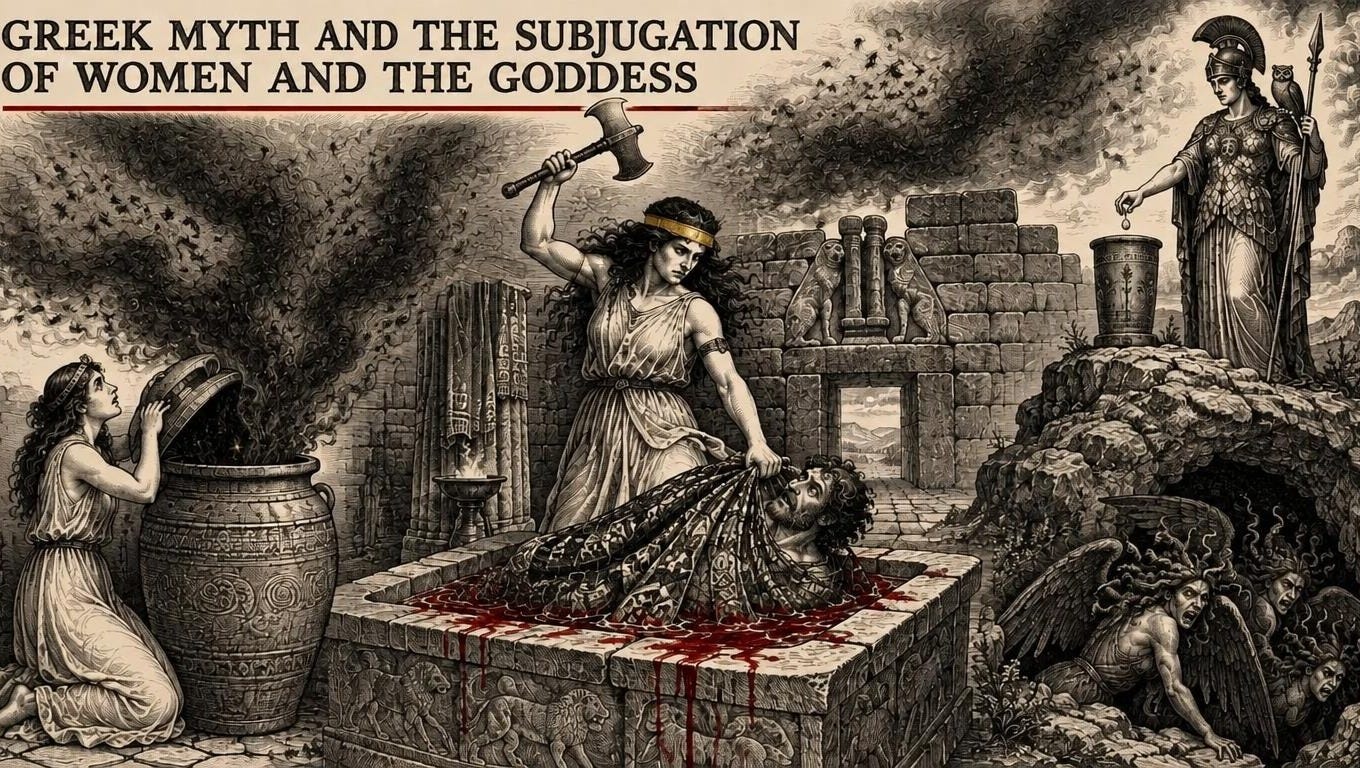
We are going to spend the next few episodes of Goddess Bible Study focusing on the ancient Greeks of the Archaic and Classical periods, who were contemporaries of the ancient Hebrews in the Iron Age. These two cultures, along with the Romans and Christianity, are the foundation stones of Western civilization. Both adopted alphabetic scripts from the Phoenicians between the 10th and 8th centuries BCE and began writing new stories.
The Hebrews and the Greeks emerged from the Bronze Age Collapse with dramatic histories, fresh mythologies, and reordered pantheons. The new Iron Age religions of Yahweh and the Olympians shared a desire to subvert the independence and power of the Bronze Age goddesses and make them submissive to their new Iron Age lords, just as human women were being forced to submit to their husbands.
This was the era when the last vestiges of the old Bronze Age matriarchies were subsumed by a series of violent imperial conquests. In the Iron Age, women would no longer be allowed to live independently of patriarchal control. All women inside civilization were forced to submit once and for all, like wild horses forced to take the bridle and saddle.
Previously, we discussed Helen of Troy and the Bronze Age Collapse, including the events of the Trojan War. Helen and her sister Clytemnestra represent the older Mycenaean civilization, with its matriarchal lineages, which collapsed along with Troy. These legends were foundational to Greek literature and myth.
In this episode, we will focus on two major writers, Hesiod and Aeschylus, with particular attention to the goddesses and the reordered Iron Age cosmos the Greeks introduced.
The Theogony
Hesiod was the most significant Greek poet after Homer. He recorded many of the classical Greek myths in his poems, the Theogony and Works and Days, composed around 700 BCE. In Works and Days, Hesiod presents himself as a small farmer in Boeotia, far removed from the royal courts and their lives of luxury, writing from the perspective of a humble countryman living in a harsh world.
Hesiod's works exalted justice and disdained hubris. He believed that man should earn his livelihood through strenuous and persistent work. For Hesiod, hard work was the only path to prosperity and distinction, in contrast to the ideals of glory and immortality portrayed by Homer.
The Theogony is an account of the creation of the universe and the gods. In the beginning, four primordial beings came into existence spontaneously: first came Chaos (the Void), then Earth (Gaia), Tartarus (the Abyss), and Eros (Desire), "the fairest of the deathless gods." For the Greeks, the universe was born from the primordial mother, Gaia, who gave birth to the heavens, the mountains, the sea, and most of the gods. (Chaos produced its own separate line, beginning with Darkness and Night.)
And Earth first bare starry Heaven,
equal to herself,
to cover her on every side,
and to be an ever-sure abiding-place for the blessed gods.
— Hesiod, Theogony 126–128 (trans. H. G. Evelyn-White)
The Homeric Hymns are a collection of poems dedicated to the various Greek gods. By tradition they are credited to Homer, but their actual authors are unknown, and most were composed in the 7th and 6th centuries BCE or later. Hesiod's Theogony was also widely adapted by later Greek writers, and here I present some of those later, more robust retellings.
Homeric Hymn to Gaia
I will sing of well-founded Earth, mother of all, eldest of all beings.
She feeds all creatures that are in the world, all that go upon the goodly land, and all that are in the paths of the seas, and all that fly: all these are fed of her store.
Through you, O queen, men are blessed in their children and blessed in their harvests, and to you it belongs to give means of life to mortal men and to take it away.
Happy is the man whom you delight to honour!
He has all things abundantly: his fruitful land is laden with corn, his pastures are covered with cattle, and his house is filled with good things.
Such men rule orderly in their cities of fair women: great riches and wealth follow them: their sons exult with ever-fresh delight, and their daughters in flower-laden bands play and skip merrily over the soft flowers of the field.
Thus is it with those whom you honour O holy goddess, bountiful spirit.
Hail, Mother of the gods, wife of starry Heaven; freely bestow upon me for this my song substance that cheers the heart!
And now I will remember you and another song also.
Cronus and Gaia
Gaia, the primordial Earth Mother, gave birth to her own husband, Uranus, the Heavenly Father. Uranus mated with Gaia, and she gave birth to the twelve Titans, the three Cyclopes (giant one-eyed monsters), and the three Hecatoncheires (monsters with a hundred hands and fifty heads). Uranus was cruel and hated his children from the start. As each one was born, he hid it away inside the Earth — inside Gaia's own body — and would not let it come into the light, greatly angering their mother.
Gaia, groaning with pain, appealed to her children for help, and her youngest, the Titan Cronus, answered. Cronus hated his lusty father and took up the sickle his mother had made for him. Gaia hid Cronus in ambush, and when Uranus came to lie with her, Cronus reached out with the sickle, castrated his father, and threw the severed genitals over his shoulder. From the drops of blood were born the Furies, the Giants, and the ash-tree nymphs. The genitals fell into the sea, and a foam formed around them, out of which was born Aphrodite, the goddess of the foam (the foam is widely read as semen).
Gaia gave birth to many children — gods, monsters, and forces of nature — and she remained an active character in Greek myth, while Uranus retreated into the background of the Greek imagination.
Cronus ruled the universe with his sister-queen Rhea, mother of the Olympians. The Phoenician History of Philo of Byblos, written in Greek, explicitly identifies Cronus with the Canaanite El and names Rhea among El's wives, which suggests an identification of Rhea with Asherah (Rhea was also identified with the Anatolian mother goddess Cybele). In the Canaanite texts from Ugarit, El is called the Creator of Creatures and the Father of Years, and Cronus was later associated with Time (Chronos).
Cronus learned that one of his children was destined to overthrow him, so he swallowed each of his children as soon as they were born. When Rhea gave birth to her sixth child, Zeus, she hid him away safely on Crete and tricked Cronus with a stone wrapped in swaddling clothes, which he swallowed instead.
When Zeus was grown, he led a rebellion against Cronus and forced him to disgorge the stone and his five siblings: Hera, Hestia, Demeter, Poseidon, and Hades. Zeus set the stone at Delphi, where the priests there anointed it with oil every day. Zeus and his brothers and sisters waged a mighty war against Cronus and the Titans that shook the universe to its core. Zeus and the gods prevailed, and he punished his enemies terribly, binding them in chains deep in Tartarus, the abyss. Among the Titans was Atlas, who was punished by having to hold up the sky on his shoulders.
I argue that this mythological trope, in which a young god or gods overthrow and conquer an older generation of gods, reflects actual historical shifts in religion, as when a new empire conquers an older one and replaces its gods. The Babylonian creation story, the Enuma Elish, in which Marduk becomes king of the gods, is a memory of the newer Babylonian pantheon displacing the older Sumerian one. Likewise, the Iron Age Greeks reordered the earlier Bronze Age Mycenaean pantheon, while the Iron Age Yahwists overthrew the Bronze Age Baal cult.
Prometheus
In later versions of the myth, some Titans sided with Zeus and were rewarded for their loyalty. In the retelling by Plato, Prometheus and his brother Epimetheus were given the task of equipping man and the animals. Absent-minded Epimetheus gave all the great gifts to the animals — speed, strength, and flight — leaving nothing for man. It was wise Prometheus who made man noble, upright, and intelligent. And to make up for man's lack of physical gifts, Prometheus gave him fire, stolen from the gods.
Greek writers celebrated man as the noblest of creatures — "Many wonders there are, but none more wondrous than man," sings the chorus in Sophocles' Antigone — in contrast to the Mesopotamians, who believed humans were lowly creatures created to serve the gods. The Greeks also pictured their gods in fully human form, unlike the Egyptians, whose gods often had the heads of animals.
Zeus was greatly angered at Prometheus. Not only had Prometheus given man fire, but he had also arranged a trick sacrifice, offering the gods bones wrapped in glistening fat and leaving the good meat for men to eat — the origin of the Greek custom of burning the bones for the gods. (Hesiod says Zeus saw through the trick but chose the bones anyway.)
Zeus swore revenge. Prometheus was taken away and chained to a rock, where an eagle swooped down every day to eat his liver, only to have it grow back every night. Prometheus endured this torture for a long time until Heracles killed the eagle and freed him, as Hesiod tells it.
Pandora, the First Woman
At this time there were no women: in the Greek Golden Age, men lived on the earth without women. Hesiod's writings were deeply misogynistic, reflecting Greek culture and its regressive attitudes. Hesiod was the first to tell a story similar to that of Eve in the Garden of Eden: how the first woman brought ill upon the men of the world. The story of Pandora was retold by many writers.
Zeus, in his anger with Prometheus, created the cleverest punishment of all for man: the first woman, Pandora. Hephaestus shaped her into a lovely young maiden, with a face like the immortal goddesses. All the gods gave her gifts. Athena dressed her and taught her weaving; Aphrodite poured grace upon her; the Graces and Persuasion hung golden necklaces on her; the Seasons crowned her with spring flowers; and Hephaestus made her a golden crown. But Hermes gave her lies, crafty words, and a deceitful nature. Her name, Pandora, means "all-gifted," because all the gods gave her a gift. Zeus, delighted with his stratagem, brought her out, and gods and men alike were struck with wonder. From Pandora was born the race of women, who, according to Hesiod, are an evil to men, with a nature to do evil.
Zeus had Pandora delivered to Epimetheus, who accepted her despite Prometheus's warning never to accept a gift from Zeus. Pandora brought with her a great storage jar (a pithos, often mistranslated as a "box"). Hesiod says only that she lifted its lid; later retellings added that Zeus gave her the jar as a wedding present and warned her not to open it.
In those later tellings, Pandora was curious. She could not help herself; she tried to resist temptation, but in the end she opened the jar, unleashing Zeus's curses on humanity. Out of the jar streamed all of life's miseries: greed, envy, hatred, pain, disease, hunger, poverty, war, and death. Pandora was terrified by all the evil spirits and closed the jar as fast as she could, but it was too late.
Only one spirit remained inside the jar: hope. Hesiod says Pandora closed the lid by the will of Zeus, and whether hope was a final boon to humanity or one more trap has been debated since antiquity. In the popular reading, against the onslaught of life's unending suffering, there remains the constant flickering candle of hope, and as long as hope burns, humans still stand a chance.

The Oresteia
Greek literature and mythology served a role similar to that of the Hebrew Bible in codifying the diminished status of women and the Goddess in their society. In 458 BCE — by traditional reckoning the same year Ezra brought the Book of the Law to Jerusalem — the famous Greek playwright Aeschylus won first prize at the Athens Dionysia festival for his trilogy, the Oresteia.
The Oresteia tells the story of an escalating cycle of family violence that culminates in matricide, and of a trial in which the god Apollo argues that killing one's mother is no crime because the child belongs solely to the father, and the goddess Athena casts the vote that acquits the son.
Aeschylus was deeply religious and was born in Eleusis, home of the Mystery religion of Demeter. The playwright was very influential, and by having a god argue that matricide is not a blasphemous crime because no blood relationship exists between mother and child, he implicitly argued in favor of exclusive patrilineal descent, just as the Hebrew Bible does.
This story codifies the moment in Greek culture when the ancient ways of the Goddess were finally overthrown by male dominance. It depicts the clash between matriarchal and patriarchal cultures and tells the story of the founding of the Greek legal system, which sought to bring order out of chaos by ending the cycles of clan vengeance for family murders that had existed for millennia.
The story begins with the return of King Agamemnon from the Trojan War. Agamemnon was the thuggish leader of the Greeks, who had defeated Troy but, in doing so, had committed sacrilege by desecrating the Trojan temples, women, and people. His wife, Queen Clytemnestra, is the sister of Helen (and their husbands are brothers). She is shown eagerly awaiting his return after ten long years of absence. But Clytemnestra does not love Agamemnon; she has murder on her mind.
Before leaving for Troy a decade earlier, Agamemnon had angered the goddess Artemis. The angry goddess becalmed the winds, which prevented the Greek armada from setting sail for Troy. To appease her, Agamemnon arranged to sacrifice his daughter Iphigenia.
There are many versions of this story. All of the Trojan War legends lived long in oral tradition and were retold by many poets with varying details. In some versions, Agamemnon offended Artemis by killing her sacred deer; in Aeschylus, the goddess is angered by an omen of two eagles tearing apart a pregnant hare. In Euripides' version, Agamemnon lures Iphigenia to the altar by telling his wife and daughter that she is to marry the hero Achilles; in Aeschylus, she is gagged so she cannot curse her family and is lifted over the altar like a sacrificial goat. In some versions, Artemis rescues the maiden, but in Aeschylus's influential version, the girl dies. The winds then returned, and the ships sailed to Troy.
Queen Clytemnestra never forgave her husband for killing their daughter, her matriarchal heir, and in her role as matriarch, she was obligated to avenge her. Clytemnestra is a dominant figure who represents the old ways, the primal traditions of the Goddess, and Aeschylus portrays her as deceitful and murderous. She is a character similar to Queen Jezebel in the Hebrew Bible, who is likewise portrayed as a villain.
In the play, Clytemnestra greets Agamemnon with fulsome praise and invites him into the palace. Agamemnon has brought along his war prize, the slave concubine Cassandra, a tragic figure who was given the divine gift of prophecy but cursed so that no one would ever believe her. Cassandra foresees the murder, but no one listens. Clytemnestra draws Agamemnon a warm bath, and while he is in it, she entangles him in a robe like a fishing net and strikes him down. She kills Cassandra as well and publicly proclaims the deed, declaring her tribal right to revenge.

The second play, The Libation Bearers, tells the story of Orestes, the son of Agamemnon and Clytemnestra. Orestes has been ordered by the god Apollo to return to his homeland and take revenge on his mother. He joins his sister Electra, who shares his desire to avenge their father. At the fateful moment, Clytemnestra begs her son to spare her life, and Orestes hesitates, knowing that killing his mother is a great crime. But Orestes follows Apollo's instructions and cuts his mother down. No sooner has he slain her than Orestes begins to see visions of the Furies, the ancient goddesses of vengeance and justice who punish evildoers, particularly those who murder their own kin. Driven by madness, Orestes flees, ending the second play.
The third play, The Eumenides, opens at Apollo's temple at Delphi, famous to this day as the home of the Pythia, the oracle and prophetess of Apollo. The Pythia finds Orestes clinging to the sacred center stone of the temple, his hands still dripping with blood. Around him sit the fearsome, terrifying Furies. Apollo tells Orestes that he will protect him and that he should go to the temple of Athena in Athens. Apollo argues with the Furies, who express their disgust with this new and unjust god who would both encourage Orestes to murder a parent and then offer him sanctuary in his temple. The Furies vow revenge on Orestes for his blood crime — it is the ancient way.
The scene shifts to the temple of Athena, where Orestes begs the goddess for protection. Athena arrives and listens to both Orestes and the Furies plead their cases. She announces that the matter is too grave for her to decide alone, so she institutes the first homicide court and holds a trial with a jury of oath-bound citizens to render a verdict. The play thus mythologizes the origins of the Greek legal system, which was established to replace the traditional path of tribal blood vengeance. Orestes is the defendant, Athena presides, and a group of Athenian citizens serves as the jury. The Furies, despite their misgivings, act as the prosecutors, while Apollo serves as Orestes' defense advocate.
Apollo makes an unusual argument in Orestes' defense, one that would be as profound in establishing the role of women in society as Eve in the Garden of Eden. The Furies are charged with avenging the murder of kin, but Apollo argues that the mother cannot be considered kin, because she merely safeguards the father's seed; the child belongs to the father alone. "The mother of what is called her child is not the parent, but the nurse of the newly-sown embryo," says Apollo (Eumenides 658–659, trans. H. W. Smyth). A child has only a father, and the mother is of no significance, so Orestes has not committed the grave sin of murdering his kin.
Apollo offers as proof none other than the goddess Athena, who was born fully grown from the head of Zeus, with no birth mother. The jury’s votes come out evenly split, and Athena announces her own vote for Orestes, declaring that she is wholly on the side of the male, except in marriage.
Apollo: This too I answer; mark a soothfast word, Not the true parent is the woman’s womb That bears the child; she doth but nurse the seed New-sown: the male is parent; she for him, As stranger for a stranger, hoards the germ Of life; unless the god its promise blight.
And proof hereof before you will I set. Birth may from fathers, without mothers, be: See at your side a witness of the same, Athena, daughter of Olympian Zeus, Never within the darkness of the womb Fostered nor fashioned, but a bud more bright Than any goddess in her breast might bear.
Athena: Mine is the right to add the final vote, And I award it to Orestes’ cause. For me no mother bore within her womb, And, save for wedlock evermore eschewed, I vouch myself the champion of the man, Not of the woman, yea, with all my soul,-- In heart, as birth, a father’s child alone.
Furies: Woe on you, younger gods! The ancient right Ye have o’erridden, rent it from my hands.
— Aeschylus, Eumenides (trans. E. D. A. Morshead)
Orestes is acquitted and returns to his city of Argos as the new king. The Furies are shocked and dismayed, and they vow vengeance on the entire city of Athens. But Athena dissuades them by offering them a place in the new order: from now on, they will defend Athenian justice and bless the city. She gives them a cave to dwell in beneath the city, symbolizing how they were driven underground.
This marks the Axial Age shift from the ancient ways of superstition to something more philosophical and institutional. From the Greek perspective, this was a just and ethical correction of society's moral structure, marked by the advent of formal legal systems. Athenian democracy and its legal system laid the foundation for the best aspects of liberal governance in the Western tradition. But like so many things, it comes as a paradox: the advance toward democracy was directly tied to the repression of women and the denial of their most sacred role, as mothers.
Clytemnestra was defending her clan by killing Agamemnon, but she was denied the right to take revenge because a tribal matriarch held no standing in Greek society. The original killing of Iphigenia was completely forgotten, her murder dismissed.
Athena and Apollo were not foreign imports in this period, like Aphrodite; both were native Greek deities (the name Athena appears in the Bronze Age Mycenaean Linear B tablets).
Athena in particular represents the idealized Greek view of femininity. She is wisdom, civilization, and the patron of weaving; she is chaste and celebrates her virginity and restrained sexuality. Her birth from the head of Zeus represents wisdom derived directly from the godhead, and she sits at his right hand.
Apollo held the role of oracle and master of divination, which was generally a goddess's role — even as the Pythia who served in his temple was always a woman.
Next episode, we will dive into the Olympian pantheon, the crossovers with the Canaanites, and discuss how the powers of the Bronze Age goddess of Love and War were divided across Athena and Aphrodite in the Iron Age.