

For the next few weeks on Goddess Bible Study, we will step back from the Bible to explore some of the neighboring cultures in Mesopotamia and Canaan.
We pick up from our last discussion last week about the qedesha priestesses, i.e., temple prostitutes, and take a deeper dive into the evidence for sacred sex and ritual prostitution across the ancient world. There are many details we don’t know about these practices since most of it was never written down, but the details we have are intriguing.
We observe a progression from the Bronze Age into the Iron Age, of women steadily losing their sexual independence and respected societal positions. We see this loss of status in both cultural practices and in the mythology of the goddesses.
Over a period of 3000 years, from the Bronze Age Sumerians and Akkadians, into the Iron Age Neo-Assyrian and Neo-Babylonian empires (as well as the Israelites), the rights and mobility of free women were steadily constrained. Until finally, the independence of women came to be seen as a threat to the now-established patriarchal order.
At the dawn of urban civilization, we see that women had a great deal of independence and power, and consecrated roles in the temples. Modern scholarship demonstrates that the qedesha were only one category of free women who lived in Bronze Age Mesopotamia, as martriarchal families co-existed alongside patriarchal families for many centuries. Men often used their mother’s family names.
Elite women ran businesses, could read and write, engaged in far-flung trade, bought and sold property and slaves, met with the king, and spoke to men as equals. These women had unique names and identities such as: qedesha (priestesses, holy ones), naditu (consecrated business women), ishtaritu (priestesses of Ishtar), and harimtu (freewomen). Exclusive female professions included: midwife, nurse, sorceress, wet nurse, as well as tavern keepers, doctors, scribes, cooks, barbers, bakers, wig makers, weavers, and laborers, priestesses.
Sumerian Naditu were a class of cultic professional women who did not generally marry or have children and lived together in the temple precinct. These women were engaged in business, often representing their father’s estates, and were highly respected businesswomen.
Attestations of these independent women diminish over time, as do lists of women’s professions, implying a growing social intolerance and preference for marriages and male control over women’s bodies. By the late Babylonian period, around the same time of the Hebrew prophets in the early Iron Age, women had disappeared from the names of professionals completely.
Harimtu - Freewomen or Prostitutes?
Julia Assante led an academic revision of the notions of cult prostitution, she argues rather convincingly that the “harimtu,” who has historically been translated as a prostitute, and perhaps a cult prostitute, should be seen not as a sex-professional but instead as a free woman who lived on her own outside of patriarchal authority, with no husband or father having authority over her. These women were sexually autonomous and could choose their partners, and they may or may not have been promiscuous.
The most famous harimtu is Shamhat from the Epic of Gilgamesh, humanity’s oldest written epic. In the story, Shamhat travels with Gilgamesh to meet Enkidu, the wild man of the forest. Shamhat tames and civilizes the wildman through her sexuality and wisdom, bringing him into the city and teaching him the ways of man, but at the cost of running wild with the animals.
Harimtu supported themselves outside of patriarchal authorities with no husband or (legal) father, often living with other harimtu in multi-generational homes. Harimtu were legally defined and established as a normative part of society, but did not have much legal protection for their children or estates.
The harimtu were physically and financially independent, though it is not precisely clear how they supported themselves. Many harimtus had children, and they were on their own to raise them, whether or not they had the support of the child’s father or other men.
Assante, Julia. “The kar.kid/harimtu, Prostitute or Single Woman? A Reconsideration of the Evidence,” Ugarit-Forschungen 30 (1998)
Prostitution and Patriarchy
The cultures of the Ancient Near East were openly sexual, using sex in magic and agricultural rituals, and the basic existence of ritual temple prostitution is well established. Brothels were common in the neighborhoods around goddess temples.
In the early Sumerian period, women’s unrestrained sexual desires were idealized and celebrated, and by the later periods, these women were seen as fearsome and threatening.
The high goddess Inanna/Ishtar was explicitly a prostitute whose raw sexuality was on display. Extensive amounts of erotic art were found in Mesopotamia, and it was common in public spaces.
There is certainly no doubt about the existence of conventional prostitution in brothels and taverns, which was legal, common, and taxed throughout the ancient world. Greek and Roman law was expansive on the behavior and taxation of prostitutes, concubines, and slaves, and children born to them.
Sex at or around Venus temples was one of the more consistent pagan practices all the way through Greek and Roman times, until the temples were shuttered with the rise of Christianity in the 4th century.
The sexual freedom of women comes to be seen as more than simply an obedience problem, but a genuine danger to society. Freewomen were seen as a threat to the patriarchal social order and inheritance, and many were castigated as witches.
In one of our oldest written legends, we have the birth story of the legendary Sargon of Akkad, who was the world’s first military emperor. Around 2300 BCE, Sargon defeated the Sumerians and united the disparate Mesopotamian kingdoms into the first true empire. You will notice similarities in this legend to the birth story of Moses.
Sargon was born to a high priestess in a virgin birth, presumably because she got pregnant in a ritual with an anonymous man.
Sargon’s daughter, Enheduanna, was also a high priestess and was the first named poet in all of history. She wrote many hymns and prayers celebrating the goddess Ishtar, the favorite of his father.
My mother was a high priestess, my father I knew not.
The brothers of my father loved the hills.
My city is Azupiranu, which is situated on the banks of the Euphrates.
My high priestess mother conceived me, in secret she bore me.
She set me in a basket of rushes, with bitumen she sealed my lid.
She cast me into the river which rose over me.
The river bore me up and carried me to Akki, the drawer of water.
Akki, the drawer of water, took me as his son and reared me.
Akki, the drawer of water, appointed me as his gardener.
While I was a gardener, Ishtar granted me her love,
and for four and ... years I exercised kingship.
The black-headed [people] I ruled, I governed;
- Legend of Sargon of Akkad - 23rd century BCE
The liturgies of the great goddess Ishtar, who was arguably the most popular goddess of the Bronze Age, are famously sexually explicit. Ishtar was Venus, the goddess of love and war, the maiden, the virgin. She is known by many names across cultures: Inanna, Astarte, Aphrodite Urania, Venus, Uzza, and many others. She lives on today as Durga in contemporary India.
Ishtar is the chthonic embodiment of sexuality, which was linked to the growth of plants and fertility. Ishtar’s sexuality literally makes the plants grow, and the Mesopotamians were not shy about celebrating her sexual prowess.
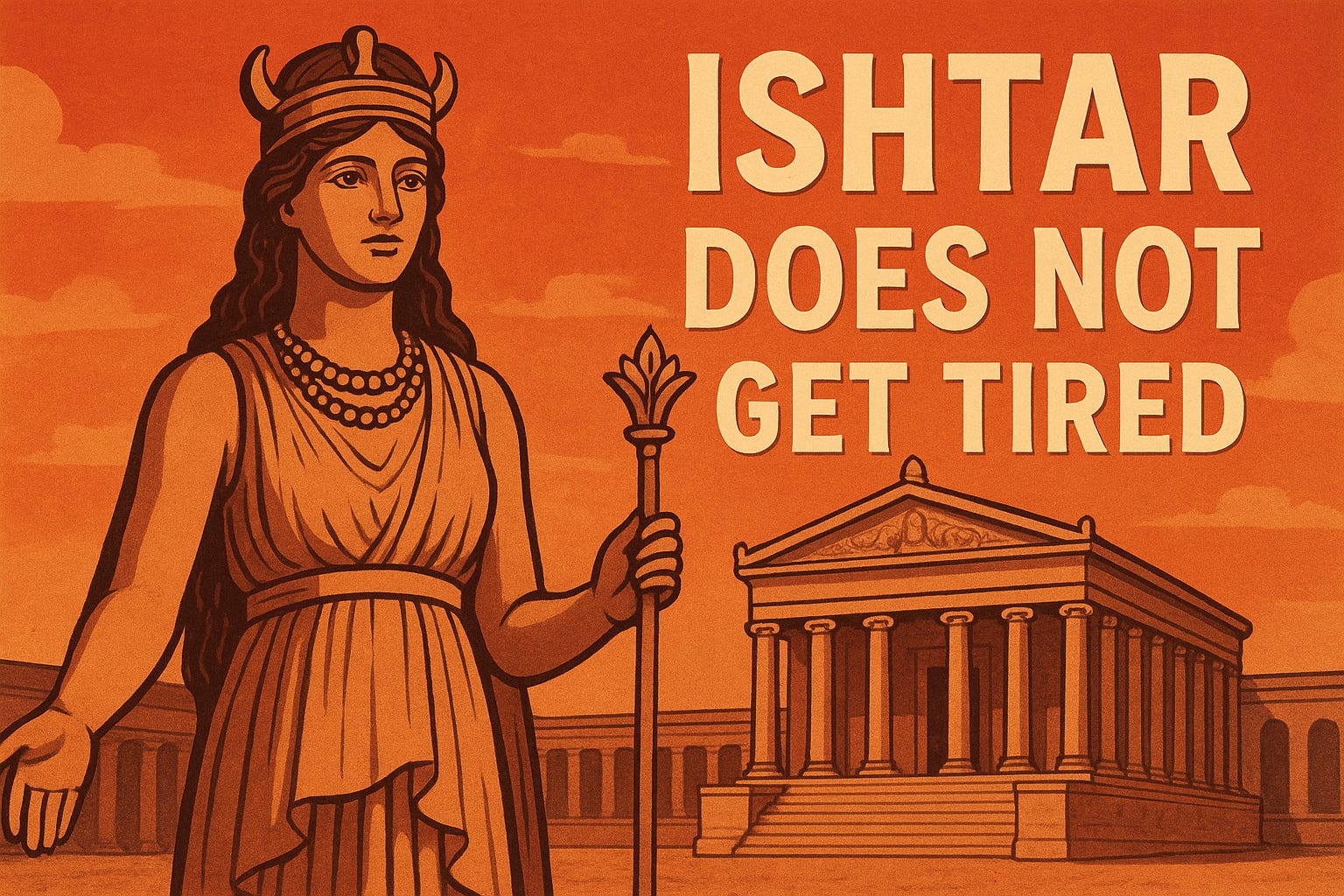
The following hymn, “Ishtar Does Not Get Tired”, would probably get censored in many places. It is a good example, but far from the only one, of Ishtar’s explicit sexuality being put on display.
Ishtar will not tire
One comes up to her (The city is built on pleasure)
Come here, give me what I want (The city is built on pleasure)
Then another comes up to her (The city is built on pleasure)
Come here, let me touch your vulva (The city is built on pleasure)
Since I’m ready to give you all that you want (The city is built on pleasure)
Get all the young men of your city together (The city is built on pleasure)
Let’s go to the shade of the wall (The city is built on pleasure)
Seven for her midriff, seven for her loins (The city is built on pleasure)
Sixty then sixty satisfy themselves in turn upon her nakedness
(The city is built on pleasure)
Young men have tired, Ishtar will not tire (The city is built on pleasure)
Get on with it, fellows, for my lovely vulva (The city is built on pleasure)
As the girl demanded, (The city is built on pleasure)
the young men heeded, gave her what she asked for
(The city is built on pleasure)
- Akkadian Hymn, time of Hammurabi, c. 1800 BCE
- Foster, B.R. 1993. Before the Muses: An Anthology of Akkadian Literature. Bethesda: University of Maryland Press. Vol II, p 584
The following passage is an advertisement for a Mesopotamian prostitute, though presumably secular and not sacred. You can see the use of farming and agricultural metaphors for sex that were common in this era.
Farmers symbolized the matriarchal peasant farmers who worshipped the goddesses, while shepherds were the patriarchal warrior kings who imposed themselves as a new ruling class beginning in the Bronze Age. The rivalry between farmers and shepherds plays out throughout the Biblical text.
Julia Assante wrote, “poets idealized Uruk as a city of festivals, its streets full of singing and dancing, one imagines that part of its allure included its famed female population of beautiful and voluptuous women, women with luxuriantly curly hair and available single women in general.” (Assante article)
Asante continues that street sex was associated with Inanna. “The street is a place where young love blooms and maidens sing and dance. Such as the streets of Uruk, a safe, happy place where the young pass the day.”
From the Sumerian through to the late Babylonian period, a clear decline is observed in the attitudes towards the financially independent harimtus with their prodigious sexual appetites and predatoriness.
“When I am standing by the wall it is one lamb.
When I am bowing down, it is one and a half shekels.
Don’t go digging any other canal. I will be your canal!
Don’t go plowing any other field. I will be your field
Farmer, don’t go looking for any other moist patch. I will be your moist patch!”
- (Assante 1998, 86 n. 237)
In the Middle Bronze Age, we find Akkadian Wisdom texts that advise men not to marry any of the sexually free women who populate their culture. We learn a few names and why the young Mesopotamian man should avoid these women.
We learn the names of the harmitu (a free woman), the Ishtaritu who was a priestess of Ishtar, and the kulmasitu who was a courtesan. The young man is told that none of these women will submit and be a good wife to their husbands.
Do not marry a harimtu [freewoman], whose husbands are legion,
An ishtaritu [priestess], who is dedicated to a goddess,
a kulmasitu [courtesan], who gives her favors to all.
In your troubles, she will not support you,
In your fights, she will sneer at you;
She does not know respect and submission.
Should she dominate your house, get rid of her,
For she has directed her attention to another’s footfall.
- Akkadian “Counsels of Wisdom” - C. 1500 BCE
LAMBERT, W. G. (1960): Babylonian Wisdom Literature, Oxford.
As we move into the Iron Age with the Greeks and Hebrews, we see that promiscuous sexuality steadily lost its public approval over time.
The Biblical prophets never hid their disdain for the sexual practices of the Canaanite women.
Jeremiah lived late in the First Temple period and took part in the exile when the temple was destroyed by the Babylonians in 586 BCE. Jeremiah played an important role in the religious reforms of King Josiah, who championed the Yahweh-alone movement and worked hard to shut down the worship of Asherah and the goddesses.
Jeremiah was openly critical of the Queen of Heaven and argued strenuously with the other pagan Israelites. Here, Jeremiah hands the goddess the certificate of divorce.
Yahweh said to me, “Have you seen what faithless Israel has done? She has gone up on every high hill and under every spreading tree and has committed adultery there...I gave faithless Israel her certificate of divorce and sent her away because of all her adulteries.
- Jeremiah 3:6,8
Ezekiel began his prophetic career soon after the exiled Israelites arrived in Babylon. Like Jeremiah, he is deeply critical of Israelite paganism and their matriarchal sexual culture. Here, he speaks to the egalitarian sexual culture also described in the following passages, where the women take the lead in pursuing men and offer gifts to their lovers.
“’You adulterous wife! You prefer strangers to your own husband! All prostitutes receive gifts, but you give gifts to all your lovers, bribing them to come to you from everywhere for your illicit favors. So in your prostitution you are the opposite of others; no one runs after you for your favors. You are the very opposite, for you give payment and none is given to you.
- Ezekiel 16:32-34
The famous Greek historian Herodotus, writing in the 5th century BCE, 1200 years after Hammurabi, described ritual prostitution in Babylon as the most vile of traditions. His account is very famous and has been referenced by scholars ever since.
Many modern critics dismiss Herodotus’ account as slander or conjecture, and claim that this single passage has been overly influential in shaping views of Near Eastern culture.
But Herodotus was not alone; Greeks, Romans, and early Church Fathers all described the sexually “licentious” goddess-worshipping traditions that existed in many countries, and the biblical Hebrew prophets went to great lengths to vilify them.
The foulest Babylonian custom is that which compels every woman of the land to sit in the temple of Aphrodite (Ishtar) and have intercourse with some stranger once in her life. Many women who are rich and proud and disdain to mingle with the rest, drive to the temple in covered carriages drawn by teams, and stand there with a great retinue of attendants. But most sit down in the sacred plot of Aphrodite, with crowns of cord on their heads; there is a great multitude of women coming and going; passages marked by line run every way through the crowd, by which the men pass and make their choice.
Once a woman has taken her place there, she does not go away to her home before some stranger has cast money into her lap, and had intercourse with her outside the temple; but while he casts the money, he must say, “I invite you in the name of Mylitta” [Assyrian for Aphrodite]. It does not matter what sum the money is; the woman will never refuse, for that would be a sin, the money being by this act made sacred. So she follows the first man who casts it and rejects no one. After their intercourse, having discharged her sacred duty to the goddess, she goes away to her home; and thereafter there is no bribe however great that will get her. So then the women that are fair and tall are soon free to depart, but the uncomely have long to wait because they cannot fulfill the law; for some of them remain for three years, or four. There is a custom like this in some parts of Cyprus.
Herodotus, Histories 1.199
Herodotus, The Histories, with an English translation by A. D. Godley. Cambridge. Harvard University Press. 1920.
Herodotus continues his discussion of sacred prostitution with the Lydians in Anatolia, who were the first to use coined money.
All the daughters of the common people of Lydia ply the trade of prostitutes, to collect dowries, until they can get themselves husbands; and they themselves offer themselves in marriage.
The customs of the Lydians are like those of the Greeks, except that they make prostitutes of their female children. They were the first men whom we know who coined and used gold and silver currency; and they were the first to sell by retail.
- Herodotus, Histories 1.94 -94
Strabo was a Greek writer who lived 64 BCE – 24 CE, contemporary with Rufus, and 500 years after Herodotus. Strabo wrote in his book Geographica about cult prostitution among the Persians and Armenians, where the exchange of gifts was mutual between men and women. Acilisene was an Anatolian city now known as Erzincan, and Anaitis was a Persian goddess considered to be a manifestation of Ishtar.
Now the sacred rites of the Persians, one and all, are held in honour by both the Medes and the Armenians; but those of Anaïtis are held in exceptional honour by the Armenians, who have built temples in her honour in different places, and especially in Acilisenê. Here they dedicate to her service male and female slaves. This, indeed, is not a remarkable thing; but the most illustrious men of the tribe actually consecrate to her their daughters while maidens; and it is the custom for these first to be prostituted in the temple of the goddess for a long time and after this to be given in marriage; and no one disdains to live in wedlock with such a woman.
Something of this kind is told also by Herodotus in his account of the Lydian women, who, one and all, he says, prostitute themselves. And they are so kindly disposed to their paramours that they not only entertain them hospitably but also exchange presents with them, often giving more than they receive, inasmuch as the girls from wealthy homes are supplied with means. However, they do not admit any man that comes along, but probably those of equal rank with themselves.
- Strabo, Geographica, Book XI, Chapter 14, verse 16
The Geography of Strabo, published in Vol. V of the Loeb Classical Library edition, 1928.
Quintus Curtius Rufus (died 53 CE) was a Roman senator and author of an important history of Alexander the Great that described the sexually permissive culture in Babylon, where Alexander died in 323 BCE. Rufus does not describe ritual prostitution, but he makes it clear that Babylon was a sexually free society.
Alexander’s stop in Babylon was longer than anywhere else, and here he undermined military discipline more than in any other place. The moral corruption there is unparalleled; its ability to stimulate and arouse unbridled passions is incomparable.
Parents and husbands permit their children and wives to have sex with strangers, as long as this infamy is paid for. All over the Persian empire kings and their courtiers are fond of parties, and the Babylonians are especially addicted to wine and the excesses that go along with drunkenness.
Women attend dinner parties. At first they are decently dressed, then they remove their top-clothing and by degrees disgrace their respectability until (I beg my reader’s pardon for saying it) they finally throw off their most intimate garments. This disgusting conduct is characteristic not only of courtesans but also of married women and young girls, who regard such vile prostitution as “being sociable”.
- History of Alexander the Great of Macedonia [5.1.36-38]
Curtius Rufus’ History of Alexander the Great of Macedonia, translated by John Yardley
These cultural practices existed for thousands of years, and the last vestiges were only finally extinguished when Christianity became the state religion of the Roman Empire under Emperor Constantine in the 4th century CE.
Eusebius of Caesarea (c. 265-c. 340) was an early Church Father who wrote histories of early Christianity and a biography of Emperor Constantine, the first Roman emperor to convert to Christianity and who began the systematic and violent purging of pagan religions.
In his Life of Constantine, Eusebius described in critical terms the Phoenicians from Lebanon. Eusebius praised Constantine for closing the Venus temples and forcing the people to behave themselves.
... a hidden and fatal snare of souls in the province of Phœnicia. This was a grove and temple, not situated in the midst of any city, nor in any public place, … [on] the summit of Mount Lebanon, and dedicated to the foul demon known by the name of Venus. It was a school of wickedness for all the votaries of impurity, and such as destroyed their bodies with effeminacy.
Here men undeserving of the name forgot the dignity of their sex, and propitiated the demon by their effeminate conduct; here too unlawful commerce of women and adulterous intercourse, with other horrible and infamous practices, were perpetrated in this temple as in a place beyond the scope and restraint of law.
Meantime these evils remained unchecked by the presence of any observer, since no one of fair character ventured to visit such scenes. These proceedings, however, could not escape the vigilance of our august emperor, who, having himself inspected them with characteristic forethought, and judging that such a temple was unfit for the light of heaven, gave orders that the building with its offerings should be utterly destroyed. Accordingly, in obedience to the imperial command, these engines of an impure superstition were immediately abolished, and the hand of military force was made instrumental in purging the place. And now those who had heretofore lived without restraint learned self-control through the emperor’s threat of punishment.
- Chapter 55. Overthrow of an Idol Temple, and Abolition of Licentious Practices, at Aphaca in Phœnicia.
Eusebius described how Emperor Constantine closed the Venus temple at Heliopolis, known today as the city of Baalbek in Lebanon. This was a particularly famous and important pilgrimage location, home to magnificent temples to Jupiter (formerly Baal), Bacchus (Dionysus), and Venus (Astarte). The site was long sacred to the Phoenicians and was later rebuilt by the Romans.
The remarkable Jupiter temple at Baalbek was not only the biggest temple anywhere in the Roman Empire, but it also contains the Trilithon, three megalithic stones, 900 tons apiece, that are the largest and heaviest stones ever carved by human beings anywhere in the world. No one knows who moved these stones or how they did it. We know it was not the Romans, as they never claimed to have done it, and they hid the megalithic stones when they rebuilt the Jupiter temple.
We may instance the Phœnician city Heliopolis, in which those who dignify licentious pleasure with a distinguishing title of honor, had permitted their wives and daughters to commit shameless fornication. But now a new statute, breathing the very spirit of modesty, proceeded from the emperor, which peremptorily forbade the continuance of former practices.
- Chapter 58. How he destroyed the Temple of Venus at Heliopolis, and built the First Church in that City.
Life of Constantine, Eusebius of Caesarea (c. 265-c. 340). Source. Translated by Ernest Cushing Richardson. From Nicene and Post-Nicene Fathers, Second Series, Vol. 1.
Listen to the Goddess Bible Study discussion, live Tuesday night, Oct. 14 at 7pm EST.
Next week, we will explore the foundational mythology of the greatest Mesopotamian goddess of the Bronze Age, Inanna/Ishtar.