

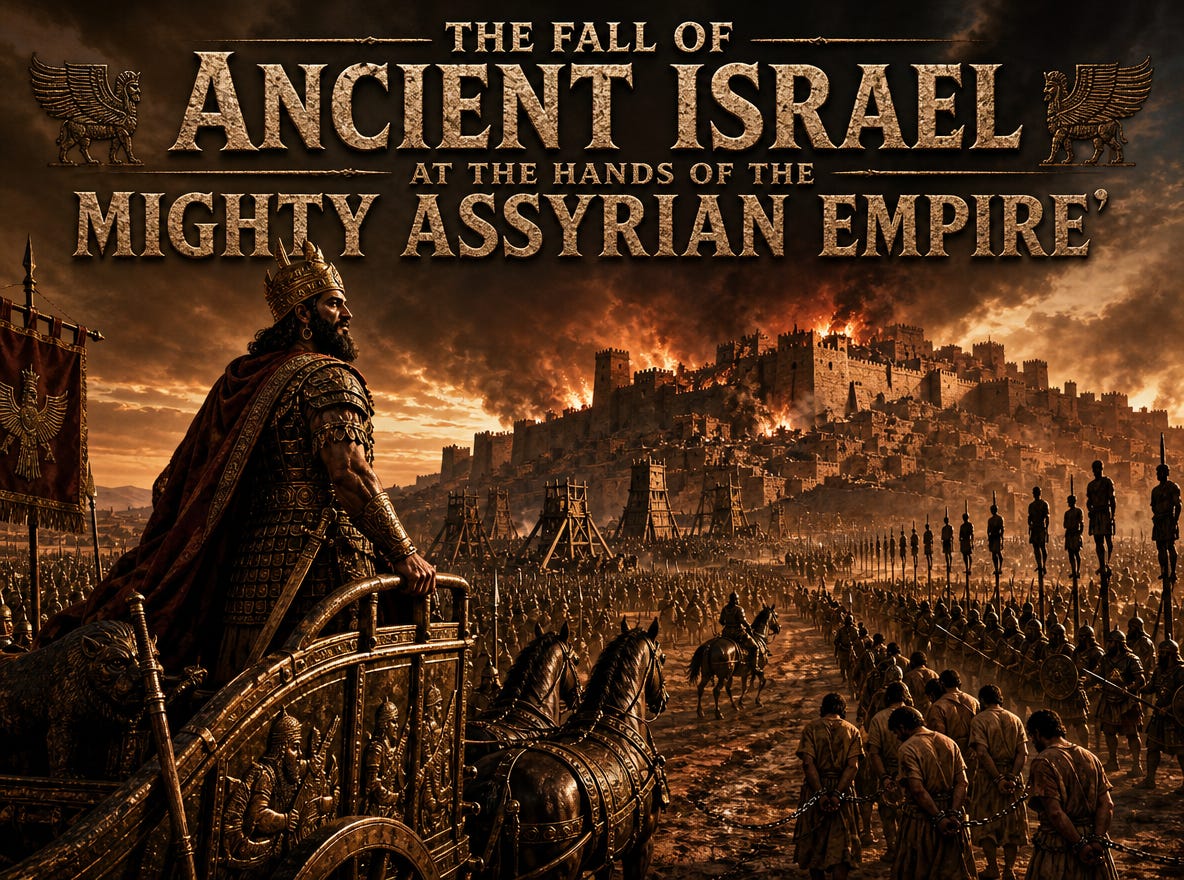
In this episode of Goddess Bible Study, we dig into the brutal and theologically fascinating history of the Assyrian Empire, the dominant military force of the early Iron Age. The Assyrians destroyed the nation of Israel in 722 BCE and sent ten of the twelve tribes into exile, never to be heard from again.
The Rise of Assyria
For three centuries, from 912 to 612 BCE, the Neo-Assyrian Empire was the most powerful the world had yet seen, and sophisticated in its own way. The Assyrians exercised a highly political theology where their god Ashur was the greatest power in the cosmos and ordained them to rule as his servants. Brutality was the will of the gods, divine punishment for the failure to submit.
The Assyrians built a model of leadership and bureaucracy that later empires would study and imitate. They were the first to mass-produce iron weapons, superior in every way to the bronze arms of their rivals. Their army was disciplined and professional, their tactics advanced, and their siege engines were the pride of the empire — purpose-built machines engineered to breach even the mightiest walled cities.
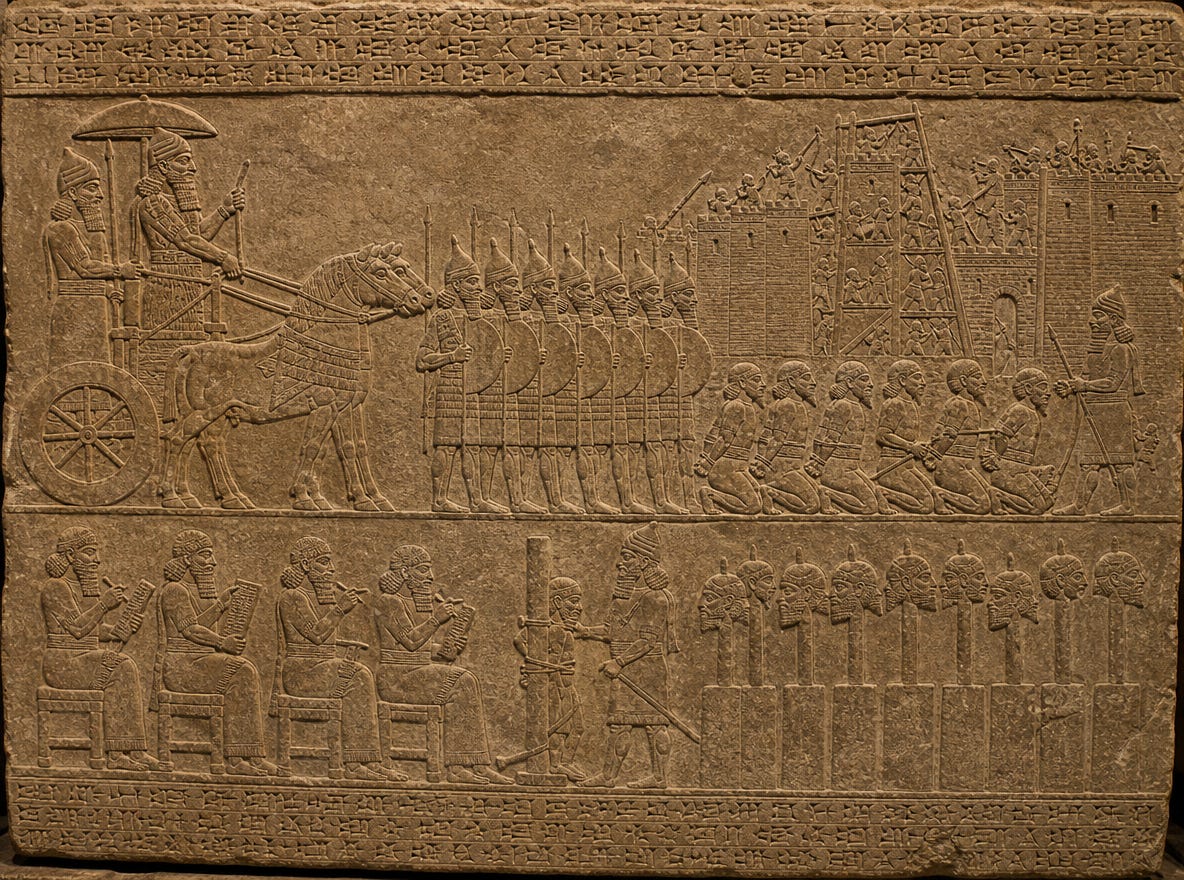
The Assyrians earned a reputation for extraordinary cruelty, and it was a deliberate, well-documented policy. The palace reliefs at Nineveh, Nimrud, and Khorsabad depict flaying captives alive, impaling rebels on stakes, and stacking severed heads into pyramids outside conquered cities — carved in intricate detail as boasts, not incidental battle scenes.
Amputating limbs and gouging out eyes, then leaving victims alive to wander as walking warnings, was a calculated strategy to instill fear and ensure submission, not cruelty for its own sake. Assyrian kings framed these campaigns of terror as carrying out the will of Ashur: the king executed divine judgment on rebels who, in Assyrian ideology, had broken their sworn oath to the god.
Assyria’s reach extended across the major trade routes of the ancient world, dominating Babylonia, western Persia, Anatolia, and the Levant, with its territory eventually stretching as far as Egypt. Israel and Judah, sitting astride vital trade corridors, played an outsized role in this imperial story, and the Assyrians appear throughout the biblical record as a result.
This is one of the best-documented periods in the ancient Near East — historians and archaeologists have corroborated the biblical account against the records of Israel’s neighbors, so we can read these conflicts from both sides.
Assyria’s achievements weren’t limited to war and theology. Building on medical foundations laid by Babylon, and absorbing the knowledge and talent of every people it conquered, Assyria made real progress in medical science. Ashurnasirpal II (884–859 BCE), who consolidated Assyrian rule across the Levant and Canaan, went so far as to compile the first systematic lists of plants and animals in the empire, bringing scribes along on his campaigns specifically to record new discoveries.
Assyrian expansion along the Mediterranean coast began in earnest under Shalmaneser III (859–824 BCE), who extracted tribute from the wealthy Phoenician cities of Tyre and Sidon during the years Ahab and Jezebel ruled Israel. Assyrian records confirm that Ahab’s successor, King Jehu, submitted to Shalmaneser III and paid him tribute. We showed the Black Obelisk of Shalmaneser in the last episode.
Ashur, Supreme God
Assyrian religion offers a striking parallel to the religious transformation underway in Israel and Judah. The Assyrians practiced a form of monolatry that approached, and clearly influenced, later monotheism. They insisted their god Ashur was the supreme power in the universe, but they didn’t ban the worship of other gods outright — they simply recast every foreign deity as another manifestation of Ashur himself. It was shrewd political theology, allowing the empire to maintain religious and political consistency across its territory while avoiding the destructive conflict that comes with forcibly suppressing local temples.
Assyrian military dominance was treated as self-evident proof of Ashur’s supremacy, and the imperial propaganda machine made sure everyone knew it. The Assyrians believed Ashur had chosen them as his people and granted them the divine right to rule over other nations — a belief that directly shaped Assyrian identity, ideology, and military expansion.
Theology and empire grew in lockstep, and the theology was actively rewritten to justify political dominance. The empire wanted Ashur acknowledged as supreme, not other gods erased — monolatry was a political project first. Tellingly, Ashur’s cult disappeared entirely once Assyria collapsed; the god had no independent life apart from the imperial project that created him. His theology was so thoroughly a political instrument that it had no staying power once the political structure it served was gone.
Assyrian religion was part of a broader current running through the ancient world in this era — the Axial Age — which pushed cultures toward higher, more transcendent conceptions of the divine. Hebrew monotheism, Zoroastrianism, Chinese Taoism, Confucianism, and strands of Greek philosophy all emerged from this same current, each rejecting the older, more immanent understanding of the divine found in nature worship and shamanism.
This shift had consequences that fell disproportionately on women. Assyria was a deeply patriarchal culture. Women’s legal and property rights were severely curtailed compared to older Mesopotamian cultures, and their sexuality was tightly controlled by their families.
Tiglath-Pileser III
Assyria had fallen into civil war before Tiglath-Pileser III (745–727 BCE) seized power and revitalized the empire. Many scholars regard his reign as the true beginning of the Neo-Assyrian Empire proper. He reorganized the military into what became the most effective fighting force history had yet produced. In 729 BCE, he marched into Babylonia and captured the king of Babylon himself. Tiglath-Pileser appears directly in the biblical text as the conqueror who brought Israel to heel and demanded heavy tribute from Samaria.
In the time of Pekah king of Israel, Tiglath-Pileser king of Assyria came and took Ijon, Abel Beth Maakah, Janoah, Kedesh and Hazor. He took Gilead and Galilee, including all the land of Naphtali, and deported the people to Assyria.
-2 Kings 15:29
King Ahaz and the Altar of Ashur
In Judah, King Ahaz became a vassal of Tiglath-Pileser, paying tribute and allying himself with Assyria against Israel and Syria. Ahaz was thoroughly pagan in his practice, embracing Assyrian religion wholesale. He even built an altar to Ashur and installed it inside the Temple of Yahweh itself — an act that scandalized the biblical writers. Ahaz went further still, sacrificing his own children, placing him among the most offensive kings in the biblical record, second only to Ahab and Jezebel in the eyes of the Deuteronomistic historians.
[Ahaz] followed the ways of the kings of Israel and even sacrificed his son in the fire, engaging in the detestable practices of the nations Yahweh had driven out before the Israelites. He offered sacrifices and burned incense at the high places, on the hilltops and under every spreading tree.
-2 Kings 16:3–4
Ahaz’s submission to Assyria was total and self-interested. Facing pressure from Aram and Israel, he turned to Tiglath-Pileser directly for rescue, stripping the treasuries of both the Temple and the royal palace to pay for it.
Ahaz sent messengers to say to Tiglath-Pileser king of Assyria, “I am your servant and vassal. Come up and save me out of the hand of the king of Aram and of the king of Israel, who are attacking me.” And Ahaz took the silver and gold found in the temple of Yahweh and in the treasuries of the royal palace and sent it as a gift to the king of Assyria. The king of Assyria complied by attacking Damascus and capturing it. He deported its inhabitants to Kir and put Rezin to death.
-2 Kings 16:7–9
The altar itself has a remarkable origin story. Ahaz traveled to Damascus to meet Tiglath-Pileser in person, and while there, he saw an altar that impressed him enough to send detailed construction plans home ahead of him.
Then King Ahaz went to Damascus to meet Tiglath-Pileser king of Assyria. He saw an altar in Damascus and sent to Uriah the priest a sketch of the altar, with detailed plans for its construction. So Uriah the priest built an altar in accordance with all the plans that King Ahaz had sent from Damascus and finished it before King Ahaz returned. When the king came back from Damascus and saw the altar, he approached it and presented offerings on it. He offered up his burnt offering and grain offering, poured out his drink offering, and splashed the blood of his fellowship offerings against the altar. As for the bronze altar that stood before Yahweh, he brought it from the front of the temple — from between the new altar and the temple of Yahweh — and put it on the north side of the new altar.
-2 Kings 16:10–14
The image is hard to miss: the altar of Yahweh is physically shoved aside to make room for the altar modeled on Assyrian religion, with the king of Judah himself performing the sacrifices.
The Siege of Israel
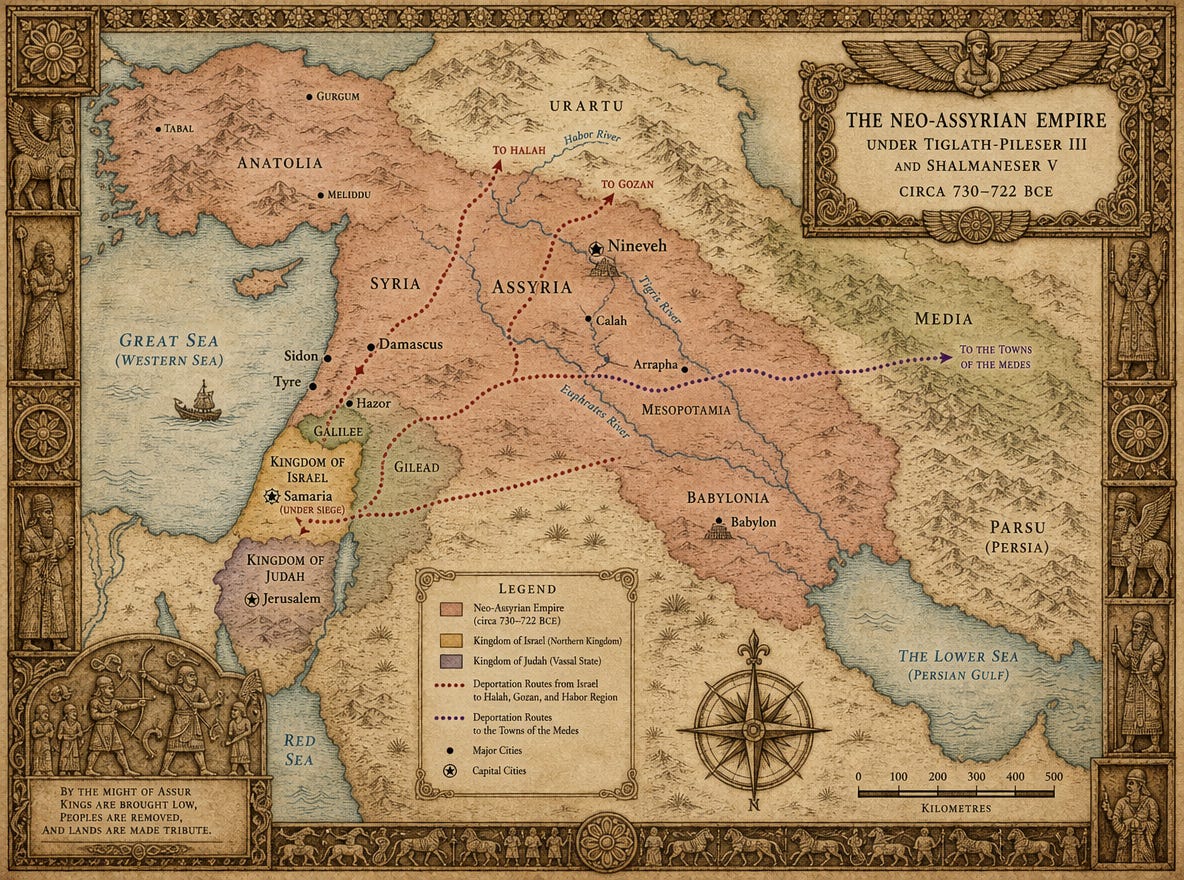
Tiglath-Pileser III died in 727 BCE and was succeeded by Shalmaneser V. King Hoshea of Israel, perhaps sensing weakness in the transition, stopped paying tribute and allied himself with Egypt against Assyria in 725 BCE. It was a fatal miscalculation. Shalmaneser responded by invading Israel outright and laying siege to Samaria for three years. Hoshea himself was captured and imprisoned.
Shalmaneser king of Assyria came up to attack Hoshea, who had been Shalmaneser’s vassal and had paid him tribute. But the king of Assyria discovered that Hoshea was a traitor, for he had sent envoys to So, king of Egypt, and he no longer paid tribute to the king of Assyria, as he had done year by year. Therefore Shalmaneser seized him and put him in prison. The king of Assyria invaded the entire land, marched against Samaria and laid siege to it for three years. In the ninth year of Hoshea, the king of Assyria captured Samaria and deported the Israelites to Assyria. He settled them in Halah, in Gozan on the Habor River and in the towns of the Medes.
-2 Kings 17:3–6
The fall of Samaria in 722 BCE brought a permanent end to Israel as an independent kingdom. Its people were deported across the Assyrian Empire, scattering into history as the Ten Lost Tribes of Israel.
The Assyrians were not indiscriminate about resettlement— deportees were allowed to bring their families and possessions and were settled on new land, while people from other conquered territories were moved in to replace them. Once a conquered population submitted to the central authority, the Assyrians treated them as Assyrians. Resettlement served as a form of forced assimilation, and those who complied were treated relatively well, while resistance was met with slaughter.
The biblical writers, naturally, tell a different story about why Israel fell. For them, the cause was not Assyrian military superiority but Israel’s failure to worship Yahweh properly — even as the Assyrians themselves credited their victories to the superior power of Ashur.
Biblical writers performed the ultimate theological judo when they successfully recast the destruction of Israel, and later Judah, by outside powers as Yahweh’s punishment of Israelite polytheism, rather than victories for the Assyrian Ashur or Babylonian Marduk.
All this took place because the Israelites had sinned against Yahweh their God... The Israelites secretly did things against Yahweh their God that were not right. From watchtower to fortified city they built themselves high places in all their towns. They set up sacred stones and Asherah poles on every high hill and under every spreading tree. At every high place they burned incense, as the nations whom Yahweh had driven out before them had done. They did wicked things that aroused Yahweh’s anger.
-2 Kings 17:7, 9–11
The list of offenses reads like a checklist of everything the Yahwist reform movement was working to stamp out: idols, golden calves, an Asherah pole, worship of the starry hosts, worship of Baal, child sacrifice, and divination.
They forsook all the commands of Yahweh their God and made for themselves two idols cast in the shape of calves, and an Asherah pole. They bowed down to all the starry hosts, and they worshiped Baal. They sacrificed their sons and daughters in the fire. They practiced divination and sought omens and sold themselves to do evil in the eyes of Yahweh, arousing his anger.
-2 Kings 17:16–17
In the aftermath, the king of Assyria repopulated the towns of Samaria with people brought in from Babylon, Kuthah, Avva, Hamath, and Sepharvaim, who took over the towns the Israelites had left behind.
The king of Assyria brought people from Babylon, Kuthah, Avva, Hamath and Sepharvaim and settled them in the towns of Samaria to replace the Israelites. They took over Samaria and lived in its towns.
-2 Kings 17:24
After Samaria: Sargon II to Ashurbanipal
Shalmaneser V died suddenly during the siege of Samaria and was succeeded by Sargon II, under whom the empire reached its greatest political and military heights. Sargon II was followed by Sennacherib (705–681 BCE), who campaigned widely and ruthlessly, devastating Judah and laying siege to Jerusalem during the reign of King Hezekiah.
Sennacherib made the ancient city of Nineveh his capital, building there the famed “Palace Without Rival” along with a vast library. Nineveh was dedicated to the goddess Ishtar, and many scholars now believe that Sennacherib’s grand palace gardens at Nineveh were, in fact, the true “Hanging Gardens of Babylon” — since no trace of that famous Wonder of the Ancient World has ever been found in Babylon itself.
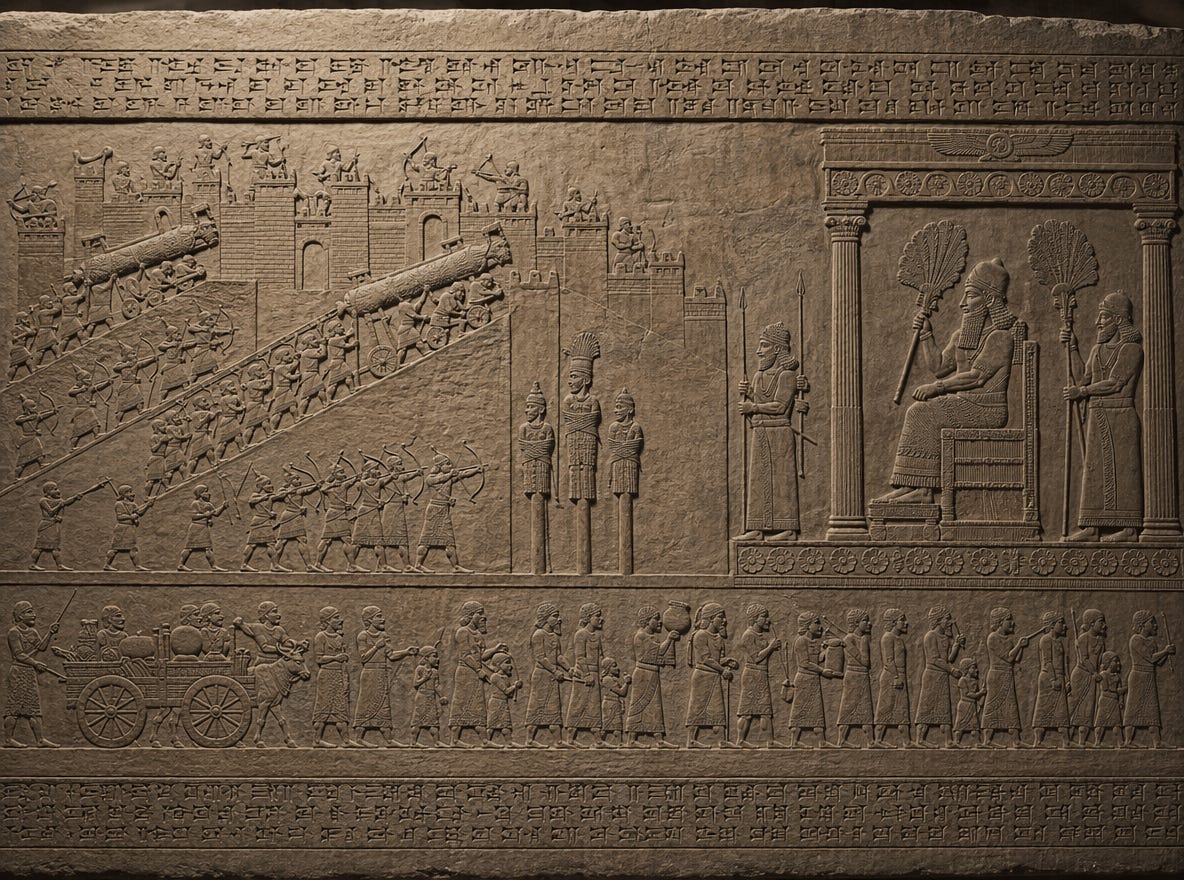
In 701 BCE, Sennacherib sieged the Judean city of Lachish, a critical fortified city. The loss of Lachish was devastating to King Hezekiah, but the Bible gives the event only a brief mention. The victory was important enough to Sennacherib that he commissioned an enormous carved relief detailing the battle in all its bloody glory for his palace in Nineveh.
The relief covers the walls of a large room and measures 39 feet long and 16.7 feet high and currently resides in the British Museum. These contrasting accounts, Biblical vs Assyrian, is one of the clearest examples of how the Book of Kings is total political propaganda. We will explore this event more fully in the next episode on King Hezekiah.
In the fourteenth year of Hezekiah’s reign, Sennacherib king of Assyria attacked and captured all the fortified cities of Judah. So Hezekiah king of Judah sent word to the king of Assyria at Lachish, saying, “I have done wrong; withdraw from me, and I will pay whatever you demand from me.” And the king of Assyria exacted from Hezekiah king of Judah three hundred talents of silver and thirty talents of gold.
-2 Kings 18:13-14
Sennacherib’s ambitions eventually turned toward Babylon, which he invaded, breaking its canals and flooding the city before looting its ancient temples — an act of sacrilege so extreme that even his own people considered it beyond the pale. Sennacherib was ultimately assassinated in his own palace by his sons, who saw his crimes against the old Babylonian gods as unforgivable.
His successor was Esarhaddon, one of those very sons, who secured the throne by killing all his brothers and rivals in a brief civil war. Esarhaddon went on to expand the empire into Egypt and secured vassal treaties across the region.
The last great king of Assyria was Ashurbanipal, who reigned from 669-631 BCE and is remembered above all for the extraordinary library he built at Nineveh, sending envoys to every corner of the empire to acquire texts for preservation in the Royal Library. Ashurbanipal is famed as a scholar king who spoke many languages and was highly literate.
After Ashurbanipal’s death, the empire began to unravel. It had grown too large to govern effectively, and its outlying regions began breaking away one by one. In 612 BCE, a coalition of Babylonians, Persians, Medes, and Scythians sacked and burned Nineveh, massacring its residents. The destruction of Nineveh was complete and systematic - it seems Assyria’s enemies truly hated them. Ashur’s cult center in Assur was plundered, and the temples desecrated. Worship of Ashur disappeared along with the empire he championed.
In Nineveh, the largest city in the world at the time, the brutal combat went house-to-house, and the temples to Ashur were completely razed to the ground. The king was killed, and a new Assyrian king attempted to hold on in exile for a few more years before finally falling at the hands of Nebuchadnezzar II of Babylon at Carchemish in 605 BCE. We will also discuss this event in more detail when we get to King Josiah.
There is a strange grace in how the story closes. The fires that destroyed Nineveh baked its clay tablets hard and buried them beneath the rubble, preserving them for millennia. The catastrophe inadvertently produced one of the greatest archaeological discoveries in history when the ruins were unearthed 2,454 years later, in 1842 CE. The Royal Library of Ashurbanipal yielded a treasure trove, vast quantities of art and some 30,000 cuneiform tablets, including the Epic of Gilgamesh, the Enuma Elish, and also clear evidence of the ritual use of cannabis.
In the next couple of episodes, we will get into the great kings of Judah, the Yahwist reformers Hezekiah and Josiah, and the successful pagan Manasseh. This is a critical period in the development of radical Yahwist theology and the fight with the goddesses.