

Goddess Bible Study returns with the arrival of kingship and the end of matriarchies in ancient Israel. It is the depths of the Bronze Age Collapse, a time of famine, anarchy, and lawlessness, that we see portrayed in the books of Ruth and Samuel.
In the late 11th century BCE, the Israelites decided they wanted a king to lead them. Whether the people understood at the time or not, this decision would end their tribal, more cooperative and egalitarian lifestyle, and replace it with top-down rule by kings who demand taxes, tribute, and the service of the people’s sons and daughters.
The arrival of kingship also extinguished the final vestiges of Bronze Age matriarchy that still existed among the Israelites and ushered in the new era of firm Iron Age patriarchy.
The first king was the disgraced Saul, followed by the most beloved King David, and then the wisest, King Solomon, as seen in the books of 1st and 2nd Samuel.
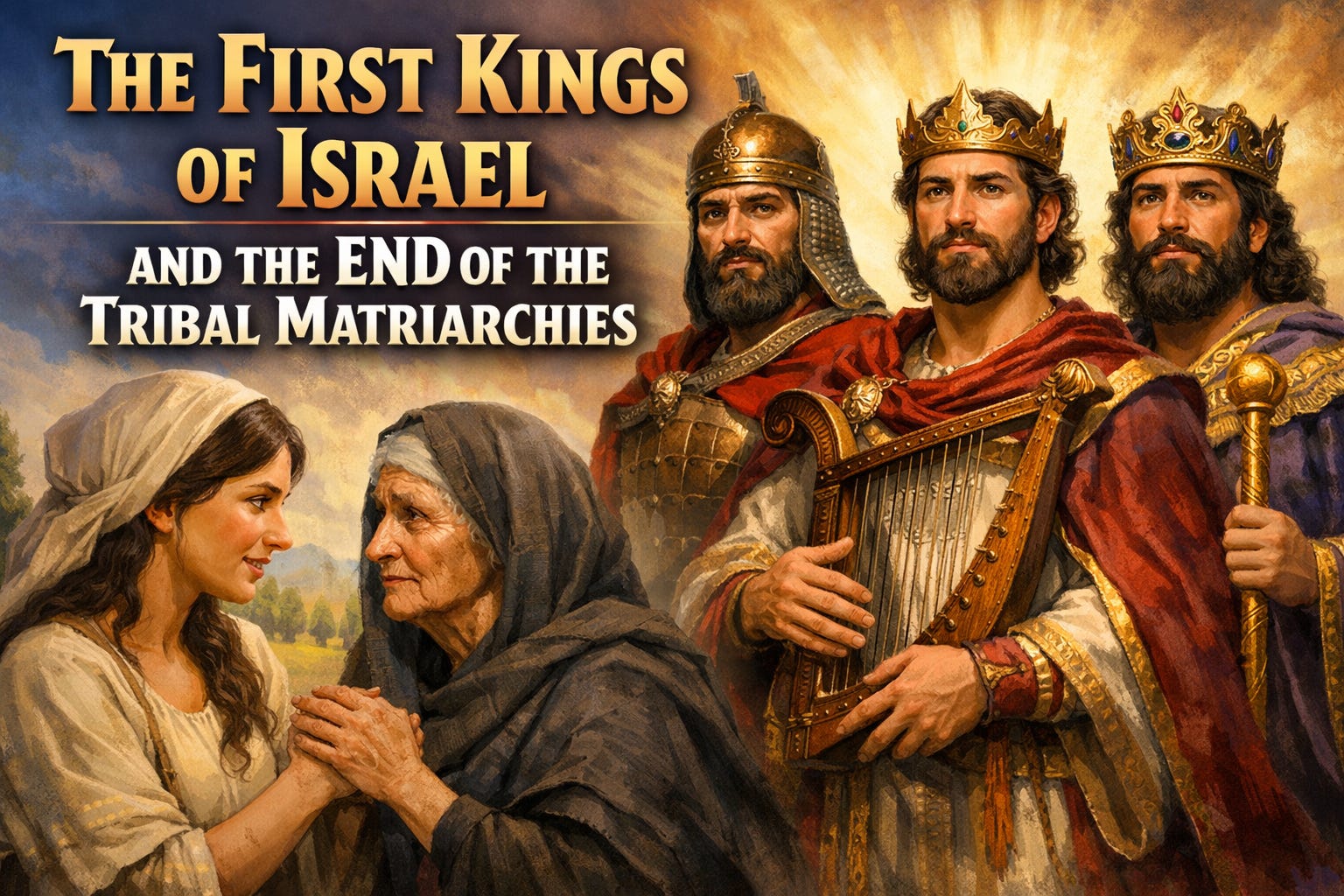
But first, we look at the book of Ruth, which is the last mention of a matriarchy in the Biblical timeline. It is a treatise on why women should join the patriarchal Yahweh clans.
Earlier, we saw the prophetesses Deborah and Miriam as tribal leaders. Going forward, we see kings with many wives, while the Queen Mothers, like Jezebel, will be overthrown.
I have been making the case all along that during the Bronze Age, patriarchal and matriarchal family structures coexisted (mother’s homes and father’s homes), and in the Iron Age, the tribal matriarchies were purged from civilization.
The Book of Ruth shows this historical transition point when the last of the tribal matriarchies were still around, and women still had a bit of choice in the matter.
Ruth was a Moabite woman who married into an Israelite family that had moved to Moab to escape famine in Israel. Famines were a feature in this time period and are mentioned during the reign of King David. Modern scholarship shows there were many famines during the 300-year Bronze Age Collapse that contributed to the instability and social breakdown.
Ruth had married one of the two sons, but tragically, all the men died, leaving three widows, the mother Naomi, and two daughters-in-law. Naomi instructed the young women to return to their “mother’s home,” and their gods in Moab, which was one of the matriarchal, polytheistic Canaanite groups that the Biblical writers are always raging against. But Ruth chose to stay with her mother-in-law and put her faith in Yahweh, who rewarded her with an honorable husband, named Boaz, and a child who would become the grandfather of King David.
The story is a not-so-subtle pitch to the women of the day that Yahweh would take care of you in his patriarchal families, even if your husband dies. In matriarchal families, the women could rely on each other for support and were less dependent on their husbands. Women had to be convinced, sold, or kidnapped into joining patriarchal families.
Then Naomi said to her two daughters-in-law, “Go back, each of you, to your mother’s home. May Yahweh show you kindness, as you have shown kindness to your dead husbands and to me. May Yahweh grant that each of you will find rest in the home of another husband.”
-Ruth 1:8-9
At this they wept aloud again. Then Orpah kissed her mother-in-law goodbye, but Ruth clung to her. “Look,” said Naomi, “your sister-in-law is going back to her people and her gods. Go back with her.”
But Ruth replied, “Don’t urge me to leave you or to turn back from you. Where you go I will go, and where you stay I will stay. Your people will be my people and your God my God. Where you die I will die, and there I will be buried. May Yahweh deal with me, be it ever so severely, if even death separates you and me.” When Naomi realized that Ruth was determined to go with her, she stopped urging her.
-Ruth 1:14-18
They go back to Bethlehem, where Ruth meets Boaz, an honorable kinsman. There are clear sexual overtones in the following story, as the word “feet” commonly serves as a euphemism for “penis” throughout the Bible.
One day Ruth’s mother-in-law Naomi said to her, “My daughter, I must find a home for you, where you will be well provided for. Now Boaz, with whose women you have worked, is a relative of ours. Tonight he will be winnowing barley on the threshing floor. Wash, put on perfume, and get dressed in your best clothes. Then go down to the threshing floor, but don’t let him know you are there until he has finished eating and drinking. When he lies down, note the place where he is lying. Then go and uncover his feet and lie down. He will tell you what to do.”
“I will do whatever you say,” Ruth answered. So she went down to the threshing floor and did everything her mother-in-law told her to do.
When Boaz had finished eating and drinking and was in good spirits, he went over to lie down at the far end of the grain pile. Ruth approached quietly, uncovered his feet and lay down. In the middle of the night something startled the man; he turned—and there was a woman lying at his feet!
“Who are you?” he asked.
“I am your servant Ruth,” she said. “Spread the corner of your garment over me, since you are a guardian-redeemer of our family.”
“Yahweh bless you, my daughter,” he replied. “This kindness is greater than that which you showed earlier: You have not run after the younger men, whether rich or poor. And now, my daughter, don’t be afraid. I will do for you all you ask. All the people of my town know that you are a woman of noble character.
-Ruth 3:1-11
So Boaz took Ruth and she became his wife. When he made love to her, Yahweh enabled her to conceive, and she gave birth to a son. The women said to Naomi: “Praise be to Yahweh, who this day has not left you without a guardian-redeemer. May he become famous throughout Israel! He will renew your life and sustain you in your old age. For your daughter-in-law, who loves you and who is better to you than seven sons, has given him birth.”
Then Naomi took the child in her arms and cared for him. The women living there said, “Naomi has a son!” And they named him Obed. He was the father of Jesse, the father of David.
-Ruth 4:13-17
Sometime around 1030 BCE, during the hard period of famine and lawlessness, the Israelite people demanded a king to fight their battles for them. The elders summoned the prophet Samuel and asked him to appoint a king to lead them.
Prophet Samuel objected. He told the people that a king would take the best of everything for himself and drive them into slavery, but the people insisted. Samuel’s warnings all proved true, and we live with the effects to this day.
When Samuel grew old, he appointed his sons as Israel’s leaders. The name of his firstborn was Joel and the name of his second was Abijah, and they served at Beersheba. But his sons did not follow his ways. They turned aside after dishonest gain and accepted bribes and perverted justice.
So all the elders of Israel gathered together and came to Samuel at Ramah. They said to him, “You are old, and your sons do not follow your ways; now appoint a king to lead us, such as all the other nations have.”
But when they said, “Give us a king to lead us,” this displeased Samuel; so he prayed to Yahweh. And Yahweh told him: “Listen to all that the people are saying to you; it is not you they have rejected, but they have rejected me as their king. As they have done from the day I brought them up out of Egypt until this day, forsaking me and serving other gods, so they are doing to you. Now listen to them; but warn them solemnly and let them know what the king who will reign over them will claim as his rights.”
Samuel told all the words of Yahweh to the people who were asking him for a king. He said, “This is what the king who will reign over you will claim as his rights: He will take your sons and make them serve with his chariots and horses, and they will run in front of his chariots. Some he will assign to be commanders of thousands and commanders of fifties, and others to plow his ground and reap his harvest, and still others to make weapons of war and equipment for his chariots. He will take your daughters to be perfumers and cooks and bakers. He will take the best of your fields and vineyards and olive groves and give them to his attendants. He will take a tenth of your grain and of your vintage and give it to his officials and attendants. Your male and female servants and the best of your cattle and donkeys he will take for his own use. He will take a tenth of your flocks, and you yourselves will become his slaves. When that day comes, you will cry out for relief from the king you have chosen, but Yahweh will not answer you in that day.”
But the people refused to listen to Samuel. “No!” they said. “We want a king over us. Then we will be like all the other nations, with a king to lead us and to go out before us and fight our battles.”
When Samuel heard all that the people said, he repeated it before Yahweh. Yahweh answered, “Listen to them and give them a king.”
-1 Samuel 8:1-21
King Saul was the first king of Israel, but Saul was eventually disgraced. He stands as a cautionary tale of hubris and mistrust. Though the Bible is not precise, scholars believe Saul ruled Israel for roughly 20 years, from around 1030-1010 BCE.
Saul was a great military leader, tall and handsome. He fought many battles and won many victories against the Moabites, Ammonites, Edomites, Philistines, the Amalekites, and others. A biblical summary states that “wherever he turned, he was victorious”.
King Saul died by his own sword in battle, and the Philistines took his armor to the temple of Astarte as a war prize.
They put his armor in the temple of the Ashtoreths and fastened his body to the wall of Beth Shan.
-1 Samuel 31:10
King Saul lost favor, and Yahweh chose a young shepherd named David to become the new king. King David is one of the great heroes of the Bible.
David was first brought into Saul’s court as his young armor-bearer and gained fame when he defeated the giant Goliath using only a stone and a sling. David became Saul’s top general, and his military success and popularity with the people made him a threat to the king.
Saul tried to have David killed, but Saul’s son Jonathan was a close friend of David and repeatedly helped him escape. Many modern critical scholars suggest that David and Jonathan may have been lovers. Jonathan was killed alongside his father, and David mourned bitterly.
I grieve for you, Jonathan my brother; you were very dear to me. Your love for me was wonderful, more wonderful than that of women.
-2 Samuel 1:26
After Saul’s death, David had to fight another of Saul's sons, Ish-Bosheth, who was king for two years. Ish-Bosheth means “man of shame.” His proper name was Eshbaal, “man of Baal".
The -eth epithet meaning “shame” is also applied to the goddesses. Ashtoreth means “shameful Astarte,” and represents the origin of slut-shaming.
King David fought many military victories, he was a great general.
Perhaps David’s most long-lasting military legacy was taking Jerusalem from the Jebusites in the year 1004 BCE. Scholars accept that this was a historical event (even if there was no real King David), and we can place a flag firmly on our timeline here.
The Bible offers minimal details, but it appears that David led his soldiers up a water shaft to get past the city walls. Jerusalem was well-fortified and proved to be a difficult city to capture over the centuries.
The king and his men marched to Jerusalem to attack the Jebusites, who lived there. The Jebusites said to David, “You will not get in here; even the blind and the lame can ward you off.” They thought, “David cannot get in here.” Nevertheless, David captured the fortress of Zion - which is the City of David.
On that day David had said, “Anyone who conquers the Jebusites will have to use the water shaft to reach those ‘lame and blind’ who are David’s enemies. That is why they say, “The ‘blind and lame’ will not enter the palace.”
David then took up residence in the fortress and called it the City of David. He built up the area around it, from the terraces inward. And he became more and more powerful, because Yahweh God Almighty was with him.
2 Samuel 5:6-10
David had many wives and concubines. But the most famous and scandalous wife was Bathsheba, the mother of Solomon.
One evening David got up from his bed and walked around on the roof of the palace. From the roof he saw a woman bathing. The woman was very beautiful, and David sent someone to find out about her. The man said, “She is Bathsheba, the daughter of Eliam and the wife of Uriah the Hittite.” Then David sent messengers to get her. She came to him, and he slept with her. (Now she was purifying herself from her monthly uncleanness.) Then she went back home. The woman conceived and sent word to David, saying, “I am pregnant.”
2 Samuel 11:2-5
Bathsheba was a married woman when the king summoned her for a visit. David impregnated her, setting off a series of events as David attempted to cover his tracks. Bathsheba’s husband was a loyal officer named Uriah. David brought him home from the battle in hopes he would visit his wife, but Uriah refused the comforts of home while his men remained in the field. Then David raised the stakes. He sent Uriah into the thick of the fight, knowing that he would be struck down.
Uriah was killed, and Bathsheba mourned him. After a time, David brought her home and married her, and their child was born. This scandalous behaviour displeased Yahweh and the prophet Nathan, who confronted David with his crimes. David admitted everything, and Nathan proclaimed that tragedy would befall David’s family.
The baby was struck ill and died. David had many children with his various wives, and throughout his life, there was always family turmoil. At one point, his oldest son, Absalom, would rebel and attempt to seize the throne before being killed.
David established an archetype that has been followed by kings, presidents, and prime ministers ever since. When caught in adultery or other scandals, the politician theatrically retreats to the model of King David by publicly confessing, proclaiming they are flawed, and seeking redemption from the people. Of course, they all hope to avoid the misery that followed David to his grave.
David lived to be an old man, but the palace intrigue never ended. Of all the famous characters in the Bible, David seems the most real to me, the most human. David’s story reads like the biography of a real historical figure, full of contradictions, heroism and treachery, bravery and tragedy, and with minimal supernatural intervention.
Archaeologists have never confirmed the existence of King David, though they have found evidence of the House of David, which strongly implies his reality. It was an illiterate and anarchic time period, so it makes sense that there are no written records.
During the reign of David, there was a famine for three successive years; so David sought the face of Yahweh.
2 Samuel 21:1
There was some joy for David though. He had another child with Bathsheba, who was so beloved, he was given the name Jedidiah, “loved by the Lord.” We know him better as King Solomon.
Then David comforted his wife Bathsheba, and he went to her and made love to her. She gave birth to a son, and they named him Solomon. Yahweh loved him; and because Yahweh loved him, he sent word through Nathan the prophet to name him Jedidiah.
2 Samuel 12:24-25
For the next few weeks, we will dive into King Solomon, who is the most pivotal Bible figure from the Goddess perspective. King Solomon was the greatest, wisest, and most legendary of all the Israelite kings. His wealth and glory were unsurpassed, and yet King Solomon had a problem, he worshipped the goddesses! And the Biblical writers were not happy about it at all.
King Solomon is the father of the Wisdom traditions. Wisdom is also known as Sophia, a goddess, and she lies at the heart of all Western esoteric and occult traditions, such as Kabalah and Hermeticism. The Greeks portrayed Sophia as a goddess, and the Gnostics placed her at the heart of their mystical Christian traditions.
As the father of wisdom traditions, King Solomon is the conduit through which the acceptable parts of the feminine divine were channeled into the monotheistic Abrahamic faiths.
This week’s discussion will be live on Tuesday, Feb 17 at 7:00 pm EST.
Contact me at:
goddessbiblestudy@gmail.com