

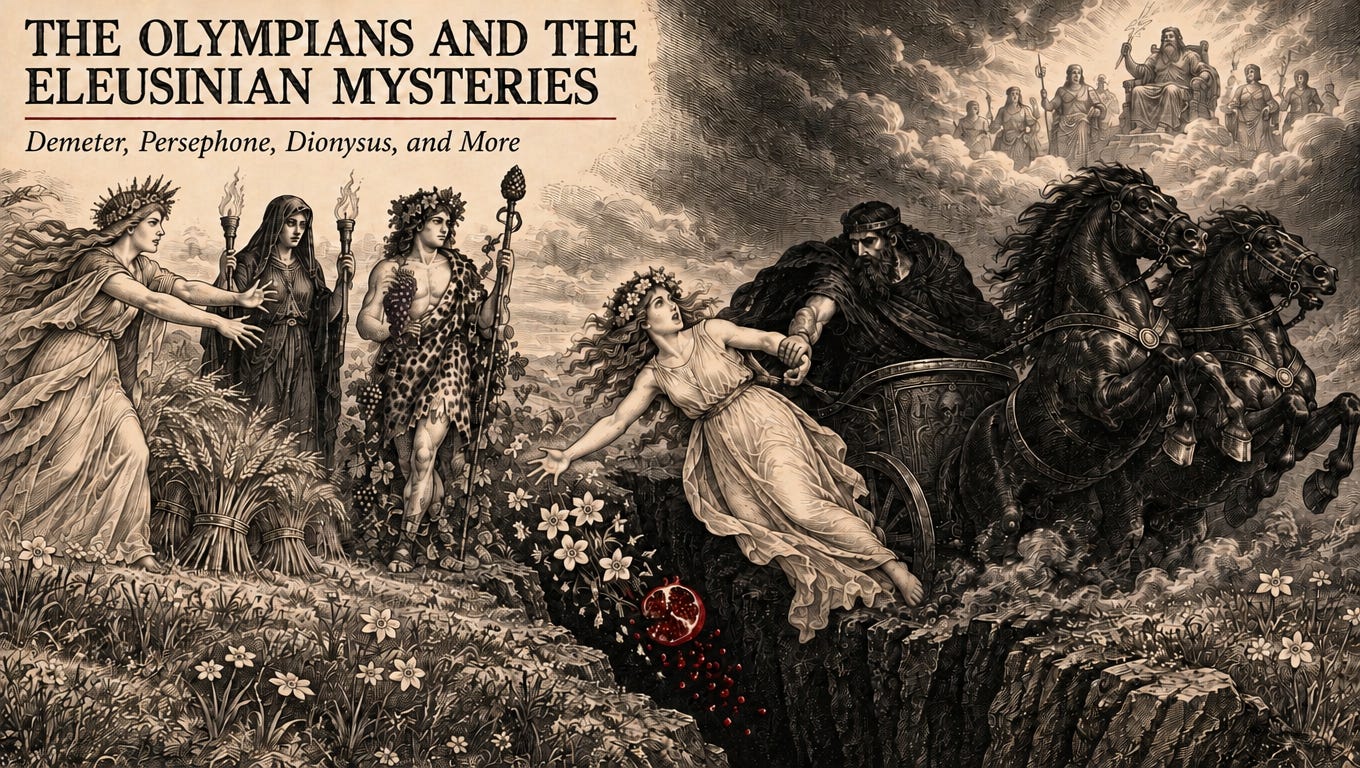
This week, Goddess Bible Study continues in the realm of Archaic Greece, whose people were contemporaries of the First Temple Israelites in the early Iron Age. The Hebrews and Christians, the Greeks and Romans, are the four cornerstones of Western civilization, and it is important to track how their ideas and culture developed over time.
I argue that the Greeks and the Hebrews both emerged in the early Iron Age, and both brought major cultural shifts and religious reformations, instituting new religious frameworks that seem ancient to us today but were novel and innovative at the time.
A striking contrast between Bronze Age and Iron Age religion is the status of the goddesses. Bronze Age goddesses, such as Ishtar and Inanna in Mesopotamia or Isis and Sekhmet in Egypt, were not submissive to the male gods; they did not take orders from their husbands and fathers. In fact, they held great power over them.
Iron Age religions reordered their pantheons to make the goddesses submissive and, in the case of Judaism, eliminated the goddesses altogether. Some Bronze Age goddess traditions lived on, particularly the Eleusinian Mysteries of Greece, which we will explore below, and the Isis traditions of the Roman era, which we will get to in later episodes.
First, a brief overview of the Greek Olympian pantheon, first immortalized by Homer and Hesiod — though a brief overview cannot remotely do it justice. Last episode, we discussed Hesiod’s Theogony, the Greek creation story, in which Zeus and his siblings overthrew the Titans, the older generation of gods. I argue that the Bronze Age Titans were equivalent to the Canaanite pantheon of the Bible, where El = Cronus and Rhea = Asherah.
The Olympian Gods
By Greek tradition, the twelve great gods lived on Mount Olympus, much as the Canaanite storm god Baal dwelt on Mount Zaphon. The six oldest and most important deities were the siblings born to the Titan Mother Goddess Rhea and King Cronus.
Zeus
Zeus was the King of the Gods and the supreme deity of Greek religion. He seized power from the older generation of cruel Titans with the help of his brothers and sisters. He was the prototypical warrior storm god, lord of thunder and master of lightning.
In later periods, Greek philosophers elevated Zeus to something approaching monotheism. In the Hellenistic Isis traditions, Zeus was merged with Osiris to create a new god, Serapis, as the Heavenly Father.
Zeus is notorious for raping many women and goddesses.
Zeus = Baal, Marduk, Thor, Yahweh, Indra, Jupiter, and many others.
Poseidon
Poseidon was the powerful god of the sea. He was Zeus’s brother and among the most ancient of the Greek gods, one of the most prominent deities of Mycenaean times. For a seafaring people like the Greeks, the god of the sea was always vital. Sea gods are favored in goddess traditions, as the Mother Goddess is the ocean.
Poseidon is notorious for the rape of Medusa (in Ovid’s telling).
Poseidon = Yamm (Canaan)
Hades
Hades was the King of the Underworld, the god of the dead (though not Death itself). He was the eldest brother of Zeus and Poseidon, and together the three formed a triad of leading gods. Hades was not counted among the Olympians, since he did not live on the mountaintop with the other gods but ruled from his underworld kingdom of the dead. At his side stood the lovely Queen Persephone, the goddess of spring.
Hades is notorious for the rape of Persephone.
Hades = Mot (Canaan)
Hera
Hera was the Queen of the Gods, the Queen of Heaven, and the sister-wife of Zeus. Hera had roots in older Mycenaean traditions, but Olympian myth rarely showed her in a flattering light. Though obviously powerful, in most stories Hera was reduced to a jealous scold who pursued and tormented the many women with whom Zeus had extramarital affairs.
Hera’s wrath was legendary, and her revenge against Zeus’s lovers was the backbone of many Greek myths. Yet most of these women had been unwilling participants, raped or abducted by Zeus in the first place, only to be persecuted by his wife — a sign of the poor prospects faced by pretty young women in Greek society.
Hera was also the scourge of unfaithful husbands.
Demeter
Demeter was arguably the most popular deity in Greek religion alongside Zeus. The goddess of agriculture and grain had roots reaching back into the Bronze Age, and perhaps the Neolithic, and hers was the most ancient and sustained worship in all of Greek culture.
Demeter and her daughter Persephone were at the heart of the Eleusinian Mysteries, the best-attended of all Greek religious festivals. See below.
Hestia
Hestia was the virgin goddess of the hearth and home and the first of the six siblings born to Rhea and Cronus. Hestia was a minor character in Greek myth, mostly worshipped in the home, and in later tradition she gave up her seat to the youngest Olympian, Dionysus, the god of wine, ecstasy, and ritual intoxication.
Athena
Athena was the goddess of wisdom, war strategy, the arts, weaving, and civilization. She was among the most highly esteemed of the gods and the most distinctively Greek. Athena most closely represented Classical Greek values, and she was not imported from foreign lands or earlier cultures (though her name was already in use among the Mycenaeans). The city of Athens was named for her, and the Parthenon in Athens was her great temple.
Athena was notably asexual and virginal, dismissing and even punishing would-be suitors, which reflects the parochial Greek attitude toward women’s sexuality. It was Athena who ruled for the father, affirming Apollo’s argument that children belonged to their father alone, the mother being nothing more than an anonymous vessel for the father’s all-important seed. This ruling codified Greek values and patriarchal bloodlines and confirmed women’s subordinate role in society.
Athena was born directly from the skull of Zeus, fully grown and armed. She sat at the right hand of Zeus and gave him counsel. Her mythic birth symbolized an enduring Hellenistic philosophical ideal: that wisdom springs directly from the Godhead, as seen in the ideal of Sophia.
Athena took half the powers of the Bronze Age goddesses of love and war: war, wisdom, and the arts of civilization. Aphrodite took the other half: desire, love, and beauty.
In the Iliad, Athena and Aphrodite are rivals throughout the Trojan War. In Book 21, Athena strikes Aphrodite in the chest and makes her knees buckle.
Aphrodite
Aphrodite was the goddess of love, sex, beauty, and desire. She was the most beautiful of the immortals, the golden one who was always smiling. The Greeks said that Aphrodite had come from Asia, and she was among the oldest deities in their culture. She was born from the sea and protected sailors. She was the patron of prostitutes and, in some eras, was commonly depicted nude. Aphrodite was the patron goddess of Corinth, a wealthy trading city famous for its seaports and brothels.
The Greeks actually recognized two Aphrodites who coexisted. They distinguished the older Aphrodite Urania (Heavenly Aphrodite) from Aphrodite Pandemos (Common Aphrodite), the daughter of Zeus and Dione in Homer, as described in Plato’s Symposium.
Aphrodite Urania was linked to the Near East, and in some of her cults, as on the island of Cythera, she was portrayed in armor. She was the Queen of Heaven, the Greek goddess closest to the full powers of her West Asian counterparts over sex, war, and divination.
Aphrodite Pandemos had the same beauty and symbolism as Inanna, Ishtar, and Astarte, such as the planet Venus and the dove, but none of the political significance of her West Asian counterparts. In the popular imagination, Aphrodite Pandemos had no war powers or wisdom; she was weak, nude, and the patron of brothels. The patriarchal Greeks reduced Aphrodite to romance and sexuality and little else. She was not one to lead the generals into battle.
In the Trojan War legends, Aphrodite won the beauty contest judged by Paris and rewarded him with the love of Helen of Troy. During the ensuing war, Aphrodite supported the Trojans but rarely stepped onto the battlefield; on one occasion, she cried and fled after being wounded on the wrist.
[Zeus] the father of men and gods smiled, and calling to him golden Aphrodite, said: “Not unto thee, my child, are given works of war; nay, follow thou after the lovely works of marriage, and all these things shall be the business of swift Ares and Athena.”
— Homer, Iliad 5.426–430 (trans. A. T. Murray)
For Aphrodite Pandemos, the connection between love and war appears in her illicit romance with Ares, the god of war (Odyssey, Book 8) — another story that diminishes her character, defining her by her promiscuity and unfaithfulness as a wife.
By Greek standards, the Babylonian Ishtar combined the powers of Aphrodite (sex and love), Athena (war strategy and weaving), and Apollo (divination). But Ishtar’s personification of matriarchal power and independence did not fit patriarchal Greek values. The powers of the Bronze Age goddesses were divided among the Iron Age goddesses in order to make them submissive.
The Roman-era Venus restored the goddess’s battle armor and full powers.
Apollo
Apollo, whose origins are still debated, was the highly popular god of divination, music, medicine, and the bow. He was the patron of the civilized arts and the epitome of youth and beauty, a central character in many tales, and widely worshipped.
Apollo was most famously associated with the Oracle at Delphi, the most important center of divination in the ancient world. The oracle at Delphi existed long before the Classical Greeks, and Apollo captured it by killing the serpent that guarded it — another case of the Iron Age Greeks reordering the gods to suit their patriarchal culture.
Pilgrims traveled from all over the Mediterranean to hear the cryptic messages delivered by the Pythia, the female oracle priestess. The Pythia took her title from Pytho, the old name of Delphi, which was named for the serpent Python — yet another link between serpents and divination.
Artemis
The Olympian Artemis was the twin sister of Apollo, the virgin goddess of the hunt who protected wildlife and young girls. She was depicted as a maiden huntress with a bow and arrows who guarded her virginity carefully. Artemis was also the patron of midwives and, in some traditions, helped deliver her own twin brother.
The twins’ mother was the Titan Leto, a favorite lover of Zeus, who got her pregnant before he married Hera. Hera was extremely jealous, and she pursued and hounded Leto. Leto was protected by her children, Apollo and Artemis, who grew into powerful gods to defend their mother’s honor.
Artemis played a brief but important role in the Trojan War before the Greeks ever set sail for Troy. In many versions, she was angered when King Agamemnon hunted her sacred deer, so she stilled the winds and would not let the Greek fleet sail. To appease the goddess, Agamemnon sacrificed his lovely, chaste daughter Iphigenia. In some versions, Artemis rescues the girl at the last moment; in others, the girl dies.
Artemis is commonly confused with, and was later merged with, Artemis of Ephesus, a West Asian mother goddess; both would later be known as Diana in Roman times. There has long been confusion and debate over the merging of the two goddesses, since they began as very different characters.
Ephesus, on the Anatolian coast, was one of the major centers of goddess worship. Artemis of Ephesus was extremely powerful and popular. Her great temple at Ephesus was one of the largest temples of the ancient world and one of the Seven Wonders. In the New Testament Book of Acts, the Apostle Paul nearly starts a riot in Ephesus over the goddess. The Greek Artemis and the Ephesian Artemis were originally entirely different deities, but they overlapped in the Hellenistic and Roman periods and were eventually combined into one.
The remaining Olympian gods include Hermes the messenger, Hephaestus the blacksmith, and Ares the god of war.
We will discuss Dionysus, who later took Hestia’s place among the twelve Olympians, below. But first, the Eleusinian Mysteries.
The Goddess of the Mysteries
Not all of the gods were cruel to humans; some were very kind, particularly those associated with the Earth and the cycles of life. The Olympian Demeter was the goddess of agriculture, grain, and the harvest, and her daughter Persephone was both the goddess of spring and the Queen of the Underworld.
Demeter and Persephone were the patrons of the Eleusinian Mysteries and were among the most popular and widely worshipped Greek gods. Some scholars describe Greek religion as centered on Zeus and Demeter.
Demeter was highly esteemed and especially popular with women; she was far nobler and more sympathetic than her sister Hera. Their eldest sister, Hestia, the virgin goddess of the hearth, home, and domestic life, was worshipped primarily in the home, not in public.
Demeter was a goddess of childbirth and marriage, and as the patron of the Mysteries, she guided the passage to Elysium, the blessed afterlife. The sacred rites of the nature goddesses Demeter and Persephone speak to the most mysterious experiences in life — birth, sexuality, death, and enduring love. Men and women alike expressed their joy in the beauty and abundance of nature and in the rebirth of the human spirit through suffering and death.
These rituals were the Greek equivalent of West Asian nature goddess worship. Demeter and Persephone’s central myth was the basis for the Mystery festivals and is one of the best-known resurrection cycles. The story parallels Inanna’s Descent to the Underworld and other myths that represent the turning of the seasons through a dying and rising god.
The story is told in the Homeric Hymn to Demeter from the 7th century BCE, but its roots are far older, and like most Greek myths, it exists in many versions.
Persephone
Demeter had only one daughter, fathered by Zeus: the lovely Persephone, maiden of the spring. Zeus promised Persephone to his brother Hades, the god of the underworld, without telling Demeter, since he knew she would oppose the marriage.
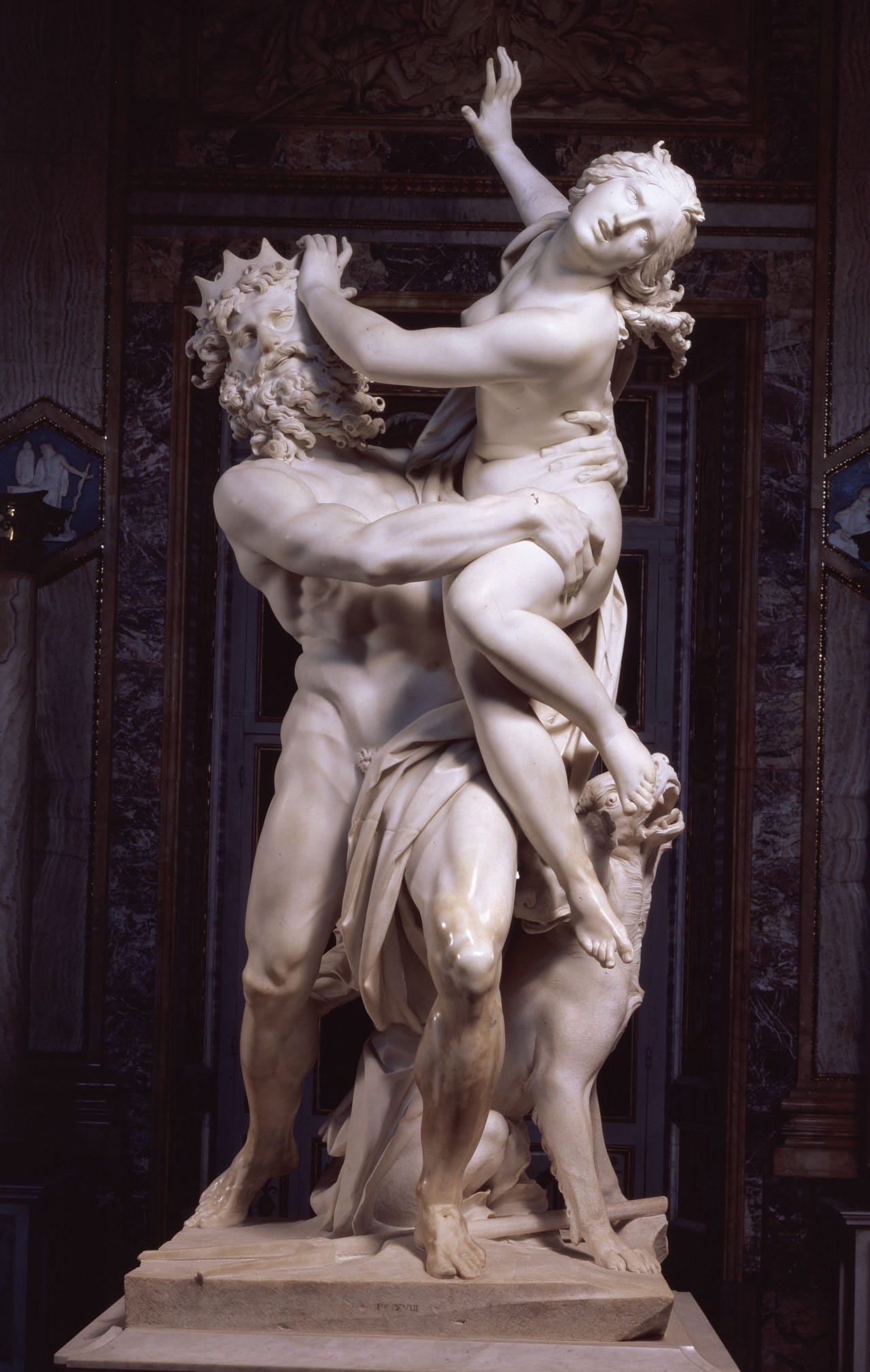
One day, while out walking with her nymphs, Persephone was lured by the wondrous bloom of a narcissus flower. While she was distracted, Hades, the King of the Dead, rose up through a chasm in the Earth, seized her by the wrist, and carried her down to his realm to be his wife and queen. Persephone cried out and wept as she was taken away, but the only divinities who heard her cries were Hecate and Helios, the sun.
The Rape of Persephone was one of the most famous motifs in classical Greek art (and beyond). The Persephone myth was also a model for Greek marriage: a girl taken from her mother and carried off to her husband’s house, sometimes against her will.
Hecate
Hecate was the enduring goddess of magic, witchcraft, the night, the moon, and ghosts. To the Greeks, she was a Titan who was honored by the Olympians. Hecate was one of the main protective goddesses of the household rather than a goddess of major temples. She was often depicted in triple form, and her shrines stood at three-way crossroads and in doorways, a tradition that lasted into medieval times.
Hecate is thought to have originated in Thrace or Anatolia and was closely associated with Artemis of Ephesus. She is very old and was worshipped across a wide area of Europe and West Asia, a mystical goddess whose character overlapped with many other goddesses in various traditions. For the Greeks, she was the handmaiden of Persephone and central to the Mysteries.
In some traditions, Hecate is a psychopomp, like the Greek Hermes: a guide of souls who can travel back and forth to the underworld and who ushers people across the threshold at the time of their passing.
Demeter, Persephone, and Hecate formed the Greek Triple Goddess, as Robert Graves described them — a view I share, even if contemporary academics seek to minimize it.
Eleusis
Demeter sensed that something was wrong with Persephone, but no one could help her. She wandered the Earth for nine days in grief, taking no food or drink. On the tenth day, she met Hecate, who told her she had heard Persephone’s cries but had not seen what happened. Hecate took torches in both hands and led Demeter on the search until they came to Helios, the watchman of both gods and men. Helios told them that Hades had taken the girl with the consent of Zeus.
Demeter was enraged and avoided Olympus, dwelling on the Earth, where she gave blessings wherever she was welcomed and punished those who did not receive her gifts with proper reverence.
During her wanderings, in the guise of an old woman, Demeter came to the Greek city of Eleusis and was introduced to King Keleos and Queen Metaneira. The queen thought the old woman noble, and they invited her to nurse their infant son. Demeter loved the child, and he grew quickly, anointed with the ambrosia of the Goddess.
Demeter wanted to make the child immortal, so at night she held him in the fire so that he might live like a god. Then one night, Queen Metaneira grew suspicious and crept up on the Goddess. The queen screamed when she saw her baby in the fire. Demeter was angered, and the child lost his chance at immortality.
Demeter then revealed herself in all her power and glory and said:
“Witless are you mortals and dull to foresee your lot, whether of good or evil, that comes upon you.”
— Homeric Hymn to Demeter 256–258 (trans. H. G. Evelyn-White)
The king and queen were terrified and dedicated themselves to her, so Demeter taught them her sacred rites, and they built her a temple at Eleusis. This parallels the story of Isis at Byblos with Queen Astarte (Plutarch, Isis and Osiris 15–16). Holding infants over a flame may have been a ritual in the Mystery religions.
The Famine
In her anger at losing Persephone, the goddess caused a great famine on Earth, refusing to let the fields bear fruit. Zeus grew gravely concerned that the entire human race might perish and sent the gods to entreat Demeter with gifts, but the goddess would not be appeased. Demeter vowed that she would not restore the Earth’s fertility until she had her daughter back. Zeus finally realized that he must convince Hades to let his bride return to her mother, or else all humanity would perish.
Demeter is one of the very few deities who could counter Zeus’s authority and force him to reverse a decision, symbolizing the latent power of nature and the old matriarchies.
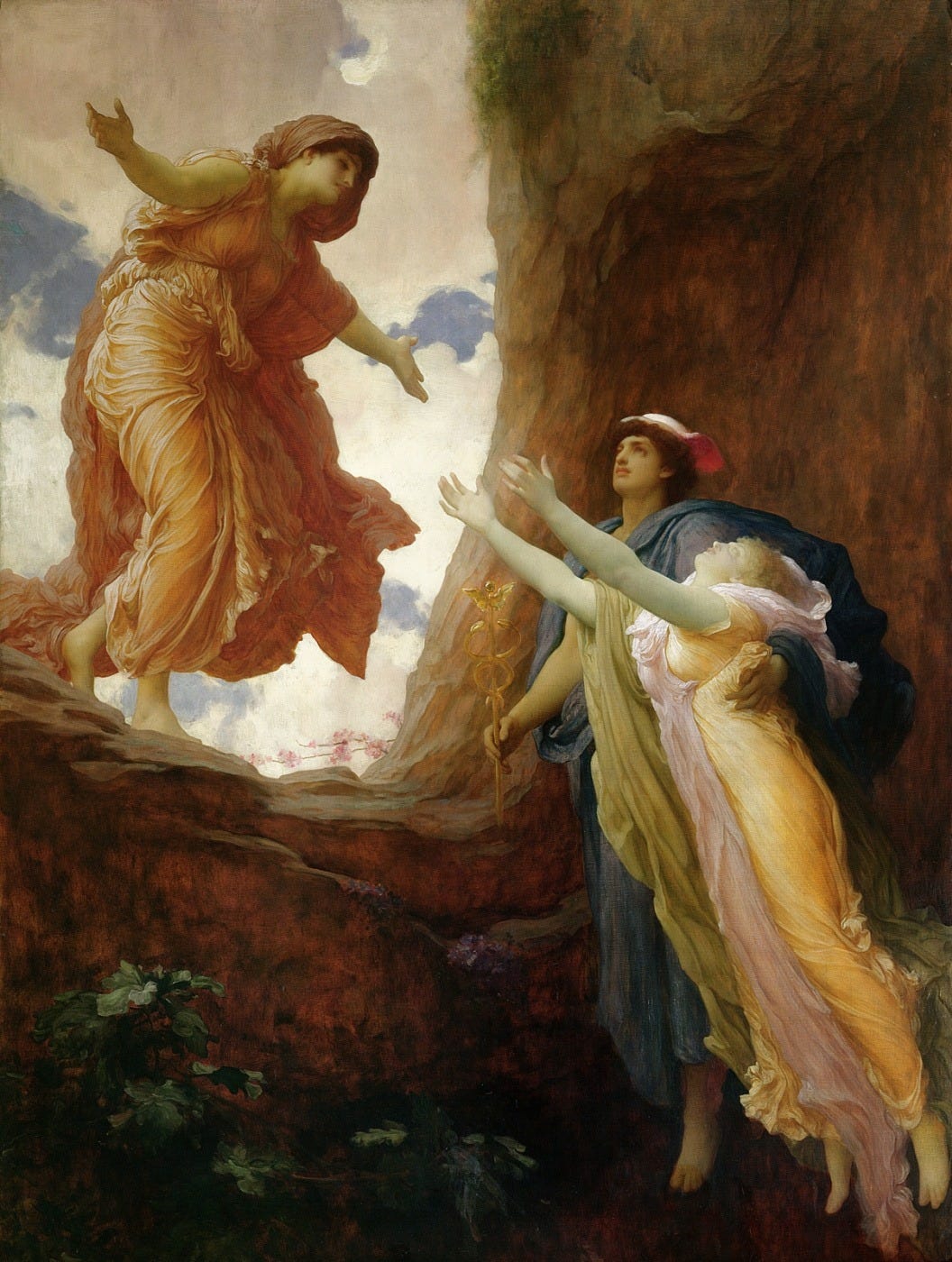
Zeus sent the messenger Hermes to the underworld, where he found Hades and Persephone sitting side by side, the maiden crestfallen, missing her mother as much as she was missed. Hermes delivered Zeus’s message, and Persephone was overjoyed.
Hades knew he must obey Zeus’s command, but he begged Persephone not to think harshly of him and not to be sad that she was married to one of the greatest of the immortals.
But Persephone had taken a fateful step: Hades had slipped her a pomegranate seed, and she had eaten it. Whoever ate food in the underworld was bound to it forever.
Demeter ran to meet her daughter like a maenad rushing down a hillside. They rejoiced to be reunited, but Demeter grieved to learn of the pomegranate seed, knowing what it meant. Zeus sent a revered messenger, none other than his own mother, the Titan Rhea, to deliver his judgment.
For having eaten the seed, Persephone was to return to Hades for one-third of the year, four months (in some versions, six), and remain with her mother the rest of the year. During those months, winter descends and the vegetation dies, to be reborn each spring with Persephone’s return.
Demeter sadly conceded, and every year she watches her daughter return to her husband, where she reigns as Queen of the Underworld. When she returns, Persephone is the goddess of spring and rebirth.
Demeter was kind, and she was sorry for the desolation she had caused. She made the fields rich again with abundant grain and fruit and the world bright with blooming spring. She returned to her temple at Eleusis, where she established the sacred rites that would become known as the Eleusinian Mysteries, and through the Eleusinian prince Triptolemus she taught humanity to sow grain.
Eleusinian Mysteries
There were numerous Mystery religions in other lands with similar precepts, and many were said to have originated with the mythical poet Orpheus. In the best-known versions of his story, told by the Roman poets Virgil and Ovid, Orpheus was a prince of Thrace so devastated by the death of his beloved wife Eurydice that he followed her to the underworld. He played his lyre before Hades and Persephone and begged them to honor his love for Eurydice.
Persephone was moved to tears, and Hades agreed to let Eurydice leave the underworld. Orpheus was instructed to walk ahead of his love and not turn around until they had returned to the world above. But Orpheus could not help himself; he turned around, and Eurydice was lost to him.
In the Roman era, Orpheus was credited with the Orphic Hymns, and he was said to have traveled widely, singing the great songs of doomed and tragic love and teaching the rites of Demeter, Dionysus, Isis, and the other Mysteries.
Demeter’s chief festival took place in the autumn and became one of the most enduring, sacred, and famous of the Mystery traditions. The Eleusinian Mysteries were among the most popular religions in Greece, a respected state religion attended by the most prominent philosophers and politicians. The Lesser and Greater Mysteries were celebrated for more than a thousand years, and pilgrims flocked from all over to take part.
The Mysteries were open to everyone from slaves to kings; the only requirements were that initiates speak Greek and that their hands be free of the stain of murder. There were large public festivals lasting several days, as well as sacred rites performed inside the temple. The public festivals featured great feasts filled with dancing, drinking, and merriment.
Initiates were sworn to secrecy about the sacred rites, and the vows were enforced by law, so little is known about them despite their long history. The rites spoke to the mysteries of life and the afterlife, and no one knows what the central revelations were.
We do know that initiates drank a mysterious intoxicating drink, the kykeon. Its full recipe has never been revealed, though it is known to have contained barley, water, and pennyroyal. In The Immortality Key, the modern author Brian Muraresku argues, building on the earlier work of R. Gordon Wasson, Albert Hofmann, and Carl Ruck in The Road to Eleusis (1978), that the potion was based on ergot. Ergot is a fungus that grows on grain; it contains natural psychedelic compounds and is the source from which LSD was first synthesized.
These rituals had their roots in the ancient goddess cultures of Minoan Crete, Anatolia, and Thrace, regions rich in the full apothecary of ancient drugs and psychedelics, such as cannabis, opium, ergot, belladonna, and psilocybin.
For initiates, the rites put them in touch with the divine, helping them recognize their own immortality and divinity. The annual rebirth of Persephone symbolized immortality, and initiates are believed to have glimpsed Elysium, the glorious afterlife, in their ecstasies.
Ritual objects found at Eleusis include images of wheat and barley; pomegranates, a symbol of fertility; poppies, a symbol of sleep and death; and snakes, symbols of rebirth and divination. Snakes protected the grain harvest from rodents and were welcome around granaries and temples, and of course they had long been associated with goddess worship.
Doves, bees, and pigs were also important symbols of Demeter. In the Mystery celebrations of the Goddess, men and women renewed their belief in the fundamentally loving nature of the universe, with regeneration and rebirth as the pathway to overcoming death.
Warlike patriarchal religions, particularly the monotheistic Biblical faiths, denigrated these beliefs and reduced them to mere “fertility cults,” while their jealous God demanded absolute fealty to him alone, leaving no room for any goddess to share in the reverence.
Goddess worship was fundamentally egalitarian and peaceful, with a morality that rejected rape and plunder, the primary means of achieving wealth and power in the ancient world. The requirement that initiates be free of the stain of murder speaks to the emphasis on peace and morality in the Mystery traditions.
An important characteristic of the cycle-of-life festivals in both Babylon and Greece was ritual lamentation over the death of the central figure, whether Persephone or Dumuzi/Tammuz. One part of the ritual was devoted to weeping, followed by joyful celebration of the return from death. The prophet Ezekiel describes women weeping for Tammuz at the Jerusalem Temple.
The Thesmophoria was a separate, women-only festival of Demeter, filled with merriment and laughter. In these ritual communities, older women instructed young women in menstruation, sex, marriage, pregnancy, childbirth, and motherhood. These rites created deep bonds of loyalty and friendship among the women.
Dionysus
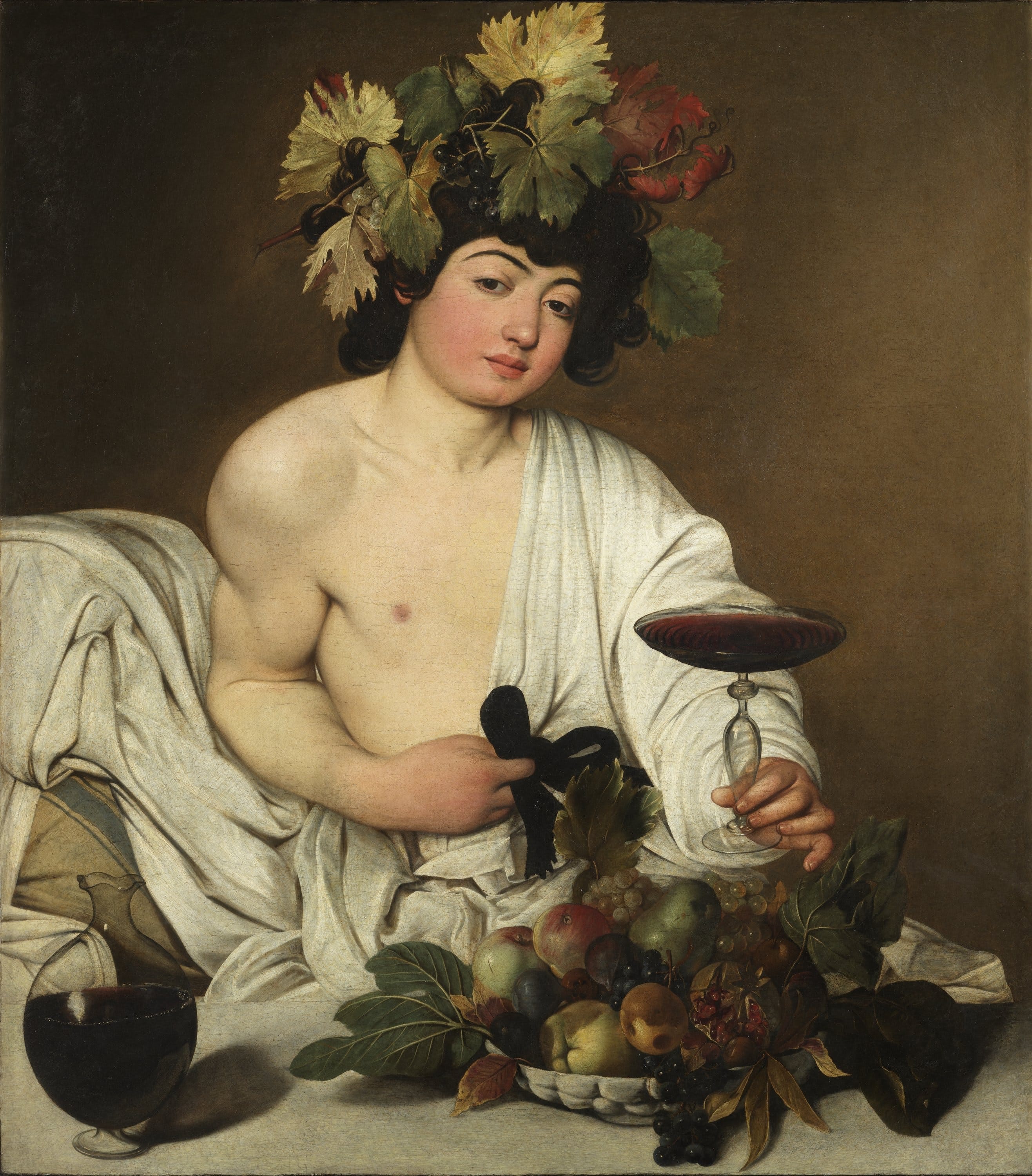
Dionysus, known as Bacchus in Roman times, was the god of wine, vegetation, pleasure, ecstatic frenzy, and ritual intoxication. He was widely worshipped as a fertility god and was commonly depicted nude. Phallic images and elaborate processions were common features of his festivals, which also included theatrical performances and drama competitions. Wild Dionysian (Bacchic) orgies were a famous, and at times scandalous, aspect of his rites.
Dionysus was worshipped in many lands and was among the most popular gods, as shown by the Roman temple to Bacchus at Baalbek, Lebanon, beside those of Jupiter (Zeus) and Venus (Astarte).
Dionysus was worshipped alongside Demeter in the Mystery religions, though the Greeks traced his roots to Thrace, where he was the patron of wine. Thrace was famous for its wine, and the Greeks associated winemaking with the region.
Though considered the youngest Olympian, Dionysus was actually quite old. The Greek myths remember his religion as a foreign import, but his name already appears in the Bronze Age Mycenaean Linear B tablets. There are multiple conflicting myths about his parentage and youth, and his cult had many variations.
Dying and Rising God
In Greece, Dionysus was the last god introduced to the Olympian pantheon and the only one born to a mortal mother. His mother, Semele, was another of the unfortunate women loved by Zeus and tormented by jealous Hera.
While Semele was pregnant, Hera tricked her into asking Zeus to reveal himself in his full glory. Zeus had promised Semele her heart’s desire, but he warned her that no human could survive contact with the Godhead. She insisted, and the moment Semele beheld his full divine splendor, she was consumed. Zeus saved the unborn child by sewing him into his thigh until he came to term, making Dionysus twice-born.
In another set of stories, from the Orphic tradition, Hera has the Titans tear the infant Dionysus to pieces. In some traditions, Demeter restored his body, but there are many versions of the myth. What matters is that Dionysus is a god who dies and is reborn, like so many others we have discussed.
Grapevines represent the dying and rising god because the vine is pruned back to its bare stalk after the harvest and reborn each spring, demonstrating the resurrection cycle to humans in very practical terms.
God of Wine
When Dionysus grew up, he discovered how to cultivate grapes and extract their precious juice, the first to do so. Once again Hera intervened, striking Dionysus with madness and forcing him to wander through foreign lands. In Anatolia, he was cured by the goddess Cybele, whom the Greeks knew as Rhea, and she taught him her religious rites.
Dionysus then traveled through Asia, teaching people to make wine and to worship the Mother, journeying as far as India, where his cult became well established. There are many tales of Dionysus and his travels. Among his legacies, Dionysus is the god who gave King Midas the golden touch. He also had a brief affair with Aphrodite and fathered a child, Priapus, whom Hera cursed with ugliness.
Dionysus eventually returned to Greece in triumph, made peace with Hera, and is considered the originator of the triumphal procession. Wild Dionysian parades were annual drunken festivals featuring sculptures of giant phalluses. Many Dionysus myths depict resistance to his arrival in new towns; in some cases, the king had to be killed before Dionysus was finally welcomed.
In Rome, the Bacchic cults sparked a moral panic and were outlawed throughout Italy by a Senate decree of 186 BCE, the Senatus consultum de Bacchanalibus. Some 7,000 people were implicated, and many leaders were executed. It was one of the largest religious persecutions in Rome before the persecution of the Christians, but the cult survived, with its more controversial practices moved indoors and out of public view.
Maenads
Dionysus was depicted either as an older, bearded god or as an effeminate, long-haired youth. He was served by maenads, satyrs, and nymphs.
The maenads were the female followers of Dionysus and the most important members of his retinue. Known as the “Raving Ones,” they were inspired by the god to ecstatic frenzy through dance and intoxication. Dressed in animal skins and often handling snakes, they were famous for running wildly through the forests, killing the animals they caught with their bare hands, tearing them apart, and eating the raw flesh, symbolizing the death and rebirth of the god. The maenads were associated with a variety of supernatural women, both historical and mythological.
Nymphs
Nymphs were semi-divine female spirits of the air, seas, woods, and waters who tended nature. Like fairies, they were depicted as beautiful, young, graceful maidens and were popular in art and literature.
Satyrs
Satyrs were male nature spirits, depicted as half-man, half-goat, or as men with horses' tails. They were known for their ribald behavior; typically depicted naked with comically large erections, they were lovers of wine, music, dancing, and women. Satyrs were known for their bawdy humor and their attempts, often unsuccessful, to seduce women and nymphs.
Greek Sex
The Greeks had a sexually open culture. Graphic sexual imagery, nudity, and erect phalluses were common in Greek art and were often displayed in public and in people’s homes. Prostitution was legal, common, and taxed.
Dionysus was also the god of gender-bending and effeminacy. Described as androgynous and soft, he was not shy about perfuming his flowing locks (Euripides, Bacchae 235), his robes gay and shining with gold. Dionysus was known to be receptive in homosexual intercourse, as in the story of Prosymnus (Pausanias 2.37.5; Clement of Alexandria, Protrepticus 2.34). The Greeks had a rather unusual view of homosexuality, even for the times, accepting it only in certain circumstances, which contributed to Dionysus’s scandalous, yet oh-so-popular, reputation, like a modern-day rock star.
[The infant] Dionysus was hidden from every eye … a clever babe. He would mimic a newborn kid; hiding in the fold … Or he would show himself like a young girl in saffron robes and take on the feigned shape of a woman; to mislead the mind of spiteful Hera, he molded his lips to speak in a girlish voice, tied a scented veil on his hair. He put on all a woman’s many colored garments: fastened a maiden’s vest about his chest and the firm circle of his bosom, and fitted a purple girdle over his hips like a band of maidenhood.
— Nonnus, Dionysiaca 14.143 ff. (trans. W. H. D. Rouse, Loeb Classical Library, 1940; Greek epic, 5th century CE)
In Greek culture, pederasty was normal and accepted, but strict lines of etiquette had to be maintained. Greek culture was chauvinistic and patriarchal, and any behavior that made a masculine man effeminate was frowned upon. Public nudity in athletics and prostitution were common, so there was no shortage of outlets for sexual energy.
Pederastic relationships were honored as a coming-of-age tradition in ancient Greece, though they are obviously not acceptable by modern standards. An adult man mentored an adolescent boy in a relationship that was intimate and affectionate, and that introduced the younger partner to the social and professional networks he would need in adulthood. These relationships were traditional, and the participants were typically family friends. The older man was always dominant and the younger partner passive; these roles mattered because they reflected the cosmic and social order.
K. J. Dover argued in Greek Homosexuality (1978) that in these relationships it was typical to kiss and share a bed, but physical affection stopped short of penetration, a critical line of etiquette. Arousal and orgasm were acceptable so long as neither partner was penetrated, which was considered degrading to a masculine man. Similarly, sexual relationships between adult men of the same age were discouraged, as proper homosexual relationships were understood to be purely pederastic.
Prostitution
The Greeks did not practice sacred temple sex in the manner of the Bronze Age matriarchies, where respectable women played the leading roles. The Greeks placed a much greater emphasis on female chastity than the West Asians did and kept their wives and daughters confined.
Inanna, Ishtar, and Astarte stood at the top of their pantheons, and their priestesses, such as the qedesha, were honored in their communities, consecrating the kings in the hieros gamos ceremonies. Aphrodite Pandemos, on the other hand, was primarily the patroness of secular prostitutes and the pleasures of the flesh, with none of the overt political importance of her West Asian counterparts.
Temples to Aphrodite were widely regarded throughout the ancient world as homes of prostitution, and brothel districts were found near them. The famous temple at Corinth was said to have 1,000 prostitutes dedicated to the goddess, spread throughout the town (Strabo 8.6.20). These consecrated women were sometimes called hierodules, and while they were dedicated to the temple and engaged in ritual sex, they did not have the elevated social status of the Bronze Age qedesha.
The truth is that sacred sex in the ancient world remains largely a mystery, since most of it was never written down. We know these various categories of women existed, but we know only fragments of their day-to-day lives and social status.
Prostitution was common, legal, and taxed in ancient Greece and Rome. Secular prostitutes, called pornai, worked in brothels and taverns. Sex slaves may have been owned by both temples and brothels.
Concubines were servant sex partners from a lower social class, or slaves, who were not eligible for respectable marriage to an upper-class man, but they could have warm, romantic relationships, albeit with one-sided power dynamics.
In Greek culture, men were allowed only one legal wife, unlike West Asian kings and patriarchs, who could take several. Married men faced little or no expectation of monogamy, but a married woman’s sexuality belonged to her husband, and girls were expected to remain virgins until marriage.
The Greeks did not have qedesha priestesses or matriarchal families, but they did have many courtesans, called hetairai, usually independent freedwomen or foreigners, who had semi-exclusive sexual relationships with wealthy men. Courtesans were educated and sophisticated; many were artists and musicians who could socialize at the most elite levels of society and support themselves through their relationships.
Artists, actors, and musicians of both sexes often supplemented their income through paid sex. Courtesans were not sacred, but they did have some legal property rights, and some were famous and influential, though they had mixed and somewhat scandalous reputations in Greek society. It is safe to say that married women did not think highly of the courtesans who slept with their husbands and received valuable gifts from them.
Next episode, we will return to the Greeks for part 3, with a discussion of the Scythians, better known as Amazons, Alexander the Great, and anything else I can cram in there. This episode ran long, but there is so much material from the Greeks that even a cursory overview is a lot.