

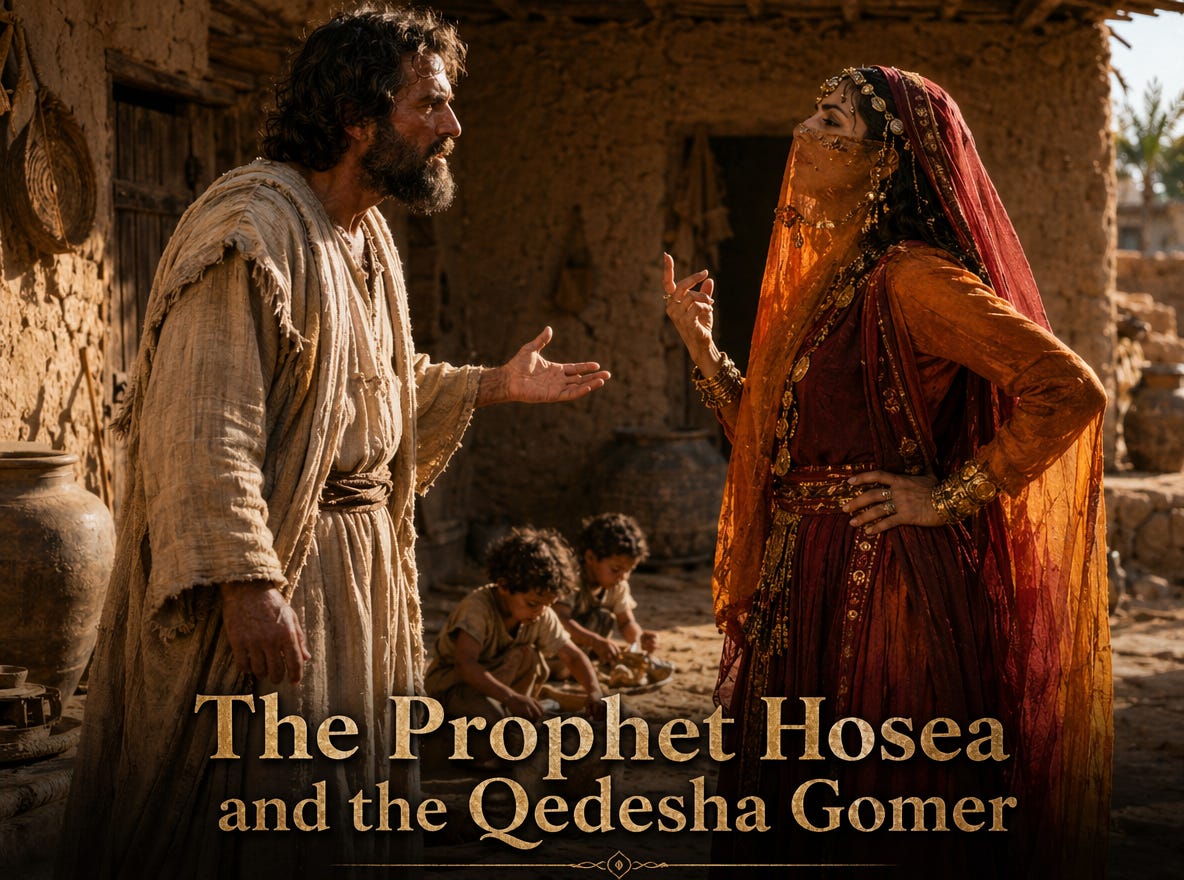
Goddess Bible Study continues with one of the most colorful and pivotal chapters in the divorce saga of the mother goddess, the marital dispute between the prophet Hosea and his wife, the qedesha Gomer.
The biblical book of Hosea tells the story of the prophet who lived in Israel during the kingdom’s final days. This short book reads on multiple levels, between the prophet and his wife, Yahweh and Israel, God and Goddess. Unfortunately, it is a heated argument that ultimately ends in divorce.
Hosea is the first of the twelve minor prophets, and his book is considered one of the oldest texts in the Bible, written around 760–720 BCE. Hosea preached doom for the nation of Israel, warning that if the people continued their pagan worship and failed to turn completely to Yahweh, destruction would follow.
At the center of Hosea’s story is his marriage to a woman named Gomer, described in the text as a “woman of adultery.” Gomer was most likely a qedesha, though the text does not say so explicitly — at the very least, she was a matriarchal Canaanite woman. Their marriage was contentious. Gomer bore three children, but only the first was fathered by Hosea.
Gomer is typically regarded as a cheating wife and a sinful woman, an assumption rooted in the idea that her culture shared the same patriarchal norms of marital monogamy that we take for granted today. That assumption deserves to be challenged.
Gomer is better understood as representative of the broader society of her time — a Canaanite everywoman, and most likely a holy woman of the qedesha tradition, who would have had considerably more latitude in matters of sexuality and childbearing than an ordinary married woman. Qedesha were free to marry, but they were known to make difficult wives precisely because of their independence.
In the allegory of the book, Gomer’s “adultery” functions as a metaphor for the spiritual adultery of Israel — a nation that worshipped many gods and goddesses rather than Yahweh alone. The Book of Hosea is a layered poetic allegory that operates on several levels simultaneously: it is a conversation between the prophet and his wife, Yahweh and Israel, and Yahweh and Asherah. At its deepest level, this is the argument that leads to divorce - the final declaration and paperwork come later.
When Yahweh began to speak through Hosea, Yahweh said to him, “Go, marry a promiscuous woman and have children with her, for like an adulterous wife this land is guilty of unfaithfulness to Yahweh.” So he married Gomer daughter of Diblaim, and she conceived and bore him a son.
Then Yahweh said to Hosea, “Call him Jezreel, because I will soon punish the house of Jehu for the massacre at Jezreel, and I will put an end to the kingdom of Israel. In that day I will break Israel’s bow in the Valley of Jezreel.”
Gomer conceived again and gave birth to a daughter. Then Yahweh said to Hosea, “Call her Lo-Ruhamah (which means “not loved”), for I will no longer show love to Israel, that I should at all forgive them. Yet I will show love to Judah; and I will save them—not by bow, sword or battle, or by horses and horsemen, but I, Yahweh their God, will save them.”
After she had weaned Lo-Ruhamah, Gomer had another son. Then Yahweh said, “Call him Lo-Ammi (which means “not my people”), for you are not my people, and I am not your God.
-Hosea 1:2-9
The names of the three children are symbolic and carry the weight of this allegory. The first son is named Jezreel, after the location of Jezebel’s palace — the very place where the military commander Jehu massacred her family during his violent coup. Though Jehu was a Yahwist, his treachery and bloodthirstiness were remembered with shame.
The second and third children, who belonged to Gomer alone and were not fathered by Hosea, are given the names “Not Loved” and “Not My People.” Yahweh applies these names to Israel’s children because they lack the proper father, and the names almost certainly reflect Hosea’s own feelings toward his wife’s children as well.
The extended passage in Hosea 2 is, at its core, a declaration of war against the goddess traditions. “Rebuke your mother!” Yahweh announces that he will put an end to the Mother Goddess’s celebrations, terminate her festivals, and punish her people for burning incense to Baal.
The Yahwists want to shut down the goddess traditions entirely — and with them, put the qedesha out of business. The charge of bearing “illegitimate children” is leveled because the society practiced maternity rather than paternity: lineage ran through the mother, not the father, and the Yahwists found this intolerable.
The story of Hosea and Gomer mirrors this conflict at the domestic level. Hosea seeks to end Gomer’s independence just as Yahweh seeks to end goddess worship and her nature festivals, her carousing, and her sexual rituals. When Hosea plans to shut Gomer in and cut her off from her lovers, it is simultaneously Yahweh declaring that the Goddess will also have no lovers — and that he intends to contain her.
“Rebuke your mother, rebuke her, for she is not my wife, and I am not her husband. Let her remove the adulterous look from her face and the unfaithfulness from between her breasts. Otherwise, I will strip her naked and make her as bare as on the day she was born; I will make her like a desert, turn her into a parched land, and slay her with thirst.
I will not show my love to her children, because they are the children of adultery. Their mother has been unfaithful and has conceived them in disgrace. She said, ‘I will go after my lovers, who give me my food and my water, my wool and my linen, my olive oil and my drink.’
Therefore I will block her path with thornbushes; I will wall her in so that she cannot find her way. She will chase after her lovers but not catch them; she will look for them but not find them. Then she will say, ‘I will go back to my husband as at first, for then I was better off than now.’
She has not acknowledged that I was the one who gave her the grain, the new wine, and oil, who lavished on her the silver and gold - which they used for Baal. “Therefore I will take away my grain when it ripens, and my new wine when it is ready. I will take back my wool and my linen, intended to cover her naked body. So now I will expose her lewdness before the eyes of her lovers; no one will take her out of my hands.
I will stop all her celebrations: her yearly festivals, her New Moons, her Sabbath days - all her appointed festivals. I will ruin her vines and her fig trees, which she said were her pay from her lovers; I will make them a thicket, and wild animals will devour them. I will punish her for the days she burned incense to the Baals; she decked herself with rings and jewelry and went after her lovers, but me she forgot,” declares Yahweh.
“Therefore, I am now going to allure her; I will lead her into the wilderness and speak tenderly to her. There I will give her back her vineyards, and will make the Valley of Achor a door of hope. There she will respond as in the days of her youth, as in the day she came up out of Egypt.
“In that day,” declares Yahweh, “you will call me ‘ishi’; you will no longer call me ‘Baali.’ I will remove the names of the Baals from her lips; no longer will their names be invoked.
-Hosea 2:2-17
The language Yahweh uses to describe the new order is telling. Ishi means “my husband” and Baali means “my lord” — the latter having been a conventional Canaanite greeting and term of devotion. The Yahwists banned its use entirely, scrubbing even the word from acceptable speech.
From there, Yahweh moved to absorb the powers of nature and creation that had belonged to the Goddess, claiming them as his own. The word Jezreel means, “God plants” or “God sows,” while also being a town name.
In that day I will make a covenant for them with the beasts of the field, the birds in the sky, and the creatures that move along the ground. Bow and sword and battle I will abolish from the land, so that all may lie down in safety. I will betroth you to me forever; I will betroth you in righteousness and justice, in love and compassion. I will betroth you in faithfulness, and you will acknowledge Yahweh.
“In that day I will respond,” declares Yahweh – “I will respond to the skies, and they will respond to the earth; and the earth will respond to the grain, the new wine, and the olive oil, and they will respond to Jezreel. I will plant her for myself in the land; I will show my love to the one I called ‘Not my loved one.’ I will say to those called ‘Not my people,’ ‘You are my people’; and they will say, ‘You are my God.’”
-Hosea 2:18-23
In the third chapter, Hosea approaches Gomer with valuables — barley and silver, since coinage did not yet exist — in an effort to win her back. These verses are often read as Hosea purchasing Gomer from another man, but the text does not explicitly say who received the payment. Given that the qedesha were masters of their own behavior and kept the gifts they received in exchange for their favors, it seems more likely that Hosea gave the gifts directly to Gomer to win back her affection. He then tells her she must be sexually faithful to him, and pledges the same in return.
The book does not record her response - Gomer never speaks at all in the book. For all the reader knows, Gomer may have demanded a divorce and left with the children. She never appears again after chapter 3.
Yahweh said to me, “Go, show your love to your wife again, though she is loved by another man and is an adulteress. Love her as Yahweh loves the Israelites, though they turn to other gods and love the sacred raisin cakes.”
So, I bought her for fifteen shekels of silver and about a homer and a lethek of barley. Then I told her, “You are to live with me many days; you must not be a prostitute or be intimate with any man, and I will behave the same way toward you.”
-Hosea 3:1-3
The dispute described in Hosea was not only a cosmic event between Yahweh and the Goddess. It was a rupture within the human community itself — a divorce between men and women, between the Yahwist priests and the priestesses who were their own wives, daughters, and mothers. The sacred traditions these women carried had to be repressed and expelled.
The book goes on without Gomer, and Hosea continues to complain of Israel’s sins.
He pledges to “destroy your mother.”
You stumble day and night, and the prophets stumble with you. So I will destroy your mother— my people are destroyed from lack of knowledge. “Because you have rejected knowledge, I also reject you as my priests; because you have ignored the law of your God, I also will ignore your children.
The more they multiplied, the more they sinned against Me; they exchanged their Glory for a thing of disgrace. They feed on the sins of my people and relish their wickedness. And it will be: Like people, like priests. I will punish both of them for their ways and repay them for their deeds.
“They will eat but not have enough; they will engage in prostitution but not flourish, because they have deserted Yahweh to give themselves to prostitution; old wine and new wine take away their understanding.
My people consult a wooden idol, and a diviner’s rod speaks to them. A spirit of prostitution leads them astray; they are unfaithful to their God. They sacrifice on the mountaintops and burn offerings on the hills, under oak, poplar and terebinth, where the shade is pleasant. Therefore your daughters turn to prostitution and your daughters-in-law to adultery.
“I will not punish your daughters when they turn to prostitution, nor your daughters-in-law when they commit adultery, because the men themselves consort with harlots and sacrifice with qedesha [shrine prostitutes] — a people without understanding will come to ruin!
“Though you, Israel, commit adultery, do not let Judah become guilty.”
-Hosea 4:5-15
They are unfaithful to Yahweh; they give birth to illegitimate children. When they celebrate their New Moon feasts, he will devour their fields.
-Hosea 5:7
The hostility toward the feminine divine that runs through Hosea is not unique to him — it is a defining feature of the Biblical prophetic tradition. Other prophets of Yahweh would continue to use stark, often brutal sexual language to condemn Israel and Judah for their matriarchal and pagan ways.
The Yahwists wanted to normalize the patriarchal family structure and eliminate the older tribal customs that preceded it. The general hostility to the feminine divine pervades the Biblical texts, with the notable exception of the works attributed to King Solomon.
The contrast with the Greek world is instructive - both cultures imposed firm patriarchy and mandated marital monogamy for women. The Greeks reordered their Olympian pantheon and demoted the goddesses, subordinating them to Zeus and a male-dominated divine hierarchy. The Yahwists went further: they eliminated the goddesses altogether. The erasure was so complete that the Hebrew language developed no word for “goddess” at all.
Isaiah, Jeremiah, Ezekiel
The prophet Isaiah was a contemporary of Hosea and was active in Judah during the reigns of Kings Ahaz and Hezekiah in the 8th century BCE. Like Hosea, Isaiah predicted doom for the Hebrews if they continued in their idolatrous ways — and his condemnations extend explicitly to women who enjoyed lives of independence and adornment.
Isaiah’s misogyny runs deep, and it is not incidental to his theology; the subordination of women and the suppression of goddess worship are two sides of the same campaign.
We will revisit all three of these prophets at length later on, here is a sample to show the continuity with Hosea.
Yahweh says, “The women of Zion are haughty, walking along with outstretched necks, flirting with their eyes, strutting along with swaying hips, with ornaments jingling on their ankles. Therefore Yahweh will bring sores on the heads of the women of Zion; Yahweh will make their scalps bald.”
In that day Yahweh will snatch away their finery: the bangles and headbands and crescent necklaces, the earrings and bracelets and veils, the headdresses and anklets and sashes, the perfume bottles and charms, the signet rings and nose rings, the fine robes and the capes and cloaks, the purses and mirrors, and the linen garments and tiaras and shawls. Instead of fragrance, there will be a stench; instead of a sash, a rope; instead of well-dressed hair, baldness; instead of fine clothing, sackcloth; instead of beauty, branding.
Your men will fall by the sword, your warriors in battle. The gates of Zion will lament and mourn; destitute, she will sit on the ground.
-Isaiah 3:16-26
Jeremiah was a critical reformer who lived late in the first temple period under King Josiah and witnessed its destruction by the Babylonians. Jeremiah issued the divorce papers and had the final argument about the Queen of Heaven as the people were all walking into exile with Jerusalem on fire behind them.
“Have you seen what faithless Israel has done? She has gone up on every high hill and under every spreading tree and has committed adultery there.”
-Jeremiah 3:6
She saw that because faithless Israel had committed adultery, I gave her a certificate of divorce and sent her away.
-Jeremiah 3:8
The prophet Ezekiel lived in Judah during the Babylonian conquest of Jerusalem and departed with the first wave of exiles. Like Hosea, Ezekiel makes extensive use of sexual language and imagery — women’s bodies, infidelity, and prostitution serving as his primary metaphors for Israel’s religious unfaithfulness.
Yahweh called Ezekiel to prophesy against the exiled Israelites for their stubborn and obstinate behavior. Ezekiel accused Israel of breaking the covenant and warned that Jerusalem would be attacked again as a consequence.
Among his targets were the women prophets, who can be understood as qedesha — identifiable by the magic charms on their wrists and the veils they wore. Ezekiel’s charges against them are striking: he accuses them of holding the powers of life and death, killing those who should not have died and sparing those who should not have lived, in direct defiance of Yahweh’s judgment. This is not merely a condemnation of folk magic; it is an acknowledgment that these women wielded genuine spiritual authority — authority the Yahwists were determined to extinguish.
Ezekiel’s rebuke of the women is extensive and sexually graphic. This is a small sample.
“Woe to the women who sew magic charms on all their wrists and make veils of various lengths for their heads in order to ensnare people. Will you ensnare the lives of my people but preserve your own? You have profaned me among my people for a few handfuls of barley and scraps of bread. By lying to my people, who listen to lies, you have killed those who should not have died and have spared those who should not live.
“’Therefore this is what the Sovereign Yahweh says: I am against your magic charms with which you ensnare people like birds and I will tear them from your arms; I will set free the people that you ensnare like birds. I will tear off your veils and save my people from your hands, and they will no longer fall prey to your power. Then you will know that I am Yahweh.
“Because you disheartened the righteous with your lies, when I had brought them no grief, and because you encouraged the wicked not to turn from their evil ways and so save their lives, therefore you will no longer see false visions or practice divination. I will save my people from your hands. And then you will know that I am Yahweh.”
-Ezekiel 13:18-21
Next Goddess Bible Study, we will return to the Book of Kings and pick up the story with the destruction of Israel by the Assyrians in 722 BCE, and the Yahwist reformation in Judah under King Hezekiah.
Watch the podcast discussion on YouTube.
Reach out to:
goddessbiblestudy@gmail.com