

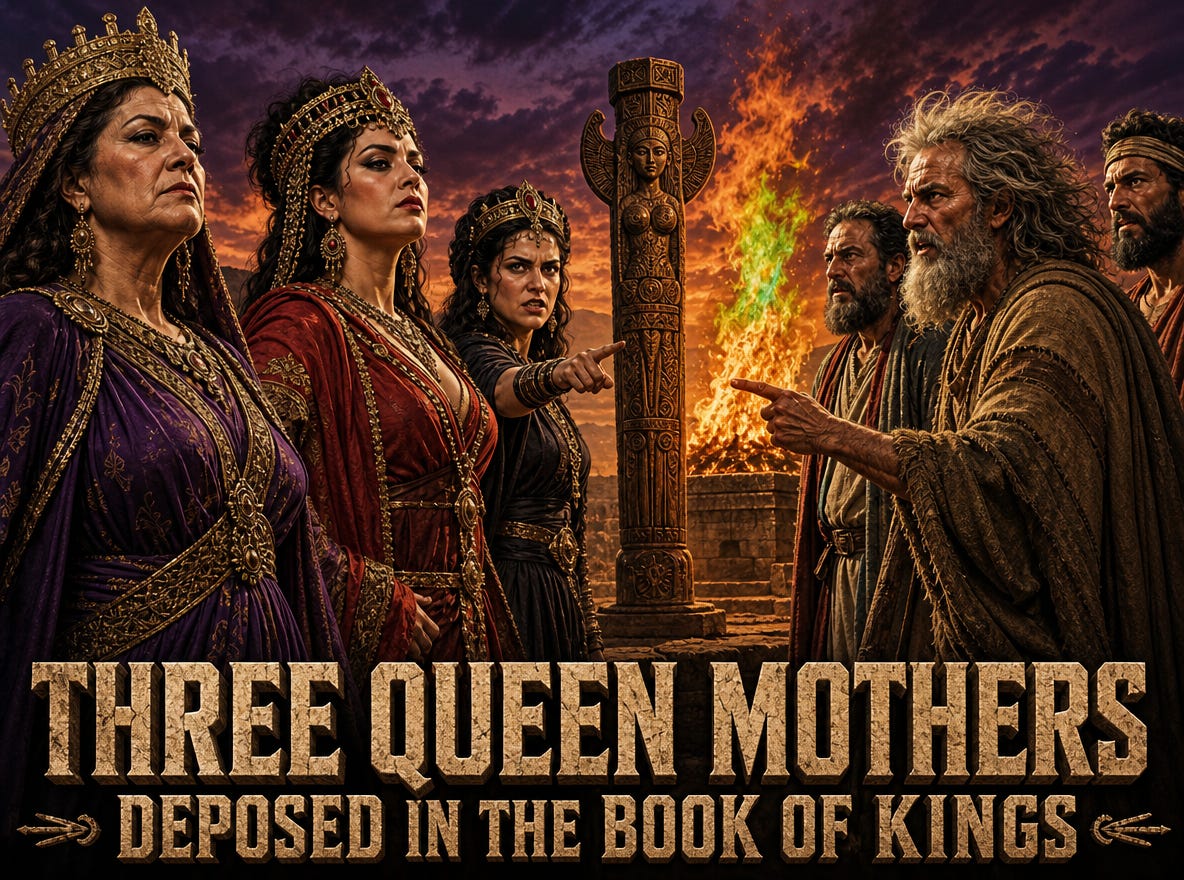
This week on Goddess Bible Study, we are in the 9th century BCE, investigating the three Queen Mothers from Israel and Judah who were deposed in the Book of Kings for their worship of the mother goddess Asherah. This is the first of two parts.
Queen Jezebel is the most famous of the three and the most reviled woman in the Bible. She was assassinated by the followers of Yahweh, as was her daughter Athaliah, the only woman ever to rule in Jerusalem. The first to be thrown out was Queen Maacah, wife of Rehoboam, who was deposed by her own grandson, King Asa.
We will also dive into the famous Battle of the Prophets on Mount Carmel, where I argue that Elijah used stage magic to make his offering erupt in flames and defeat the prophets of Baal and Asherah.
We are now entering territory where scriptural history begins to align with hard archaeological evidence, as literacy emerged in the 9th century BCE with new alphabetic scripts copied from the Phoenicians.
King Asa and the Deposition of Queen Maacah
King Asa was the grandson of the bad king Rehoboam and ruled Judah from 911 to 870 BCE. He is depicted in scripture as the first of the reformist Yahwist kings to actively suppress the worship of Asherah and other traditional pagan religious practices. There is no specific archaeological evidence of Asa or his reforms — we have only the Biblical narrative to go on — but the Bible makes it clear that these Israelites were polytheists fighting a culture war over the role of the old gods versus the new.
Among Asa’s most striking acts was the deposition of his own grandmother, Queen Mother Maacah, because she had constructed an Asherah pole. He also expelled the male qadesh — transgender priests translated in some Bibles as “temple sodomites” — from the land. Notably, he did not expel the female qedesha, who appear to have been a far more entrenched and difficult opponent for the Yahwist reformers.
Asa did what was right in the eyes of Yahweh, as his father David had done. He expelled the male qadesh from the land and got rid of all the idols his ancestors had made. He even deposed his grandmother Maakah from her position as queen mother, because she had made a repulsive image for the worship of Asherah. Asa cut it down and burned it in the Kidron Valley. Although he did not remove the high places, Asa’s heart was fully committed to Yahweh all his life.
-1 Kings 15:11-14
Jehoshaphat, son of Asa, continued his father's Yahwist reforms, though paganism remained widespread throughout the land. He was also an ally of the northern kingdom of Israel and rode into battle alongside King Ahab — the very battle in which Ahab was killed. The qadesh were still present during Jehoshaphat's reign and were persecuted again, which suggests that the earlier expulsions had been only partially effective.
In everything he followed the ways of his father Asa and did not stray from them; he did what was right in the eyes of Yahweh. The high places, however, were not removed, and the people continued to offer sacrifices and burn incense there.
-1 Kings 22:43
He rid the land of the rest of the male qadesh who remained there even after the reign of his father Asa.
-1 Kings 22:46
The Book of Chronicles tells this story somewhat differently. Written later than the Book of Kings, Chronicles clearly adjusts the narrative to present the Biblical heroes in a more favorable light, removing embarrassing details and amplifying their piety.
His heart was devoted to the ways of Yahweh; furthermore, he removed the high places and the Asherah poles from Judah.
-2 Chronicles 17:6
9th Century BCE: When the Bible Meets Archaeology
The 9th century BCE marks a turning point in the history of Israel, both politically and in terms of the historical record. This is the period when scriptural history begins to align with archaeological data, largely because writing — in both Hebrew and early Greek — returns at this time. Hebrew inscriptions and coins begin to appear regularly, giving historians solid ground to work with.
Omri became king of Israel in 884 BCE, establishing the new city of Samaria as his capital. His lineage is unknown, but his impact was immediate and lasting. He is one of the oldest Biblical figures whose existence has been confirmed archaeologically, and the royal house he founded became known as the House of Omri, just as Judah’s royal line was called the House of David. After roughly fifty years of civil war, Omri stabilized the political situation in Israel, forming alliances with Judah to the south and the Phoenicians to the north, while resisting the growing pressure of the Neo-Assyrian Empire.
Omri’s son Ahab succeeded him as king of Israel around 873 BCE and reigned until his death in 852 BCE. Ahab was a serious and formidable military commander whose forces were large enough to be mentioned by neighboring kingdoms. The Biblical writers, however, despised both Omri and Ahab for their devotion to traditional religion. Samaria under their rule featured a large Asherah pole and a temple dedicated to Baal.
Ahab Becomes King of Israel
In the thirty-eighth year of Asa king of Judah, Ahab son of Omri became king of Israel, and he reigned in Samaria over Israel twenty-two years. Ahab son of Omri did more evil in the eyes of the Lord than any of those before him.
He not only considered it trivial to commit the sins of Jeroboam son of Nebat, but he also married Jezebel daughter of Ethbaal king of the Sidonians, and began to serve Baal and worship him. He set up an altar for Baal in the temple of Baal that he built in Samaria. Ahab also made an Asherah pole and did more to arouse the anger of the Lord, the God of Israel, than did all the kings of Israel before him.
-1 Kings 16:29-33
The Battle of Qarqar, 853 BCE — The Kurkh Stele
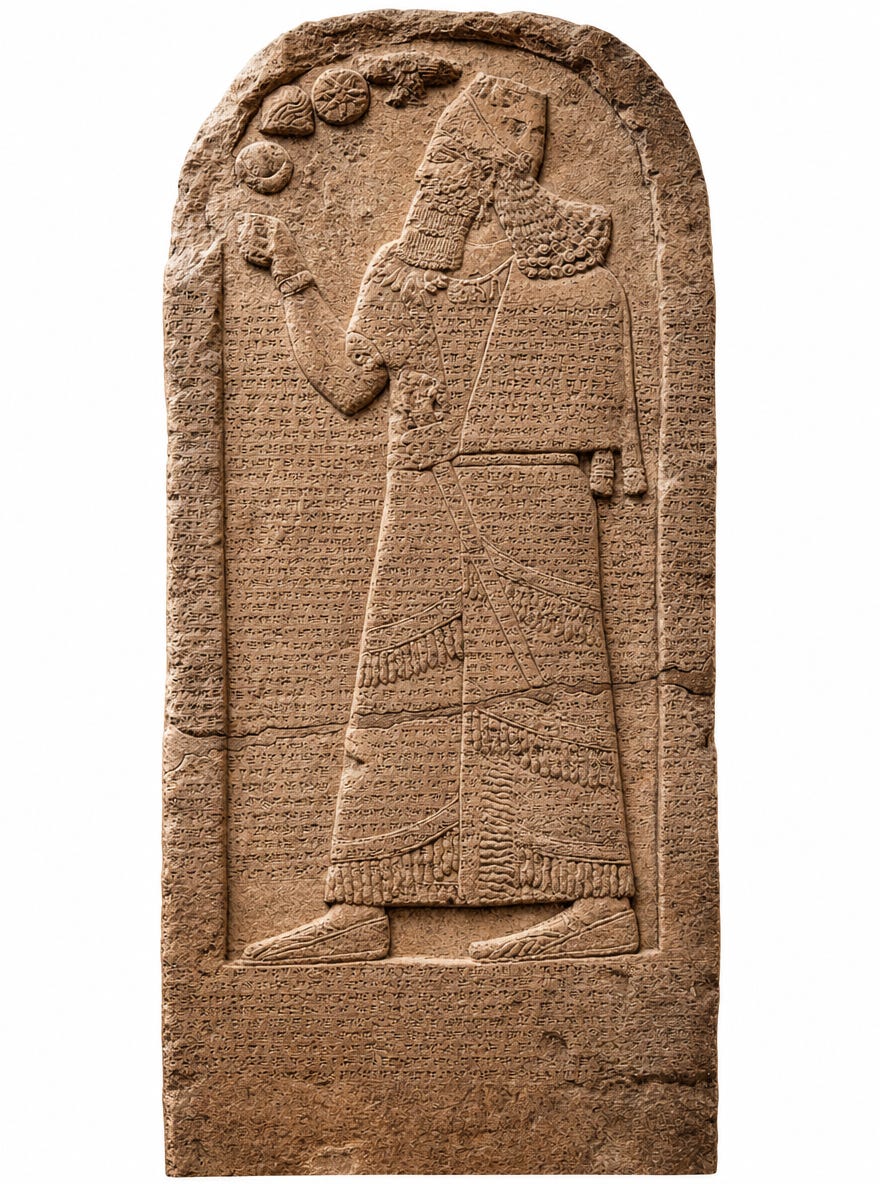
In 853 BCE, King Ahab led a major military force at the Battle of Qarqar, one of the largest and most significant battles of the ancient Near East. The battle pitted the resurgent Neo-Assyrian Empire, led by Emperor Shalmaneser III, against a coalition of twelve kings fighting in resistance.
According to the Kurkh Stele — an Assyrian victory monument now in the British Museum — King Ahab of Israel sent the largest contingent of chariots among the resistance, though scholars dispute the exact numbers. The Kurkh Stele is one of the earliest extra-Biblical references to an Israelite king. Remarkably, the Bible makes no mention of the Battle of Qarqar at all, a notable omission given how significant the conflict was for the entire region.
The Battle with Moab, 840 BCE — The Mesha Stele
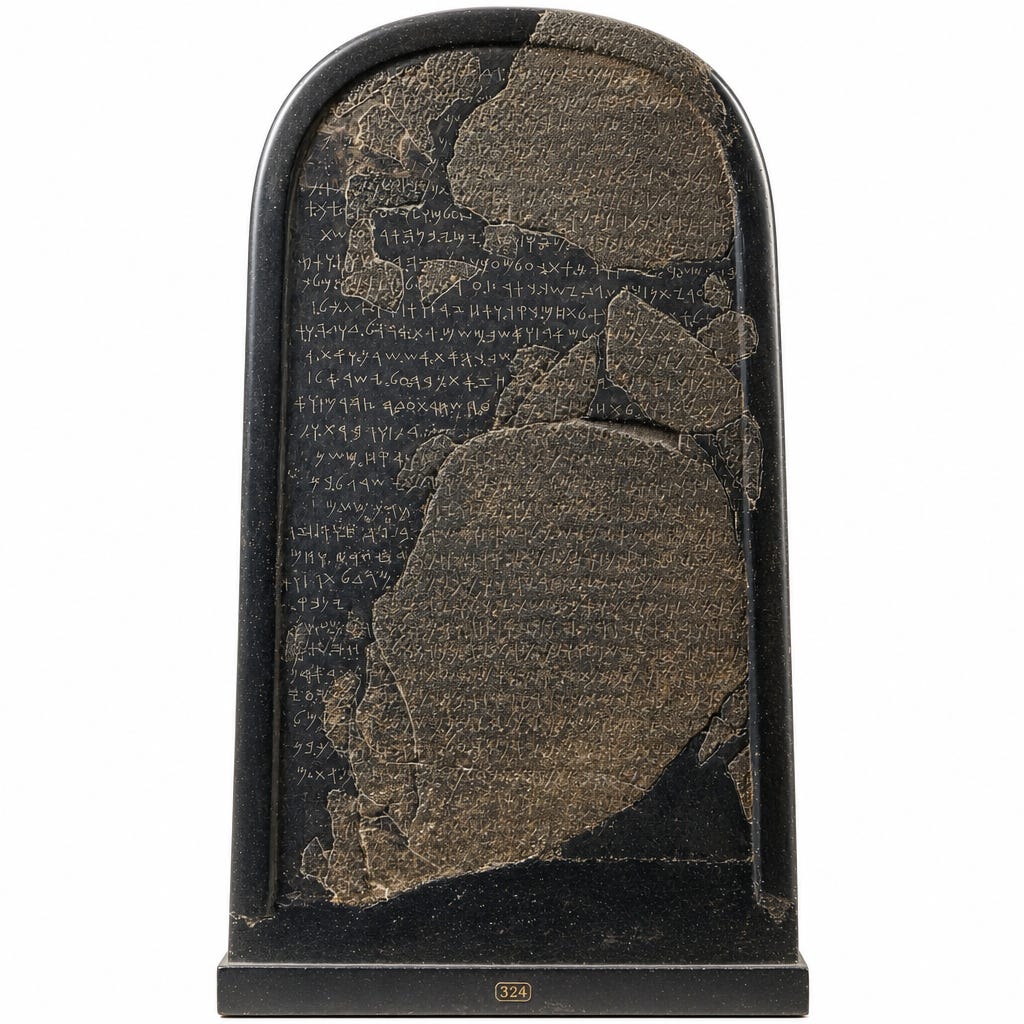
The Mesha Stele is a victory monument erected by King Mesha of Moab, celebrating his successful war against Israel and Judah and the victory of his god Chemosh over Yahweh. It is the oldest known mention of Yahweh outside the Bible and also references the House of Omri, possibly the House of David, and King Ahab himself. The events described on the stele correspond to the account in 2 Kings 3:1–27.
The Biblical account includes a dramatic and disturbing turning point: when the king of Moab saw that the battle had turned against him, he sacrificed his own firstborn son and heir on the city wall — and the tide suddenly shifted in Moab’s favor. According to the Bible, the human sacrifice of a royal prince appeared to work.
When the king of Moab saw that the battle had gone against him, he took with him seven hundred swordsmen to break through to the king of Edom, but they failed.
Then he took his firstborn son, who was to succeed him as king, and offered him as a sacrifice on the city wall. The fury against Israel was great; they withdrew and returned to their own land.
-2 Kings 3:26-27
Jezebel, The Phoenician Princess and Queen of Israel
Ahab’s queen was the Phoenician princess Jezebel, who died in 841 BCE and remains the most vilified woman in the entire Bible. She was the daughter of Ithobaal I — also known as Ethbaal — of Tyre and Sidon, who had been a high priest of Astarte before assassinating the previous king and seizing the throne. Ithobaal is an actual historical figure, documented to have lived from approximately 915 to 847 BCE. The royal marriage between Jezebel and Ahab served as the seal on a powerful political alliance between Phoenicia and Israel.
Together, Ahab and Jezebel built a new temple to Baal in Samaria, complete with 450 prophets, and erected a grand Asherah pole in the capital city. In Jezreel, they built both a palace and a temple to the mother goddess Asherah, home to 400 prophets, with Jezebel as their personal patron.
The story is generally told that Jezebel introduced foreign gods into Israel — but this framing is misleading. Baal and Asherah were not foreign gods. They were the incumbent gods, the traditional deities of the land. Yahweh was the new, young god, representing a radical break from established religious tradition. When Jezebel supported Baal and Asherah, she was defending the old ways against dangerous revolutionaries. It was Elijah and the Yahwists who were the insurgents.
Elijah and the Battle of the Prophets on Mount Carmel
Elijah was a prophet of Yahweh in Israel and the chief opponent of Ahab and Jezebel. The Yahwist prophetic order — called the "Sons of the Prophets" — operated as his movement. Jezebel, for her part, actively persecuted the Yahwists and worked to eliminate them. Elijah confronted Ahab directly, declaring: "I will bring disaster upon you and wipe out your house." He also prophesied Jezebel's gruesome end:
“Dogs will devour Jezebel by the wall of Jezreel.”
-1 Kings 21:23
The confrontation reached its peak at the Battle of the Prophets on Mount Carmel, described in 1 Kings 18:22–40. The contest was simple: each side would call upon their god to ignite a sacrificial bull on an altar, without the use of fire.
Elijah won — and in the aftermath, slaughtered all 450 prophets of Baal. The 400 prophets of Asherah, however, were left entirely untouched.
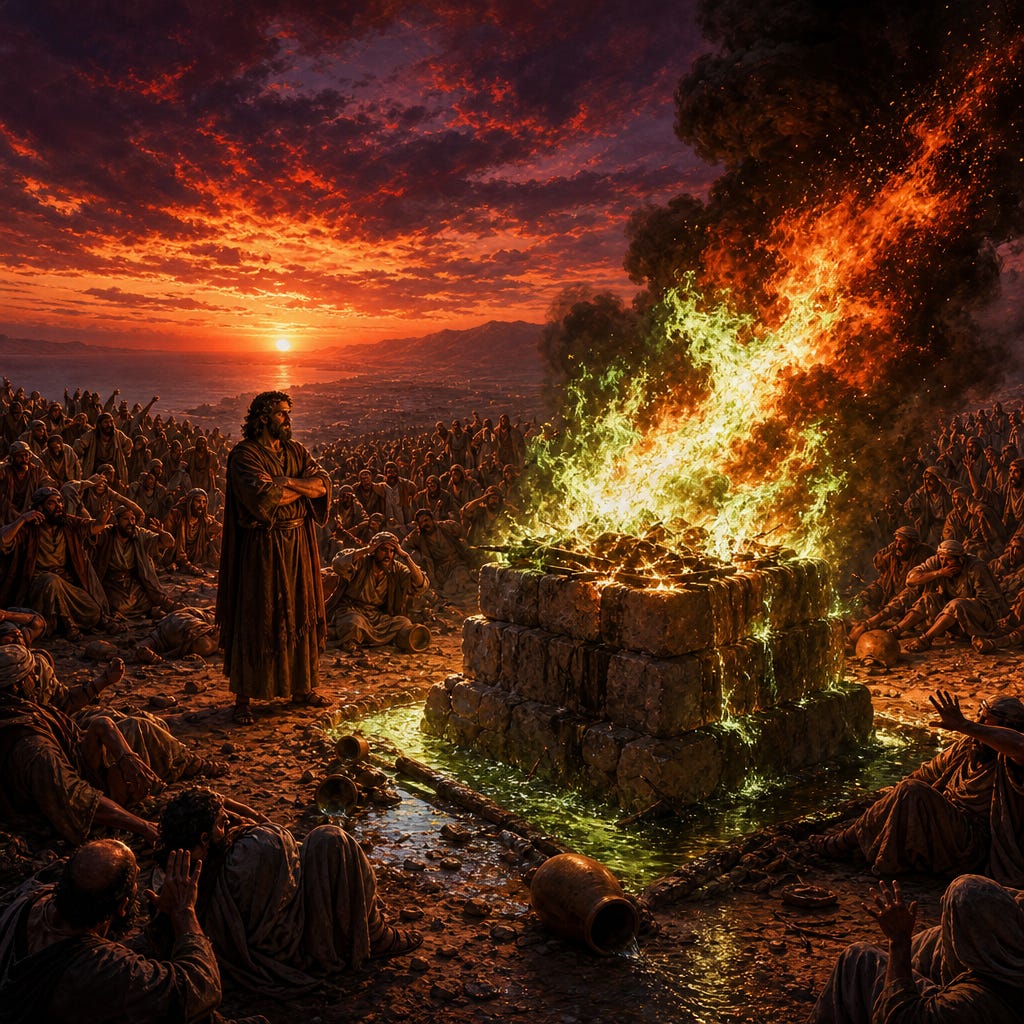
Elijah chose Mount Carmel strategically. There was an old limestone altar to Yahweh there that had been torn down, and limestone that had been burned changes chemically into quicklime (calcium oxide). His preparation was a three-step setup:
Rebuilt the altar from the old quicklime limestone
Salted the meat and altar with powdered sulfur
Drenched everything with what appeared to be water but was actually naphtha — “thick water,” a clear petroleum distillate known in the ancient world, imported from Persia
The combination of naphtha + sulfur + quicklime creates a violent, fiery chemical reaction — essentially the same technology later weaponized as Greek Fire in naval battles. A related recipe appears in 2 Maccabees 1:31–36, where “nephthar” (meaning purification) produces exactly such a fire.
Elijah was very clever — he challenged the prophets of Baal to a contest he knew they would lose because he was utilizing a magician’s trick.
So Obadiah went to meet Ahab and told him, and Ahab went to meet Elijah. When he saw Elijah, he said to him, “Is that you, you troubler of Israel?”
“I have not made trouble for Israel,” Elijah replied. “But you and your father’s family have. You have abandoned the Lord’s commands and have followed the Baals. Now summon the people from all over Israel to meet me on Mount Carmel. And bring the four hundred and fifty prophets of Baal and the four hundred prophets of Asherah, who eat at Jezebel’s table.”
So Ahab sent word throughout all Israel and assembled the prophets on Mount Carmel. Elijah went before the people and said, “How long will you waver between two opinions? If the Lord is God, follow him; but if Baal is God, follow him.”
But the people said nothing.
Then Elijah said to them, “I am the only one of the Lord’s prophets left, but Baal has four hundred and fifty prophets. Get two bulls for us. Let Baal’s prophets choose one for themselves, and let them cut it into pieces and put it on the wood but not set fire to it. I will prepare the other bull and put it on the wood but not set fire to it. Then you call on the name of your god, and I will call on the name of the Lord. The god who answers by fire—he is God.”
Then all the people said, “What you say is good.”
Elijah said to the prophets of Baal, “Choose one of the bulls and prepare it first, since there are so many of you. Call on the name of your god, but do not light the fire.” So they took the bull given them and prepared it.
Then they called on the name of Baal from morning till noon. “Baal, answer us!” they shouted. But there was no response; no one answered. And they danced around the altar they had made.
At noon Elijah began to taunt them. “Shout louder!” he said. “Surely he is a god! Perhaps he is deep in thought, or busy, or traveling. Maybe he is sleeping and must be awakened.” So they shouted louder and slashed themselves with swords and spears, as was their custom, until their blood flowed. Midday passed, and they continued their frantic prophesying until the time for the evening sacrifice. But there was no response, no one answered, no one paid attention.
Then Elijah said to all the people, “Come here to me.” They came to him, and he repaired the altar of the Lord, which had been torn down. Elijah took twelve stones, one for each of the tribes descended from Jacob, to whom the word of the Lord had come, saying, “Your name shall be Israel.” With the stones he built an altar in the name of the Lord, and he dug a trench around it large enough to hold two seahs of seed. He arranged the wood, cut the bull into pieces and laid it on the wood. Then he said to them, “Fill four large jars with water and pour it on the offering and on the wood.”
“Do it again,” he said, and they did it again.
“Do it a third time,” he ordered, and they did it the third time. The water ran down around the altar and even filled the trench.
At the time of sacrifice, the prophet Elijah stepped forward and prayed: “Lord, the God of Abraham, Isaac and Israel, let it be known today that you are God in Israel and that I am your servant and have done all these things at your command. Answer me, Lord, answer me, so these people will know that you, Lord, are God, and that you are turning their hearts back again.”
Then the fire of the Lord fell and burned up the sacrifice, the wood, the stones and the soil, and also licked up the water in the trench.
When all the people saw this, they fell prostrate and cried, “The Lord—he is God! The Lord—he is God!”
Then Elijah commanded them, “Seize the prophets of Baal. Don’t let anyone get away!” They seized them, and Elijah had them brought down to the Kishon Valley and slaughtered there.
And Elijah said to Ahab, “Go, eat and drink, for there is the sound of a heavy rain.” So Ahab went off to eat and drink, but Elijah climbed to the top of Carmel, bent down to the ground and put his face between his knees.
-1 Kings 18:16-42
It is notable that all 450 prophets of Baal were killed while the 400 prophets of Asherah were left entirely untouched. In this period, Yahweh was associated with Asherah, and would eventually be associated with Anat as well. This fight was between Baal and Yahweh — the goddesses remained, ready to align themselves with whichever male god came out victorious.
Jezebel’s response was fury. She sent a threatening message to Elijah: “May the gods punish me severely if by this time tomorrow I do not make your life like one of them.” Elijah, afraid for his life, fled into the desert. Jezebel surely prayed to Anat for his slaughter.
Now Ahab told Jezebel everything Elijah had done and how he had killed all the prophets with the sword. So Jezebel sent a messenger to Elijah to say, “May the gods deal with me, be it ever so severely, if by this time tomorrow I do not make your life like that of one of them.”
Elijah was afraid and ran for his life.
-1 Kings 19:1-3
Next week, we will continue the story of Jezebel, Athaliah, and their murders at the hands of Jehu the usurper and the followers of Yahweh.
We will discuss this topic on the Goddess Bible Study podcast on YouTube and soon on other platforms as well.