

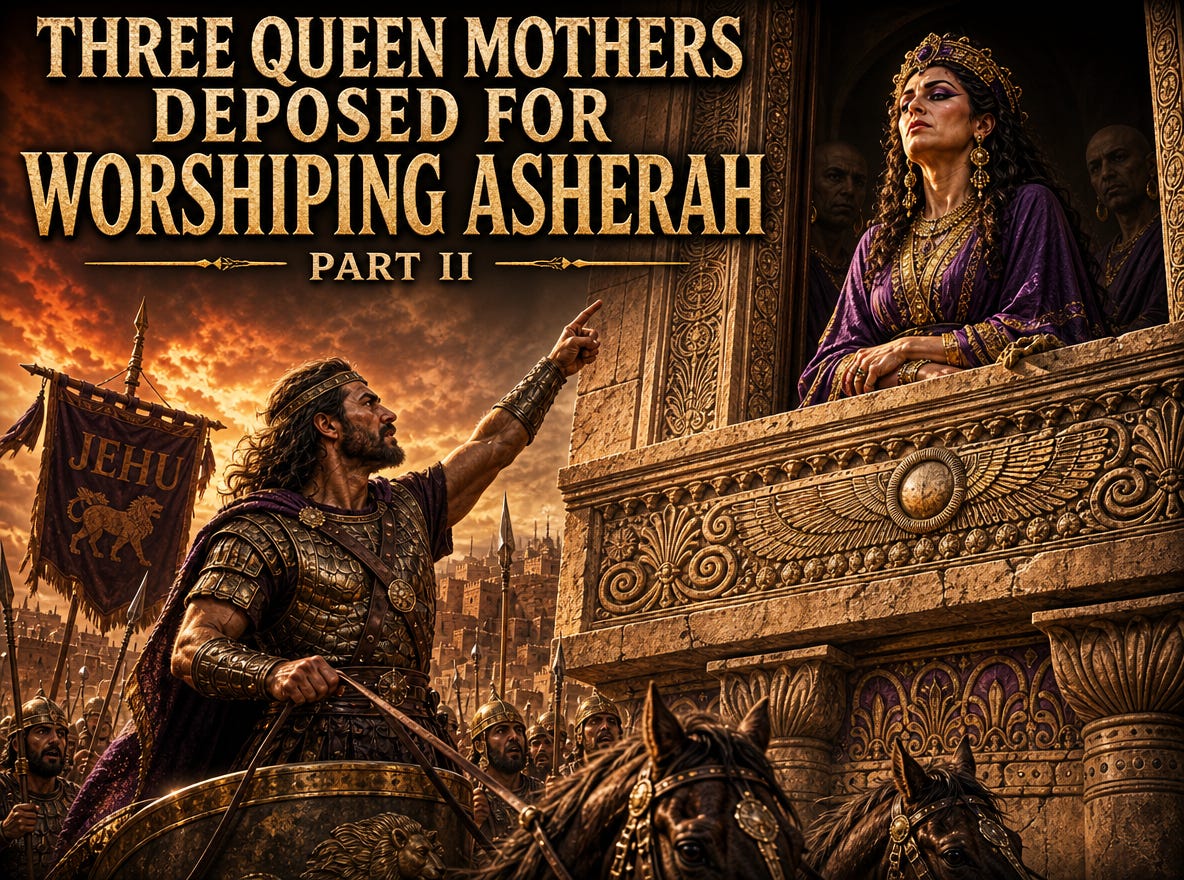
Goddess Bible Study continues in the 9th century BCE with the Book of Kings. In this period, the Yahwist prophets confronted the traditional religion of Baal and the mother goddess Asherah, while the kingdoms of Israel and Judah were embroiled in ongoing wars with their neighbors and turbulent royal succession.
This episode focuses on the prophets Elijah and Elisha, whose influence inspired the bloody coup by Jehu that overthrew the House of Omri in Israel. Queen Jezebel — the most vilified woman in the Bible — was famously assassinated, as was her daughter Athaliah, the only woman to ever rule Jerusalem in her own right.
Israel and Judah maintained an uneasy alliance while fighting wars with Aram, Edom, and Syria. Meanwhile, the shadow of the Assyrian Empire loomed on the horizon. King Ahab was a respected military commander, but was ultimately killed on the battlefield, setting off a succession of short-lived kings.
The previous episode concluded with the Battle of the Prophets on Mount Carmel. According to the Bible, Elijah’s victory brought the rains back after three years of drought that had caused great suffering across the land. No archaeological record confirms the drought — but we do know that the Yahwists were ascendant in this period.
The story picks up with Elijah fleeing into the wilderness to escape Jezebel’s wrath, after killing the 450 prophets of Baal — while leaving the prophets of Asherah untouched.
Elijah was afraid and ran for his life. He traveled forty days and forty nights until he reached Horeb, the mountain of God. There, Yahweh appeared to Elijah.
[Elijah] replied, “I have been very zealous for Yahweh God Almighty. The Israelites have rejected your covenant, torn down your altars, and put your prophets to death with the sword. I am the only one left, and now they are trying to kill me too.”
Yahweh said to him, “Go back the way you came, and go to the Desert of Damascus. When you get there, anoint Hazael king over Aram. Also, anoint Jehu son of Nimshi king over Israel, and anoint Elisha son of Shaphat from Abel Meholah to succeed you as prophet. Jehu will put to death any who escape the sword of Hazael, and Elisha will put to death any who escape the sword of Jehu.
-1 Kings 19:14-17
The Bible portrays King Ahab as weak, passive, and sulking, while Queen Jezebel is cast as dominant, manipulative, and politically shrewd. The historical record tells a different story — Ahab was a formidable military leader, actively engaged in the wars of his day.
Much of the Book of Kings reads as political propaganda, written to denigrate the enemies of the Yahwist movement regardless of their actual popularity or effectiveness as rulers. The Bible is especially vitriolic toward Ahab and Jezebel — which suggests they were real and serious adversaries.
Surely there was never one like Ahab, who sold himself to do evil in the sight of Yahweh, incited by his wife Jezebel. He committed the most detestable acts by going after idols, just like the Amorites whom Yahweh had driven out before the Israelites.
-1 Kings 19:25-26
Jezebel is blamed for introducing idolatry and foreign gods to Israel — but these gods were native, and Jezebel was defending the traditional religion of her people. From her perspective, it was the Yahwists who were the dangerous insurgents, armed with revolutionary new ideas.
In 1 Kings 21, Ahab covets a vineyard beside his palace, but the owner refuses to sell. Jezebel finds her husband sulking and mocks him: “Aren’t you the king? Get up — I will get you the vineyard.” She then conspires to have the owner falsely accused of blasphemy and killed, allowing Ahab to seize the land.
The prophet Elijah confronts them both for the crime:
“I will bring calamity on you and consume your descendants; the dogs will devour Jezebel by the wall of Jezreel.” (1 Kings 21)
This pivotal moment seals Jezebel’s fate in the narrative. Not long after, Ahab is killed in battle, and his son proves a short-lived replacement. In Judah, the Yahwist king Jehoshaphat succeeds his father Asa and continues his reforms — Asa being the king who, in the last episode, deposed Queen Mother Maacah for carving an image of Asherah.
Here we get one of the few references to the transgender qadesh being expelled from Judah — and yet again, the qedesha priestesses and the prophets of Asherah are left untouched. This culture war played out over centuries, and the priestesses proved a much harder target than the trans folks.
In the fourth year of Ahab’s reign over Israel, Jehoshaphat son of Asa became king of Judah. And Jehoshaphat walked in all the ways of his father Asa; he did not turn away from them, but did what was right in the eyes of Yahweh.
The high places, however, were not removed; the people still sacrificed and burned incense on the high places. Jehoshaphat also made peace with the king of Israel.
He banished from the land the male shrine prostitutes [qadesh] who remained from the days of his father Asa.
-1 Kings 22:41-46
Ahab's death is one of the more vivid stories in 1 Kings 22. He disguised himself on the battlefield, but a randomly fired arrow found the gap in his armor. When his chariot was brought back, the dogs licked his blood from the floor — fulfilling Elijah's prophecy exactly.
Ahaziah son of Ahab became king of Israel, and he reigned in Samaria two years. And he did evil in the sight of Yahweh and walked in the ways of his father and mother and of Jeroboam son of Nebat, who had caused Israel to sin. Ahaziah served and worshiped Baal, provoking Yahweh, the God of Israel, to anger, just as his father had done.
-1 Kings 22:51-53
Young King Ahaziah proved less capable than his father and grandfather. After a serious fall inside his own palace, he sent messengers to consult Baal-zebub of Ekron — but a prophet of Yahweh intercepted them and announced the king’s imminent death.
The name Baal-zebub means “lord of the flies” — almost certainly a mocking distortion coined by the Biblical writers rather than the god’s actual name.
Now Ahaziah had fallen through the lattice of his upper room in Samaria and injured himself. So he sent messengers and instructed them: “Go inquire of Baal-zebub, the god of Ekron, whether I will recover from this injury.”
But the angel of Yahweh said to Elijah the Tishbite, “Go up to meet the messengers of the king of Samaria and ask them, ‘Is it because there is no God in Israel that you are on your way to inquire of Baal-zebub, the god of Ekron?’
Therefore this is what Yahweh says: ‘You will not get up from the bed on which you are lying. You will surely die.’”
-2 Kings 1:2-4
Ahaziah was succeeded by his brother Jehoram. Shortly after, the prophet Elijah died and was taken up to heaven in his final supernatural act, passing his mantle to the prophet Elisha.
Elisha was not nice to children.
From there, Elisha went up to Bethel, and as he was walking up the road, a group of boys came out of the city and jeered at him, chanting, “Go up, you baldhead! Go up, you baldhead!”
Then he turned around, looked at them, and called down a curse on them in the name of Yahweh. Suddenly two female bears came out of the woods and mauled forty-two of the boys.
-2 Kings 2:23-24
Moab’s rebellion — which we covered last week alongside the Mesha Stele — is recorded in 2 Kings 3.
Elisha performs a series of healings and miracles before ultimately setting in motion a bloody palace coup that would claim many lives. Elisha instructed one of the Sons of the Prophets to go to the battlefield, find the Israelite commander Jehu, and anoint him king of Israel.
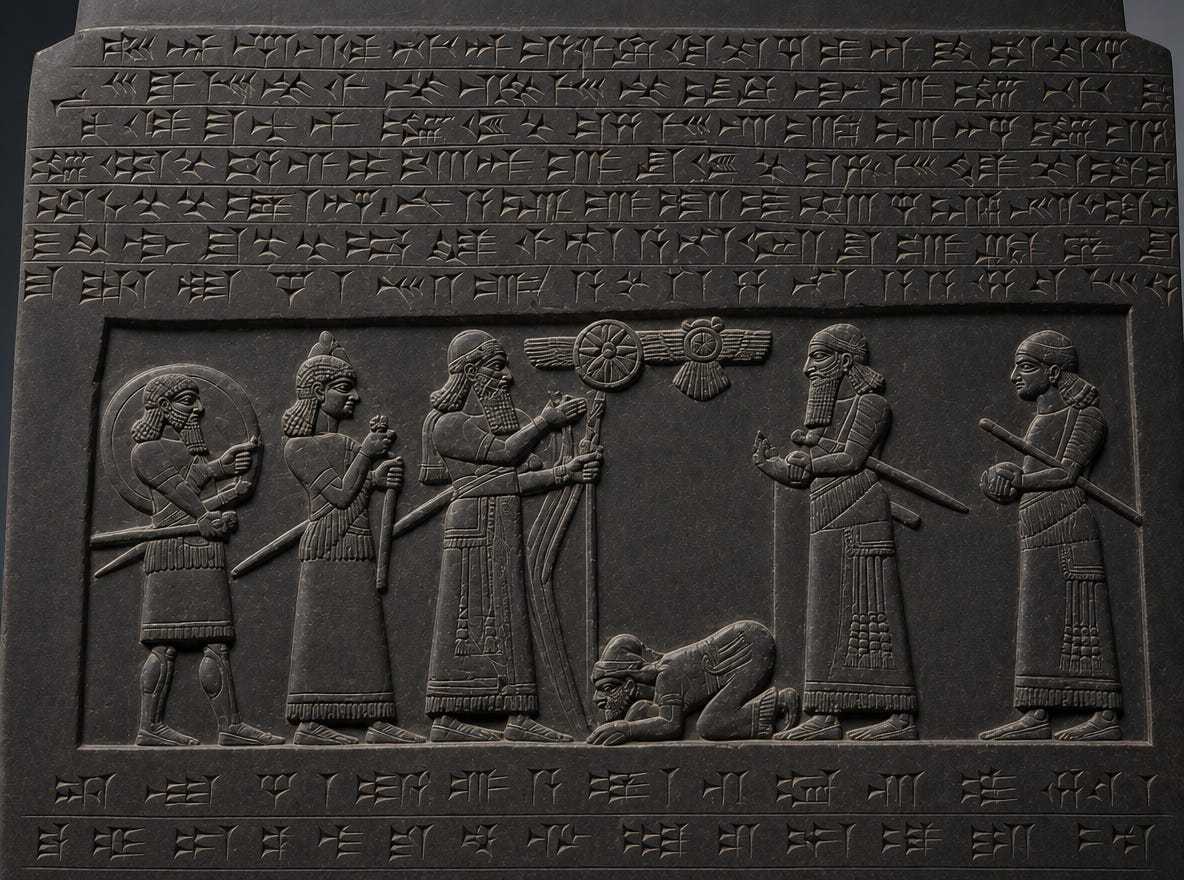
Jehu is a confirmed historical figure who ruled Israel from 841 to 814 BCE — the earliest king in the Biblical narrative to be verified in the archaeological record. His name is also one of the earliest theophoric names for Yahweh, meaning “Yahweh is he.” The emergence of theophoric names is a key marker scholars use to trace the spread of Yahwism as a cultural force. Jehoshaphat and Joash are two other Yahweh-rooted names from the same 9th-century BCE.
The Black Obelisk of Shalmaneser III (c. 841 BCE) depicts Jehu — or his envoy — prostrating before the Assyrian king, providing extra-biblical confirmation of his reign and its date. The original is held in the British Museum.
Even the Bible cannot fully rehabilitate Jehu. He comes across as treasonous and murderous, and his killing spree is remembered with shame by the later prophet Hosea (Hosea 1:4–5).
Upon his anointing, Jehu assassinated both the king of Israel and the king of Judah, along with Queen Mother Jezebel and their extended families — dozens of people in all. The assassination of Jezebel is particularly symbolic, as we will see.
Jehu was a committed Yahwist. He destroyed the temple of Baal and massacred everyone inside — but paganism did not disappear from Israel. The Biblical writers complain that the Golden Calves at Bethel and Dan remained standing, and the context makes clear that goddess worship continued and the qedesha remained untouched.
It is precisely this period that has yielded the most significant archaeological evidence linking Yahweh and Asherah.
So Jehu got up and went into the house, where the young prophet poured the oil on his head and declared, “This is what Yahweh, the God of Israel, says: ‘I anoint you king over Yahweh’s people Israel.
And you are to strike down the house of your master Ahab, so that I may avenge the blood of My servants the prophets and the blood of all the servants of Yahweh shed by the hand of Jezebel. The whole house of Ahab will perish, and I will cut off from Ahab every male both slave and free, in Israel. I will make the house of Ahab like the houses of Jeroboam son of Nebat and Baasha son of Ahijah. And on the plot of ground at Jezreel the dogs will devour Jezebel, and there will be no one to bury her.’”
Then Jehu got into his chariot and went to Jezreel, because Joram was laid up there. And Ahaziah king of Judah had gone down to see him.
Now the watchman standing on the tower in Jezreel saw Jehu’s troops approaching, and he called out, “I see a company of troops!”
“Choose a rider,” Joram commanded. “Send him out to meet them and ask, ‘Have you come in peace?’”
So a horseman rode off to meet Jehu and said, “This is what the king asks: ‘Have you come in peace?’”
“What do you know about peace?” Jehu replied. “Fall in behind me.”
And the watchman reported, “The messenger reached them, but he is not coming back.”
So the king sent out a second horseman, who went to them and said, “This is what the king asks: ‘Have you come in peace?’”
“What do you know about peace?” Jehu replied. “Fall in behind me.”
Again the watchman reported, “He reached them, but he is not coming back. And the charioteer is driving like Jehu son of Nimshi—he is driving like a madman!”
“Harness!” Joram shouted, and they harnessed his chariot.
Then Joram king of Israel and Ahaziah king of Judah set out, each in his own chariot, and met Jehu on the property of Naboth the Jezreelite.
When Joram saw Jehu, he asked, “Have you come in peace, Jehu?”
“How can there be peace,” he replied, “as long as the idolatry and witchcraft of your mother Jezebel abound?”
Joram turned around and fled, calling out to Ahaziah, “Treachery, Ahaziah!”
Then Jehu drew his bow and shot Joram between the shoulders. The arrow pierced his heart, and he slumped down in his chariot.
When King Ahaziah of Judah saw this, he fled up the road toward Beth-haggan.
And Jehu pursued him, shouting, “Shoot him too!”
So they shot Ahaziah in his chariot on the Ascent of Gur, near Ibleam, and he fled to Megiddo and died there.
Now when Jehu arrived in Jezreel, Jezebel heard of it. So she painted her eyes, adorned her head, and looked down from a window. And as Jehu entered the gate, she asked, “Have you come in peace, O Zimri, murderer of your master?”
He looked up at the window and called out, “Who is on my side? Who?”
And two or three eunuchs looked down at him.
“Throw her down!” yelled Jehu.
So they threw her down, and her blood splattered on the wall and on the horses as they trampled her underfoot.
Then Jehu went in and ate and drank. “Take care of this cursed woman,” he said, “and bury her, for she was the daughter of a king.”
But when they went out to bury her, they found nothing but her skull, her feet, and the palms of her hands.
So they went back and told Jehu, who replied, “This is the word of Yahweh, which He spoke through His servant Elijah the Tishbite: ‘On the plot of ground at Jezreel the dogs will devour the flesh of Jezebel. And Jezebel’s body will lie like dung in the field on the plot of ground at Jezreel, so that no one can say: This is Jezebel.
-2 Kings 9:6-37
Jezebel faced her death with dignity, taking time to paint her eyes and dress her hair before appearing at the window. She was thrown down by her own palace eunuchs, her blood spattering on the stones below. Her flesh was consumed by dogs — fulfilling Elijah’s grisly prophecy to the letter.
Her defenestration is one of the most loaded images in the Hebrew Bible: a great queen, hurled from her own window, devoured in the street. Over the centuries, Jezebel’s name has become synonymous with female treachery, sexual manipulation, temptation, and wickedness — a shorthand for everything the patriarchal tradition feared in a powerful woman.
She is comparable to the tragic Greek figure Clytemnestra, killed by her son Orestes in revenge for the death of his father Agamemnon, as told in Aeschylus’s Oresteia. Both Jezebel and Clytemnestra were politically powerful queens representing older matriarchal traditions, recast as villains in Iron Age patriarchal narratives that celebrated their gruesome deaths as righteous justice.
Jehu was not finished. Having killed both kings of Israel and Judah in a single campaign, and the Queen Mother of Israel, he systematically hunted down and killed their families — all of them.
His most sacrilegious act came last. He invited every remaining servant of Baal to a great sacrifice at the temple, locked the doors, and slaughtered everyone inside. Then he desecrated the temple itself, turning it into a latrine.
Now the sons of the king [Ahab], seventy in all, were being brought up by the leading men of the city. And when the letter arrived, they took the sons of the king and slaughtered all seventy of them. They put their heads in baskets and sent them to Jehu at Jezreel.
So Jehu killed everyone in Jezreel who remained of the house of Ahab, as well as all his great men and close friends and priests, leaving him without a single survivor.
Then Jehu set out toward Samaria. At Beth-eked of the Shepherds, Jehu met some relatives of Ahaziah king of Judah and asked, “Who are you?”
“We are relatives of Ahaziah,” they answered, “and we have come down to greet the sons of the king and of the queen mother.”
Then Jehu ordered, “Take them alive.” So his men took them alive, then slaughtered them at the well of Beth-eked—forty-two men. He spared none of them.
Then Jehu brought all the people together and said, “Ahab served Baal a little, but Jehu will serve him a lot. Now, therefore, summon to me all the prophets of Baal, all his servants, and all his priests. See that no one is missing, for I have a great sacrifice for Baal. Whoever is missing will not live.”
But Jehu was acting deceptively in order to destroy the servants of Baal.
And Jehu commanded, “Proclaim a solemn assembly for Baal.” So they announced it.
Then Jehu sent word throughout Israel, and all the servants of Baal came; there was not a man who failed to show. They entered the temple of Baal, and it was filled from end to end.
And Jehu said to the keeper of the wardrobe, “Bring out garments for all the servants of Baal.” So he brought out garments for them.
Next, Jehu and Jehonadab son of Rechab entered the temple of Baal, and Jehu said to the servants of Baal, “Look around to see that there are no servants of Yahweh here among you—only servants of Baal.”
And they went in to offer sacrifices and burnt offerings. Now Jehu had stationed eighty men outside and warned them, “If anyone allows one of the men I am delivering into your hands to escape, he will forfeit his life for theirs.”
When he had finished making the burnt offering, Jehu said to the guards and officers, “Go in and kill them. Do not let anyone out.”
So the guards and officers put them to the sword, threw the bodies out, and went into the inner room of the temple of Baal.
They brought out the sacred pillar of the temple of Baal and burned it. They also demolished the sacred pillar of Baal. Then they tore down the temple of Baal and made it into a latrine, which it is to this day.
Thus Jehu eradicated Baal from Israel, but he did not turn away from the sins that Jeroboam son of Nebat had caused Israel to commit—the worship of the golden calves at Bethel and Dan.
Nevertheless, Yahweh said to Jehu, “Because you have done well in carrying out what is right in My sight and have done to the house of Ahab all that was in My heart, four generations of your sons will sit on the throne of Israel.”
-2 Kings 10:6-30
There is no clear archaeological evidence that this particular temple desecration occurred, but archaeologists did discover a Judean temple at Lachish that was desecrated by the installation of a toilet, confirming it was at least a known practice.
Jehu proved to be a successful king, establishing a dynasty in Israel that lasted four generations. And yet, once again, the Yahwists succeeded against Baal but made no headway against paganism more broadly. The Golden Calves at Bethel and Dan remained standing, Asherah worship goes unconfronted, and Asherah poles are not mentioned. The Divine Council was intact. In the 9th century BCE, Yahweh was still one god among many.
Our third and final Queen Mother in this tragic trilogy is Athaliah — daughter of Jezebel and Ahab, wife of the king of Judah, Queen Mother, and ultimately sole ruler of Jerusalem in her own right.
After Jehu killed her son, King Ahaziah, and decimated her family, Athaliah launched a killing spree of her own, slaughtering the remaining royal heirs to seize the throne. One infant survived, hidden away by a family member in the temple.
Athaliah is the only woman in history to rule from Jerusalem as a sovereign queen. She held the throne for six years, from 841 to 835 BCE — until the Yahwists assassinated her, installed the seven-year-old Joash as king, and tore down the temple of Baal.
When Athaliah the mother of Ahaziah saw that her son was dead, she proceeded to annihilate all the royal heirs. But Jehosheba daughter of King Joram, the sister of Ahaziah, took Joash son of Ahaziah and stole him away from among the sons of the king who were being murdered. She put him and his nurse in a bedroom to hide him from Athaliah, and he was not killed. And Joash remained hidden with his nurse in the house of Yahweh for six years while Athaliah ruled the land.
-2 Kings 11:1-3
Then Jehoiada brought out the king’s son, put the crown on him, presented him with the Testimony, and proclaimed him king. They anointed him, and the people clapped their hands and declared, “Long live the king!”
When Athaliah heard the noise from the guards and the people, she went out to the people in the house of Yahweh. And she looked out and saw the king standing by the pillar, according to the custom. The officers and trumpeters were beside the king, and all the people of the land were rejoicing and blowing trumpets.
Then Athaliah tore her clothes and screamed, “Treason! Treason!”
And Jehoiada the priest ordered the commanders of hundreds in charge of the army, “Bring her out between the ranks, and put to the sword anyone who follows her.” For the priest had said, “She must not be put to death in the house of Yahweh.”
So they seized Athaliah as she reached the horses’ entrance to the palace grounds, and there she was put to death.
So all the people of the land went to the temple of Baal and tore it down. They smashed the altars and idols to pieces, and they killed Mattan the priest of Baal in front of the altars.
-2 Kings 11:12-18
Joash reigned in Jerusalem for forty years before being killed in a palace coup. Yahweh, it must be said, was never particularly reliable when it came to protecting his kings.
Next episode, we step away from the kings and into the world of the prophet Hosea and his wife Gomer, who is described as a woman of harlotry. I argue that Gomer is a qedesha — a priestess representing the matriarchal Canaanite tradition — and that the Book of Hosea is a poetic, symbolic confrontation between Yahweh and the goddess that ultimately ends in divorce.