

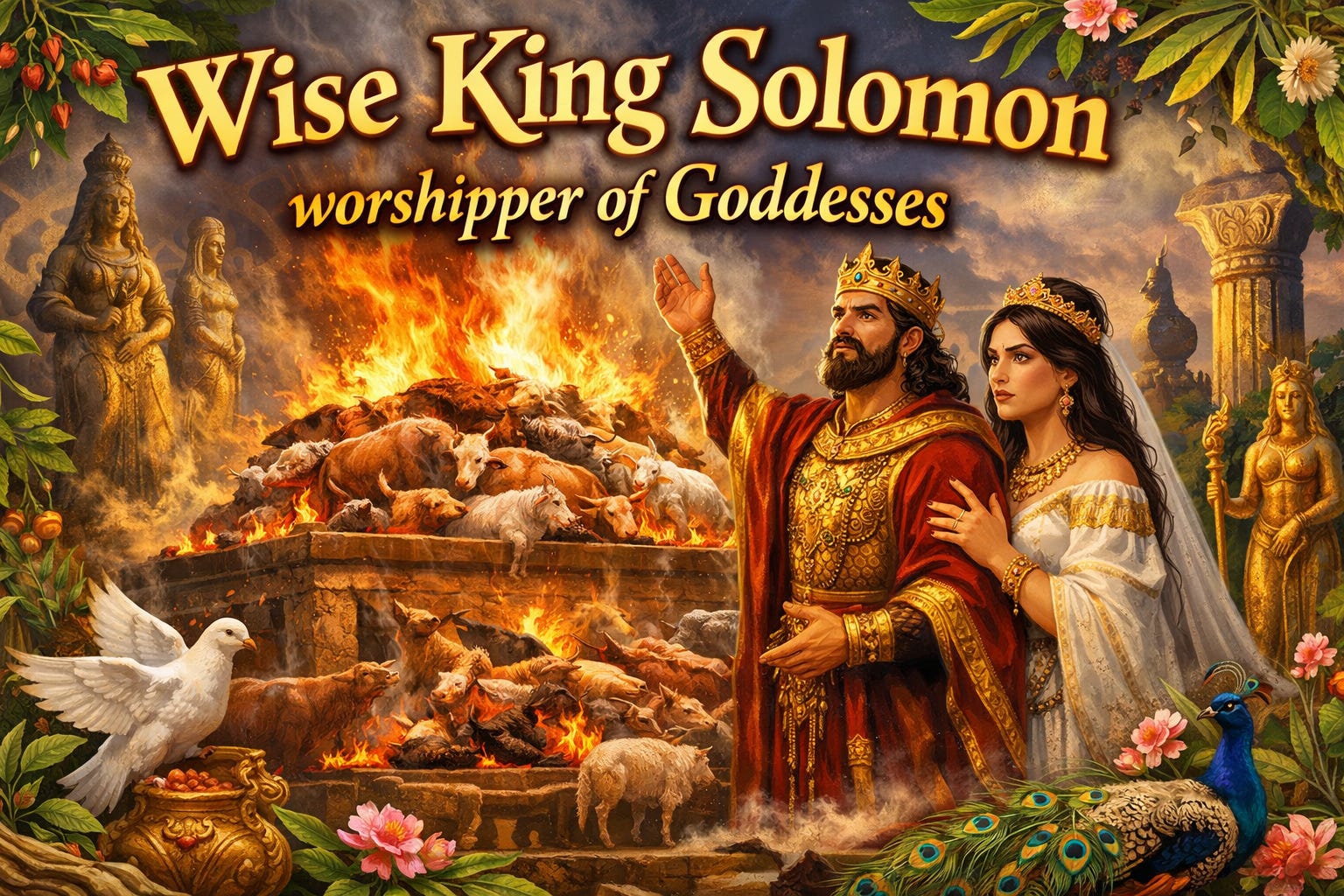
Goddess Bible Study this week begins a deep dive into King Solomon, the wisest, wealthiest, and most celebrated of all the Biblical kings. We will spend a few weeks on King Solomon as he is one of the pivotal figures in the Goddess Bible Study narrative.
King Solomon was greater in riches and wisdom than all the other kings of the earth. All the kings of the earth sought audience with Solomon to hear the wisdom God had put in his heart.
– 2 Chronicles 9:22-23
King Solomon is a paradox, the Biblical writers dress him up as the wisest king ever, and he is known as the father of the esoteric wisdom traditions. Yet the Biblical writers are also harshly critical of Solomon for worshipping goddesses, which they blame on his many wives.
King Solomon followed Yahweh, but he did not follow Yahweh alone.
King Solomon is the transitional figure who transmuted Israelite paganism into Biblical monotheism. Through Solomon, theologians pass through the acceptable aspects of the feminine divine while rejecting others. Theologians accept transcendent “wisdom”, which they describe as “she,” while they reject all the visceral nature-based traditions rooted in matriarchy, sexuality, plant medicine, and ecstasy.
The ephemeral feminine divine wisdom is seen in all Western esoteric traditions, including Kabbalah, the Rosicrucians, Hermetics, Gnostics, and modern Freemasons. The Greeks gave wisdom the name Sophia, and commonly presented her as a goddess, a tradition that continues today.
King Solomon was greater in riches and wisdom than all the other kings of the earth. All the kings of the earth sought audience with Solomon to hear the wisdom God had put in his heart.
– 2 Chronicles 9:22-23
As King David’s health failed at the end of his long rule, various princes asserted their claims for the throne. David’s wife Bathsheba, with whom he had had a scandalous adulterous affair when they first met, maneuvered her youngest son to be chosen by David as his successor.
It is worth noting the role played by Solomon’s mother in placing Solomon on the throne ahead of his many rivals.
David and Bathsheba’s 15-year-old son was named Jedidiah, “the friend of God.” After being anointed king beside the Gihon Spring, drenched in the holy cannabis oil, he would be known by a name of legendary renown.
Zadok the priest took the horn of oil from the sacred tent and anointed Solomon. Then they sounded the trumpet and all the people shouted, “Long live King Solomon!”
– 1 Kings 1:39
King Solomon ruled in Jerusalem for 40 years from 970-931 BCE and is revered by Jews, Christians, Muslims, and Rastafarians as the wisest and wealthiest of all the world’s ancient kings. King Solomon is perhaps the most celebrated of all Old Testament characters (alongside Moses), and countless stories exist about him outside the Bible.
Known as the “King of Peace,” Solomon ruled the united kingdom of Israel at its legendary height, brought trade and prosperity, and built the first Hebrew Temple in Jerusalem. The Father of Wisdom is credited with authoring the biblical books of Proverbs, Ecclesiastes, the Song of Solomon, and some Psalms.
Solomon’s exploits and wealth are clearly exaggerated, and scholars debate the very existence of King Solomon and King David, since no archaeological evidence confirming them has been found.
It is accepted that the Israelites were in Jerusalem during this period, but scholars do not believe that Jerusalem was wealthy. There was no grand palace or other large construction projects as described in the Bible.
There are megalithic stones tourists can see in the Temple Mount, similar to those found in Baalbek, Lebanon, indicating a Phoenician-style temple, but we don’t know what it looked like, and it’s doubtful that it was layered in gold.
The Temple Mount in Jerusalem is currently the home of the Islamic Dome of the Rock and the Al-Aqsa Mosque, and has not been archaeologically studied outside the Jewish sections. It is the single most contentious location on all of planet Earth, fought over by Jews, Muslims, and Christians alike.
Solomon’s Pagan Worship
Young King Solomon had to work to consolidate his power and fend off rivals. Meanwhile, the people continued to worship in the old pagan ways, offering sacrifices and burning incense at the high places. High places were hilltop altars, stone platforms, and sacred groves where the people made offerings to the various gods and goddesses.
There was no authority or centralized worship in pagan folk traditions, just community altars that people built themselves. The big cities had state religions and large temples, but in the countryside, religion was a community and family affair. There was no doctrine, dogma, or overarching authority on spiritual matters. Paganism was a do-it-yourself religious framework, and the Yahweh-alone reforms would come later.
Wise King Solomon followed the people and also burned incense and made offerings on the high places. The following passage about young Solomon is crucial. “The king went to Gibeon to offer sacrifices, for that was the most important high place.”
Solomon showed his love for Yahweh by walking according to the instructions given him by his father David, except that he offered sacrifices and burned incense on the high places. The king went to Gibeon to offer sacrifices, for that was the most important high place, and Solomon offered a thousand burnt offerings on that altar.
At Gibeon, Yahweh appeared to Solomon during the night in a dream, and God said, “Ask for whatever you want me to give you.”
Solomon answered... “Now, Yahweh my God, you have made your servant king in place of my father David. But I am only a little child and do not know how to carry out my duties.... So give your servant a discerning heart to govern your people and to distinguish between right and wrong. For who is able to govern this great people of yours?”
Yahweh was pleased that Solomon had asked for this. So God said to him, “Since you have asked for this and not for long life or wealth for yourself, nor have you asked for the death of your enemies but for discernment in administering justice, I will do what you have asked.
I will give you a wise and discerning heart, so that there will never have been anyone like you, nor will there ever be. Moreover, I will give you what you have not asked for – both wealth and honor – so that in your lifetime you will have no equal among kings.
– 1 Kings 3:3-13
King Solomon made a thousand burnt offerings at Gibeon, the most important pagan shrine. Rather than being angry, Yahweh rewarded Solomon by granting him wisdom. Solomon took that blessing and became the philosophical bridge between the pagan and monotheistic traditions.
The Book of Chronicles was written later, and it tells the same story slightly differently. The writer of Chronicles altered the detail that Gibeon was “the most important high place” and changed it to be the location for Moses’s tent of meeting instead.
This is a clear example of revisionist history, as the Bible went through generations of writers over many centuries.
Solomon and the whole assembly went to the high place at Gibeon, for God’s tent of meeting was there, which Moses Yahweh’s servant had made in the wilderness.
– 2 Chronicles 1:3
Goddess Worshipper
For all of King Solomon’s great attributes, he is harshly criticized in the Bible for his goddess worship and devotion to his wives. King Solomon built a temple (or high place) to Astarte in Jerusalem. The writers blame Solomon, in part, for the later breakup of the united kingdom of Israel into Israel and Judah.
Solomon is said to have had 700 wives and 300 concubines. He loved women, and the women loved him. The king was a sensuous man who appreciated the finer things in life: luxury, poetry, wisdom, and love.
King Solomon likely took part in the hieros gamos (sacred marriage) rituals. The Song of Solomon comes from a genre of sacred love poetry used in these traditions. The king had close relations with the goddess-worshipping Phoenicians, who helped him build the Jerusalem temple and with whom he engaged in wide-ranging trade.
King Solomon, however, loved many foreign women besides Pharaoh’s daughter--Moabites, Ammonites, Edomites, Sidonians and Hittites. They were from nations about which Yahweh had told the Israelites, “You must not intermarry with them, because they will surely turn your hearts after their gods.” Nevertheless, Solomon held fast to them in love.
He had seven hundred wives of royal birth and three hundred concubines, and his wives led him astray. As Solomon grew old, his wives turned his heart after other gods, and his heart was not fully devoted to Yahweh his God, as the heart of David his father had been.
He followed Ashtoreth the goddess of the Sidonians, and Milcolm the detestable god of the Ammonites. So Solomon did evil in the eyes of Yahweh; he did not follow Yahweh completely, as David his father had done. On a hill east of Jerusalem, Solomon built a high place for Chemosh the detestable god of Moab, and for Milcolm the detestable god of the Ammonites. He did the same for all his foreign wives, who burned incense and offered sacrifices to their gods.
-1 Kings 11:1-8
Two Women and a Baby
Solomon demonstrated his wisdom when he judged a famous dispute in the Bible. Two women came to him, both claiming to be the mother of the same baby, while the other’s baby was dead. The king said, “Bring me a sword, cut the child in half, and give one half to each mother.”
The woman whose child was alive was deeply moved out of love for her son and said, “Do not kill the living baby!” But the woman whose child was dead said, “Neither of us can have him!”
Then the king made his ruling, “Give the baby to the first woman, she is the mother of the living child.” When all Israel heard the verdict, they were awed by Solomon’s wisdom.
God gave Solomon wisdom and very great insight, and a breadth of understanding as measureless as the sand on the seashore.
Solomon’s wisdom was greater than the wisdom of all the people of the East, and greater than all the wisdom of Egypt.
He was wiser than anyone else, including Ethan the Ezrahite--wiser than Heman, Kalkol, and Darda, the sons of Mahol. And his fame spread to all the surrounding nations.
He spoke three thousand proverbs and his songs numbered a thousand and five.
He spoke about plant life, from the cedar of Lebanon to the hyssop that grows out of walls. He also spoke about animals and birds, reptiles and fish.
From all nations people came to listen to Solomon’s wisdom, sent by all the kings of the world, who had heard of his wisdom.
-1 Kings 4:29-34
In the book of Proverbs, Solomon describes how wisdom was at God’s side as he laid the foundations of creation, guided by her hand.
King Solomon would eventually die in his bed, fat, rich, and happy, surrounded by his family and the women who loved him. If God was unhappy with King Solomon, he did not show it in Solomon’s lifetime, or perhaps the Goddess just loved him more.
Next week, we will dive into some of the wisdom texts in Proverbs, Ecclesiastes, and the Wisdom of Solomon. Following that, we have his great wealth and building projects, especially the First Temple, and also the Song of Songs. Then we will conclude the discussion of King Solomon with some extra-Biblical material, including the Ethiopian legends of the Queen of Sheba, the Kebra Negast, and the Ark of the Covenant, as well as Arab legends such as the Ring of Andaleeb.
Reach out to:
goddessbiblestudy@gmail.com
Live discussion Tues, Feb. 24, at 7:00 pm EST