

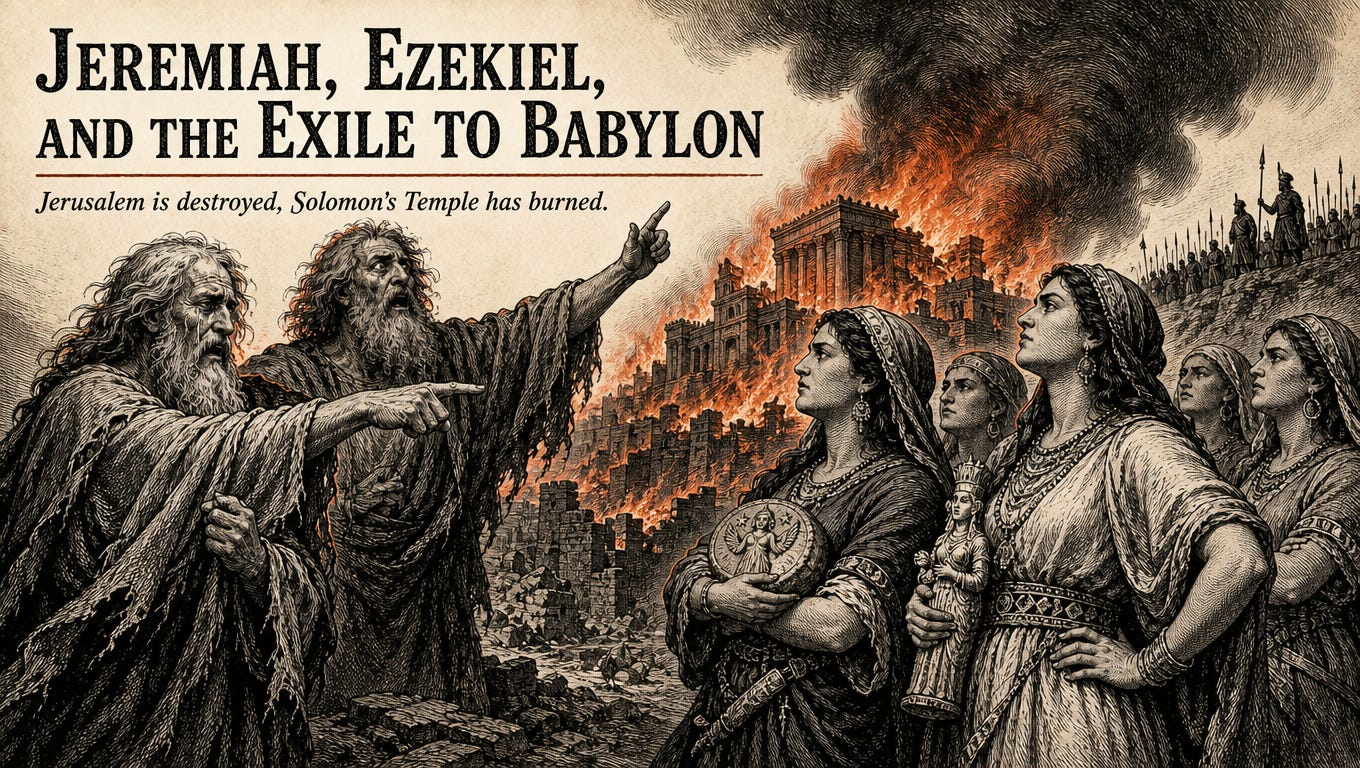
In this episode of Goddess Bible Study, we have reached the end of the First Temple period; it’s a big, important moment in the timeline. For nearly 400 years, the Hebrew temple dedicated to Yahweh had stood on the Temple Mount in Jerusalem before it was destroyed by the Babylonians in 586 BCE. The followers of Yahweh were radical reformists who had worked hard to overthrow existing religious traditions, centralize worship around one god, and institute enormous cultural changes, with varying degrees of success.
The Yahwists objected to child sacrifice (among other things) and fought against the gods, particularly Baal, who demanded it. Baal had been the incumbent king of the gods for the Israelites and Canaanites going back centuries to the time of the Hyksos. Yahweh and Baal competed for the love of the northern kingdom of Israel, and in the 9th century BCE, Yahweh won the fight for the throne, but the broader pantheon of gods remained intact. Yahweh never ruled Israel alone; it was always a pagan nation until its destruction by the Assyrians in 722 BCE.
Yahweh’s home was in the southern kingdom of Judah, with its capital of Jerusalem. Yahweh had more success consolidating worship in Judah, but for most of its history, Judah remained stubbornly pagan as well. At no point were the Hebrews monotheists in the First Temple. Yahweh had not yet been merged with his father, the creator, El Elyon, “God Most High,” and the goddesses Asherah, Astarte, and Anat remained as popular as ever.
The Yahwists also objected to the goddesses and particularly the ritual sex traditions, rooted in farming, that were thought to make the flowers grow. The goddesses and the qedesha priestesses, along with the transgender qadesh priests, represented the old Bronze Age tribal matriarchies that built families around mothers and celebrated women’s sexuality. The Yahwists were firmly patriarchal, so they needed to shut these traditions down and make the women submit to the new Iron Age order.
King Josiah (discussed in the last episode) attempted to push through the most dramatic reforms, shutting down all pagan religious practices and moving hard against the goddesses, but he was killed in battle in 609 BCE, and his reforms died with him. Judah immediately returned to its pagan ways, much to the chagrin of the Hebrew prophets, Jeremiah and Ezekiel.
Nebuchadnezzar II became the king of Babylon in 605 BCE; he was the greatest emperor of his era and looms large in the Bible. Nebuchadnezzar led a great renaissance of Babylon and made many renovations and restorations to the city, including reconstruction of the great walls, the grand processional boulevard, and the lavishly decorated Ishtar Gate. At this time, Babylon was the biggest, wealthiest, and most cosmopolitan city in the world.
At the Battle of Carchemish in 605 BCE, Nebuchadnezzar and his allies completely devastated the combined armies of Egypt and the remaining Assyrians, leaving the Babylonians as the undisputed power in the region.
Prophet Jeremiah
Jeremiah was a prophet in Judea during the time of Josiah. He was the son of the high priest Hilkiah and may have been one of the Deuteronomist writers. Jeremiah witnessed the fall of Jerusalem, the burning of the Temple, and the exile to Babylon. Jeremiah was the chief mourner for King Josiah and was deeply troubled by the prompt return to pagan practices the moment Josiah passed.
Jeremiah was known as the weeping prophet; he preached that Judah would be destroyed by invaders from the north because they had forsaken Yahweh by worshipping adulterous goddesses, committing idolatry, and all the rest of the sins of the Canaanites. Jeremiah preached social justice and advocated for the poor against the depredations of the rich and powerful.
Scholarly consensus is that there was a historical Jeremiah, and that some of the writings in his book were by him, but the overall book was edited and redacted numerous times.
The prophet frequently used the metaphor of divorce to describe the fealty Yahweh demands.
During the reign of King Josiah, Yahweh said to me, “Have you seen what faithless Israel has done? She has gone up on every high hill and under every spreading tree and has committed adultery there. I thought that after she had done all this she would return to me but she did not, and her unfaithful sister Judah saw it.
I gave faithless Israel her certificate of divorce and sent her away because of all her adulteries. Yet I saw that her unfaithful sister Judah had no fear; she also went out and committed adultery. Because Israel’s immorality mattered so little to her, she defiled the land and committed adultery with stone and wood. In spite of all this, her unfaithful sister Judah did not return to me with all her heart, but only in pretense,” declares Yahweh.
- Jeremiah 3:6-10
Jeremiah preached that the Babylonians would defeat Judah, which was an unpopular message with the king and considered treasonous.
I will destroy Daughter Zion, so beautiful and delicate.
– Jeremiah 6:2
This is what Yahweh says: “Look, an army is coming from the land of the north; a great nation is being stirred up from the ends of the earth. They are armed with bow and spear; they are cruel and show no mercy. They sound like the roaring sea as they ride on their horses; they come like men in battle formation to attack you, Daughter Zion.”
– Jeremiah 6:22-23
Cannabis Mentioned as a Burnt Offering in the Temple
This passage suggests that burnt offerings of cannabis were made to Yahweh in the Hebrew temple. The typical translation of calamus or sweet cane does not fit the context as a burnt offering, but cannabis does perfectly.
Yahweh was angry and rejected the Israelite offerings as too little and too late; they were too far gone in their sins. Cannabis from a distant land implies that they were not growing cannabis in Judah – but were trading for it.
Hear, you earth: I am bringing disaster on this people, the fruit of their schemes because they have not listened to my words and have rejected my law.
What do I care about incense from Sheba or sweet cannabis [qaneh] [calamus or sweet cane] from a distant land? Your burnt offerings are not acceptable; your sacrifices do not please me.”
– Jeremiah 6:19-20
Judah persisted in worshipping the Goddess; they made offerings to Astarte, the Queen of Heaven.
Do you not see what they are doing in the towns of Judah and in the streets of Jerusalem? The children gather wood, the fathers light the fire, and the women knead the dough and make cakes to offer to the Queen of Heaven. They pour out drink offerings to other gods to arouse my anger.
- Jeremiah 7:17-18
Yahweh’s disgust with child sacrifice is again stated by Jeremiah. Here it says that Yahweh never commanded child sacrifice, a claim debated by scholars. Arguably, in earlier centuries the Yahweh cult had also participated in the practice, but by this time, they were firmly opposed.
“The people of Judah have done evil in my eyes, declares Yahweh. They have set up their detestable idols in the house that bears my Name and have defiled it. They have built the high places of Topheth in the Valley of Ben Hinnom to burn their sons and daughters in the fire - something I did not command, nor did it enter my mind.”
- Jeremiah 7:30-31
597 - 586 BCE - Destruction of Jerusalem
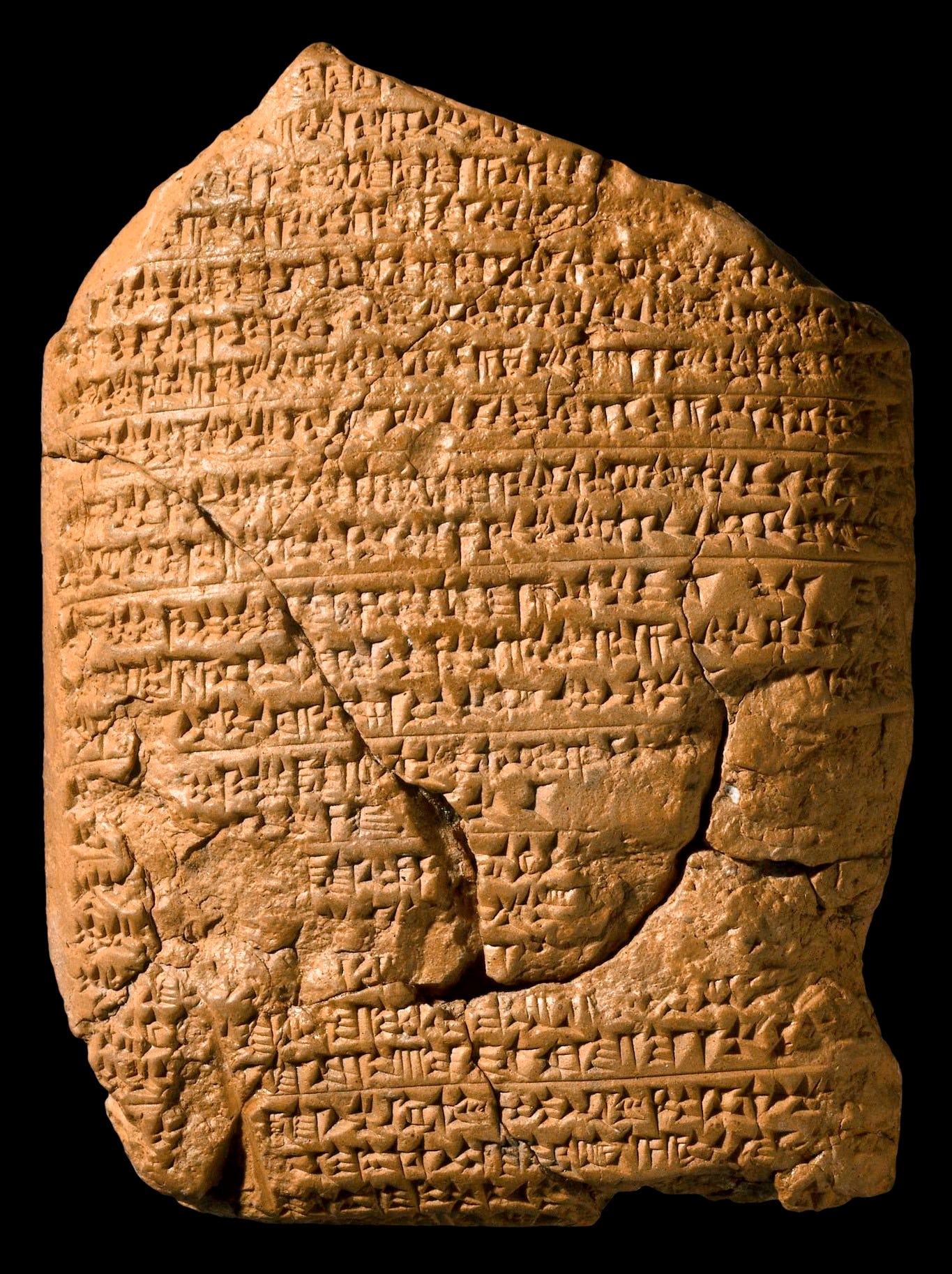
During the time of imperial unrest, Judah rebelled against Babylon. Nebuchadnezzar answered in 597 BCE by invading Judah and laying siege to Jerusalem, turning it into a vassal state.
Nebuchadnezzar marched up to the gates of Jerusalem, and the king and the entire royal family surrendered. Nebuchadnezzar stripped the Temple of its valuables and sent 10,000 elites into exile in Babylon, including the soon-to-be prophet Ezekiel.
He carried all Jerusalem into exile: all the officers and fighting men, and all the skilled workers and artisans - a total of ten thousand. Only the poorest people of the land were left.
- 2 Kings 24:14
The last king of Judah was Zedekiah; he was installed by Nebuchadnezzar and ruled for 11 years. Zedekiah was pagan and of no value to the Yahwists. Against the warnings of Jeremiah and other advisors, Zedekiah rebelled against Babylon in his ninth year and allied with Egypt.
Jeremiah warned Zedekiah that Babylon would defeat Judah and the Egyptians would not be able to save them. Jeremiah was arrested, accused of being a traitor in favor of the Babylonians. Jeremiah was then thrown into a mud-filled cistern in an attempt to kill him, but he was rescued by allies.
Nebuchadnezzar responded by invading Judah again and laying siege to Jerusalem in 588 BCE. The siege lasted 30 months, and great suffering befell the people. Jerusalem fell for good in 586 BCE.
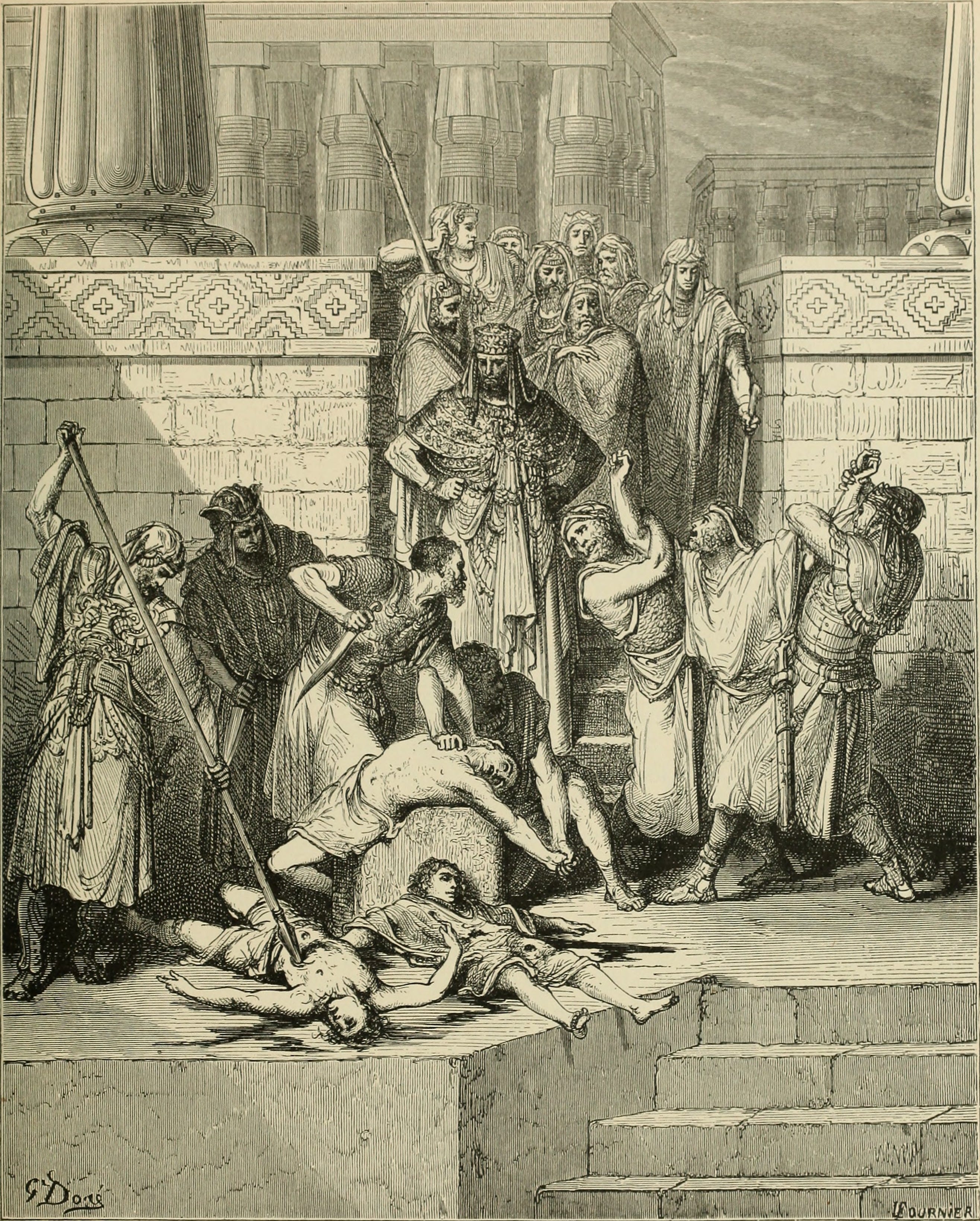
When Nebuchadnezzar finally succeeded in taking Jerusalem, Zedekiah and his family attempted to flee but were captured on the plains of Jericho. The last thing Zedekiah ever saw was the execution of his sons – his eyes were then put out, and the last king of Judah was taken as a blind captive to Babylon and imprisoned.
Solomon’s Temple Burned
The Hebrew Temple was burned, and the rest of the people were exiled, leaving behind only the poorest of the poor. All of the valuables that remained were brought back to Babylon.
The destruction of the Temple was the ultimate loss for the Israelites; Solomon’s Temple was the heart and center of Hebrew spiritual life.
On the seventh day of the fifth month, in the nineteenth year of Nebuchadnezzar king of Babylon, Nebuzaradan, commander of the imperial guard, an official of the king of Babylon, came to Jerusalem. He set fire to the temple of Yahweh, the royal palace and all the houses of Jerusalem. Every important building he burned down.
The whole Babylonian army under the commander of the imperial guard broke down the walls around Jerusalem. Nebuzaradan the commander of the guard carried into exile the people who remained in the city, along with the rest of the populace and those who had deserted to the king of Babylon. But the commander left behind some of the poorest people of the land to work the vineyards and fields.
- 2 Kings 25:8-12
Solomon’s Temple had also been the center of a spiritual conflict over fundamentally contradictory worldviews. Traditional folk beliefs held that the Heavenly Father and the Earthly Mother were husband and wife. King Solomon understood this, but the Yahwists preached that the Heavenly Father ruled alone.
Of the 373 years that Solomon’s Temple was in Jerusalem, an Asherah pole stood by the altar for roughly two-thirds of the time, worshipped by the traditional farming people, according to Hebrew scholar Raphael Patai. The Mother Goddess Asherah was El’s wife, but the Yahwists wanted a divorce, and they got it.
Monotheism leaves no room for the Goddess. The Yahwist reformers pushed her worship out of the Temple and condemned it. Yahweh then took all the powers of nature and reproduction for himself. The women in the community who were dedicated to the Goddess were neither consulted nor did they approve; monotheism was forced upon them.
Jeremiah Argues with the Women about Astarte
Jeremiah was freed by the Babylonians and told that he was free to live wherever he wanted. He could go to Babylon with royal support, but Jeremiah chose to stay behind in Judah. There were disputes and conflicts among the remaining Judeans, and the group decided to go to Egypt.
Jeremiah counseled strongly against leaving Judah but was taken against his will with the group of exiles. In Egypt, Jeremiah had a big public dispute with the exiles, particularly with the women whom he blamed for worshipping Astarte, the Queen of Heaven.
“This is what Yahweh Almighty, the God of Israel, says: ‘You saw the great disaster I brought on Jerusalem and on all the towns of Judah. Today they lie deserted and in ruins because of the evil they have done. They aroused my anger by burning incense to and worshiping other gods that neither they nor you nor your ancestors ever knew.’”
– Jeremiah 44:2-3
The women responded to Jeremiah with great anger and indignation. They argued that life was good when they made their offerings to the Queen of Heaven; they had plenty of food and suffered no evil. It was only after they stopped making offerings to Astarte that they began suffering from sword and famine.
The women clearly believed that Astarte offered them more protection than Yahweh.
This following passage from Jeremiah 44 is one of the most important references to the Israelite goddesses in the entire Bible, highlighting disputes that had been playing out for centuries and offering important details about how they baked cakes in the image of the Goddess and poured out drink offerings to her — practices also seen in Babylon.
Then all the men who knew that their wives were burning incense to other gods, along with all the women who were present – a large assembly – and all the people living in Lower and Upper Egypt, said to Jeremiah,
“We will not listen to the message you have spoken to us in the name of Yahweh! We will certainly do everything we said we would: We will burn incense to the Queen of Heaven and will pour out drink offerings to her just as we and our ancestors, our kings and our officials did in the towns of Judah and in the streets of Jerusalem. At that time we had plenty of food and were well off and suffered no harm. But ever since we stopped burning incense to the Queen of Heaven and pouring out drink offerings to her, we have had nothing and have been perishing by sword and famine.”
The women added, “When we burned incense to the Queen of Heaven and poured out drink offerings to her, did not our husbands know that we were making cakes impressed with her image and pouring out drink offerings to her?”
Then Jeremiah said to all the people, both men and women, who were answering him, “Did not Yahweh remember and call to mind the incense burned in the towns of Judah and the streets of Jerusalem by you and your ancestors, your kings and your officials and the people of the land? When Yahweh could no longer endure your wicked actions and the detestable things you did, your land became a curse and a desolate waste without inhabitants, as it is today. Because you have burned incense and have sinned against Yahweh and have not obeyed him or followed his law or his decrees or his stipulations, this disaster has come upon you, as you now see.”
Then Jeremiah said to all the people, including the women, “Hear the word of Yahweh, all you people of Judah in Egypt. This is what Yahweh Almighty, the God of Israel, says: You and your wives have done what you said you would do when you promised, ‘We will certainly carry out the vows we made to burn incense and pour out drink offerings to the Queen of Heaven.’ “Go ahead then, do what you promised! Keep your vows!”
But hear the word of Yahweh, all you Jews living in Egypt: ‘I swear by my great name,’ says Yahweh, ‘that no one from Judah living anywhere in Egypt will ever again invoke my name or swear, “As surely as the Sovereign Yahweh lives.” For I am watching over them for harm, not for good; the Jews in Egypt will perish by sword and famine until they are all destroyed. Those who escape the sword and return to the land of Judah from Egypt will be very few. Then the whole remnant of Judah who came to live in Egypt will know whose word will stand—mine or theirs.
“This will be the sign to you that I will punish you in this place,’ declares Yahweh, ‘so that you will know that my threats of harm against you will surely stand.’
- Jeremiah 44:15-29
The women angrily made clear that they had no intention of abandoning the great Goddess. Jeremiah was angry but conceded, saying, “Do what you want, but Yahweh will do you harm.”
The archaeological record shows that the Israelites in Egypt continued their polytheistic ways. Letters from a 5th century BCE Jewish temple on Elephantine Island in Egypt reference Anat-Yahu and are thought to be a pairing of Yahweh and Anat.
Prophet Ezekiel
The prophet Ezekiel lived in Judah during the Babylonian defeat of Jerusalem, and he departed with the first wave of exiles, a decade before the final destruction of Jerusalem and the Temple. Five years later, Ezekiel had a divine encounter by the rivers of Babylon and began his prophetic work.
Ezekiel’s vision is famous and awe-inspiring; some say it was drug-induced.
I looked, and I saw a windstorm coming out of the north – an immense cloud with flashing lightning and surrounded by brilliant light. The center of the fire looked like glowing metal, and in the fire was what looked like four living creatures. In appearance their form was human, but each of them had four faces and four wings. Their legs were straight; their feet were like those of a calf and gleamed like burnished bronze.
– Ezekiel 1:4-7
Yahweh called Ezekiel to prophesy against the exiled Israelites for their stubborn and obstinate behavior. Ezekiel accused Israel of breaking the covenant, saying Jerusalem would be attacked again and the Temple destroyed.
And they will know that I am Yahweh, when their people lie slain among their idols around their altars, on every high hill and on all the mountaintops, under every spreading tree and every leafy oak—places where they offered fragrant incense to all their idols.
– Ezekiel 6:13
Ezekiel had a vision of pagan worship in Solomon’s Temple. He saw women weeping for Tammuz, the dying-and-rising god, Astarte’s husband. Tammuz was the equivalent of the Sumerian Dumuzi, and the Greeks knew him as Adonis. One of the months in the Hebrew calendar is the month of Tammuz.
A day of mourning and weeping was an important part of the dying-and-rising god rituals celebrated throughout the Ancient Near East.
Then he brought me to the entrance of the north gate of the house of Yahweh, and I saw women sitting there, mourning the god Tammuz.
- Ezekiel 8:14
In Ezekiel’s vision, Yahweh orders that the idolaters be killed with impunity in an act of mass murder.
Follow him through the city and kill, without showing pity or compassion. Slaughter the old men, the young men and women, the mothers and children”
– Ezekiel 9:5-6
Ezekiel condemned the women prophets, who can be understood to be the qedesha, with their magic charms and veils of anonymity. Ezekiel says the qedesha had the powers of life itself, killing those who should not have died and sparing those who should not have lived, in defiance of Yahweh’s judgment.
“Now, son of man, set your face against the daughters of your people who prophesy out of their own imagination. Prophesy against them and say, ‘This is what the Sovereign Yahweh says: Woe to the women who sew magic charms on all their wrists and make veils of various lengths for their heads in order to ensnare people. Will you ensnare the lives of my people but preserve your own? You have profaned me among my people for a few handfuls of barley and scraps of bread. By lying to my people, who listen to lies, you have killed those who should not have died and have spared those who should not live.
‘Therefore this is what the Sovereign Yahweh says: I am against your magic charms with which you ensnare people like birds and I will tear them from your arms; I will set free the people that you ensnare like birds. I will tear off your veils and save my people from your hands, and they will no longer fall prey to your power. Then you will know that I am Yahweh.
‘Because you disheartened the righteous with your lies, when I had brought them no grief, and because you encouraged the wicked not to turn from their evil ways and so save their lives, therefore you will no longer see false visions or practice divination. I will save my people from your hands. And then you will know that I am Yahweh.”
- Ezekiel 13:17-21
These prophets were continuing in the spirit of Gilgamesh, who rejected the goddess Ishtar’s seductions in his famous epic. Gilgamesh recounts her mistreatment of past lovers and also reaches for bird imagery, describing how she broke the wing of a former lover whom she turned into a bird, leaving him crying in the woods.
Through Ezekiel, Yahweh chastises Jerusalem for her unfaithfulness, but the words can be read as God speaking angrily to his wife, the Goddess, exerting his dominance and authority.
Yahweh talks like an abusive husband.
In this long passage, Ezekiel uses sexual language and imagery similar to Hosea. The prophet heaps blame and scorn on the Judeans for practicing their traditional religions, and then claims that Yahweh is responsible for getting foreign kingdoms to punish them.
On the day you were born your cord was not cut, nor were you washed with water to make you clean, nor were you rubbed with salt or wrapped in cloths. No one looked on you with pity or had compassion enough to do any of these things for you. Rather, you were thrown out into the open field, for on the day you were born you were despised.
“Then I passed by and saw you kicking about in your blood, and as you lay there in your blood I said to you, “Live!” I made you grow like a plant of the field. You grew and developed and entered puberty. Your breasts had formed, and your hair had grown, yet you were stark naked.
“Later I passed by, and when I looked at you and saw that you were old enough for love, I spread the corner of my garment over you and covered your naked body. I gave you my solemn oath and entered into a covenant with you,” declares the Sovereign Yahweh, “and you became mine.
“I bathed you with water and washed the blood from you and put ointments on you. I clothed you with an embroidered dress and put sandals of fine leather on you. I dressed you in fine linen and covered you with costly garments. I adorned you with jewelry: I put bracelets on your arms and a necklace around your neck, and I put a ring on your nose, earrings on your ears, and a beautiful crown on your head.
“So, you were adorned with gold and silver; your clothes were of fine linen and costly fabric and embroidered cloth. Your food was honey, olive oil, and the finest flour. You became very beautiful and rose to be a queen. And your fame spread among the nations on account of your beauty, because the splendor I had given you made your beauty perfect,” declares the Sovereign Yahweh.
“But you trusted in your beauty and used your fame to become a prostitute. You lavished your favors on anyone who passed by and your beauty became his. You took some of your garments to make gaudy high places, where you carried on your prostitution. You went to him, and he possessed your beauty. You also took the fine jewelry I gave you, the jewelry made of my gold and silver, and you made for yourself male idols and engaged in prostitution with them.
And you took your embroidered clothes to put on them, and you offered my oil and incense before them. Also the food I provided for you - the flour, olive oil, and honey I gave you to eat - you offered as fragrant incense before them. That is what happened,” declares the Sovereign Yahweh.
“And you took your sons and daughters whom you bore to me and sacrificed them as food to the idols. Was your prostitution not enough? You slaughtered my children and sacrificed them to the idols. In all your detestable practices and your prostitution you did not remember the days of your youth, when you were naked and bare, kicking about in your blood.”
“Woe! Woe to you,” declares the Sovereign Yahweh. “In addition to all your other wickedness, you built a mound for yourself and made a lofty shrine in every public square. At every street corner you built your lofty shrines and degraded your beauty, spreading your legs with increasing promiscuity to anyone who passed by. You engaged in prostitution with the Egyptians, your neighbors with large genitals, and aroused my anger with your increasing promiscuity.”
“So, I stretched out my hand against you and reduced your territory; I gave you over to the greed of your enemies, the daughters of the Philistines, who were shocked by your lewd conduct. You engaged in prostitution with the Assyrians too, because you were insatiable; and even after that, you still were not satisfied. Then you increased your promiscuity to include Babylonia, a land of merchants, but even with this you were not satisfied.”
“I am filled with fury against you,” declares the Sovereign Yahweh, “when you do all these things, acting like a brazen prostitute! When you built your mounds at every street corner and made your lofty shrines in every public square, you were unlike a prostitute, because you scorned payment.”
“You adulterous wife! You prefer strangers to your own husband! All prostitutes receive gifts, but you give gifts to all your lovers, bribing them to come to you from everywhere for your illicit favors. So in your prostitution you are the opposite of others; no one runs after you for your favors. You are the very opposite, for you give payment and none is given to you.”
- Ezekiel 16:4-34
Greek and Roman writers described the custom of Near Eastern women giving gifts to their lovers.
“Therefore, you prostitute, hear the word of Yahweh! This is what the Sovereign Yahweh says: Because you poured out your lust and exposed your naked body in your promiscuity with your lovers, and because of all your detestable idols, and because you gave them your children’s blood, therefore I am going to gather all your lovers, with whom you found pleasure, those you loved as well as those you hated. I will gather them against you from all around and will strip you in front of them, and they will see you stark naked. I will sentence you to the punishment of women who commit adultery and who shed blood; I will bring on you the blood vengeance of my wrath and jealous anger.
“Then I will deliver you into the hands of your lovers, and they will tear down your mounds and destroy your lofty shrines. They will strip you of your clothes and take your fine jewelry and leave you stark naked. They will bring a mob against you, who will stone you and hack you to pieces with their swords. They will burn down your houses and inflict punishment on you in the sight of many women. I will put a stop to your prostitution, and you will no longer pay your lovers. Then my wrath against you will subside and my jealous anger will turn away from you; I will be calm and no longer angry.”
- Ezekiel 16:35-42
In a separate story, Ezekiel describes the behavior of two promiscuous sisters, Oholah and Oholibah, and Yahweh’s judgment against them. To Ezekiel, the entire city of Jerusalem was a prostitute, and his profound misogyny is on full display.
When she carried on her prostitution openly and exposed her naked body, I turned away from her in disgust, just as I had turned away from her sister. Yet she became more and more promiscuous as she recalled the days of her youth, when she was a prostitute in Egypt. There she lusted after her lovers, whose genitals were like those of donkeys and whose emission was like that of horses. So you longed for the lewdness of your youth, when in Egypt your bosom was caressed and your young breasts fondled.
“Therefore, Oholibah, this is what the Sovereign Yahweh says: I will stir up your lovers against you, those you turned away from in disgust, and I will bring them against you from every side— the Babylonians and all the Chaldeans, the men of Pekod and Shoa and Koa, and all the Assyrians with them, handsome young men, all of them governors and commanders, chariot officers and men of high rank, all mounted on horses. They will come against you with weapons, chariots and wagons and with a throng of people; they will take up positions against you on every side with large and small shields and with helmets. I will turn you over to them for punishment, and they will punish you according to their standards. I will direct my jealous anger against you, and they will deal with you in fury. They will cut off your noses and your ears, and those of you who are left will fall by the sword. They will take away your sons and daughters, and those of you who are left will be consumed by fire. They will also strip you of your clothes and take your fine jewelry. So I will put a stop to the lewdness and prostitution you began in Egypt. You will not look on these things with longing or remember Egypt anymore.
- Ezekiel 23:18-27
The First Temple has been destroyed, and the people have been scattered. The first crucial era of attempted pagan reforms is over, and the next chapter begins.
Next episode, we will be in Babylon, where we will meet the legendary Persian King Cyrus, who liberated the Hebrews from their exile and allowed them to return to Jerusalem to build the Second Temple, now known as the Jews. Under the influence of the Persian Zoroastrians, pure monotheism emerged and was crystallized in 2nd Isaiah, the first time it is said that “there are no other gods.”
We will also meet Ezra the Scribe, who brought the Book of the Law back to Jerusalem early in the Second Temple period. Ezra condemned mixed marriages between Israelites and Canaanites, forcing the Jewish men to divorce and banish their foreign wives and children, completing the divorce of the Mother Goddess.