

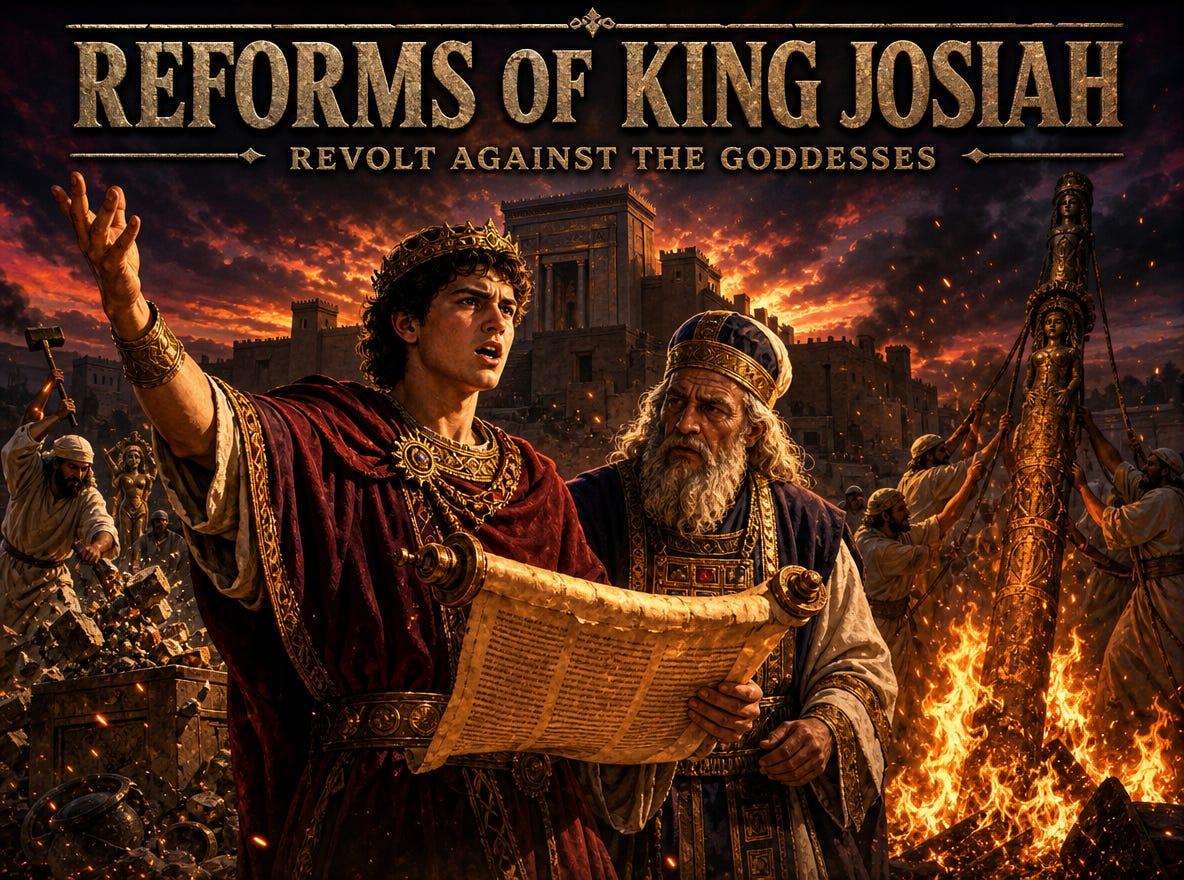
In this episode of Goddess Bible Study, we continue with the three most important kings in the late First Temple period, and the final, most sweeping revolt against the goddesses.
Last episode, we covered King Hezekiah, a nearly messianic figure who saved the Temple and the entire Yahweh movement from near-extermination at the hands of the Assyrians. Hezekiah was one of the great Yahwist reformers, working to remove the goddesses and all the pagan traditions and centralize worship in the Jerusalem Temple.
But Hezekiah's reforms did not outlast his reign. They were reversed as soon as he died.
698-642 BCE - King Manasseh
Hezekiah died a few years after the Assyrian siege and was succeeded by his son. King Manasseh had Judah's longest reign, holding the throne for fifty-five years — but the Book of Kings only mentions him briefly.
Manasseh reversed Hezekiah's reforms and reinstated pagan worship, placing a new Asherah pole in the Temple. He is condemned in the Bible as one of the worst kings of Judah, but the historical record shows that his reign was a time of stability and trade.
The Yahwist reforms had never been popular with the people, who wanted their community altars back and desired the freedom to worship as they pleased. As soon as Hezekiah died, the Asherah poles and high places were restored. The Canaanites also continued their idolatrous superstitions and child sacrifice, and Manasseh is said to have sacrificed his own son in the fire.
The people probably thought highly of Manasseh, as he brought peace and prosperity to Judah. Manasseh was a loyal vassal of Assyria and is listed in the records of multiple kings as an ally. Judah had favored trade relations with Nineveh, and there were profitable exports of olive oil and wine to the empire.
The reinstatement of folk religion was likely a smart political move that earned the loyalty of the people, but the Bible does not see it that way. In Rabbinic literature, Manasseh is said to have murdered the prophet Isaiah, and his idolatry is blamed for Jerusalem’s later destruction by the Babylonians.
The great rhetorical feat of the Bible and later tradition was to reframe invasions by outside military forces as being caused by Yahweh. It is hard to imagine anyone alive at the time taking seriously the claim that the mighty Assyrians, or the Babylonians, were following Yahweh and not their own, much more powerful gods, Ashur and Marduk
Manasseh was twelve years old when he became king, and he reigned in Jerusalem fifty-five years. His mother’s name was Hephzibah. And he did evil in the sight of Yahweh by following the abominations of the nations that Yahweh had driven out before the Israelites. For he rebuilt the high places that his father Hezekiah had destroyed, and he raised up altars for Baal. He made an Asherah pole, as King Ahab of Israel had done, and he worshiped and served all the host of heaven.
Manasseh also built altars in the house of Yahweh, of which Yahweh had said, “In Jerusalem I will put My Name.” In both courtyards of the house of Yahweh, he built altars to all the host of heaven. He sacrificed his own son in the fire, practiced sorcery and divination, and consulted mediums and spiritists. He did great evil in the sight of Yahweh, provoking Him to anger.
Manasseh even took the carved Asherah pole he had made and set it up in the temple, of which Yahweh had said to David and his son Solomon, “In this temple and in Jerusalem, which I have chosen out of all the tribes of Israel, I will establish My Name forever. I will never again cause the feet of the Israelites to wander from the land that I gave to their fathers, if only they are careful to do all I have commanded them—the whole Law that My servant Moses commanded them.”
But the people did not listen and Manasseh led them astray, so that they did greater evil than the nations that Yahweh had destroyed before the Israelites.
And Yahweh spoke through His servants the prophets, saying, “Since Manasseh king of Judah has committed all these abominations, acting more wickedly than the Amorites who preceded him, and with his idols has caused Judah to sin, this is what Yahweh, the God of Israel, says: ‘Behold, I am bringing such calamity upon Jerusalem and Judah that the news will reverberate in the ears of all who hear it.
I will stretch out over Jerusalem the measuring line used against Samaria and the plumb line used against the house of Ahab, and I will wipe out Jerusalem as one wipes out a bowl—wiping it and turning it upside down. So I will forsake the remnant of My inheritance and deliver them into the hands of their enemies. And they will become plunder and spoil to all their enemies, because they have done evil in My sight and have provoked Me to anger from the day their fathers came out of Egypt until this day.’”
Moreover, Manasseh shed so much innocent blood that he filled Jerusalem from end to end, in addition to the sin that he had caused Judah to commit, doing evil in the sight of Yahweh.
- 2 Kings 21:1-16
The Book of Chronicles adds another chapter to Manasseh's story, in which he is roughly captured by the Assyrians and taken prisoner to Babylon. In his distress, Manasseh prays to Yahweh, finds deliverance, and is restored to his throne in Jerusalem. Having found Yahweh, he proceeds with his own reforms, removing altars and foreign gods (2 Chronicles 33:10–17).
Neither the Book of Kings nor any Assyrian records mention these incidents, and the Book of Chronicles is clearly revisionist history throughout. It is always interesting to note which historical details get revised in Chronicles, like the smoothing over of rough edges in both David's and Solomon's biographies, because it demonstrates the points of sensitivity and embarrassment in the narrative. The success of Manasseh's reign was clearly a sore spot for the biblical writers — a good pagan king was a contradiction they couldn't leave standing, so Chronicles quietly rewrote him into a penitent one.
640–609 BCE King Josiah the Reformer
King Josiah was a grandson of Manasseh and took the throne at the tender age of eight. His father, Amon, had reigned only two years before being assassinated by his own officials. The "people of the land" then killed the assassins and placed young Josiah on the throne in his place (2 Kings 21:23–24).
Josiah was the second great Yahwist reformer, and he is hailed in the Bible for his fealty to Yahweh. Some say he is the greatest king in the Bible because he hit the trifecta, following Yahweh with all his heart, soul, and strength.
Neither before nor after Josiah was there any king like him, who turned to Yahweh with all his heart and with all his soul and with all his strength, according to all the Law of Moses.
-2 Kings 23:25
The reforms of Hezekiah and Josiah are the high-water marks for the Yahwists during the First Temple period. King Josiah had a large influence on the writing of the Bible, as significant portions were likely written during his rule.
When Josiah was eighteen, he ordered renovations to the Temple in Jerusalem. During the work, Hilkiah the high priest discovered the lost book of Moses, the Book of the Law, which we now see in the biblical Book of Deuteronomy. Modern scholars agree that a 600-year-old scroll couldn't have been suddenly discovered intact, and most believe it was actually written during Josiah's reign.
The lost book of Moses was brought to the king and read aloud to him. Josiah was deeply moved by the words and immediately commenced reforms to bring his nation back into the grace of Yahweh. Josiah banned all other forms of worship and began a campaign to once again wipe out the pagan traditions and centralize worship at the Temple in Jerusalem.
Then Hilkiah the high priest said to Shaphan the scribe, “I have found the Book of the Law in the house of Yahweh!” And he gave it to Shaphan, who read it.
Shaphan the scribe told the king, “Hilkiah the priest has given me a book.” And Shaphan read it in the presence of the king. When the king heard the words of the Book of the Law, he tore his clothes
-2 Kings 22:8; 10-11
Hilkiah the priest found the book of the law of Yahweh written by the hand of Moses.
-2 Chronicles 34:14
After finding the scroll, the priests then did something interesting: they consulted a prophetess named Huldah to confirm that the text was legitimate. She confirmed that the wrath of Yahweh was upon them. Huldah is one of only seven prophetesses in the entire Jewish tradition. Not much is known about her, but the Huldah Gate on the Temple Mount still bears her name today.
“Go and inquire of Yahweh for me, for the people, and for all Judah concerning the words in this book that has been found. For great is the wrath of Yahweh that burns against us because our fathers have not obeyed the words of this book by doing all that is written about us.”
So Hilkiah the priest, Ahikam, Achbor, Shaphan, and Asaiah went and spoke to Huldah the prophetess, the wife of Shallum son of Tikvah, the son of Harhas, the keeper of the wardrobe. She lived in Jerusalem, in the Second District.
And Huldah said to them, “This is what Yahweh, the God of Israel, says: ‘Tell the man who sent you that this is what Yahweh says: I am about to bring calamity on this place and on its people, according to all the words of the book that the king of Judah has read, because they have forsaken Me and burned incense to other gods, that they might provoke Me to anger with all the works of their hands. My wrath will be kindled against this place and will not be quenched.’
- 2 Kings 22:13-17
This generation of literate priests, including the prophet Jeremiah, is known colloquially as the "Deuteronomists" by contemporary scholars. They wrote the laws of Deuteronomy and preserved older texts from both Judah and Israel, later carrying them to Babylon during the Exile. They are thought to have written the historical books of Joshua, Judges, Samuel, and Kings, which share a common voice throughout. I personally believe this same generation also produced the Garden of Eden story — the divorce papers for the Goddess — as part of these reforms.
Then the king summoned all the elders of Judah and Jerusalem. And he went up to the house of Yahweh with all the people of Judah and Jerusalem, as well as the priests and the prophets—all the people small and great—and in their hearing he read all the words of the Book of the Covenant that had been found in the house of Yahweh.
So the king stood by the pillar and made a covenant before Yahweh to follow Yahweh and to keep His commandments, decrees, and statutes with all his heart and all his soul, and to carry out the words of the covenant that were written in this book. And all the people entered into the covenant.
Then the king commanded Hilkiah the high priest, the priests second in rank, and the doorkeepers to remove from the temple of Yahweh all the articles made for Baal, Asherah, and all the host of heaven. And he burned them outside Jerusalem in the fields of Kidron and carried their ashes to Bethel.
Josiah also did away with the idolatrous priests ordained by the kings of Judah to burn incense on the high places of the cities of Judah and in the places all around Jerusalem—those who had burned incense to Baal, to the sun and moon, to the constellations, and to all the host of heaven.
He brought the Asherah pole from the house of Yahweh to the Kidron Valley outside Jerusalem, and there he burned it, ground it to powder, and threw its dust on the graves of the common people. He also tore down the quarters of the qadesh [male shrine prostitutes] that were in the house of Yahweh, where the women had woven tapestries for Asherah.
Then Josiah brought all the priests from the cities of Judah and desecrated the high places, from Geba to Beersheba, where the priests had burned incense. He tore down the high places of the gates at the entrance of the gate of Joshua the governor of the city, which was to the left of the city gate. Although the priests of the high places did not come up to the altar of Yahweh in Jerusalem, they ate unleavened bread with their fellow priests.
He also desecrated Topheth in the Valley of Ben-hinnoma so that no one could sacrifice his son or daughter in the fire to Molech. And he removed from the entrance to the house of Yahweh the horses that the kings of Judah had dedicated to the sun. They were in the court near the chamber of an official named Nathan-melech. And Josiah burned up the chariots of the sun.
He pulled down the altars that the kings of Judah had set up on the roof near the upper chamber of Ahaz, and the altars that Manasseh had set up in the two courtyards of the house of Yahweh. The king pulverized them there and threw their dust into the Kidron Valley.
The king also desecrated the high places east of Jerusalem, to the south of the Mount of Corruption, which King Solomon of Israel had built for Ashtoreth the abomination of the Sidonians, for Chemosh the abomination of the Moabites, and for Milcom the abomination of the Ammonites. He smashed the sacred pillars to pieces, cut down the Asherah poles, and covered the sites with human bones.
He even pulled down the altar at Bethel, the high place set up by Jeroboam son of Nebat, who had caused Israel to sin. Then he burned the high place, ground it to powder, and burned the Asherah pole.
- 2 Kings 23:1-15
Just as Josiah had done at Bethel, so also in the cities of Samaria he removed all the shrines of the high places set up by the kings of Israel who had provoked Yahweh to anger. On the altars he slaughtered all the priests of the high places, and he burned human bones on them. Then he returned to Jerusalem.
The king commanded all the people, “Keep the Passover of Yahweh your God, as it is written in this Book of the Covenant.”
No such Passover had been observed from the days of the judges who had governed Israel through all the days of the kings of Israel and Judah. But in the eighteenth year of Josiah’s reign, this Passover was observed to Yahweh in Jerusalem.
Furthermore, Josiah removed the mediums and spiritists, the household gods and idols, and all the abominations that were seen in the land of Judah and in Jerusalem. He did this to carry out the words of the law written in the book that Hilkiah the priest had found in the house of Yahweh.
Neither before nor after Josiah was there any king like him, who turned to Yahweh with all his heart and with all his soul and with all his strength, according to all the Law of Moses.
Nevertheless, Yahweh did not turn away from the fury of His burning anger, which was kindled against Judah because of all that Manasseh had done to provoke Him to anger. For Yahweh had said, “I will remove Judah from My sight, just as I removed Israel. I will reject this city Jerusalem, which I chose, and the temple of which I said, ‘My Name shall be there.’”
As for the rest of the acts of Josiah and all his accomplishments, are they not written in the Book of the Chronicles of the Kings of Judah?
During Josiah’s reign, Pharaoh Neco, king of Egypt, marched up to help the king of Assyria at the Euphrates River. King Josiah went out to confront him, but Neco faced him and killed him at Megiddo.
- 2 Kings 23:19-29
Josiah's reforms were far-reaching. The Asherah pole installed at Solomon's Temple was cut down, burned, ground into powder, and the dust scattered over the graves of her own worshippers. The burning of incense on the high places is condemned, as is the worship of Baal and other gods.
Josiah removed the male qadesh, but pointedly does not mention the female qedesha, who were presumably left alone. The priestesses were always a much tougher target.
The text mentions that the women in the Temple did sacred weaving for Asherah. Using cannabis hemp, perhaps? Fabrics and tapestries were commonly used in temples of the period to create separate rooms, tents, and pavilions to house guests, vendors, or perhaps the qedesha themselves.
Josiah also desecrated the Topheth, the burial ground for infant sacrifice, so that it could not be used again. Perhaps this is why no Topheth has ever been found in Israel today.
Josiah destroyed the high places Solomon built for Astarte and other foreign gods. Here the writers again refer to Astarte as Ashtoreth, "the shameful Astarte," the vile goddess of Sidon, confirming that King Solomon had once worshipped her.
Josiah even pulled down the altar at Bethel, a center for the worship of El, and the great rival to the Jerusalem Temple. The altar at Bethel was first established by Jacob and called El Elohe Israel ("El is the God of Israel"). It was also the site where Jeroboam had built one of the golden bulls to El after Israel split from Judah.
Josiah defiled the ancient altars by digging up the nearby graves and burning the human bones on them. The king condemned the shamans and spiritists and eliminated household-god worship. Archaeologists have found shrines from this period that were deliberately overturned and dismantled — evidence that appears to confirm the reforms of Josiah and Hezekiah, as we discussed in the last episode.
The household gods mentioned may be connected to the small pillar-base figurines archaeologists have found all over Israel. These figurines were popular in the 8th–7th centuries BCE, during the reigns of Hezekiah and Josiah, and continued to be made right up until Jerusalem was overthrown and the Hebrews exiled. Though obviously feminine, scholars are not entirely sure what these objects were for, but they were common in households throughout Judah.

609 BCE — Death of Josiah and the End of the House of David
Josiah witnessed the fall of the Assyrian Empire and the sack of Nineveh in 612 BCE, which we discussed here. All of a sudden, the landscape of political alliances shifted — but this turn of events did not work out well for Josiah.
In 609 BCE, Pharaoh Necho II of Egypt marched his army up the Mediterranean coast to assist the Assyrians in their fight with the Babylonians. The Egyptians attempted to cross through the Jezreel Valley and appealed to Josiah for permission to pass. Necho was not looking to fight Josiah, but the king rejected the Egyptian appeal anyway, as he was allied with the Babylonians for reasons that remain unclear.
Josiah was killed at Megiddo, the only king of Judah ever killed in battle. This episode is considered a genuine historical event, even though no extrabiblical evidence naming Josiah has ever been found.
The Bible actually preserves two versions of his death, and the differences are telling. The account in 2 Kings treats it almost as an aside — a brief mention that Necho killed Josiah at Megiddo. The account in Chronicles, however, turns it into a full dramatic scene, filling in emotional and theological detail that Kings leaves bare.
After all this, when Josiah had set the temple in order, Neco king of Egypt marched up to fight at Carchemish by the Euphrates, and Josiah went out to confront him. But Neco sent messengers to him, saying, “What is the issue between you and me, O king of Judah? I have not come against you today, but I am fighting another dynasty, and God has told me to hurry. So stop opposing God, who is with me, or He will destroy you!”
Josiah, however, did not turn away from him; instead, in order to engage him in battle, he disguised himself. He did not listen to Neco’s words from the mouth of God, but went to fight him on the Plain of Megiddo. There the archers shot King Josiah, who said to his servants, “Take me away, for I am badly wounded!”
So his servants took him out of his chariot, put him in his second chariot, and brought him to Jerusalem, where he died. And Josiah was buried in the tomb of his fathers, and all Judah and Jerusalem mourned for him.
- 2 Chronicles 35:20-24
Apparently, King Josiah's dedication to Yahweh provided him no protection in battle and no assurance of victory. God, in this telling, was on the side of Egypt. Josiah's death brought an end to fealty to Yahweh in Judah. Egypt installed new vassal kings, all of them pagan, and a few years later Jerusalem was destroyed by the Babylonians.
Josiah’s death at Megiddo marked the end of Judean independence and, for all practical purposes, the end of the House of David. The Yahwist reforms — even at their most sweeping and sincere — were not enough to spare Yahweh’s people from destruction and exile.
Next episode, we discuss the prophet Jeremiah, the destruction of Jerusalem, and the exile to Babylon.