

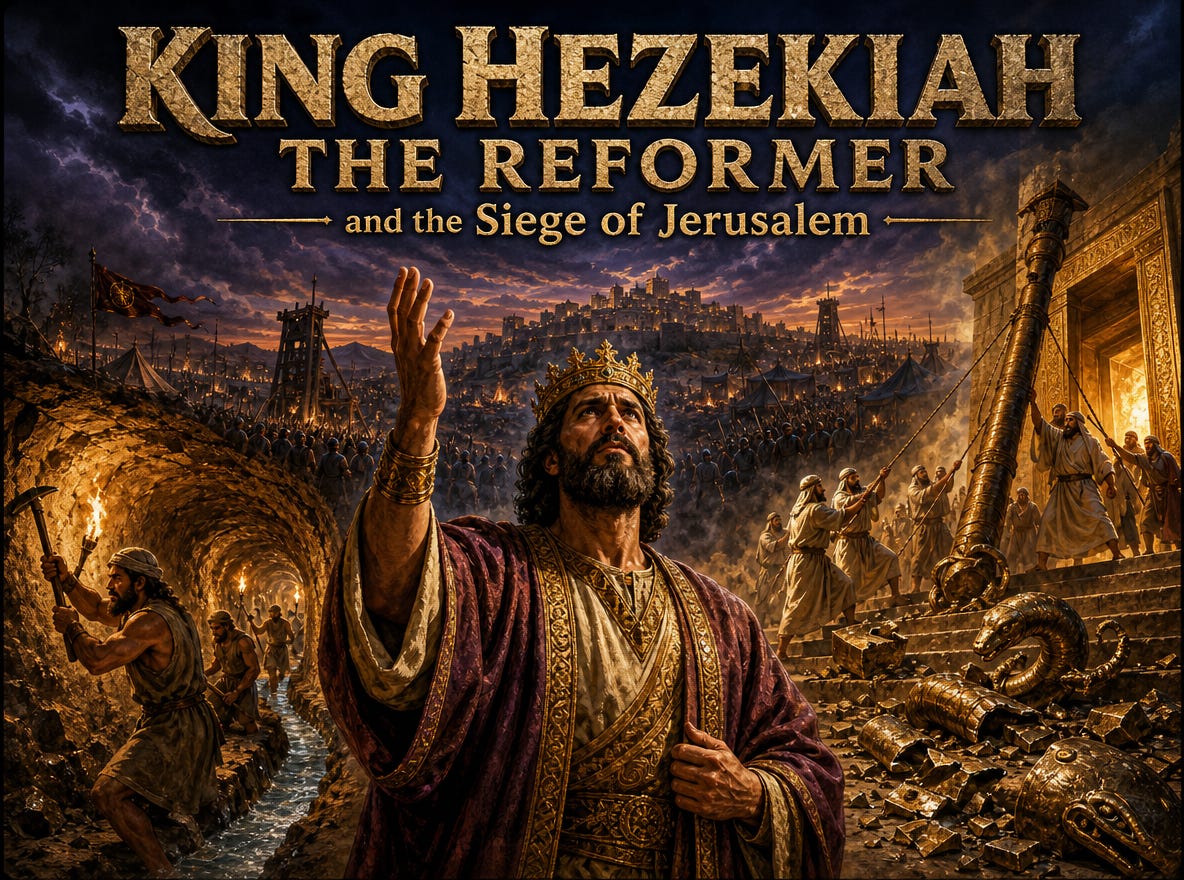
In this episode of Goddess Bible Study we dig into one of the most turbulent periods in the long fight against the Mother Goddess.
King Hezekiah
King Hezekiah was one of the most important Hebrew kings and one of the great Yahwist reformers who worked to eliminate the goddesses and pagan idols. He was considered a near-messianic figure, remembered for his dedication to Yahweh and his success in holding the Assyrians back from destroying Jerusalem. Hezekiah ruled Judah from 715 to 686 BCE, and he is exceptionally well attested by archaeologists, having left permanent marks on the city of Jerusalem that can still be seen today.
As a young man, Hezekiah witnessed the destruction of Israel at the hands of the Assyrians, and he spent much of his reign contending with that same aggressive empire. Refugees from the fallen northern kingdom streamed into Judah during this period, including followers of the northern prophets.
Hezekiah was preceded by his father, the pagan King Ahaz, who had built an altar to Ashur inside the Hebrew Temple itself. Ahaz was condemned by the prophet Isaiah and by the biblical writers generally as a committed pagan — he worshipped Baal, sacrificed his own children, and made offerings on the high places. His son Hezekiah wanted nothing to do with any of it. He didn’t merely decline to follow in his father’s footsteps; he refused Ahaz even a proper burial.
Yahwist Reformer
Hezekiah was one of only two biblical kings recorded as being fully committed to Yahweh. He carried out dramatic religious reforms and set out to exterminate pagan religion in Judah entirely, with the prophet Isaiah serving as his mentor and adviser throughout. Hezekiah smashed the sacred stones, cut down the Asherah poles, and destroyed the high places used for community worship.
In the first month of the first year of his reign, he opened the doors of the temple of Yahweh and repaired them.
-2 Chronicles 29:3
When all this had ended, the Israelites who were there went out to the towns of Judah, smashed the sacred stones, and cut down the Asherah poles. They destroyed the high places and the altars throughout Judah and Benjamin and in Ephraim and Manasseh. After they had destroyed all of them, the Israelites returned to their own towns and to their own property. He ordered the people living in Jerusalem to give the portion due the priests and Levites so they could devote themselves to the Law of Yahweh.
-2 Chronicles 31:1, 4
Hezekiah reopened and repaired the Temple and reinstated the Passover Festival. He closed the public altars, smashed the idols, and cut down the Asherah poles across the kingdom. These reforms went far beyond the symbolic — Hezekiah sought to centralize worship entirely at the Jerusalem Temple, ordering that all offerings be consolidated into the hands of the temple priests.
This centralization of worship was a critical step in the formation of the Judeo-Christian traditions. It marks the first real attempt by temple priests to consolidate all religious worship under their own authority.
Paganism had always been a do-it-yourself religious framework, rooted in family and community, where anyone could build an altar and make an offering. The introduction of religious authorities who mediated all worship — who stripped ordinary people of the independence to create their own sacred spaces — would become a defining feature of the Judeo-Christian and Islamic traditions that followed.
Smashing the Bronze Serpent
Among Hezekiah’s reforms, one act stands out as especially striking: he “broke into pieces the bronze snake Moses had made.” This was the bronze serpent Moses had fashioned in Numbers 21:6–9 to heal the Israelites from a plague of snakes sent by Yahweh. By Hezekiah’s time, the relic had been kept and venerated for roughly 500 years.
He removed the high places, smashed the sacred stones, and cut down the Asherah poles. He broke into pieces the bronze snake Moses had made, for up to that time the Israelites had been burning incense to it. (It was called Nehushtan.) Hezekiah trusted in Yahweh, the God of Israel. There was no one like him among all the kings of Judah, either before him or after him.
-2 Kings 18:4–5
In Hebrew, “Nehushtan” means something like “a mere piece of brass” — a derogatory, dismissive label, though English Bibles typically present it as simply the object’s proper name. This is one of the great flashpoints in the long divorce between Yahwism and the older religious world it grew out of, and a clear example of a goddess-adjacent symbol being deliberately purged by monotheistic reformers working to push its worship underground.
It is safe to conjecture that the Garden of Eden story with the serpent as villian was written in the same general time period as part of these reforms.
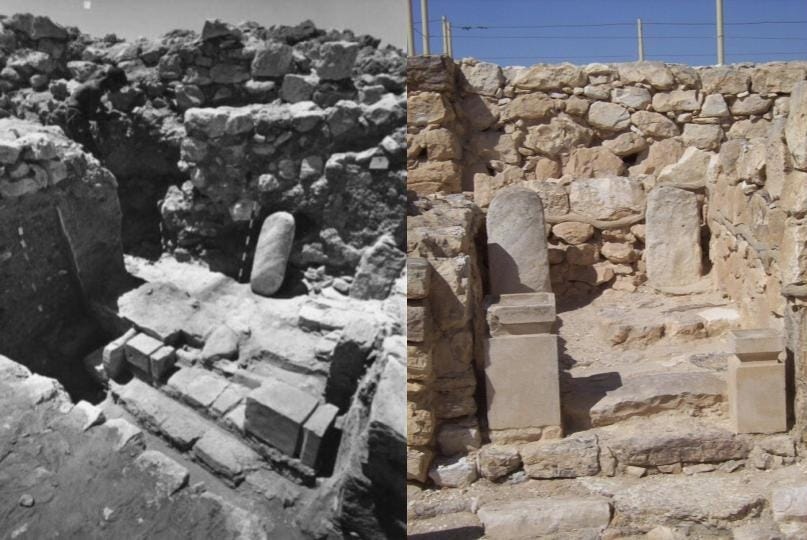
Israeli archaeologists have found evidence of Hezekiah’s reforms. We have discussed Tel Arad previously, it is the only temple site ever recovered in Judah from the First Temple period. The holy of holies in the Tel Arad temple had been carefully dismantled and buried by hand with sand. The pair of altars and pair standing stones were laid over on their sides and not broken.
These pairs correspond to Yahweh and Asherah, and simultaneously demonstrates Israelite paganism, and also the reforms of Hezekiah. Residue on the incense altars were analyzed in 2020 with the larger altar to Yahweh having frankincense, and the smaller altar to Asherah containing cannabis.
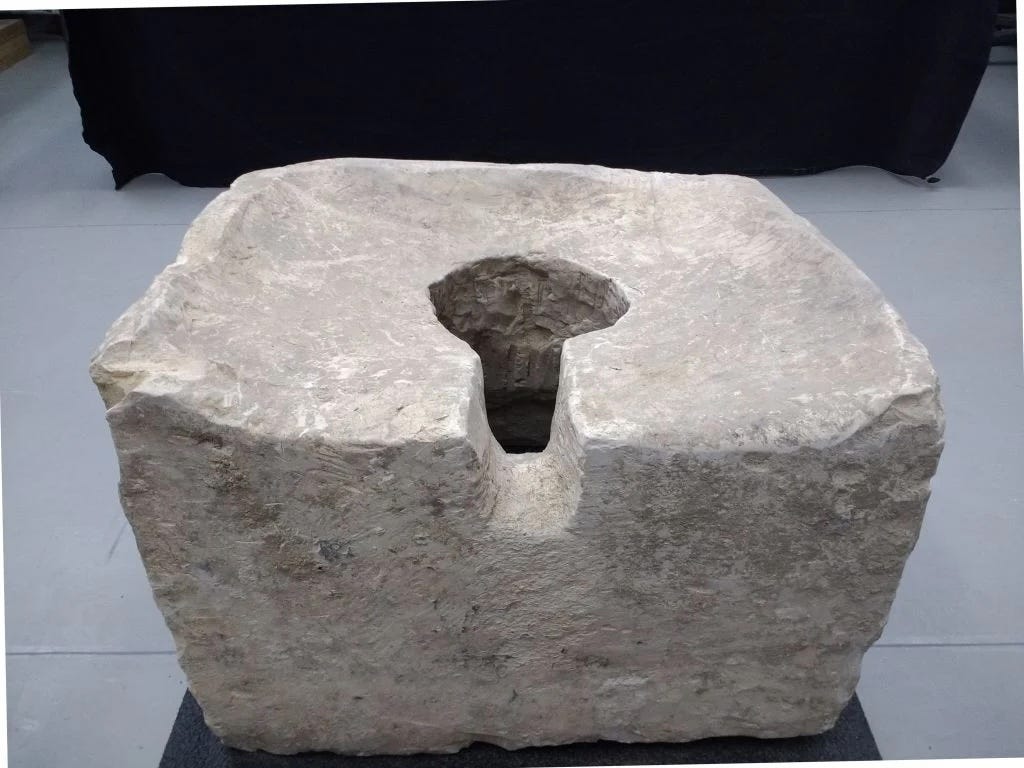
Archaeologists excavated Lachish, which we will discuss more below, and they found something unusual, inside of a shrine, they found a commode alongside smashed altars. This also appears to be evidence of Hezekiah’s reforms, and tracks with the events during King Jehu when they desecrated the temple of Baal and made it into a latrine in 2 Kings 27.
Hezekiah’s Tunnel
Hezekiah rebelled against Assyria and stopped paying tribute, allying himself with Egypt instead. Knowing full well that Jerusalem would face an Assyrian siege as a result, he undertook major building campaigns to prepare the city, fortifying the Broad Wall of Jerusalem and constructing towers along it.
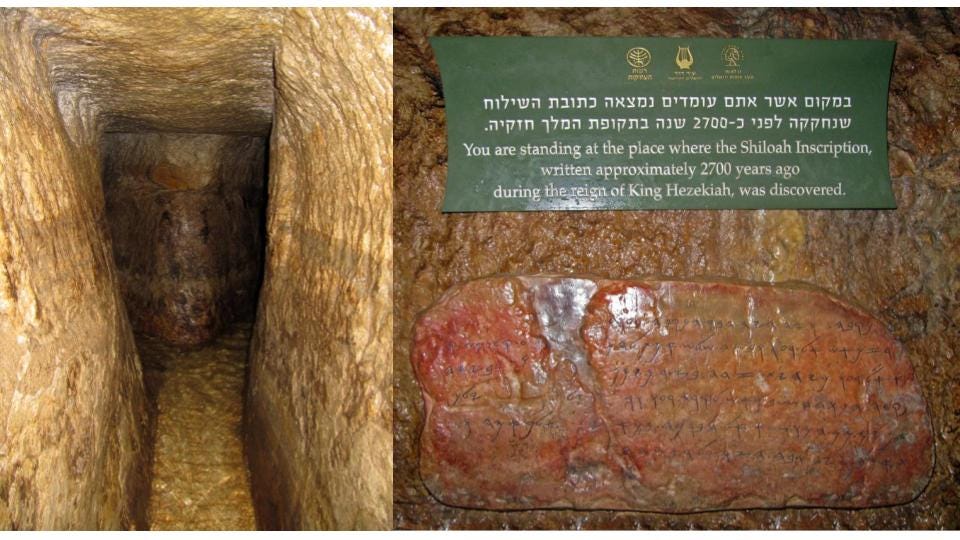
Hezekiah also commissioned one of the most impressive engineering achievements of the ancient world. Jerusalem’s water supply came from the Gihon Spring, which lay outside the city walls — a serious vulnerability in the event of a siege. To protect the water and deny it to the Assyrians, Hezekiah had a long tunnel cut through solid rock to channel the spring’s water directly into the City of David.
The tunnel runs 583 yards (533 meters) and was excavated by two separate teams working from opposite ends, meeting almost perfectly in the middle — a feat that required remarkably sophisticated engineering and measurement for the era. Modern scholars still haven’t fully determined how the two teams managed to find each other underground.
The tunnel was eventually sealed by an earthquake sometime in the Middle Ages, but archaeologists later rediscovered it, and visitors can walk through it today. An inscription carved into the tunnel wall commemorates the exact moment, over 2,700 years ago, when the two digging teams broke through and met.
It was Hezekiah who blocked the upper outlet of the Spring of Gihon and channeled it down to the west side of the City of David. And Hezekiah prospered in all that he did.
-2 Chronicles 32:30
Attack on Judah
In 701 BCE, Sennacherib, king of Assyria, attacked Judah, laying waste to the countryside and capturing every fortified city in his path. Lachish, a heavily defended fortress roughly 80 miles from Jerusalem and the second most important city in Judah, fell to the Assyrians in a major and decisive victory. Sennacherib was proud enough of the achievement to commission huge stone reliefs celebrating it, which now reside in the British Museum — the same reliefs we discussed in the last episode.
The biblical writers, tellingly, barely mention this catastrophic defeat. What they do record is that after Lachish fell and its people were slaughtered, Hezekiah’s envoys went there to meet the Assyrians and offer tribute. Hezekiah stripped the Temple and the royal treasury of all their gold and silver to pay the Assyrians off and spare Jerusalem a siege.
So Hezekiah king of Judah sent this message to the king of Assyria at Lachish: “I have done wrong. Withdraw from me, and I will pay whatever you demand of me.” The king of Assyria exacted from Hezekiah king of Judah three hundred talents of silver and thirty talents of gold. So Hezekiah gave him all the silver that was found in the temple of Yahweh and in the treasuries of the royal palace. At this time Hezekiah king of Judah stripped off the gold with which he had covered the doors and doorposts of the temple of Yahweh, and gave it to the king of Assyria.
-2 Kings 18:14–16
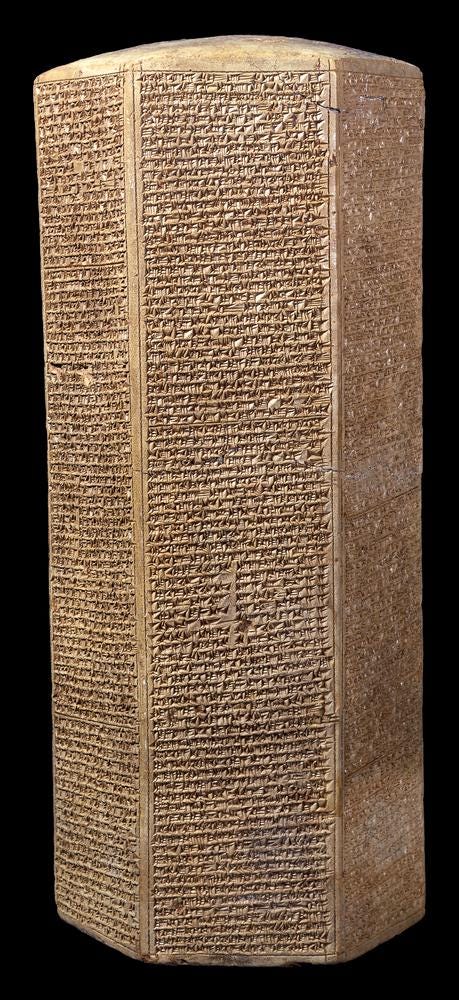
This meeting between Hezekiah and Sennacherib was independently recorded by the Assyrians themselves. Sennacherib’s own inscriptions describe laying siege to Jerusalem and departing only after extracting heavy tribute, boasting that he left Hezekiah trapped in his own palace like a bird in a cage.
The Assyrian account inflates the silver figure from 300 to 800 talents and adds Hezekiah’s daughters and concubines to the tribute list, but is otherwise strikingly consistent with the biblical record. This account survives on the Taylor Prism, a large six-sided cuneiform inscription detailing Sennacherib’s campaigns, unearthed in the ruins of Nineveh and now held in the British Museum alongside the Lachish reliefs.
As to Hezekiah, the Jew, he did not submit to my yoke, I laid siege to his strong cities, walled forts, and countless small villages, and conquered them by means of well-stamped earth-ramps and battering-rams brought near the walls with an attack by foot soldiers, using mines, breeches as well as trenches. I drove out 200,150 people, young and old, male and female, horses, mules, donkeys, camels, big and small cattle beyond counting, and considered them slaves. Himself I made a prisoner in Jerusalem, his royal residence, like a bird in a cage. I surrounded him with earthwork in order to molest those who were his city’s gate. Thus, I reduced his country, but I still increased the tribute and the presents to me as overlord which I imposed upon him beyond the former tribute, to be delivered annually. Hezekiah himself did send me, later, to Nineveh, my lordly city, together with 30 talents of gold, 800 talents of silver, precious stones, antimony, large cuts of red stone, couches inlaid with ivory, nimedu-chairs inlaid with ivory, elephant-hides, ebony-wood, boxwood and all kinds of valuable treasures, his own daughters and concubines.
-D. Luckenbill, Ancient Records of Assyria and Babylonia, Vol. II (1927); T. C. Mitchell, The Bible in the British Museum (1988)
Hezekiah’s Despair
The biblical narrative doesn’t end with the tribute payment. According to the text, Sennacherib accepted the payment and departed, only to return and threaten Jerusalem’s destruction a second time. This time, the city was said to be saved through direct divine intervention.
Upon hearing that the Assyrians had returned, Hezekiah despaired. He put on sackcloth and went to the Temple to pray for deliverance, arguing before Yahweh that every other god the Assyrians had destroyed was nothing more than wood and stone — while Yahweh alone was the one true God.
When King Hezekiah heard this, he tore his clothes and put on sackcloth and went into the temple of Yahweh. “It is true, Yahweh, that the Assyrian kings have laid waste these nations and their lands. They have thrown their gods into the fire and destroyed them, for they were not gods but only wood and stone, fashioned by human hands. Now, Yahweh our God, deliver us from his hand, so that all the kingdoms of the earth may know that you alone, Yahweh, are God.”
-2 Kings 19:1, 17–19
The Miracle
According to the Bible, Yahweh heard Hezekiah and saved Jerusalem.
“Therefore, this is what Yahweh says concerning the king of Assyria: ‘He will not enter this city or shoot an arrow here. He will not come before it with shield or build a siege ramp against it. By the way that he came he will return; he will not enter this city,’ declares Yahweh. ‘I will defend this city and save it, for my sake and for the sake of David my servant!’” That night the angel of Yahweh went out and put to death a hundred and eighty-five thousand in the Assyrian camp. When the people got up the next morning — there were all the dead bodies! So, Sennacherib king of Assyria broke camp and withdrew. He returned to Nineveh and stayed there.
-2 Kings 19:33–36
The Assyrians left no record of any such catastrophe — though it’s fair to say a decimated army isn’t the kind of thing an empire tends to memorialize in its own annals. Interestingly, the Egyptians preserved a strikingly similar legend about the very same campaign: they claimed Sennacherib was repulsed in Egypt when his army was decimated in a single night by a plague of field mice that chewed through their bowstrings and shield-thongs, rendering them defenseless.
Whatever actually happened, the outcome is not in dispute: Jerusalem survived and was never sacked by the Assyrians, even as the rest of Judah was laid waste around it. This deliverance became the foundation for a powerful and lasting belief among the Hebrews — that Yahweh was a truly great God, and that Jerusalem itself was inviolable, protected by divine decree. That confidence held strong for more than a century, until the city was finally burned by the Babylonians.
Sennacherib on the other hand, came to an untimely end. He was murdered in 681 BCE in his palace at Nineveh, killed by his own sons as punishment for his sacrilege — the desecration of Babylon’s sacred temples and the flooding of the ancient city.
One day, while he was worshiping in the temple of his god Nisrok, his sons Adrammelek and Sharezer killed him with the sword, and they escaped to the land of Ararat. And Esarhaddon his son succeeded him as king.
-2 Kings 19:37
Next episode we will continue in the book of Kings with the pagan Manassah, the longest lived and among the most successful kings of Judah, and his grandson, the second great reformer, Josiah, who was not as long-lived and successful.