

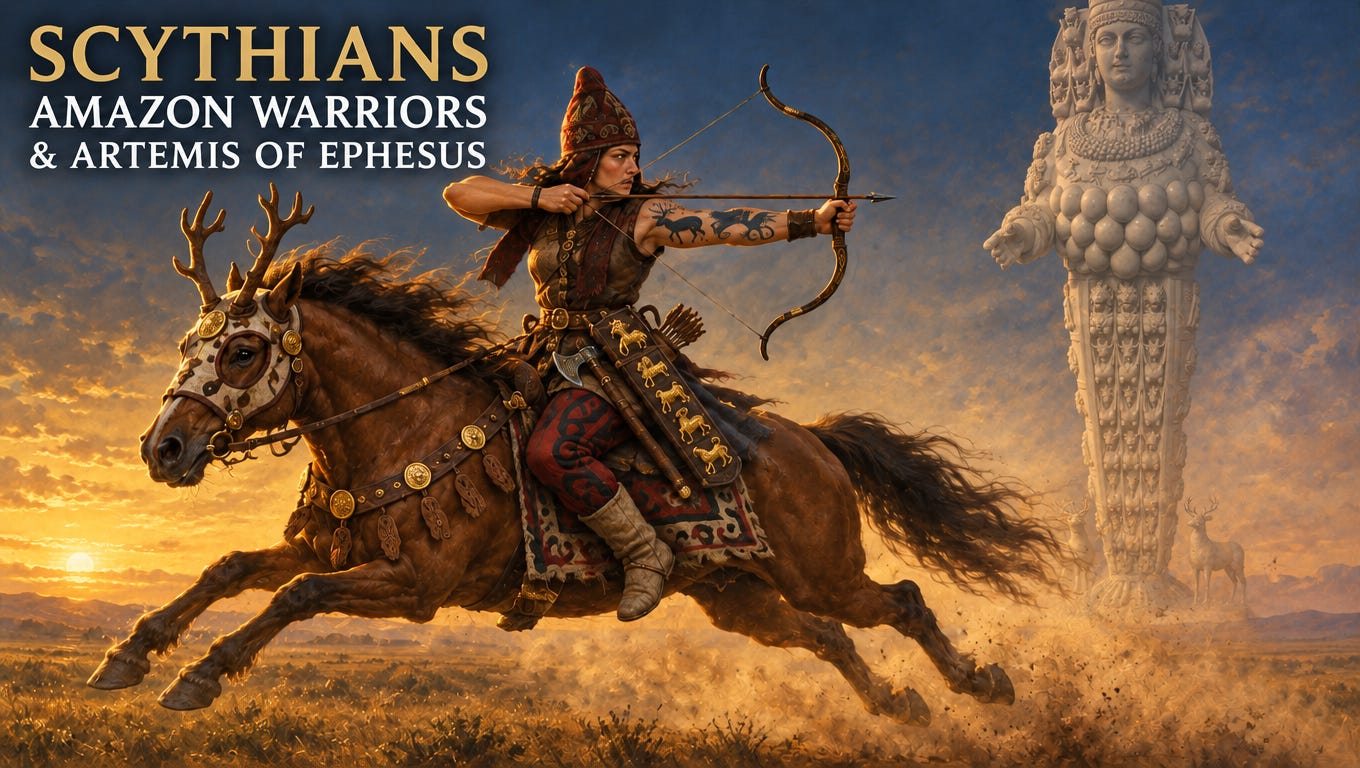
This week on Goddess Bible Study we reach our third week on the Greeks before returning to the Biblical narrative. This episode focuses on the Scythians, the nomadic, horse-riding people who lived on the edge of the Greek world and were known as the Amazons. The Scythians were a proud and powerful matriarchal, cannabis-smoking, Goddess-centric culture whose women rode and fought alongside their men.
We will also discuss Artemis of Ephesus, one of the most important goddesses of the ancient world, whose grand temple was founded, according to legend, by the Amazons.
Scythian Horse Lords
Farmers and shepherds were not the only communities in the early Bronze Age; there were also the horse lords. Horses were first domesticated and ridden in the same region of Central Asia where cannabis originated.
The original horse lords were tribes of the Eurasian steppe. Tribes such as the Botai, and Yamnaya peoples were among the first to domesticate and ride horses, around 5,000 years ago at the dawn of the Bronze Age.
These people rode horses to help them hunt across the wide ranges of the Eurasian steppe. Their nomadic descendants became the mighty Scythians of classical antiquity, whose Goddess-worshipping warrior women remain famous today as the Amazons.
The Eurasian steppe that gave us horses was also home to native cannabis. There is a deep connection between cannabis, horses, and the Bronze Age horse lords, one that extends into their Goddess-worshipping cultures. The first horse riders likely used hemp ropes to corral the animals, and perhaps horse and rider were sharing the ganja as well. Horses are fond of eating wild cannabis and likely benefit from some of its medicinal properties.
Humans and horses may have formed their first bonds while traversing the vast fields of cannabis they both enjoyed. Hemp ropes were used for reins, and woven hemp may have been used for riding blankets and pants. The horse lords did as much as anyone to spread cannabis seeds across the continent, from Central Asia to India and Europe.
Noble Barbarians
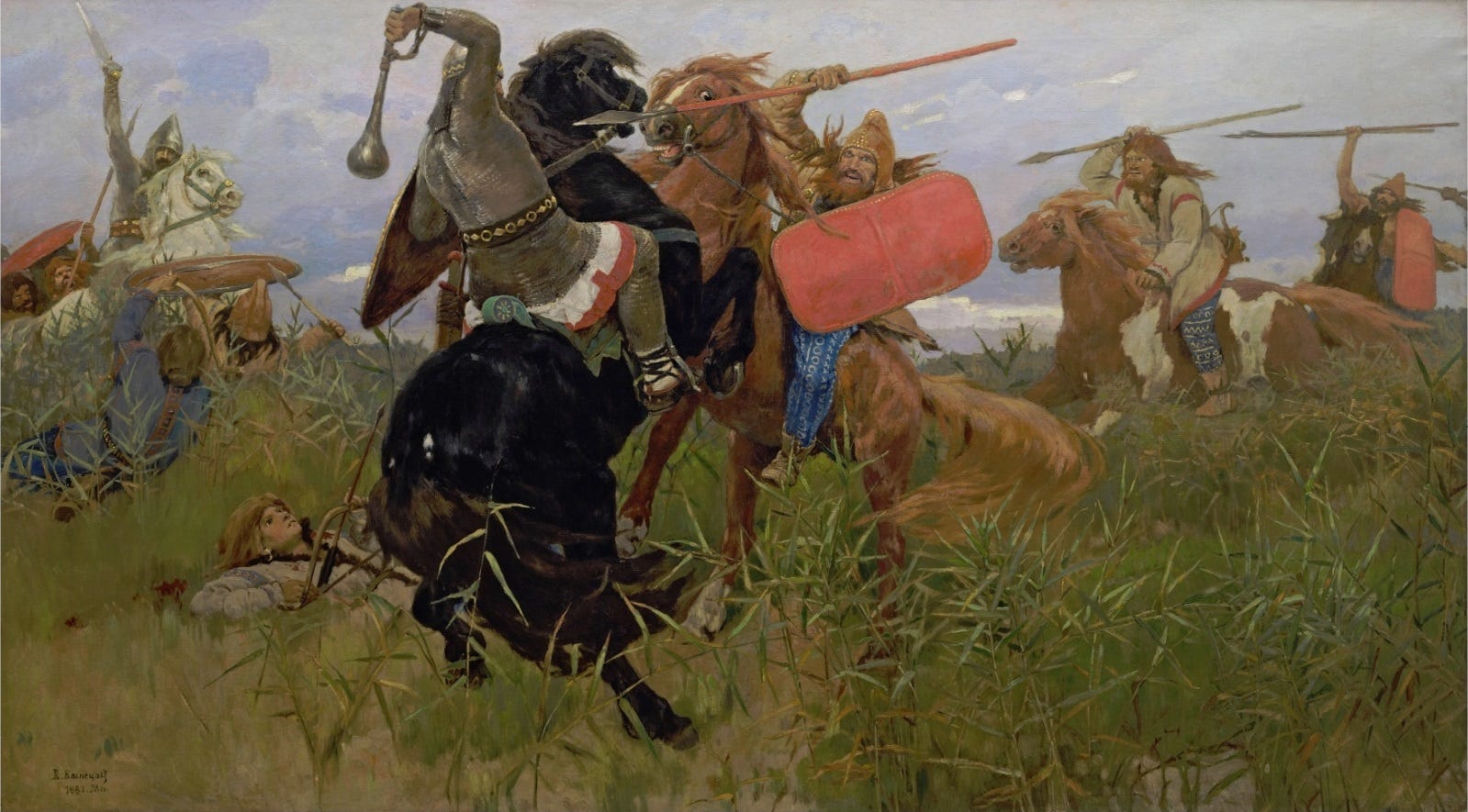
The nomadic Scythians were widely feared and respected in the ancient world, and they cast a forbidding shadow. Picture stampedes of fierce barbarian warriors, men and women riding side by side, covered head to toe in elaborate tattoos, their horses dressed and adorned. The Scythians were an intimidating presence.
The Scythians ranged and raided across Europe and Asia for a thousand years. They offer the clearest example of a culture with strong, independent women, powerful goddesses, and extensive use of cannabis. In the Iron Age, the Scythians were one of the last vestiges of the old tribal matriarchies.
“Scythians” is an umbrella term for a loose confederation of tribes. We do not know what they called themselves, and we know little of their history or of the relations between them. They ranged across the steppes from Siberia and Mongolia to eastern Europe and the Black Sea, periodically fighting the Persians, Mesopotamians, and Greeks.
They were nomads who kept cattle and oxen, which pulled the wagons they lived in as they followed the good grasslands. The Scythians left no writing behind. Most of what we know about them comes from their traditional enemies, the Greeks and Persians, and from archaeological excavations of their graves.
Amazon Warrior Women
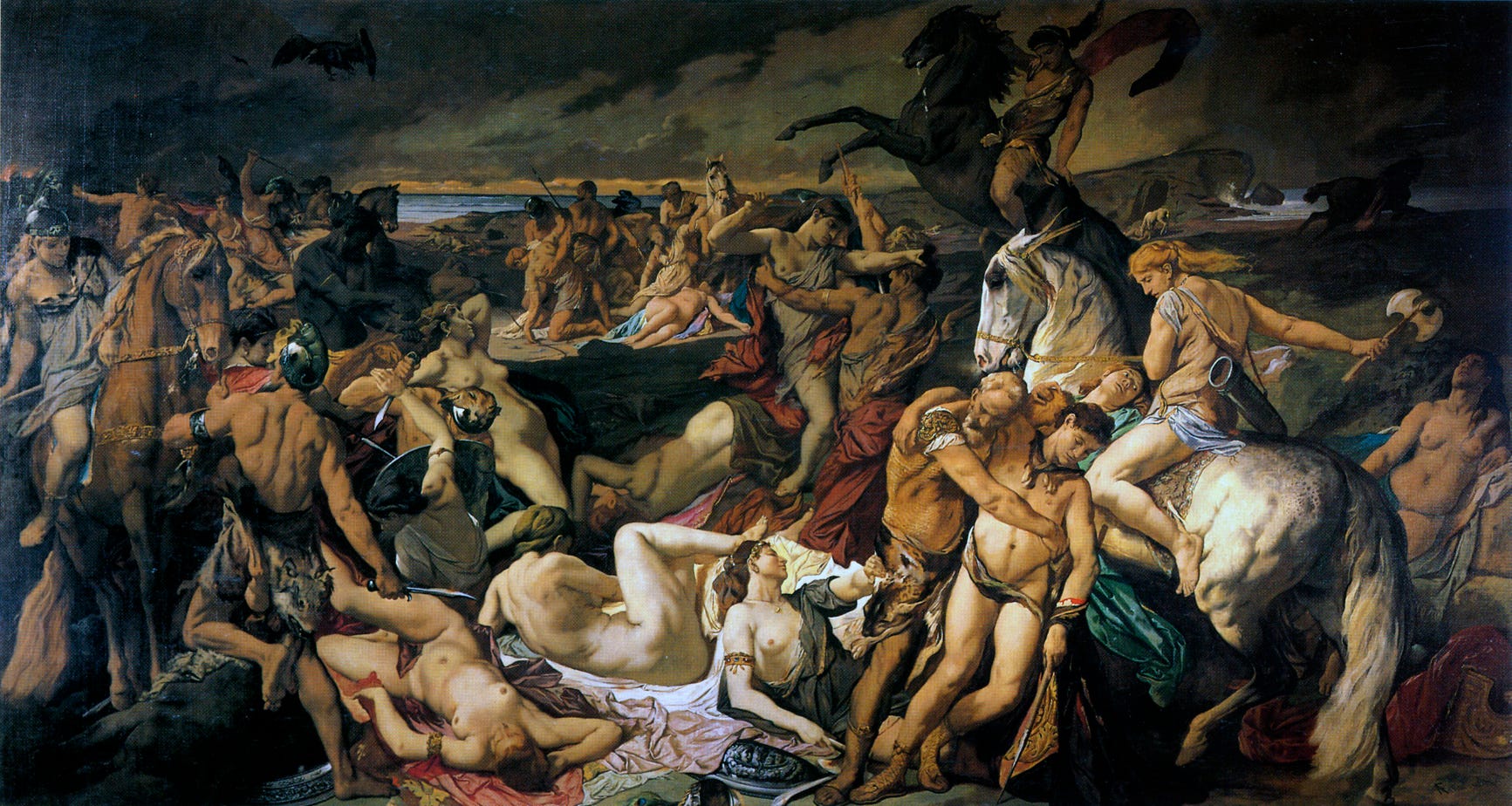
In nomadic tribes, it was important that women be mobile and independent. Scythian girls were trained from childhood to ride, fight, and hunt alongside the boys. Scythian women were masters of the bow and arrow and kept birds of prey for hunting. On horseback, a woman with a bow was just as deadly as a man. The Scythians developed powerful recurve bows of their own design.
All young Scythian women took part in hunting and raiding. Women with children could choose to continue as warriors or to stay in the wagons with the children. Of the thousands of Scythian kurgan graves that have been excavated, around twenty percent of the warriors were women, buried with their weapons and some bearing war wounds. Scythian graves also contained censers for burning cannabis and charred cannabis seeds.
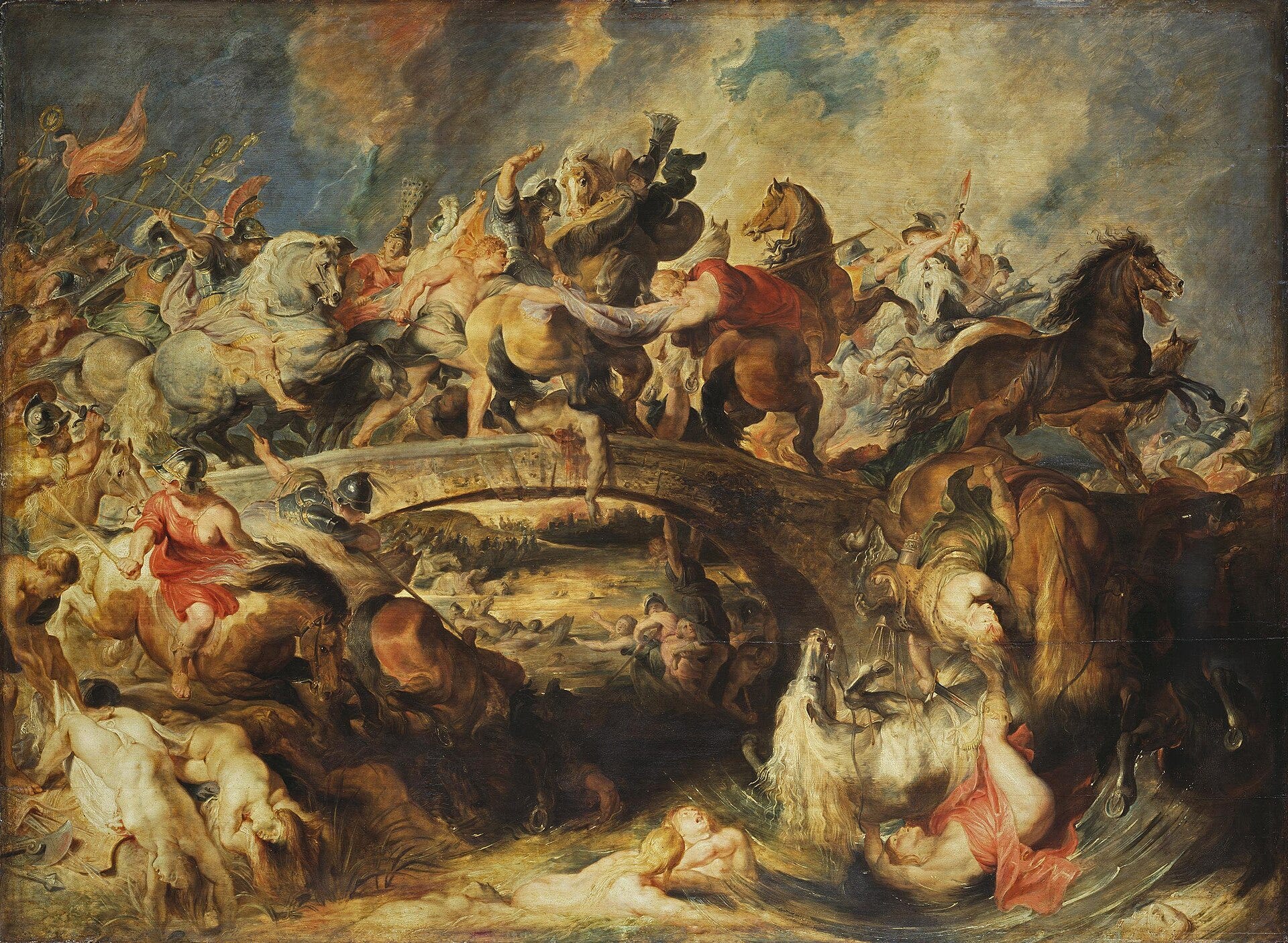
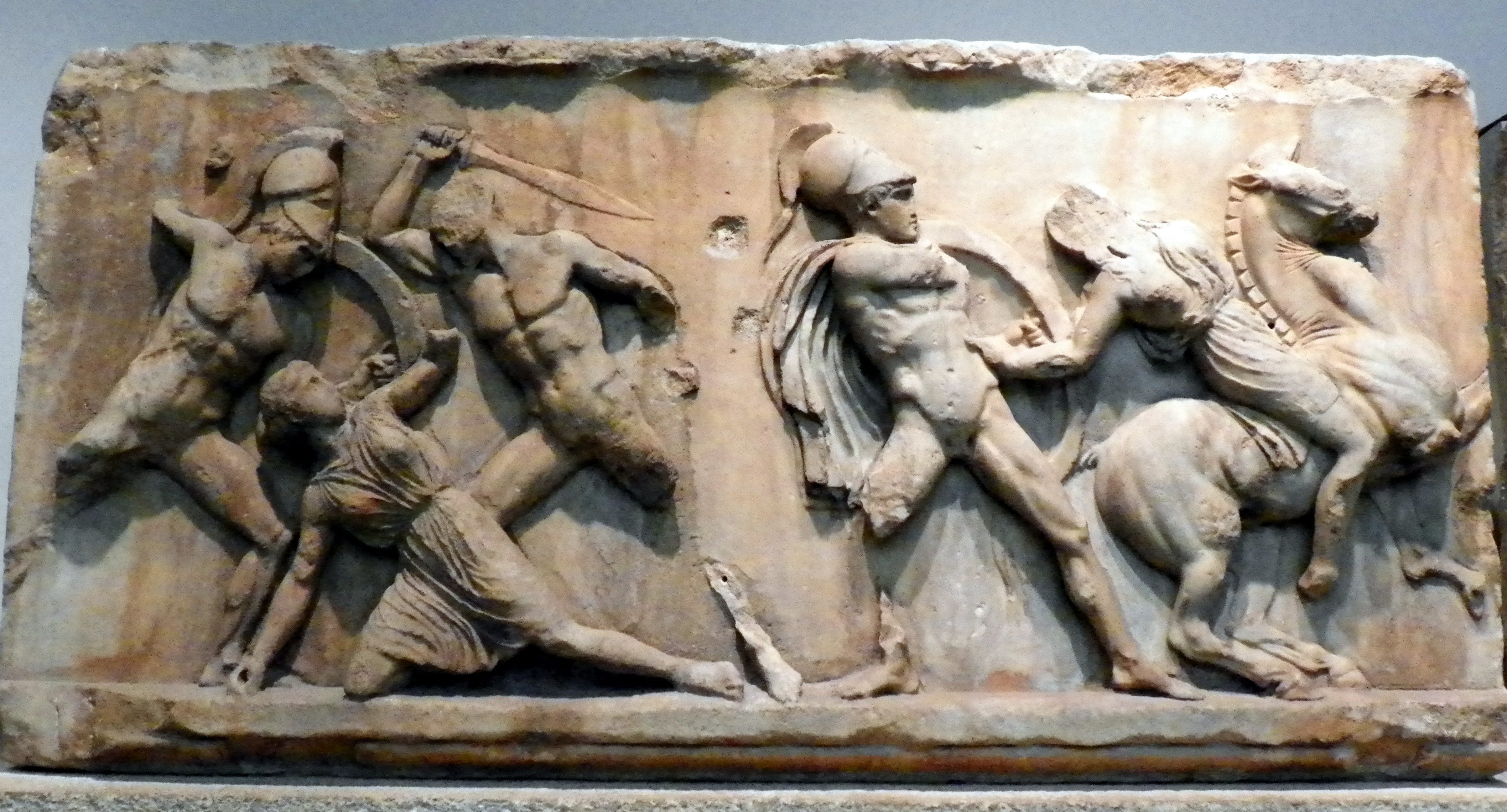
The Scythian women were the mighty Amazons of Greek legend, warrior women who fought both with and against men. Greek legends say the Amazons were a women-only society, but that is unlikely, however much troops of beautiful lesbian warriors make for a good fantasy. More realistically, the Amazon warrior women fought alongside their men and lived with them in an egalitarian society. Some Greek legends claimed the Amazons cut off one breast to make it easier to draw a bow, but there is no evidence for this, nor does it make anatomical sense.
Greek History
Herodotus wrote about the Scythians and the Amazons, attempting to explain their origins and culture to his Greek audience. The Greeks knew the Scythians as barbarians who had dwelled in the lands around the Black Sea since the most ancient times. Relations with the Scythians were mainly through trade, but occasional battles fired the Greek imagination, and the Greeks were fascinated by these exotic foreigners whose women were equal to men and fierce in battle.
The Scythians participated in the sack of Nineveh in 612 BCE, and raided throughout the Levant in the First Temple period, though precise details are spotty and legendary. We told the story in a previous episode of how the Persian King Cyrus, of Biblical fame, lost his head to Tomyris, the Amazon warrior queen of the Massagetae.
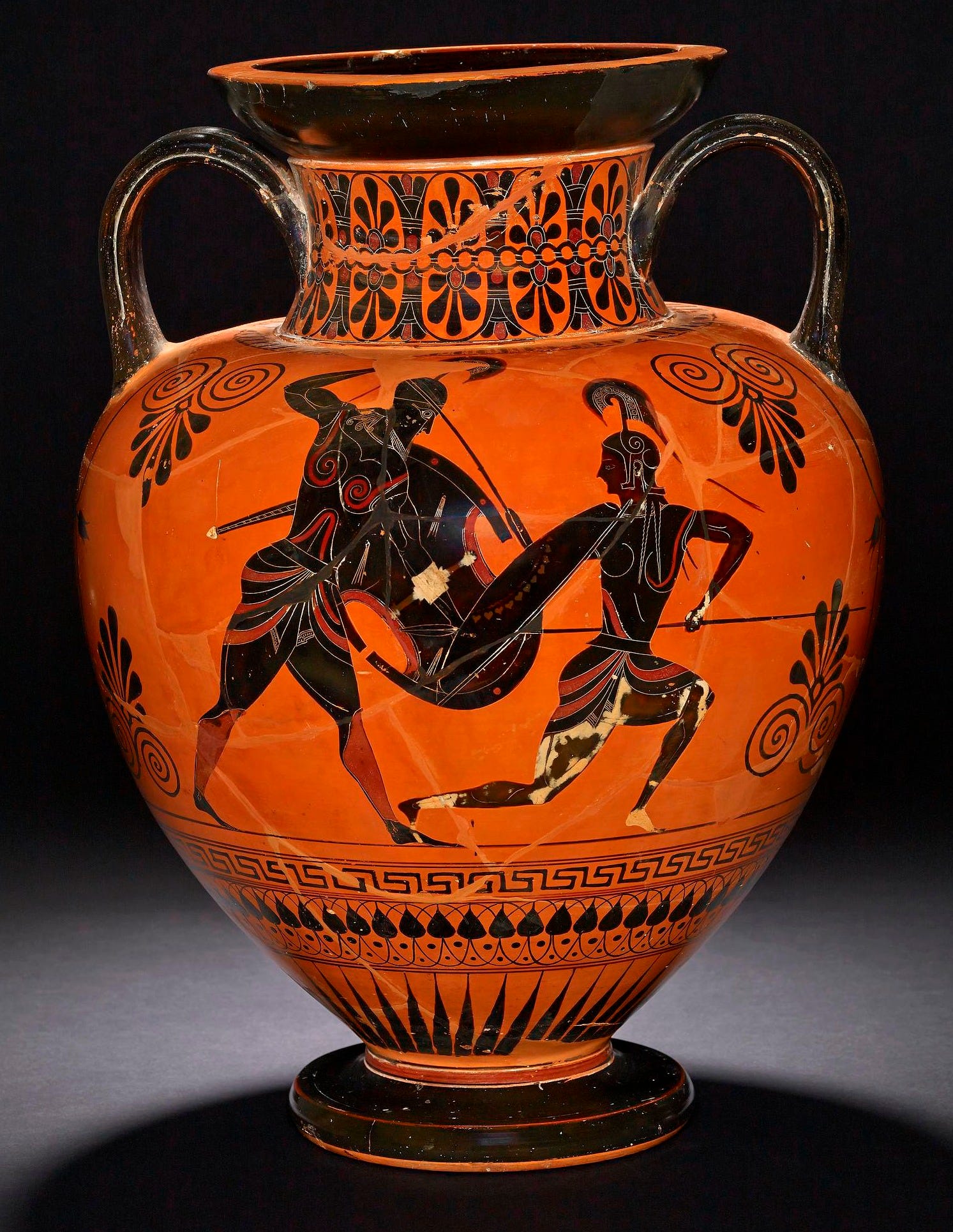
The Greeks thought of the Scythians as noble barbarians, among the most honest and forthright people in their dealings, yet a terrifying enemy. The firmly patriarchal Greeks were both awed by and disdainful of the Amazons. They were a popular motif in art and legend, and Greek children played with Amazon dolls. Heroes of Greek myth, like Hercules, tested themselves against mighty Amazon queens who were skilled slayers of men.
The Greeks saw themselves as masculine in contrast to the Persians, their primary Asiatic rivals, whom they regarded as feminine. The Amazon warriors, on the other hand, challenged Greek masculinity by meeting them head-on and winning many battles.
Greek women were kept on a tight leash, mostly confined indoors to tend the weaving and the children, so the contrast with the tough nomadic warrior women was stark. The Amazons were heroic and beautiful, spirited, courageous, and brave, bold barbarian archers on horseback who gloried in fighting, hunting, and sexual freedom.
The Scythians were known for elaborate tattoos covering their bodies. Their women wielded battle axes, used lassos, and trained eagles and dogs to hunt. The Scythians also dressed in a fashion foreign to the Greeks: they wore pants, which were invented for riding horses. In general, Scythian clothing was made of leather, wool, hemp, and silk.
Scythian Cannabis
The Scythian horse lords were famous in the ancient world for their love of cannabis. The Persians called the Scythians “haoma drinkers,” which would mean they drank bhang, if you accept that haoma and soma were bhang, a point that is debated.
Herodotus gives us one of the oldest written descriptions of people getting high in his account of the elaborate Scythian funeral rituals. These rituals included honoring the corpse for 40 days, keeping it in a wagon, and holding feasts until the final burial.
The Scythians burned cannabis inside a small tent that filled with intoxicating smoke, causing them to “howl with joy.” Herodotus also mentions the Thracians producing fine hemp fabrics indistinguishable from linen.
After burying them the Scythians cleanse themselves in the following way:—they soap their heads and wash them well, and then, for their body, they set up three stakes leaning towards one another and about them they stretch woollen felt coverings, and when they have closed them as much as possible they throw stones heated red-hot into a basin placed in the middle of the stakes and the felt coverings.
Now they have hemp growing in their land, which is very like flax except in thickness and in height, for in these respects the hemp is much superior. This grows both of itself and with cultivation; and of it the Thracians even make garments, which are very like those made of flaxen thread, so that he who was not specially conversant with it would not be able to decide whether the garments were of flax or of hemp; and he who had not before seen stuff woven of hemp would suppose that the garment was made of flax.
The Scythians then take the seed of this hemp and creep under the felt coverings, and then they throw the seed upon the stones which have been heated red-hot: and it burns like incense and produces a vapour so think that no vapour-bath in Hellas would surpass it: and the Scythians being delighted with the vapour-bath howl like wolves.
– Herodotus, Histories (4.73-75) - translated by G. C. Macaulay
Many Scythian tombs contained the burnt remains of cannabis, showing that the Scythians fumigated before and after burials. The Scythians' method of inhaling cannabis smoke inside a small tent or cave is so simple that we can only speculate how far back in time the practice goes.
Archaeological Proof
Herodotus’s descriptions were confirmed when archaeologists found small censers and tents for burning cannabis, along with charred seeds, in the frozen tombs of the Pazyryk culture, dating to the 4th–3rd century BCE. These tombs belonged to a Scythian tribe of the Altai Mountains in Siberia, near the borders of Mongolia, China, and Kazakhstan. The tombs were frozen solid in ice, which preserved their contents spectacularly.
Archaeologists found two complete mummies with intricate tattoos, a chief and a maiden, along with numerous textiles, including the oldest known pile rug. Inside one tomb was a small wooden tent frame with bronze cauldrons holding charred stones and charred cannabis seeds. The archaeologists also found a leather pouch containing cannabis seeds and other herbs.
The Pazyryk tombs have been well documented by many scholars.
Source: Rudenko, Sergei I. Frozen Tombs of Siberia: The Pazyryk Burials of Iron Age Horsemen. Translated by M. W. Thompson. Berkeley and Los Angeles: University of California Press, 1970, pp. 197–200, 284–285, fig. 35.
Herodotus also wrote about another nomadic tribe, neighbors of the Massagetae, who used intoxicating herbs rather than alcohol. The passage does not name cannabis, but the description fits.
Moreover it is said that other trees have been discovered by them which yield fruit of such a kind that when they have assembled together in companies in the same place and lighted a fire, they sit round in a circle and throw some of it into the fire, and they smell the fruit which is thrown on, as it burns, and are intoxicated by the scent as the Hellenes are with wine, and when more of the fruit is thrown on they become more intoxicated, until at last they rise up to dance and begin to sing. This is said to be their manner of living.
– Herodotus, Histories (1.202) - translated by G. C. Macaulay
Roman writer, Pliny the Elder wrote about Bactrian laughing weed growing along the banks of the Borysthenes River, where the Scythians lived. Scholars have long identified the weed as cannabis, and here we see it mixed with myrrh in wine. This is called “strong drink” in the Bible and antiquity.
Bactria lies in Central Asia, north of the Hindu Kush, in the cannabis homeland. The Borysthenes is the Dnieper River in Ukraine, which flows into the Black Sea. It is one of the great rivers of Europe and was an important agricultural center for the Scythians.
There is laughing weed in Bactria and along the Borysthenes river. If this plant is consumed with myrrh and wine, different hallucinations are observed and there is no end of laughing until you drink the kernel of pine nuts with pepper and honey in palm wine.
– Pliny the Elder, Natural History 24.102 (§164)
Translation Alan Sumler, Cannabis in the Ancient Greek and Roman World. P. 63
Scythian Goddess Religion
Only limited information about Scythian religion survives, but it was clearly Goddess-centric. The Scythians had a pantheon of eight deities, three female and five male, led by a supreme queen named Tabiti, goddess of fire, the hearth, and primeval heat, whom the Greeks equated with Hestia.
Api was the Earth Mother, equivalent to Gaia, and Papaios was the Heavenly Father, equivalent to Zeus.
Argimpasa was a maiden love goddess, similar to Ishtar/Astarte, and an oracular deity associated with the practice of shamanism. She was served by the Enarees, a class of gender-fluid priests. The Enarees were soothsayers and magicians who practiced fortune-telling and likely used cannabis to induce trance and divination.
Herodotus documented the existence of these shamanic transgender oracles among the Scythians. He records that their condition was a hereditary curse from the goddess for plundering her temple at Ascalon, while the Enarees themselves said Aphrodite had given them the art of divination, which is consistent with Goddess traditions throughout the ancient Near East.
This manner of divination they have from their fathers: but the Enareës or "man-women" say that Aphrodite gave them the gift of divination, and they divine accordingly with the bark of the linden-tree.
– Herodotus, Histories (4.67.2) - translated by G. C. Macaulay
The passage below recounts Herodotus's tale of how some Scythians once sacked the ancient temple of Aphrodite Urania in Ascalon (present-day Ashkelon in Israel) and were punished by being turned, along with their descendants, into Enaree hermaphrodites. This Aphrodite Urania was the great Canaanite and Phoenician goddess Astarte, the same Queen of Heaven the Israelites worshipped, whom we have been discussing throughout GBS.
Thence they went on to invade Egypt; and when they were in Syria which is called Palestine, Psammetichos king of Egypt met them; and by gifts and entreaties he turned them from their purpose, so that they should not advance any further: and as they retreated, when they came to the city of Ascalon in Syria, most of the Scythians passed through without doing any damage, but a few of them who had stayed behind plundered the temple of Aphrodite Urania. Now this temple, as I find by inquiry, is the most ancient of all the temples which belong to this goddess; for the temple in Cyprus was founded from this, as the people of Cyprus themselves report, and it was the Phoenicians who founded the temple in Kythera, coming from this land of Syria. So these Scythians who had plundered the temple at Ascalon, and their descendants for ever, were smitten by the divinity with a disease which made them women instead of men: and the Scythians say that it was for this reason that they were diseased, and that for this reason travelers who visit Scythia now, see among them the affection of those who by the Scythians are called Enareës.
– Herodotus, Histories (1.105) - translated by G. C. Macaulay
Tree of Life and Serpents
The Tree of Life was a common motif in Scythian artwork, often with a serpent twining around it. Both symbols appear in the Biblical Garden of Eden story, and both are important and widespread.
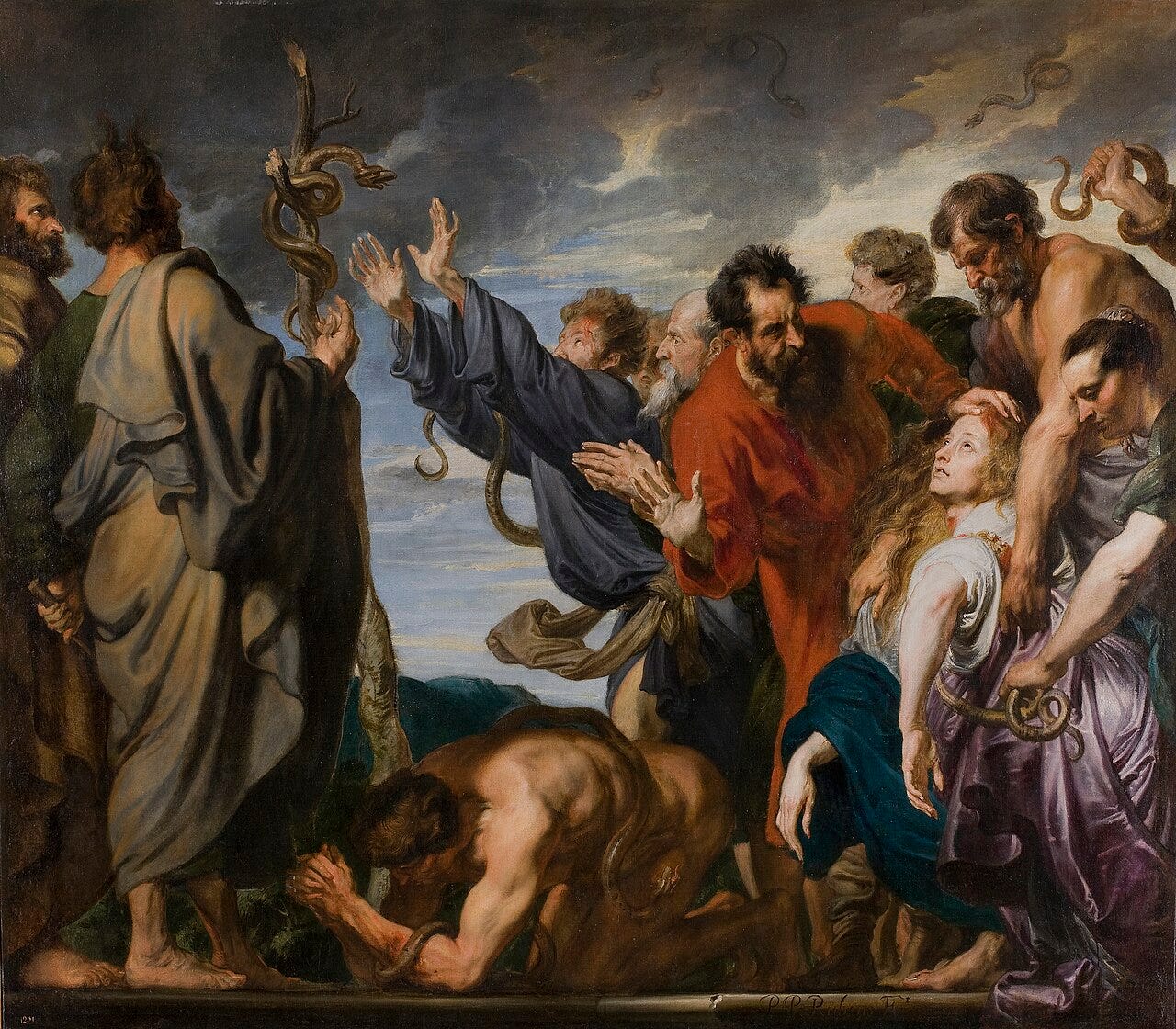
Serpents are believed to be very wise and are closely associated with goddesses, especially in the context of oracles, divination, and wisdom. The serpent lives down in the Earth and emerges to shed its skin, continually renewing itself like the cycle of life.
Eurasian shamans carved serpents into the handles of the whips and drums they used on their journeys to the spirit world.
The serpent-entwined staff is a powerful symbol. The Greeks called it the Rod of Asclepius, and it represented doctors and medicine, as it still does today. Moses made a bronze serpent staff for the wandering Hebrews, and later Israelites burned incense to it until King Hezekiah smashed it in his reforms for Yahweh.
In mythical imagery, the good serpent is generally presented standing vertically. A serpent presented horizontally, slithering on the ground, is a negative or evil presentation.
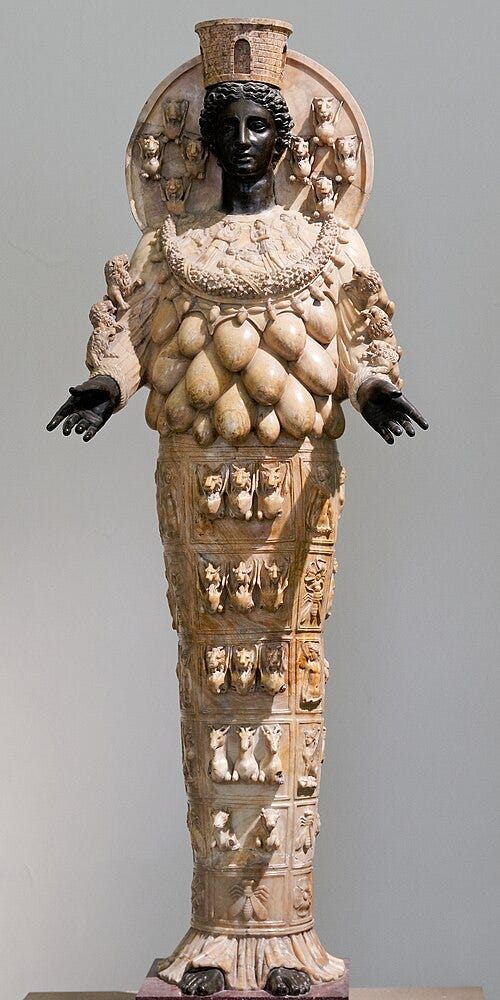
Artemis of Ephesus
Ancient legends credited the Amazon warrior women with establishing the original worship of Artemis at Ephesus. Ephesus was one of the most important cities in Asia Minor, a wealthy port of 100,000 residents with important roads leading into the interior, which made it a strategic center of government and commerce.
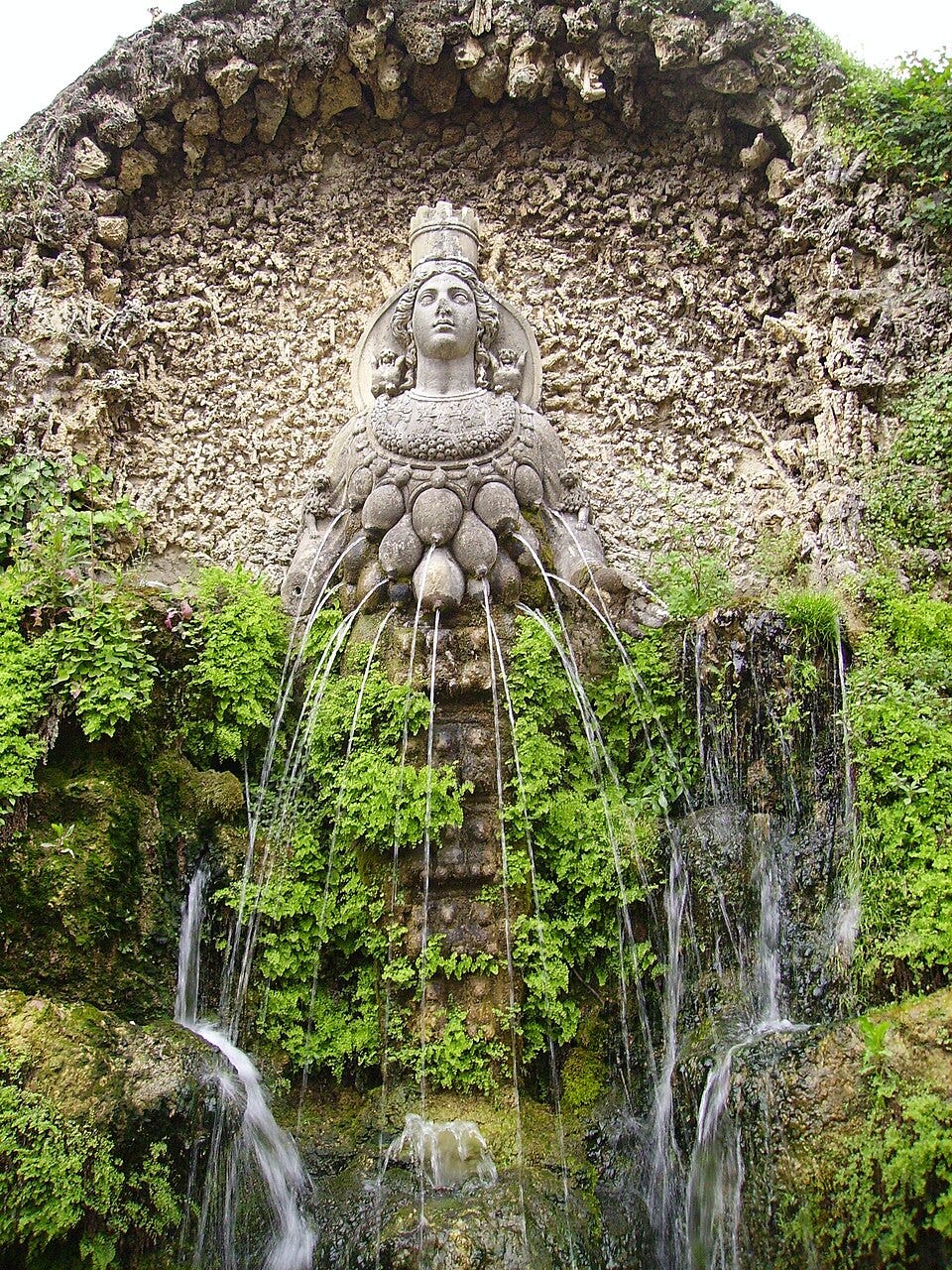
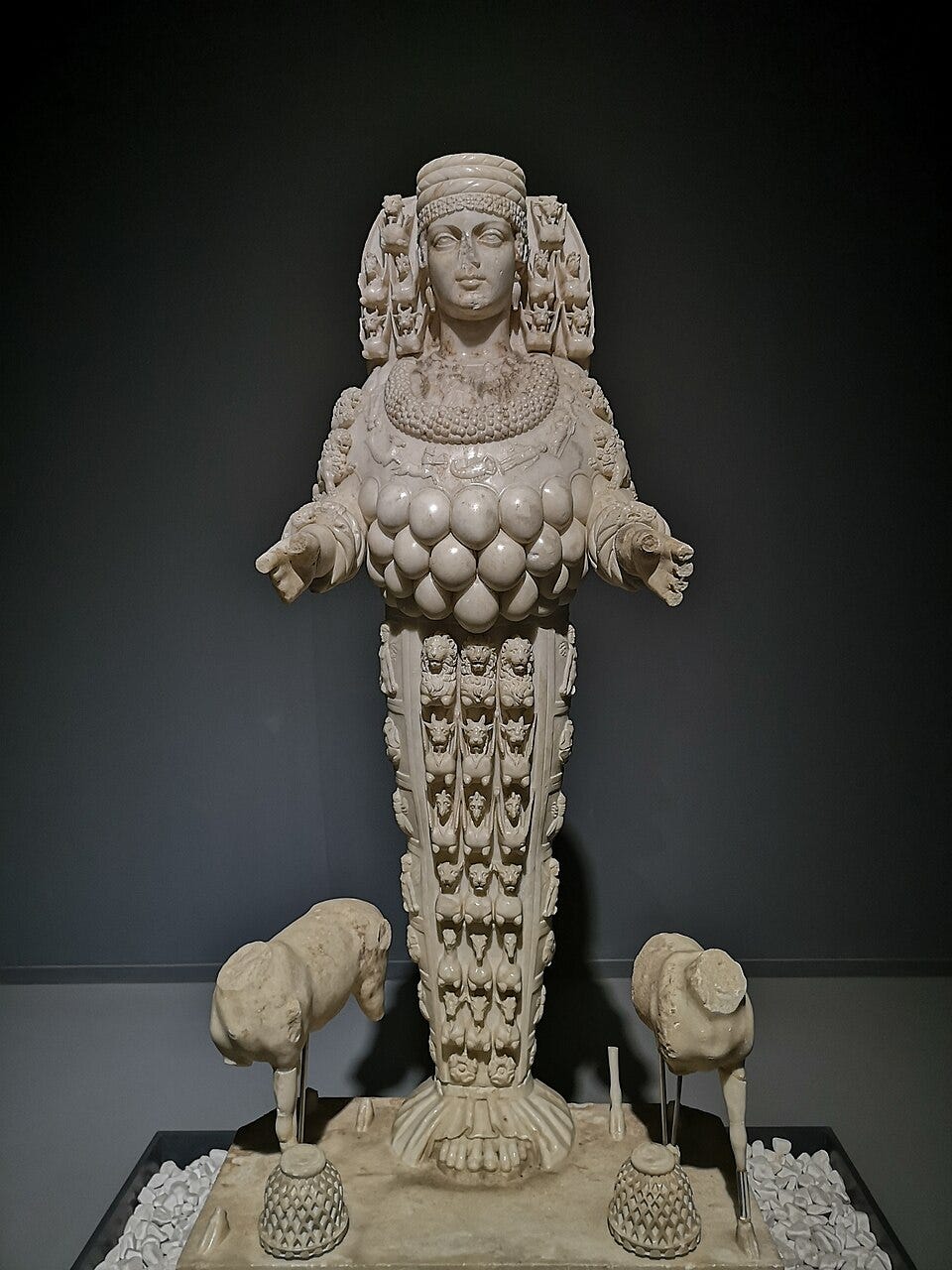
Ephesian Artemis was a great goddess related to Cybele, the Anatolian Mother Goddess. Her famous statues depict her with rows upon rows of breasts, which on closer inspection appear to be a coat of gourds or bull testicles, perhaps of a kind worn by a priestess, though interpretations vary. The roots and early history of Ephesian Artemis remain a mystery, but we know she was one of the most important goddesses in the entire Mediterranean.
Artemis was a midwife who protected fertility and childbirth. Her statue featured many animals, including lions, leopards, goats, griffins, bulls, and bees, and she was called the Lady of the Animals.
Artemis also had a retinue of transgender priests, the highly honored Megabyzi. They were similar to the Scythian Enarees, the eunuch Galli priests who tended Cybele in Rome, and to the male qadesh of the First Temple Israelites.
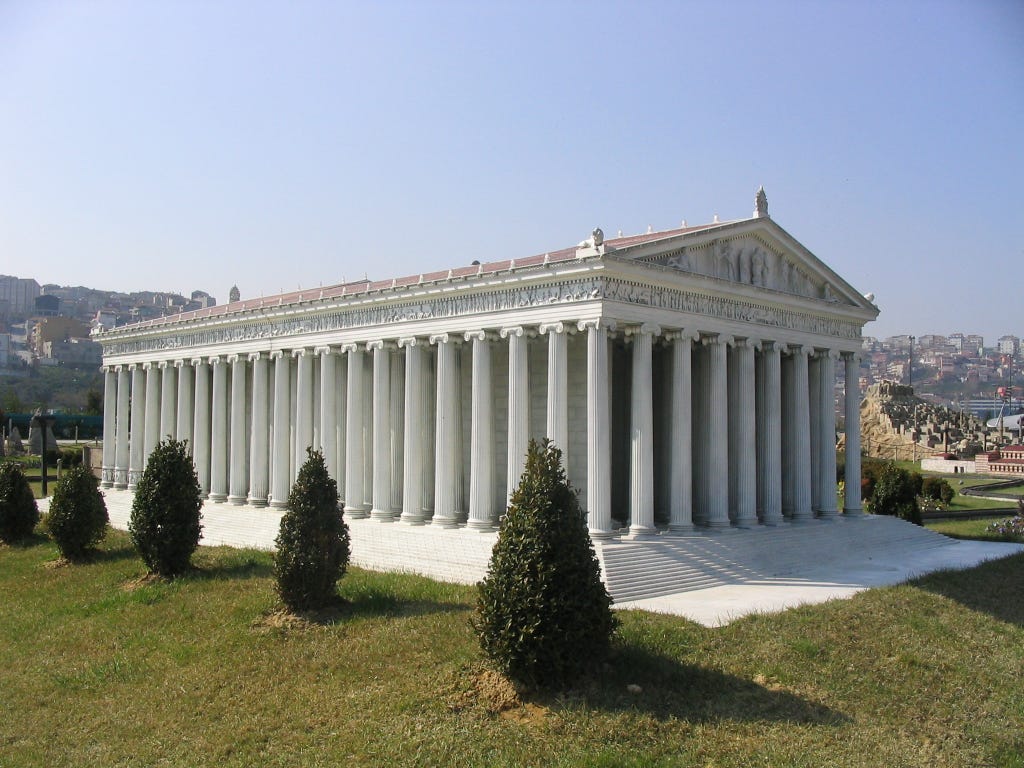
The grand temple of Artemis at Ephesus was one of the biggest and most magnificent pagan temples ever built. It was four times the size of the Parthenon in Athens and one of the Seven Wonders of the Ancient World. Worship began there around 800 BCE with a sacred meteorite. Beyond its priceless works of art, the temple held four huge bronze statues of Amazon warrior women, honoring the legend that the Amazons founded Ephesus.
The temple was destroyed and rebuilt multiple times. In 356 BCE it was burned down by an arsonist seeking immortal glory, and the Ephesians were so angry that they passed a law forbidding his name ever to be mentioned. It was said that Alexander the Great was born the day the temple burned, and that the great goddess, distracted by attending his safe birth, could not save her own temple from destruction.
The temple was rebuilt grander than ever, and no expense was spared. It was built entirely of marble, with 127 columns 60 feet high.
I have gazed on the walls of impregnable Babylon along which chariots may race, and on the Zeus by the banks of the Alpheus, I have seen the Hanging Gardens, and the Colossus of the Helios, the great man-made mountains of the lofty Pyramids, and the gigantic tomb of Mausolus; but when I saw the sacred house of Artemis that towers to the clouds, the others were placed in the shade, for the sun himself has never looked upon its equal outside Olympus.
– Antipater of Sidon, Greek Anthology IX.58 (140 BCE)
Apostle Paul’s Visit
The cult of Artemis at Ephesus was one of the most popular in the ancient Near East, and the city was uniquely devoted to her. Pilgrims from all over the Near East bought small statuettes of the goddess as souvenirs, and these have been found all over the Mediterranean.
In the New Testament, the Apostle Paul visited Ephesus and caused a near riot in the theater. Artemis is the only goddess named in the New Testament, which demonstrates her importance at the time.
A silversmith named Demetrius who made silver shrines of Artemis, bringing much business to the craftsmen.
Demetrius assembled the craftsmen, along with the workmen in related trades. “Men,” he said, “you know that this business is our source of prosperity. And you can see and hear that not only in Ephesus, but in nearly the whole province of Asia, this Paul has persuaded a great number of people to turn away. He says that man-made gods are no gods at all. There is danger not only that our business will fall into disrepute, but also that the temple of the great goddess Artemis will be discredited and her majesty deposed—she who is worshiped by all the province of Asia and the whole world.”
When the men heard this, they were enraged and began shouting, “Great is Artemis of the Ephesians!” Soon the whole city was in disarray. They rushed together into the theatre, dragging with them Gaius and Aristarchus, Paul’s traveling companions from Macedonia.
Paul wanted to go before the assembly, but the disciples would not allow him. Even some of Paul’s friends who were officials of the province of Asia sent word to him, begging him not to venture into the theatre.
Meanwhile the assembly was in turmoil. Some were shouting one thing and some another, and most of them did not even know why they were there. The Jews in the crowd pushed Alexander forward to explain himself, and he motioned for silence so he could make his defense to the people. But when they realized that he was a Jew, they all shouted in unison for about two hours: “Great is Artemis of the Ephesians!”
Finally the city clerk quieted the crowd and declared, “Men of Ephesus, doesn’t everyone know that the city of Ephesus is guardian of the temple of the great Artemis and of her image, which fell from heaven? Since these things are undeniable, you ought to be calm and not do anything rash.
– Acts 19:24-36
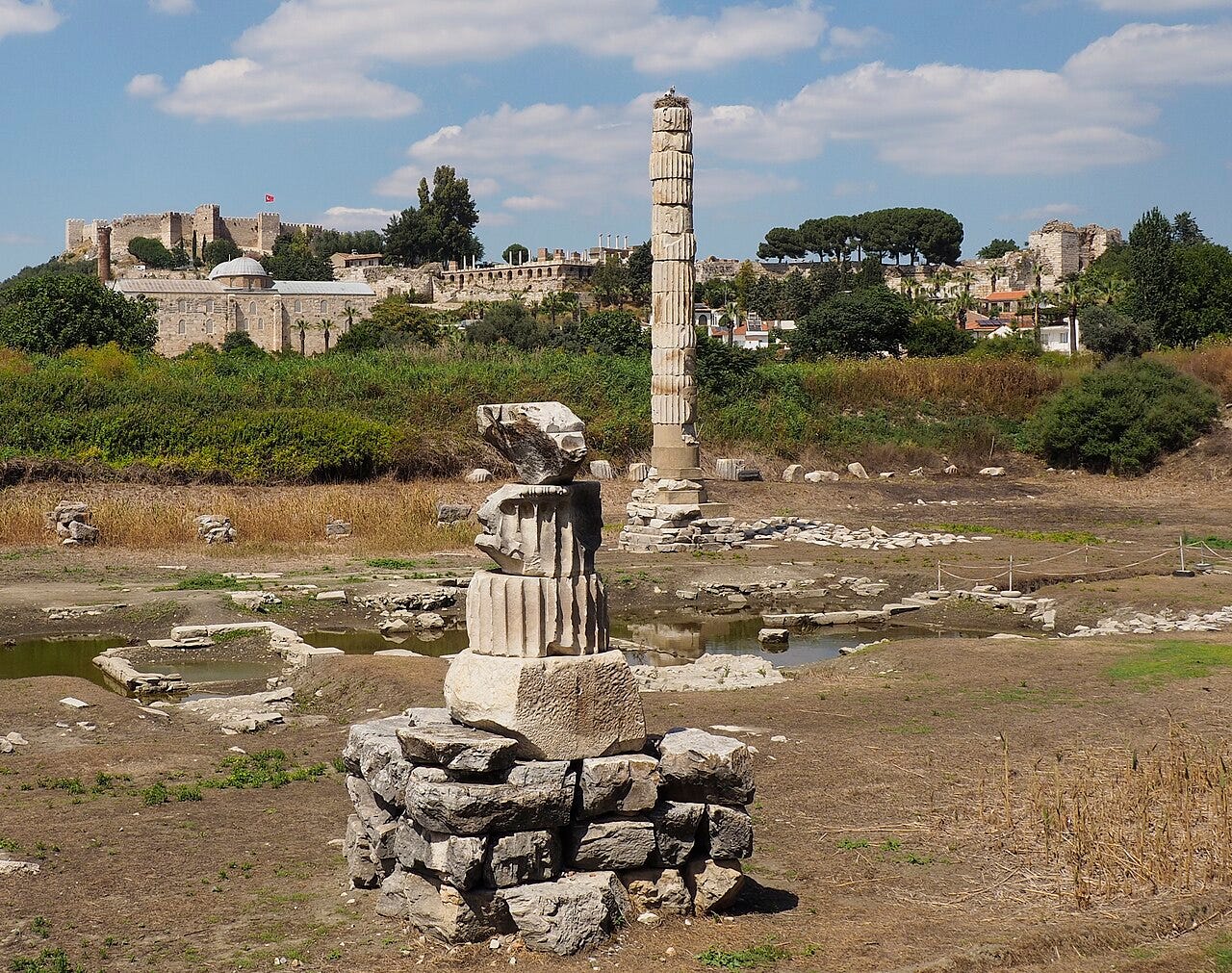
The temple of Artemis at Ephesus was sacked by the Goths in 268 CE and ultimately destroyed by a Christian mob in 401 CE. Most of its marble was hauled away for other building projects, and today barely a trace remains of the grandest temple that ever stood in the ancient world.
But the Christians would continue the Goddess traditions at Ephesus in their own fashion. Ephesus became the center of Catholic veneration of the Virgin Mary, and it was at Ephesus in 431 CE that Mary was declared the “Mother of God,” a title she holds to this day.
We will have much more to say about the Virgin Mary in Ephesus later on.
Next episode, we return with Alexander the Great, his deification in Egypt, and the founding of Alexandria, a city that played a profound role in Judaism, Christianity, and Greco-Roman religion.